










Acanthus mollis: The Bear’s Breeches Plant — A Complete Guide
Introduction to Acanthus mollis
If you’ve ever walked past a plant and done a double-take, Acanthus mollis — better known as Bear’s Breeches — is probably responsible for a few of those moments. This bold Mediterranean perennial has been turning heads in gardens for centuries, and it’s not hard to see why. Those deeply lobed, glossy dark green leaves and towering flower spikes have a way of commanding attention without even trying.
The common name “Bear’s Breeches” is thought to come from those big, deeply cut leaves, which supposedly resemble the rough, shaggy paws of a bear. The genus name Acanthus traces back to the Greek word for “spine” or “thorn” — a nod to the spiny bracts tucked around its flowers. The plant belongs to the family Acanthaceae and has been a fixture in European gardens since at least the 1500s, though its cultural roots run much deeper than that, stretching all the way back to ancient Greece and Rome.
Size-wise, this plant doesn’t do anything halfway. Leaves can reach 60 centimeters long, and the flower spikes regularly soar past 150 centimeters. Once it gets comfortable in your garden, it spreads steadily and just keeps getting better — forming impressive clumps that become more spectacular year after year. It’s the kind of plant that gets passed down through generations, and for good reason.
Historical and Cultural Significance
Very few plants can claim to have shaped the history of architecture, but Acanthus mollis is one of them. The ancient Greeks were so taken with the plant’s elegant, scrolling leaves that they worked the design into the capitals of Corinthian columns — one of the three great classical orders of Greek architecture. Legend has it that the architect Callimachus stumbled onto the idea after seeing an Acanthus plant growing around a basket left on a child’s grave, its leaves curling naturally around the structure beneath a tile. Whether or not the story is true, the result was one of the most enduring decorative motifs in human history.
The Corinthian style spread rapidly across the ancient world, and it never really went out of fashion. You can spot Acanthus-inspired ornament on the Pantheon in Rome, on Renaissance cathedrals and palaces across Italy, France, Spain, and England, and on civic buildings from one end of Europe to the other. Each revival of classical architecture brought a fresh wave of Acanthus leaves carved in stone.
Beyond columns and capitals, the Acanthus leaf has shown up in mosaics, tapestries, silverwork, furniture carving, and embroidery across the centuries. Medieval manuscript illuminators loved it as a border motif, and the Victorians embraced it wholeheartedly on wallpapers, textiles, and ceramics. William Morris — arguably the defining figure of Victorian decorative design — drew heavily on Acanthus imagery, and his patterns remain popular today. That’s over two thousand years of continuous cultural influence from a single plant, which is pretty remarkable by any measure.
Botanical Characteristics and Identification
Part of what makes Acanthus mollis so recognizable is its foliage. The leaves are large, deeply lobed, and glossy on top, with that rich dark green that holds up well through most of the growing season. Each leaf is divided into rounded lobes that give it a sculptural quality — almost like something carved rather than grown. The species name “mollis” is Latin for “soft,” which distinguishes it from its spikier relative Acanthus spinosus; the leaf margins here are relatively gentle by comparison.
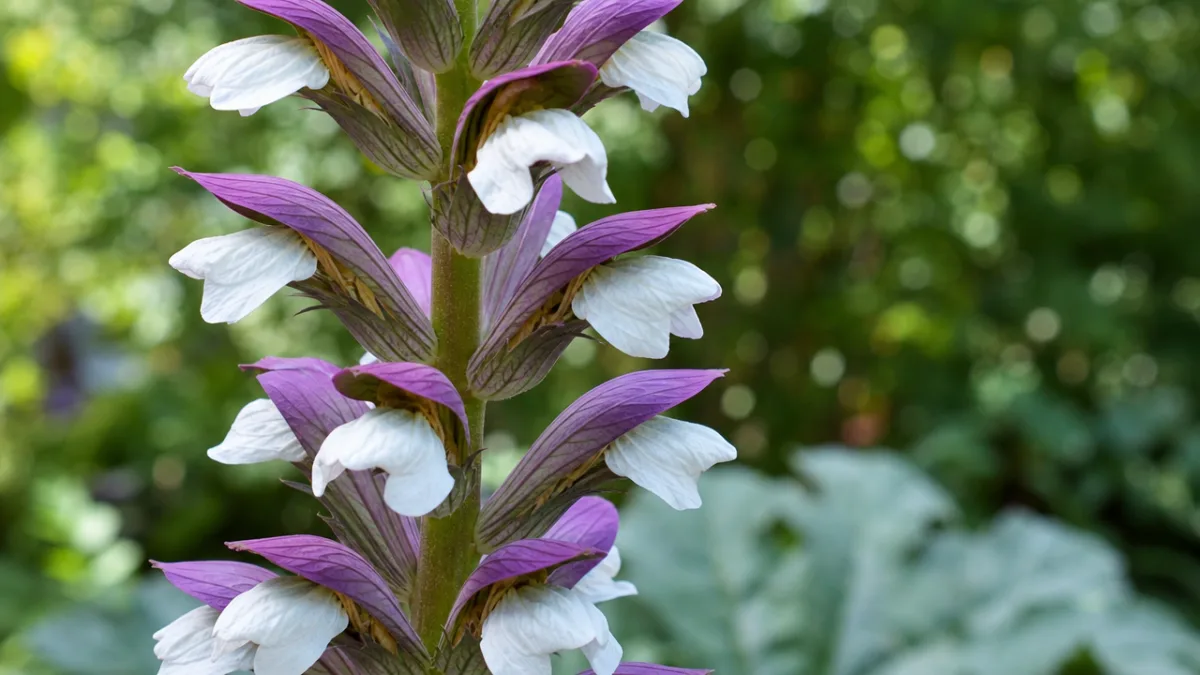
The flower spikes are genuinely dramatic. They appear in late spring or early summer as tall, upright racemes densely packed with tubular, two-lipped flowers in creamy white or pale lilac, each one cradled in a spiny purple or reddish-green bract. Bumblebees are particularly fond of them. One word of caution though — those bracts have real spines, and they can cause minor irritation if you handle the stalks carelessly, so wear gloves when you’re deadheading or cutting for arrangements.
Several cultivars have been developed for garden use, and a few stand out as especially worthwhile:
- Acanthus mollis ‘Hollard’s Gold’ — a striking cultivar with golden-yellow foliage that brightens shady corners of the garden, fading to chartreuse green as the season progresses.
- Acanthus mollis ‘Rue Ledan’ — known for its particularly free-flowering habit and vigorous growth, making it one of the most reliable performers in garden conditions.
- Acanthus mollis ‘Fielding Gold’ — another golden-leafed form that provides excellent contrast when planted alongside darker-leaved companions in a mixed border.
- Acanthus mollis var. latifolia — a broader-leaved variant that produces even larger, more impressive foliage than the standard species, with flower spikes to match.
After flowering, the plant produces large, bean-like seed capsules that dry out and split open with surprising force, flinging seeds a good distance — which goes a long way toward explaining how Acanthus manages to pop up in unexpected corners of the garden. The seeds are easy enough to collect if you catch them in time. The root system is deep and fleshy, which is great for drought tolerance but does mean that if you ever decide you want to move or remove the plant, you’ll need to be thorough about it. Even a small root fragment left behind can sprout into a new plant.
Growing Conditions and Garden Cultivation
One of the things that makes Acanthus mollis such a practical garden plant is how adaptable it is. It’s not fussy — but like any plant, it does have preferences. It’s happiest in well-drained soil that’s moderately fertile, somewhere between waterlogged and bone dry. It handles clay, loam, and sandy soils without much complaint, though it really hits its stride in a deep, humus-rich loam where its roots can explore freely. If you’re planting into compacted or poor soil, working in some well-rotted organic matter before you plant will make a real difference to how quickly it settles in.
One of its best qualities for practical gardeners is its shade tolerance. It flowers most freely in full sun, but it’s one of the few large, dramatic perennials that can hold its own in partial or even fairly heavy shade — under trees, along shaded walls, in those awkward spots where so many plants simply give up. In hot climates, a bit of afternoon shade is actually welcome, keeping the foliage looking its best and preventing the leaf scorch that can occur during the most intense summer heat.
Once it’s established, Acanthus mollis is remarkably drought-tolerant, which makes sense given its Mediterranean roots. It’s a natural fit for gardens in southern Europe, California, Australia, or anywhere else with warm, dry summers. That said, during its first year in the ground it does need consistent watering — you’re asking it to establish a deep root system, and it needs your help to do that. After the first growing season, you can ease right off and let it fend for itself, watering only during extended dry spells.
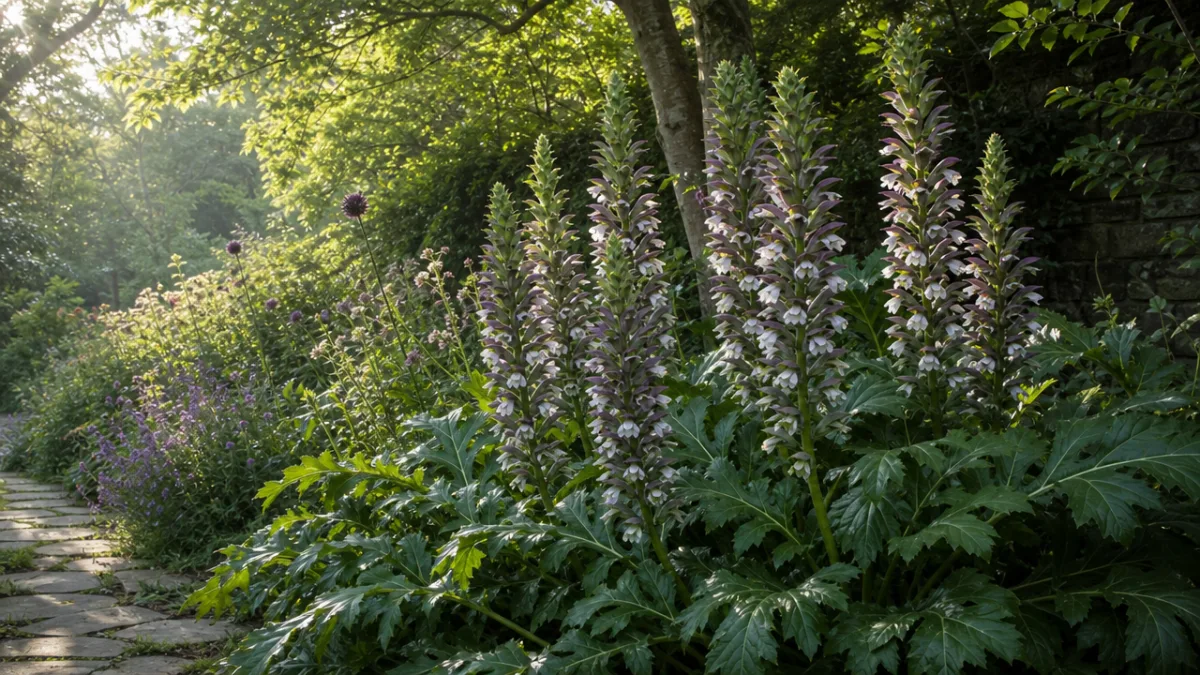
Give it room. This plant spreads via underground rhizomes and self-seeding, and it will take advantage of any space you give it — and some you don’t. Allow at least a meter of clearance around it when planting. It works beautifully as a structural anchor in large borders, as groundcover on slopes or difficult areas, or as a bold specimen in a prominent position. If you’re worried about it encroaching on neighboring plants, physical root barriers are a sensible precaution.
Propagation Methods and Techniques
There are three reliable ways to propagate Acanthus mollis, and each suits a different situation. Seed is the most straightforward if you’re not in a hurry. Collect the seeds just as the capsules start turning brown, before they split and launch themselves across the garden. Sow in autumn or spring into pots of well-drained compost, cover lightly, and put them somewhere cool — a cold frame or unheated greenhouse works well. Germination can be a bit uneven and may take several weeks, but fresh seed generally performs well. Grow seedlings on in individual pots before planting them out.
Root cuttings are faster and more predictable, and late winter or early spring — while the plant is still dormant — is the right time to do it. Cut sections of root about 5 to 10 centimeters long, insert them vertically into pots of sandy compost with the top of each cutting at or just below the surface, and keep them in a cool, sheltered spot. New shoots usually appear within a few weeks. Once they’re growing strongly, pot them on and give them a protected spot to develop before planting out.
Division is probably the most practical method for most gardeners, and it does double duty — you get new plants and you keep the original clump from getting out of hand. Do it in autumn or early spring with a sharp spade, making sure each section includes both root and crown material. Divisions establish quickly and often flower in their first or second season. It’s worth dividing established clumps every three to five years anyway, just to keep things tidy and vigorous.
Pest, Disease, and Maintenance Considerations
Acanthus mollis is refreshingly tough and rarely gives gardeners much to worry about. Its main weakness is powdery mildew, a fungal issue that tends to show up during dry spells or where air circulation is poor. You’ll notice it as a white powdery coating on the leaves, which can cause them to yellow and drop. The best approach is prevention: give plants enough space, avoid watering from overhead, and keep the soil consistently moist so the plant isn’t stressed. If mildew does appear, remove the affected leaves and bin them rather than composting.
Slugs and snails can have a go at the young spring growth, though established plants bounce back quickly from minor nibbling. If slugs are a persistent problem in your garden, organic pellets, copper barriers, or encouraging natural predators like hedgehogs and ground beetles can all help during the vulnerable establishment phase. Once the plant is producing mature, tough foliage, it becomes much less appealing to them.
Routine maintenance is genuinely minimal. The main tasks through the year are:
- Spring tidy-up: Remove any dead or damaged leaves from the previous season and apply a mulch of well-rotted compost or bark around the base of the plant to retain moisture and suppress weeds.
- Deadheading or seed collection: Once the flower spikes have finished, they can be cut back to the base. If self-seeding is not desired, the seed heads should be removed before they ripen and split.
- Autumn cutting back: In colder climates, the foliage can be cut back in late autumn to prevent wind damage and reduce the risk of crown rot during wet winters. In milder areas, the evergreen foliage can be left to provide winter interest.
- Division and containment: Every three to five years, consider dividing the clump to maintain vigor and prevent unwanted spread into adjacent areas of the garden.
On the question of frost hardiness: Acanthus mollis handles cold down to around minus ten degrees Celsius (USDA Zone 7), though it tends to cope better with dry frost than with cold, wet conditions combined. In borderline climates, piling some straw, bracken, or dry leaves around the crown in late autumn can make a real difference to winter survival. In genuinely cold regions, the plant may die back to the ground each winter, but as long as the crown survives, it’ll come back from those deep roots in spring — often more vigorously than you’d expect.
Landscape Design Applications and Plant Combinations
In garden design terms, Acanthus mollis fills a role that very few plants can match — a bold structural presence that earns its place through both its foliage and its flowers. Landscape designers reach for it regularly in Mediterranean-style gardens, where it sits naturally among lavender, rosemary, cistus, and ornamental grasses, contributing to that combination of drought tolerance and visual drama that defines the style at its best.
In shadier spots, it becomes genuinely indispensable. Paired with ferns, hostas, and hellebores, it provides exactly the kind of bold counterpoint those finer-textured plants need. The contrast between its large, deeply divided leaves and the delicate fronds of something like Dryopteris wallichiana, or the broad paddles of a good hosta, is one of those combinations that just works. For shaded urban gardens in particular — where few plants can offer real architectural impact — Bear’s Breeches is hard to beat.
For anyone drawn to gardens with a classical or historical feel, Acanthus mollis is an obvious choice. Plant it alongside bay laurel, iris, and old rose cultivars and you can evoke the gardens of antiquity in a way that feels genuinely authentic rather than contrived. There’s something satisfying about growing the plant that inspired Corinthian columns — it connects you to a long lineage of people who looked at the same leaves and found them beautiful.
It also has a place in more naturalistic, wildlife-friendly designs. The flowers are a valuable nectar source for bumblebees in late spring and early summer, bridging a gap when many other garden plants have already finished. Leave the seed heads standing through autumn and winter and they add architectural interest while feeding seed-eating birds. Mixed with other pollinator-friendly perennials — Salvia, Echinacea, Verbena bonariensis — Acanthus mollis helps create the kind of planting that looks after itself while looking after the wildlife that depends on it.








What do you think?
It is nice to know your opinion. Leave a comment.