










6 Terrible Places to Plant Crepe Myrtle: What Every gardener Needs to Know
Crepe myrtles are among the most beloved ornamental trees in the American South and beyond. Their spectacular summer blooms, attractive peeling bark, and remarkable drought tolerance make them a go-to choice for homeowners and landscapers alike. Yet despite their reputation for toughness, crepe myrtles are far more particular about their planting location than most people realize. Plant one in the wrong spot, and you will spend years battling poor growth, disease, structural damage, and disappointment. Understanding where not to plant these trees is just as important as knowing how to care for them once they are established.
The most common mistakes gardeners make with crepe myrtles are not about watering schedules or fertilizer choices — they are about location. A tree crammed under a roofline, wedged against a foundation, or shoved into a shady corner will never thrive no matter how attentively you tend it. These trees evolved in full sun with excellent air circulation, and when those conditions are denied, the results range from disappointing to genuinely damaging. This article walks through six of the worst places you can put a crepe myrtle, explaining the science behind each problem and giving you the information you need to make a smarter planting decision.
Whether you are planning a new landscape, reconsidering an existing planting, or trying to diagnose why your crepe myrtle looks perpetually unhappy, the guidance here will help you make sense of what is going wrong and how to correct it. Crepe myrtles deserve to be seen at their best — tall, floriferous, and architecturally stunning — and that only happens when they have the right conditions from the very beginning. Let us look at the places you should absolutely avoid.
1. Too Close to Your House or Building Foundation
One of the single most damaging mistakes homeowners make is planting a crepe myrtle directly against the foundation of their home. It seems logical at first — you want to fill that bare space along the wall, add some color near the front door, or frame a window with soft summer blooms. But crepe myrtles, depending on the variety, can grow anywhere from eight to forty feet tall with a canopy spread to match. What starts as a modest shrub quickly becomes a structural problem that is expensive and physically difficult to correct.
The roots of a mature crepe myrtle are strong and expansive. While they are not as notoriously destructive as willow or silver maple roots, they will absolutely follow moisture and nutrients toward your foundation, particularly if the soil near your home retains water after rain. Over time, this root intrusion can compromise mortar joints, create pathways for water infiltration, and in clay-heavy soils, contribute to foundation heave or settling. The cumulative cost of foundation repairs dwarfs any aesthetic benefit you might have enjoyed from those summer blooms.
Beyond the root problem, planting too close to a structure compromises air circulation around the tree. Crepe myrtles are highly susceptible to powdery mildew, a fungal disease that coats leaves and flower buds in a white, chalky film. Walls trap humid air and prevent the kind of gentle breeze that naturally inhibits fungal spore development. A crepe myrtle planted against your house will almost certainly struggle with powdery mildew far more than one planted in an open area of the yard. As a general rule, give your tree a minimum clearance equal to half its expected mature canopy width — and then add a few more feet for good measure.
2. Under or Near Power Lines and Overhead Utilities
The area directly beneath overhead power lines is one of the most tempting spots in many suburban landscapes. It is often a long, linear stretch of open lawn that seems to beg for some vertical interest and seasonal color. Crepe myrtles, with their upright growth habit and beautiful summer flowers, appear to be a perfect fit. This is a deeply problematic reasoning that leads to one of the most common and frustrating landscaping mistakes in neighborhoods across the country.
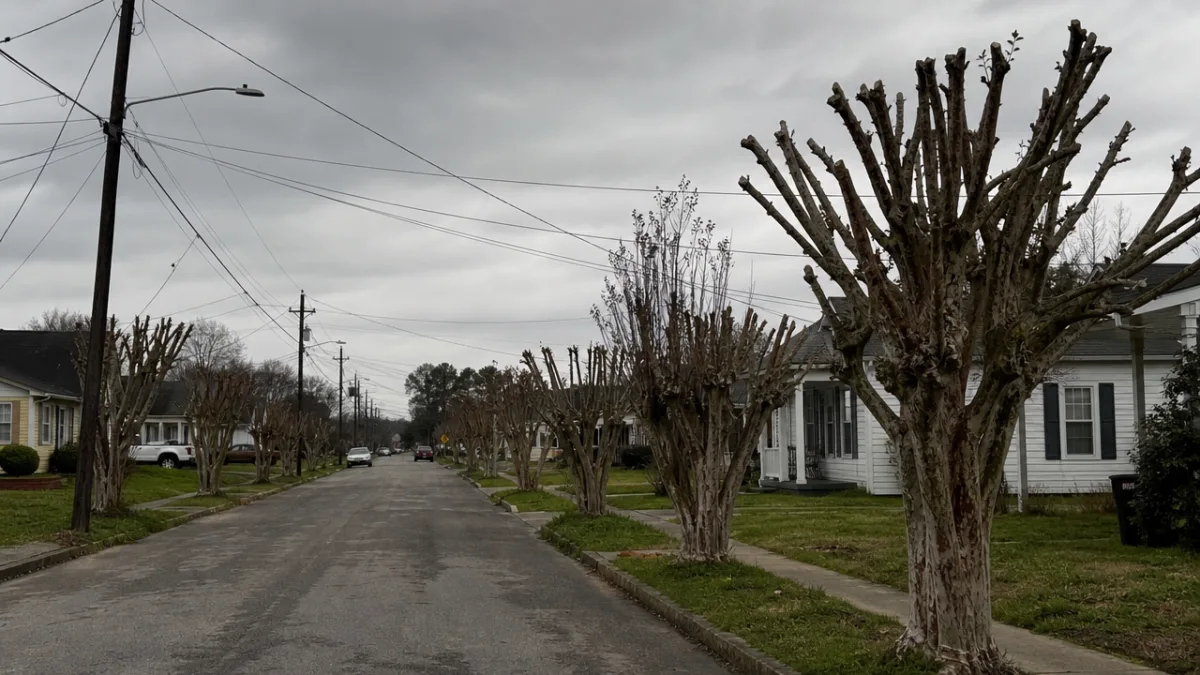
When a crepe myrtle is planted beneath a utility line and eventually grows into that space, the utility company will send a crew to prune it — and they will not prune it beautifully. Utility pruning is done for safety and efficiency, not aesthetics. Workers will cut straight across the canopy at whatever height clears the wire, leaving behind a brutal, flat-topped shape that ruins the tree’s natural form permanently. This is actually a primary driver of the widespread practice known as “crepe murder” — the severe, disfiguring topping that has become tragically common across American suburbs, often initiated not by homeowners but by utility crews responding to encroachment.
The ongoing cycle of utility pruning causes lasting structural damage to the tree. Each severe cut stimulates a flush of weak, fast-growing shoots called water sprouts that emerge from the pruning wounds. These water sprouts are poorly attached, highly prone to breakage in storms, and visually unattractive. Year after year of this treatment results in a tree with a grotesquely knobbed, deformed trunk structure and a perpetually disheveled appearance. If you want to plant beneath power lines, choose dwarf or semi-dwarf crepe myrtle varieties that will never grow tall enough to conflict with the lines, or select a completely different species with a known mature height well below the utility infrastructure.
3. In Deep Shade or Under a Tree Canopy
Crepe myrtles are sun worshippers in every sense of the word. They require a minimum of six hours of direct sunlight per day to bloom reliably, and eight hours or more is truly where they begin to perform spectacularly. Planting one in a shaded location — beneath a mature oak, along the shadowed north side of a fence, or in any spot where sunlight is blocked for most of the day — is setting the tree up for a long and frustrating struggle that rarely ends in success.
In insufficient light, crepe myrtles respond in predictable and disheartening ways. Flowering is dramatically reduced or fails entirely, which defeats the primary purpose most gardeners had in mind when they selected the tree. The foliage becomes sparse and pale, lacking the deep green richness that characterizes a healthy, sun-grown specimen. The overall growth habit becomes etiolated — that is, the branches stretch and reach toward available light, creating a leggy, unbalanced form that bears no resemblance to the graceful, full canopy you see in photographs and nursery displays.
Shade also dramatically worsens the powdery mildew problem that crepe myrtles are already somewhat prone to. Fungal diseases thrive in conditions where moisture lingers and air does not circulate freely — exactly the conditions found in dense shade. A crepe myrtle tucked under an established tree canopy will battle mildew relentlessly from spring through fall, weakening the tree over successive seasons and diminishing whatever limited flowering it might otherwise produce. If your yard is heavily shaded, explore shade-tolerant flowering alternatives such as oakleaf hydrangea, sweetshrub, or native azaleas rather than forcing a sun-loving tree into an unsuitable environment.
4. In Poorly Drained or Consistently Wet Soil
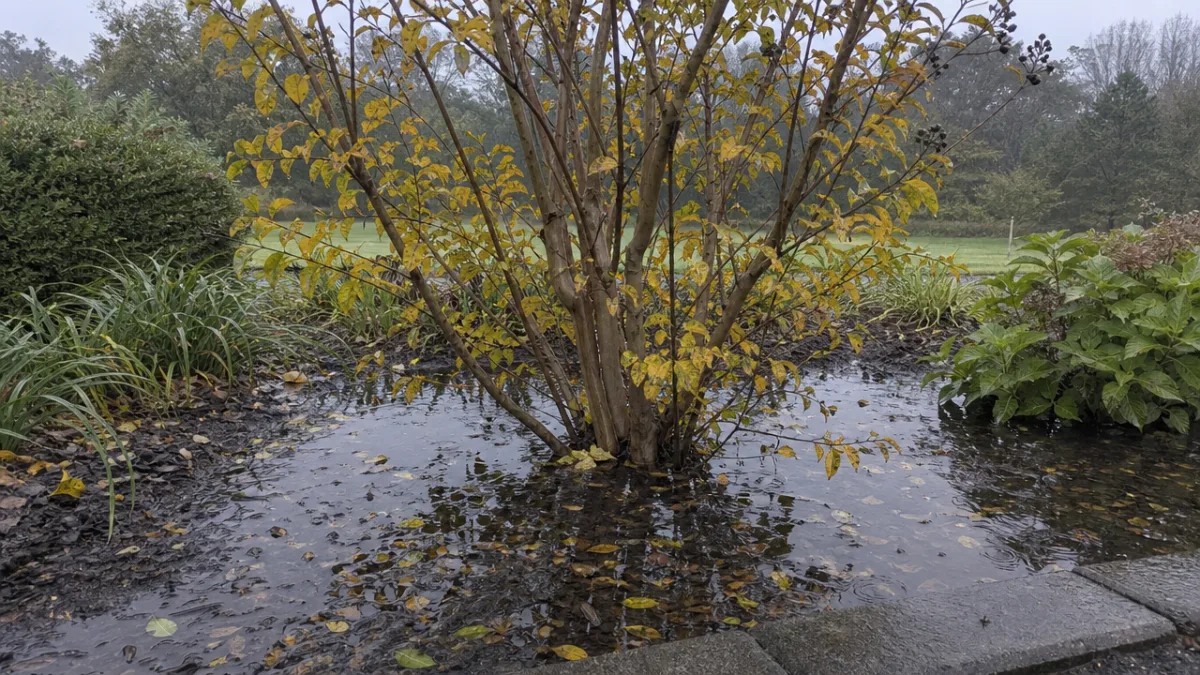
Despite their well-deserved reputation for drought tolerance once established, crepe myrtles are deeply intolerant of waterlogged or poorly drained soil conditions. The misconception that a tough, adaptable tree can handle wet feet leads many gardeners to plant them in low spots, rain garden overflow areas, clay-heavy soils with poor permeability, or anywhere that water naturally collects and sits after rainfall. The results are invariably poor, and often fatal to the tree over several seasons.
When crepe myrtle roots sit in saturated soil for extended periods, the oxygen supply to the root system is cut off. Roots require oxygen for cellular respiration, and without it, they begin to die back progressively. This root death presents itself above ground as yellowing leaves, early leaf drop, branch dieback, and a general failure to thrive that puzzles many gardeners because the tree is receiving what appears to be adequate water. In fact, it is receiving too much. The condition known as root rot, often caused by the water mold Phytophthora, can establish in waterlogged soils and accelerate root decay dramatically, sometimes killing a young tree within a single season.
Clay soils present a particularly deceptive challenge for crepe myrtle growers. Clay holds nutrients well and initially seems like fertile ground for planting, but its poor drainage characteristics create the wet-feet problem even in areas that do not appear particularly low-lying. After a moderate rain, clay soils can remain saturated for days, far longer than sandy or loamy soils. If you are working with heavy clay, amend the planting area generously with organic matter and coarse grit, build up a raised planting mound to improve drainage, and consider whether a different tree species with genuine wetland tolerance might be a more honest match for your site conditions.
5. In a Confined Space or Between Hardscape Features
The impulse to create a dramatic focal point between a driveway and a walkway, in a narrow median strip, or in a tightly defined planting bed surrounded by pavers is understandable from a design perspective. Crepe myrtles look stunning in formal arrangements, and their upright form seems as though it ought to fit neatly into structured landscape spaces. The reality of a full-sized crepe myrtle’s mature dimensions, however, makes many of these tidy-looking design concepts a long-term maintenance headache and structural liability.
When a crepe myrtle’s root system encounters the hard resistance of pavers, concrete curbing, or compacted hardscape base materials, it does not simply stop growing. Roots continue to expand and will eventually lift pavers, crack concrete edges, and disrupt the surrounding hardscape surface. This process can take several years to become dramatically visible, which is part of what makes it so frustrating — by the time the damage appears, the tree has become a significant presence that is both costly to remove and visually disruptive to the surrounding area. The damage repair often costs many times what a better-sited tree would have required in maintenance.
Beyond root damage, confined planting spaces restrict the crown’s natural development in ways that compromise the tree’s health and beauty. A crepe myrtle squeezed between two structures will grow asymmetrically, leaning and reaching toward available light and space. Branches that contact walls, fences, or other trees create wounds that become entry points for disease and insect pests. The tree never achieves the balanced, open canopy that makes crepe myrtles such effective ornamental specimens. If you love the formal look of crepe myrtles in structured settings, select compact or dwarf cultivars specifically bred for smaller spaces, such as those in the Petite or Pocomoke series, which have been developed with exactly these situations in mind.
6. Planted Too Close Together in Tight Groupings
Crepe myrtles are frequently sold and planted in groupings of three or more to create a mass planting effect, a privacy screen, or a flowering hedge along a property boundary. When the trees are young and small, these groupings can look pleasingly full and well-composed. The problem is that most gardeners plant these groupings based on the tree’s current size rather than its mature dimensions, leading to a crowded, competing tangle of trunks and canopies within just a few years of establishment.
When crepe myrtles are crowded together, the interior of the grouping becomes a zone of poor air circulation, reduced light penetration, and elevated humidity — exactly the conditions that favor the powdery mildew and other fungal pathogens that these trees are naturally prone to. Individual trees in a tight planting begin to compete for soil resources, with the strongest specimens gradually outcompeting their neighbors. Over time, crowded plantings develop uneven growth patterns, with outer trees flourishing and inner trees declining as light and nutrients become increasingly scarce.
The long-term management burden of an overcrowded crepe myrtle planting is substantial. As the trees fill in and begin to conflict with one another, the temptation to prune them back aggressively becomes overwhelming — and this is precisely how well-intentioned gardeners end up committing the dreaded crepe murder year after year. To avoid this cycle, research the specific mature spread of the variety you are planting, then space individual trees so that their mature canopies will just barely touch or maintain a modest gap between them. For most standard varieties, this means spacing of fifteen to twenty feet or more between tree centers — significantly more generous than what most nursery tags suggest at planting time.
- Always research the mature height and spread of your specific crepe myrtle cultivar before choosing a planting location, since sizes vary dramatically from dwarf varieties under three feet tall to standard trees exceeding thirty feet.
- When in doubt about spacing, err on the side of generosity — you can always fill surrounding space with lower-growing perennials or groundcovers while the tree establishes itself.
- Visit established plantings of the variety you are considering, either in public landscapes, botanical gardens, or established neighborhoods, to see how the mature tree actually occupies space before committing to a location in your own yard.
- If you have already planted in a suboptimal location, consult with a certified arborist before attempting major corrective pruning, as improper cuts made with good intentions can cause as much harm as the original placement mistake.
Making the Right Choice for Long-Term Success
Crepe myrtles are extraordinary trees that deserve to be grown where they can genuinely succeed. When sited correctly — in full sun, with excellent drainage, generous spacing, freedom from overhead obstructions, and room for their root systems to expand without conflict — these trees require minimal intervention and reward their owners with decades of spectacular seasonal display. The bark alone, peeling away in strips to reveal smooth, multicolored inner layers of cinnamon and gray, is reason enough to make the extra effort to find the right spot in your landscape.
The six problem locations described throughout this article share a common thread: they all force the tree to compete against conditions it was not designed to tolerate. Whether the conflict is with structural elements, other plants, overhead utilities, inadequate sunlight, waterlogged roots, or sheer lack of physical space, the outcome is always a tree that underperforms and creates maintenance burdens that accumulate over years. Choosing the right location at planting time is the single most impactful decision you can make for any tree, and crepe myrtles illustrate this principle with particular clarity.
Take your time before planting. Walk your property at different times of day to observe how sunlight moves across potential planting areas. Assess your soil drainage honestly by digging a hole, filling it with water, and watching how quickly it drains. Measure the distance between proposed planting spots and any structures, utilities, or hardscape features, then compare those measurements against the mature dimensions of your chosen variety. This kind of thoughtful site analysis takes perhaps an afternoon of attention, but it pays dividends every single year for the entire life of the tree. Your crepe myrtle — and your future self — will thank you for the care you took before the first shovel went into the ground.








What do you think?
It is nice to know your opinion. Leave a comment.