










20 Enchanting Mandevilla Trellis Ideas That Transform Gardens
Introduction to Mandevilla: The Queen of Climbing Vines
If you’re looking for a flowering vine that makes people stop and stare, mandevilla is it. Native to Central and South America, this vigorous climber produces an abundance of large, trumpet-shaped blooms in everything from pure white and soft pink to deep crimson and rich burgundy. Put it on the right trellis, and an ordinary garden corner, fence, or bare wall suddenly feels like something out of a travel magazine — lush, romantic, and alive with color.
What really makes mandevilla so appealing — especially for gardeners who don’t want to spend half their lives coaxing something to behave — is that it’s both beautiful and surprisingly easygoing. In warm climates it comes back as a perennial, often putting on an even better show each year. In cooler areas, it works great as an annual, or you can bring it indoors for the winter and start again come spring. It twines naturally around whatever support you give it, which makes it one of the most cooperative climbers you can grow.
That said, picking the right trellis isn’t just about giving the vine something to grab onto. It’s a genuine design decision that shapes how your whole garden feels. The trellis is there year-round — even when the vine isn’t — so its style sets the tone for everything around it. Whether your garden leans cottage-romantic, clean and modern, rustic farmhouse, or full-on tropical, there’s a mandevilla trellis pairing that will feel completely at home there.
Classic Wooden Trellis Designs for Timeless Elegance
Wooden trellises are the most popular choice for mandevilla, and it’s easy to see why. Wood has a warmth and organic quality that plays beautifully against the vine’s glossy foliage and vivid blooms in a way that other materials rarely match. A classic diamond-pattern trellis — painted white or left in natural cedar — gives mandevilla’s deep pink or red flowers the perfect backdrop to really pop. These trellises work mounted against a wall or fence, freestanding in a border, or as part of a larger pergola setup.
One of the most graceful options is the fan-shaped trellis, which spreads outward from a single point near the base. It’s especially well-suited for corners, where it can fill a wide area without feeling cramped. As mandevilla matures and fills in the frame, the trellis itself practically disappears beneath a curtain of glossy leaves and flowers — you end up with what looks like a flowering wall that somehow feels completely natural, even though someone clearly planned every bit of it.
If you like a more ornate look, carved or latticed wooden trellises with decorative finials, arched tops, or scalloped edges bring a real cottage-garden sensibility that suits mandevilla’s romantic blooms perfectly. Painting them in soft tones — dusty sage, pale lavender, a weathered white — creates lovely depth when the flowers come in. Just make sure to seal or paint your wood trellis, because untreated lumber won’t last long against sun and rain. With proper care, though, a wooden trellis can be the centerpiece of your garden for many years.

Metal and Wrought Iron Trellis Structures for Dramatic Impact
Metal trellises bring a completely different energy to the garden. The dark, graphic lines of wrought iron or powder-coated steel create a striking contrast against mandevilla’s bright blossoms, making each flower look more vivid and jewel-like by comparison. Wrought iron has that heritage feel that suits formal gardens, Mediterranean courtyards, and grand entryways, while more contemporary metal designs — geometric grids, abstract panels, clean rectangular frames — work beautifully in modern urban gardens and rooftop spaces where crisp lines are the whole point.
Arched metal trellises are probably the most dramatic option of all, especially when they’re used to frame a garden gate, pathway entrance, or seating area. Once mandevilla climbs and drapes over an arch, you get a living floral tunnel that’s genuinely hard not to love. Walking beneath one in full bloom feels almost magical — like crossing a threshold into somewhere more beautiful and a little secret. For the fullest effect, plant mandevilla on both sides of the arch so the canopy of flowers meets overhead without any gaps.
One big practical advantage of metal trellises is how long they last. While wood needs regular attention and can fall prey to rot and insects, a quality powder-coated or galvanized metal structure can easily go decades with very little maintenance. The upfront cost tends to be higher, but when you factor in how little upkeep they need and how long they hold up, metal trellises are often the smarter investment for anyone who wants a permanent garden feature that just keeps going.
Creative and Unconventional Trellis Ideas for Unique Gardens
Some of the most memorable garden moments come from throwing out the rulebook and using unexpected things to support mandevilla in ways nobody saw coming. Old ladders are a great example — wooden farm ladders, painted metal stepladders, rustic bamboo styles — just lean one against a wall or fence, plant mandevilla at the base, and within a season or two it’ll thread through every rung. The result looks like it was both an accident and completely intentional, which is honestly the best kind of garden moment.
Repurposed window frames, bicycle wheels, vintage bed headboards, and old wooden shutters all work surprisingly well as trellis alternatives. They add layers of visual storytelling that a standard trellis just can’t. These found-object supports feel especially right in eclectic, boho, or cottage-style gardens where imperfection and a collected sensibility are part of the charm. Mandevilla’s naturally twining habit means it’ll work with just about anything it encounters — the main thing to check is that whatever you use is anchored securely enough to hold a mature vine, which can get quite heavy.
Rope and twine systems are another option worth considering — low-cost, visually striking, and surprisingly versatile. A series of taut ropes stretched between two posts, or running vertically from a ground anchor up to an overhead beam, gives mandevilla just enough to work with while creating dramatic vertical ribbons of foliage and flowers. On covered patios, pergolas, or deck structures, this approach is fantastic for training vines upward into a living privacy screen or decorative partition. The rope adds a natural, textural element that feels right at home alongside the organic quality of the vine itself.
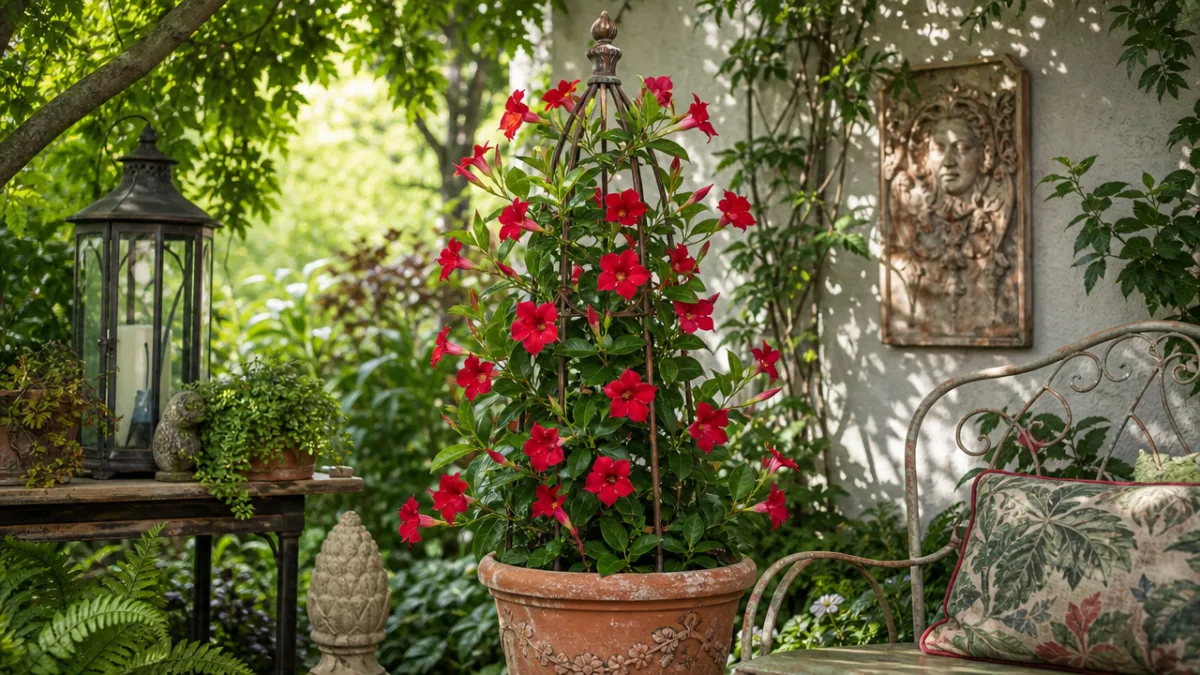
Obelisks and tower trellises are another favorite for anyone who wants height without eating up too much ground space. A tall, slender obelisk in a large container planted with mandevilla can serve as a real focal point on a patio, balcony, or compact courtyard. As the vine spirals upward around the structure, it creates a column of color that’s visible from clear across the garden — and because it’s in a pot, you can move it around to refresh things whenever the mood strikes.
Designing with Mandevilla Trellises: Color, Scale, and Composition
Pulling off a great mandevilla trellis design involves more than just picking a structure you like — it’s about thinking through how the vine will interact with everything around it, from neighboring plants to nearby architecture and hardscape. Color is one of your most powerful tools here. White-flowered varieties like ‘White Delight’ or ‘Sundaville White’ look stunning against dark-painted trellises and deep green foliage — crisp, high-contrast, and genuinely sophisticated. Pink varieties feel right at home with weathered wood and cottage-garden companions like roses, lavender, and salvia, while red-flowered cultivars bring bold tropical energy to more dramatic designs.
Scale is equally worth thinking through before you commit to anything. A small decorative trellis set against a large open wall will look lost and underwhelming. On the flip side, an oversized trellis crammed into a tiny patio can feel overwhelming and a bit claustrophobic. A useful rule of thumb is to aim for the trellis to occupy roughly a third to half of the wall or fence space behind it — enough to make a real statement without blocking out everything else. For freestanding trellises, think about how the height relates to nearby plants and structures so the proportions feel balanced.
Layering is the compositional trick that takes a mandevilla trellis from nice to genuinely impressive. Instead of treating the vine and trellis as a standalone feature, think about what’s growing in front of it, beside it, and below it. Low-growing annuals like petunias, calibrachoa, or impatiens at the base create a colorful skirt that bridges the gap between ground level and the climbing vine. A mid-height shrub or ornamental grass positioned to one side frames the trellis asymmetrically and adds depth. Even the ground surface — gravel, pavers, mulch — plays a role in the overall picture, so it’s worth considering the whole scene together.
Caring for Mandevilla on Trellises: Tips for Thriving Vines
Getting mandevilla to really thrive on a trellis comes down to understanding what the plant actually needs. Sun is non-negotiable — mandevilla wants at least six hours of direct sunlight a day, so where you place your trellis matters a lot. A south- or west-facing wall or fence in the Northern Hemisphere is usually ideal. In hotter climates, a spot with morning sun and afternoon shade can protect the leaves from scorching while still giving the plant enough light to flower well. It’s worth paying attention to your garden’s actual sun patterns before deciding on a location.
Watering and feeding make a big difference in how freely mandevilla blooms. It’s reasonably drought-tolerant once it’s established, but for the best flower show, consistent moisture through the growing season is key. Let the soil dry out slightly between waterings to encourage good root development and avoid root rot, but don’t let it go bone dry for long — drought stress causes buds to drop and leaves to look sad. A high-phosphorus fertilizer every two to three weeks during the growing season keeps the flowers coming, and a balanced slow-release fertilizer at the start of the season gives the whole plant a solid foundation.
In the early weeks after planting, it’s worth spending a little time guiding the vine onto its trellis rather than just hoping for the best. As new shoots emerge, gently direct them toward the wires, rungs, or lattice and loosely tie them in with soft garden twine or plant clips if needed. Mandevilla does twine on its own, but left entirely to its own devices it tends to cluster thickly in one spot while leaving other sections of the trellis bare. Encouraging even coverage from the start pays off enormously later. Pinching back the growing tips on young plants also encourages branching, which leads to a much fuller, lusher display overall.
Pruning is something a lot of people skip, but it really does make a difference in how the vine looks from year to year. In warm climates where mandevilla grows as a perennial, cutting it back by up to a third in late winter or early spring stimulates a flush of fresh growth and reinvigorates flowering. In cooler climates, prune it back significantly before bringing it indoors for winter to get it down to a manageable size. Deadheading spent flowers throughout the season also helps extend the overall bloom period and keeps everything looking tidy on the trellis.

Mandevilla Trellis Ideas for Containers and Small Spaces
Here’s some genuinely good news for anyone gardening on a balcony, rooftop terrace, small courtyard, or tiny patio: you don’t need a big in-ground garden to pull off a spectacular mandevilla trellis display. Modern breeding programs have produced compact varieties like ‘Sun Parasol’ and ‘Sundaville’ that are bushier, more manageable in size, and often even more floriferous than older types — which makes them ideal for container growing with small obelisk or stake-style supports. A well-chosen pot and trellis combo can completely transform even the most modest outdoor space.
Pot size matters more than people usually expect when growing mandevilla in containers. Go too small and you’ll be restricting the root system the plant needs to bloom properly. As a general guideline, a single vine with a small trellis needs a pot at least 14 to 16 inches across, and if you’re going for a more robust setup with a larger trellis, something in the 18 to 24 inch range will serve you much better. Whatever you use, make sure there are adequate drainage holes — mandevilla sitting in soggy soil will develop root problems fast, and that’s a hard situation to recover from.
The best thing about container mandevilla trellises might just be how flexible they are. You can move the whole setup to follow the sun as the seasons shift, bring it indoors when temperatures drop, or simply rearrange things when you want a fresh look on your patio or deck. That kind of flexibility is a real asset for renters who can’t make permanent changes to their outdoor space, or for anyone who enjoys periodically reimagining their garden. Group a few containers of different heights and trellis styles together and you’ll quickly create a lush, layered garden effect that feels far more expansive than the individual pieces on their own.








What do you think?
It is nice to know your opinion. Leave a comment.