










Hanging Indoor Herb Garden Ideas for a Cute Kitchen
Why a Hanging Herb Garden Belongs in Your Kitchen
Growing your own herbs indoors does something kind of magical to the way you cook. And the kitchen? It’s honestly the perfect place for it. A hanging herb garden takes all that vertical space you’re probably not using anyway and turns it into something alive, fragrant, and actually useful every single day. There’s a real difference between reaching for a jar of dried basil and snipping a few fresh leaves right there while your pasta’s on the stove — once you’ve done it that way, it’s hard to go back.
Beyond being practical, a hanging herb garden adds a warmth to a kitchen that no piece of decor can really replicate. Plants just do something to a space — they soften things, bring in color, and create this quiet sensory experience that a candle or a print on the wall can’t quite pull off. The sight of green leaves hanging near a window, the faint smell of mint or thyme drifting through the room while you cook — those little details are what make a kitchen feel like somewhere you actually want to be.
For anyone in an apartment or working with a smaller kitchen, the walls and ceiling are often the only space that isn’t already accounted for. Counter space goes fast, and floor space even faster. A hanging garden solves both problems at once — your surfaces stay clear and you’re finally putting that vertical space to use. Once you get the hang of the basics, it’s honestly a lot simpler to set up than most people expect, and the results feel rewarding almost immediately.
Choosing the Right Herbs for an Indoor Hanging Garden
Not all herbs are equally happy growing indoors, so picking the right ones from the start will save you a lot of trial and error. The best candidates for a kitchen hanging garden are herbs that can handle indoor light, don’t need a ton of root space, and are actually useful in your day-to-day cooking. Basil, chives, mint, parsley, cilantro, and thyme tend to be the most reliable performers in containers indoors. They’re also forgiving when it comes to harvesting — snipping them regularly actually encourages the plant to grow fuller rather than wearing it out.
Mint is worth calling out specifically, because it’s almost too enthusiastic as an indoor grower. It spreads like crazy and will absolutely crowd out whatever’s next to it if you let it, so keep it in its own pot. The upside is that it bounces back fast after a heavy harvest, and having fresh mint in your kitchen smells incredible. Spearmint, peppermint, and lemon mint are all great options — each one has its own slightly different personality in terms of scent and flavor.
Herbs that tend to struggle indoors are the bigger perennials — full-sized rosemary and lavender, for example, really want strong direct sun and good airflow that most kitchens can’t offer. That said, compact or dwarf rosemary varieties can actually do quite well in a bright south-facing window, especially if they’re hung somewhere that catches maximum light. The general advice is to look up each herb before committing to it and to group plants with similar light and water needs together — it makes maintenance so much easier and keeps everything looking healthier with less effort.
Creative Hanging Systems and Display Methods
The hanging system you choose is really where your personal style gets to come through — and there’s no single right answer. It all depends on your kitchen’s layout, how much light you’re working with, what you like the look of, and how much you want to spend. Some of the most beautiful herb gardens out there are built from the simplest materials: a wooden dowel hung from the ceiling with twine, holding a row of small planters, can look both rustic and intentional. What makes a hanging setup feel special is that it looks considered — like someone actually thought about it.
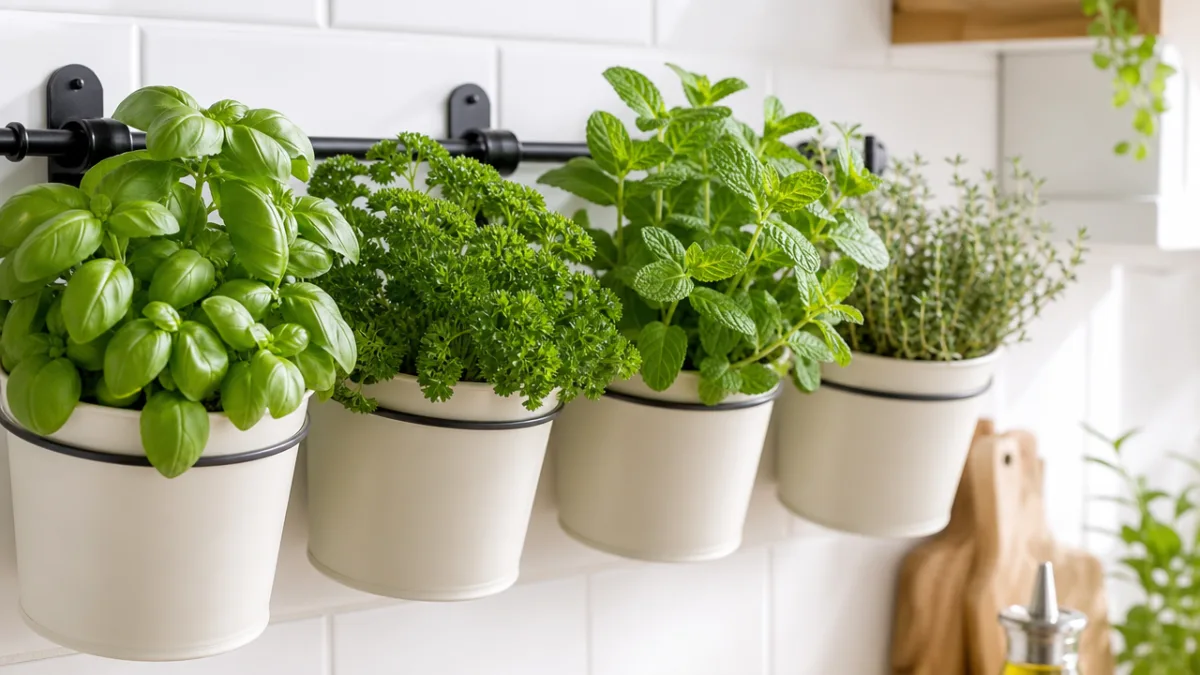
If you want something a bit more structured, wall-mounted rails with adjustable hooks are a clean, modern option. They make it easy to move pots around as your plants grow or your needs change, which is a bigger deal than it sounds. IKEA’s kitchen rail systems have become a go-to starting point for this exact reason — they’re affordable, easy to find, and look great with small clay or tin pots. Throw a chalkboard label on each one and the whole thing looks polished rather than thrown together.
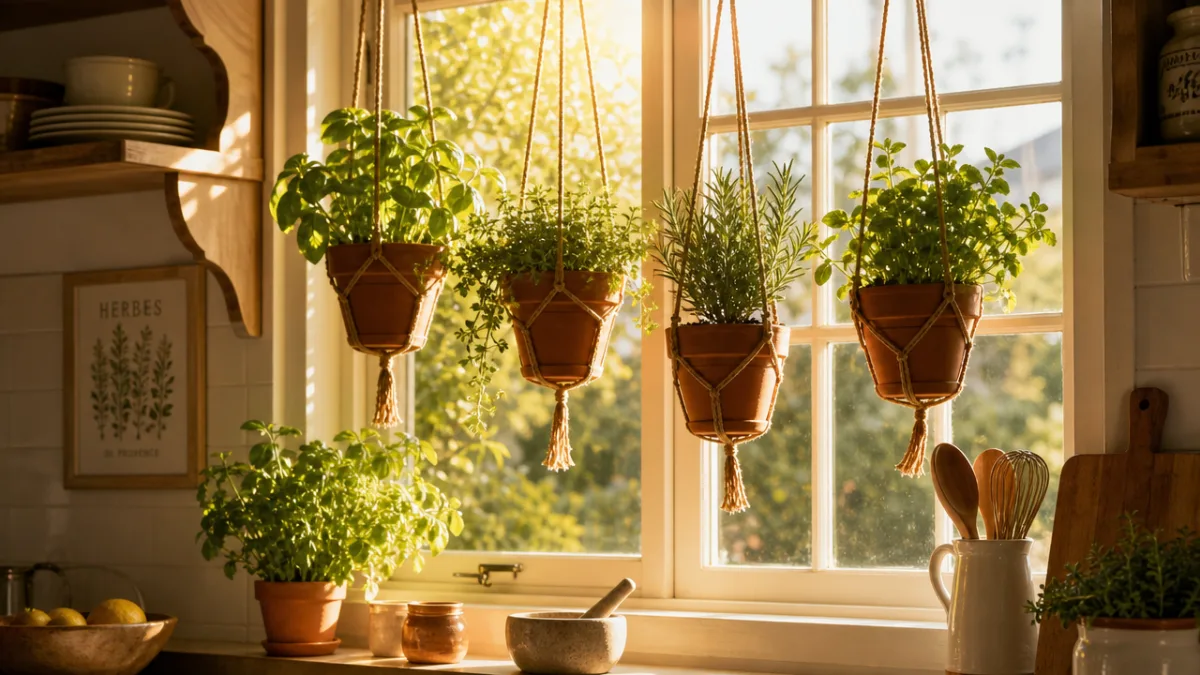
Macramé plant hangers have made a real comeback and work beautifully for individual herbs near a window. One big pot of lush basil hanging in a hand-knotted hanger makes a statement while still being completely functional. For a more industrial look, copper pipe frames mounted to the wall with leather or wire hooks create a striking effect that pairs really well with modern kitchens. The options are genuinely wide open, which means you can almost always find something that fits your space and your taste.
Some of the most charming results come from repurposed and upcycled materials. Old wooden pallets can become vertical garden panels with pots tucked between the slats. Vintage colanders, wire baskets, tin cans, mason jars — all of these can work as hanging planters with a basic drainage solution. Going this route costs very little and tends to produce a garden that has real character, something that feels personal rather than just assembled from a shopping cart.
Light, Drainage, and the Essentials of Keeping Herbs Alive
If there’s one thing that makes or breaks an indoor herb garden, it’s light. Most culinary herbs originally come from Mediterranean climates, which means they’re used to strong, generous sunshine. Indoors, that translates to getting your garden as close to your brightest window as possible — ideally south or west-facing, with at least four to six hours of direct light each day. If your kitchen doesn’t have a window that can pull that off, grow lights are a genuinely good solution, and they’ve gotten a lot more affordable and better-looking in recent years.
Drainage is the other thing you really can’t skip. Herbs hate sitting in soggy soil, and overwatering is far and away the most common reason indoor herb gardens go wrong. Every container needs drainage holes, and any outer pots or macramé hangers need to let excess water escape freely. How often you water will depend on the herb, the pot size, and the temperature in your kitchen, but a solid rule of thumb is to wait until the top inch of soil is dry before watering again. Underwatering is almost always easier to fix than overwatering.
Soil is something a lot of first-time indoor gardeners don’t think too much about, but it actually matters quite a bit. A standard all-purpose potting mix is fine as a base, but herbs do better in something that drains well. Mixing regular potting soil with perlite at about a three-to-one ratio makes a noticeable difference and cuts down on the risk of root rot. For Mediterranean herbs like thyme and oregano, adding a little coarse sand or grit helps even more. Getting the soil right from the start means fewer problems to troubleshoot down the road.
Temperature and humidity are worth a thought too. Most herbs are happiest somewhere between 60 and 75 degrees Fahrenheit, and they don’t love cold drafts from windows or AC vents. Kitchens naturally tend to be a bit more humid than other rooms thanks to cooking and dishwashing, which actually works in your favor. If your kitchen runs on the drier side, lightly misting your plants a few times a week or setting a small tray of water near the garden can help without causing the root issues that come from watering the soil too much.
Styling Your Hanging Herb Garden for Maximum Aesthetic Impact
A well-styled herb garden isn’t just a bunch of plants — it’s a design element that actually contributes to how your kitchen looks and feels. Getting there means thinking about it the way you’d think about any other part of the room: with some attention to color, texture, scale, and how things relate to each other. Mixing pot materials can make a big difference — pairing matte terracotta with a polished brass hook, or combining smooth ceramic with rough woven textures, creates depth and interest that a matching set of identical containers just doesn’t have.
Varying the heights is one of the easiest ways to make a display feel dynamic rather than flat. Hanging some pots higher than others, mixing trailing herbs like thyme with upright ones like basil, combining a big statement plant with a few smaller ones — all of it adds up to something that looks abundant rather than crowded. Think of the arrangement in layers, with taller or higher elements behind and smaller ones in front. That three-dimensional quality is what takes a row of pots and turns it into something that feels genuinely designed.
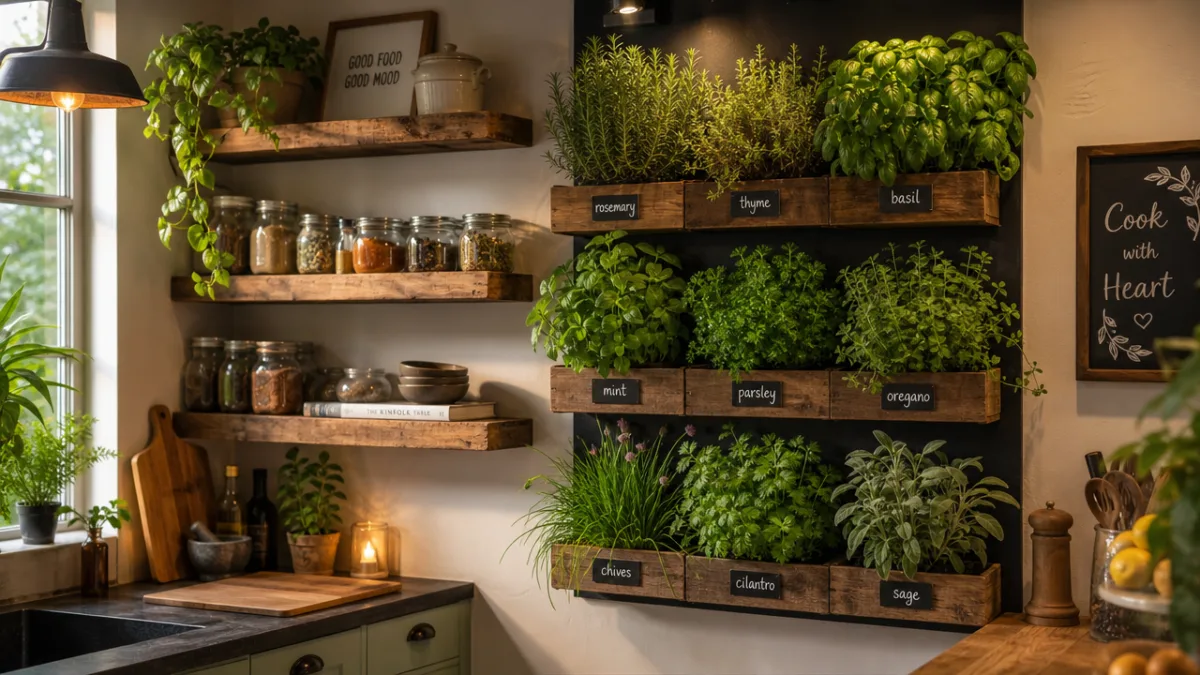
Labeling your herbs is both practical and surprisingly decorative. Small stamped metal tags, hand-lettered wooden sticks, painted river stones — each option brings a different feel to the display. To keep things cohesive, pick a labeling style that fits the rest of your kitchen. A modern, minimal kitchen might call for clean black-on-white ceramic labels, while a farmhouse-style kitchen might feel more at home with hand-inked tags tied on with twine.
Quick Styling Tips for a Pulled-Together Look
- Stick to two or three complementary pot materials — for example, terracotta, white ceramic, and one metallic accent — so the display feels cohesive rather than chaotic.
- Use odd numbers of pots in each grouping; clusters of three or five tend to look more naturally balanced than even-numbered arrangements.
- Add a non-herb element or two — a trailing pothos, some dried eucalyptus, or a small air plant — to break things up and keep the display from looking too uniform.
- Pay attention to the negative space around the garden, not just the garden itself; giving it a little room to breathe lets it stand out rather than disappear into a busy wall.
- Rotate each pot a quarter-turn every week so the plants grow evenly and don’t start leaning dramatically toward the light.
Harvesting, Maintaining, and Growing Your Garden Over Time
One of the best things about a living herb garden is that using it actually makes it healthier. Regular harvesting encourages plants to produce more leaves, keeps them from going to seed too early, and helps maintain a size that works for a hanging display. The right technique is to snip stems just above a leaf node — the spot where a pair of leaves meets the stem — rather than just pulling leaves off wherever. It’s a small habit, but it makes a real difference in how full and healthy your plants stay over time.
Fertilizing is something a lot of new herb gardeners forget about, but it becomes more important the longer you keep your garden going. Unlike plants in the ground, container herbs can’t pull nutrients from the surrounding soil — what’s in the potting mix is all they’ve got, and it gradually gets used up with every watering. A balanced liquid fertilizer every two to four weeks during the growing season (spring through early fall) keeps things nourished and productive. In winter, when growth naturally slows down, you can scale back or stop entirely. Just follow the product instructions — overfeeding is its own problem.
Even with good care, your herb garden will eventually need some refreshing. Annual herbs like basil and cilantro go through their whole life cycle fairly quickly and need to be replaced each season. Perennial herbs like thyme, oregano, and chives can last for years, but they may get woody or root-bound over time and appreciate being divided and repotted now and then. Thinking of your herb garden as something that grows and changes — rather than a set-it-and-forget-it decoration — is what keeps it looking vibrant and actually producing herbs year after year.
A Simple Seasonal Maintenance Checklist
- Spring: Refresh the potting soil in perennial containers, start seeds or grab new annual seedlings from a nursery, and increase watering as the days get longer and plants start growing faster.
- Summer: Harvest frequently to keep plants from bolting, keep an eye out for pests, fertilize every couple of weeks, and make sure nothing’s overheating near a sun-warmed window.
- Autumn: Start bringing any outdoor herbs inside if you’ve been growing them outside too, ease off on fertilizing, and take stock of which annuals will need to be replaced come spring.
- Winter: Add a grow light if natural light is falling short, water sparingly, keep plants well away from cold drafts, and start planning what you want to grow next season.
Pests are another ongoing reality that catches a lot of indoor gardeners off guard. Fungus gnats, spider mites, and aphids are the usual suspects — they move fast in the warm, sheltered environment of an indoor kitchen garden. Catching them early makes everything easier. Taking a quick look at the undersides of leaves while you’re watering only takes a second and can stop a small problem from turning into a real headache. Neem oil spray, insecticidal soap, and sticky yellow traps all work well and are low-toxicity enough to use safely around herbs you’re going to eat.
The deeper reward of a hanging indoor herb garden is harder to put into words. When you grow something yourself, look after it, watch it actually thrive, and then cook with it for yourself and the people you love — something shifts in how you relate to food. A little cluster of pots hanging in a kitchen window is, in its quiet way, a daily reminder that good food doesn’t start at the grocery store, and that even the most ordinary kitchen is capable of producing something genuinely alive and worth paying attention to.








What do you think?
It is nice to know your opinion. Leave a comment.