










Marauding Magpies: Understanding Australia’s Most Notorious Swooping Bird
The Magpie: An Australian Icon with a Fearsome Reputation
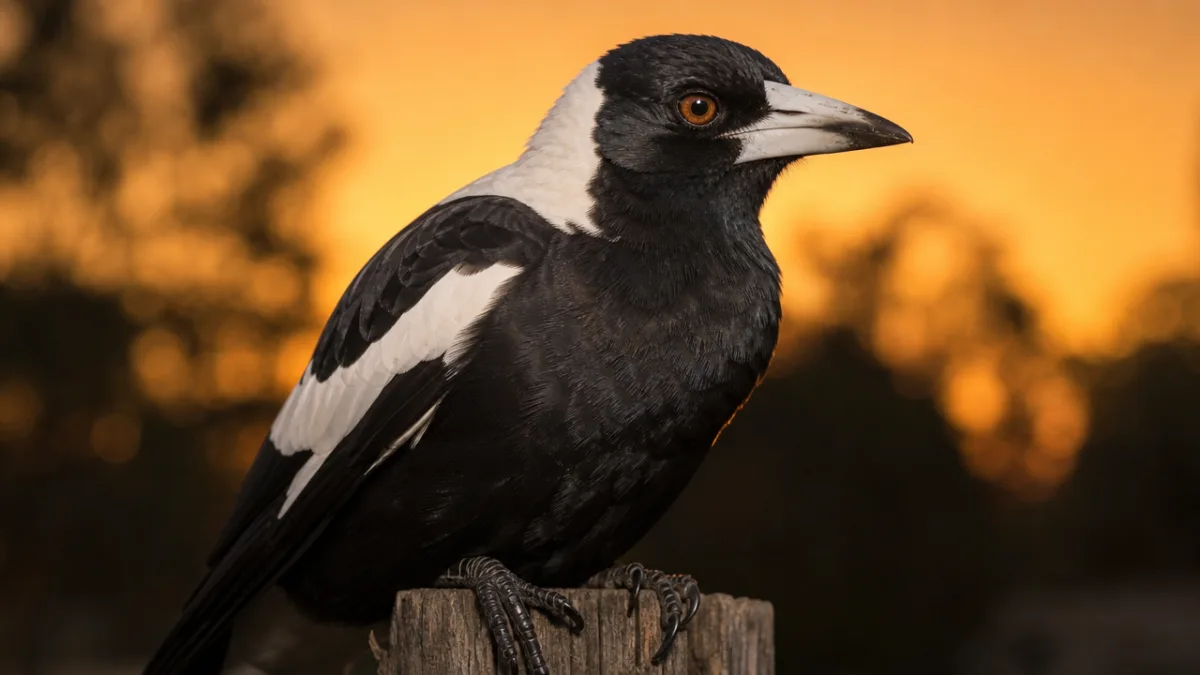
The Australian magpie (Gymnorhina tibicen) is one of the country’s most recognisable and beloved birds, celebrated for its melodious carolling and striking black-and-white plumage. Yet for a few intense weeks each year, this songbird transforms in the public imagination into something altogether more menacing. Swooping season turns footpaths, bike lanes, and schoolyard gates into gauntlets that cyclists, joggers, and pedestrians must navigate with eyes skyward and nerves steeled. Few natural encounters in suburban Australia inspire quite the same mixture of awe and genuine dread.
Despite their fearsome seasonal reputation, magpies are highly intelligent animals with complex social lives, remarkable problem-solving abilities, and a capacity for long-term memory that makes their territorial behaviour all the more sophisticated. Research has shown that magpies can recognise individual human faces and remember both those who have threatened them and those who have treated them kindly over periods of years. This cognitive sophistication means that a magpie’s decision to swoop a particular person is rarely random — it is a calculated response rooted in experience and learned association.
Understanding magpie behaviour requires appreciating the bird from its own perspective. A swooping magpie is not a villain; it is a parent. Every dive-bomb, every clack of beak, every rush of dark wings past an unsuspecting ear represents a fierce parental instinct to protect eggs or chicks from perceived danger. When we examine the biology, ecology, and social dynamics that drive this behaviour, the marauding magpie becomes less a menace and more a model of devoted parenthood — one that simply lacks the capacity to distinguish a genuine predator from a harmless cyclist.
When and Why Magpies Swoop
Swooping season in Australia typically runs from late July through to November, with peak activity concentrated between August and October. This window corresponds precisely with the magpie’s breeding season, during which mated pairs establish and defend nesting territories. The female alone incubates the eggs for roughly three weeks, while both parents share responsibility for feeding and protecting the chicks once hatched. It is during this period that the male in particular becomes intensely vigilant, scanning his territory from elevated perches and launching interception flights against anything he perceives as a threat.
Not all magpies swoop, and this is a point that often surprises people who have only experienced the aggressive minority. Studies suggest that only around ten to fifteen percent of male magpies engage in swooping behaviour directed at humans. The rest remain perfectly tolerant of pedestrians and cyclists passing through their territory. The difference often comes down to the individual bird’s prior experiences with humans, the specific layout of its territory in relation to high-traffic areas, and the proximity of the nest to paths or roads. A magpie whose nest hangs directly over a busy footpath is far more likely to feel provoked than one nesting deep within a park away from regular human movement.
The swooping itself is a precisely calibrated warning system rather than an all-out attack. Magpies almost always strike from behind, descending in a fast arc and pulling away at the last moment. In the vast majority of cases, the bird’s goal is to frighten rather than injure. The clacking of the beak that many people hear is a deliberate acoustic warning — a sharp, percussive signal that communicates “you are too close and you must leave.” Actual contact, while it does occur and can result in scratches or pecks, is less common than the drama of a swooping encounter might suggest. The bird is calibrating its response, and escalation to contact usually only happens when the perceived threat refuses to retreat.

The Science of Magpie Intelligence and Memory
Magpies belong to the family Artamidae and are widely regarded as among the most intelligent birds in the world. Their brains, while structured very differently from mammalian brains, support a remarkable range of cognitive functions including tool use, forward planning, and self-recognition. In one celebrated study, Australian magpies became only the fourth animal species ever confirmed to pass the mirror self-recognition test — a benchmark long considered a hallmark of higher-order consciousness. They joined great apes, dolphins, and elephants in this select cognitive company, a finding that reshaped scientific understanding of avian intelligence.
Perhaps most relevant to understanding swooping behaviour is the magpie’s extraordinary facial recognition ability. Research conducted at the University of Queensland demonstrated that magpies can distinguish between hundreds of individual human faces and maintain those memories across years. In one experiment, researchers wearing identical neutral masks interacted with magpie territories in either threatening or benign ways. The birds subsequently swooped the threatening researchers significantly more often than the benign ones, even when both groups wore the same disguise — suggesting the birds were reading facial cues beneath or around the masks rather than relying on clothing or other gross visual signals.
This memory system has profound practical implications. A magpie that has been harassed, had its nest disturbed, or been frightened by a particular type of person or action will remember and respond accordingly. Conversely, a bird that has been treated with consistent gentleness may become habituated to human presence and cease swooping altogether. Some urban magpies become so comfortable around trusted individuals that they approach for hand-feeding, carol in response to human voices, and seem genuinely to enjoy social interaction. The same bird that terrorises strangers on a bike may peacefully share breakfast with a familiar neighbour — a duality that perfectly encapsulates the complexity of this species.
Living Alongside Swooping Magpies: Practical Strategies
For the millions of Australians who share suburbs, parks, and school grounds with territorial magpies each spring, the question is not merely academic. Navigating swooping season safely requires a combination of awareness, practical precaution, and a degree of behavioural adaptation. The good news is that most strategies are simple, effective, and require no harm to the birds. Authorities including local councils and wildlife organisations consistently advise against any approach that involves disturbing, relocating, or harming magpies, both for ethical reasons and because such actions are illegal under Australian wildlife protection laws.
The most widely recommended practical steps for reducing swooping risk include the following approaches, each grounded in an understanding of magpie behaviour and perception:
- Avoid known swooping territories during peak breeding season by taking alternate routes when possible. Most councils and community groups maintain online maps of reported swooping locations.
- Wear a hat or helmet with eyes drawn on the back. Magpies almost exclusively attack from behind, and the illusion of a watching face disrupts their approach angle.
- Walk, do not run, through a swooping zone. Running triggers pursuit instincts and escalates the bird’s sense of threat. A calm, deliberate pace signals non-aggression more effectively.
- Maintain eye contact with the bird when possible, as magpies are significantly less likely to swoop when they believe they have been seen and identified.
- Attach cable ties or a flag to your bicycle helmet, as the vertical protrusions disrupt the clean approach path the bird prefers for its dive.
- Do not retaliate by waving arms, throwing objects, or making loud noises. Aggression reinforces the bird’s assessment that you are a threat and will intensify future swoops.
Beyond immediate protective measures, building a longer-term relationship of tolerance with neighbourhood magpies is genuinely possible and rewarding. Offering small food items such as mealworms or unseasoned meat scraps — while being careful not to create dependency or nutritional imbalance — can help a magpie associate your presence with positive outcomes. Over successive breeding seasons, a bird that learns you are not a threat may reduce or abandon swooping behaviour toward you entirely. Residents who have cultivated this kind of relationship often describe their local magpies as beloved community members, greeting them by name and delighting in the birds’ extraordinary vocalisations.

Magpie Ecology and the Urban Environment
The Australian magpie is a consummate generalist, one of the few native species that has genuinely thrived in the face of urbanisation rather than retreating from it. Originally a bird of open woodland and grassland, the magpie found in sprawling Australian suburbs an environment that closely mimicked its preferred habitat: short-cropped grass for foraging, scattered trees for nesting and perching, and a reliable year-round food supply in the form of lawn invertebrates and household scraps. Today, magpie populations are denser in many urban and suburban areas than in equivalent tracts of undisturbed native bush.
Magpies are highly territorial and live within stable group structures that can persist for decades. A typical magpie group occupies a territory of between two and twenty hectares, which it defends year-round against rival groups and potential predators. The territory provides everything the group needs: foraging ground, nest sites, and the social space in which young birds develop the complex vocal repertoire and social skills that characterise the species. Within these groups, there is a clear hierarchy, and the dominant breeding pair holds priority access to the best resources and the most secure nesting sites.
The urban landscape introduces both opportunities and challenges for magpie groups. On one hand, lawns irrigated year-round support earthworms and beetle larvae even through dry summers, providing reliable foraging where the natural environment might fail. On the other hand, urban territories are fragmented by roads, fences, and buildings in ways that can increase conflict between groups competing for limited space. Nest sites in urban trees are also exposed to higher levels of human disturbance than those in natural bush, which may partly explain why urban magpies tend to exhibit more intense swooping behaviour — their nests are more frequently approached by unknowing humans simply going about their daily lives.
Cultural Significance and Changing Attitudes
In the Australian cultural imagination, the magpie occupies a unique and somewhat contradictory position. It is simultaneously a cherished symbol of the Australian spring — its liquid, gurgling carol is one of the most recognisable and deeply loved sounds in the country — and a source of genuine seasonal anxiety for cyclists, postal workers, and school children. This tension is reflected in the enormous volume of swooping-season content that floods Australian social media each spring: videos of near-misses, crowdsourced maps of dangerous territories, and a rich vein of communal humour that treats magpie encounters as a shared national rite of passage.
Several Australian sporting teams have adopted the magpie as their emblem, most famously the Collingwood Football Club in the AFL and various state-level teams across cricket, rugby league, and soccer. In each case, the qualities being invoked are those of courage, tenacity, and fierce territorial loyalty — the same qualities that make the swooping magpie simultaneously feared and respected in the suburban environment. The magpie as sporting symbol is the magpie as competitor: bold, intelligent, and absolutely committed to defending its ground against all challengers.
Attitudes toward swooping magpies have shifted meaningfully in recent decades as public understanding of animal cognition and welfare has grown. Where previous generations might have accepted or even encouraged the shooting of nuisance birds, contemporary Australian attitudes strongly favour coexistence and management strategies that prioritise the birds’ wellbeing. Wildlife rescue organisations report increasing numbers of calls from members of the public concerned about injured magpies, and community campaigns to protect nesting birds from harassment have gained mainstream acceptance. The marauding magpie, it turns out, is best understood not as an enemy to be defeated but as a neighbour to be respected — one whose fierce seasonal behaviour is, at its heart, the same impulse that drives any parent to stand between their children and the world.
Conservation, Research, and the Future of Urban Magpies
Despite their current abundance, Australian magpies face a range of pressures that scientists and conservationists are increasingly monitoring. Habitat loss in rural areas continues to reduce the quality of natural territories, pushing more birds into urban and peri-urban environments and intensifying competition for space. Climate change is altering the timing and reliability of invertebrate prey cycles, with potential knock-on effects for breeding success in years when spring arrives early or precipitation patterns shift dramatically. Long-term monitoring studies at several Australian universities are tracking these changes with growing concern about what a warming, drying climate may mean for one of the country’s most successful native birds.
Ongoing research into magpie cognition continues to yield remarkable findings that challenge assumptions about the boundaries of animal intelligence. Studies are currently exploring whether magpies exhibit empathy, how they transmit cultural information between generations, and whether their exceptional vocal mimicry — some urban magpies have been recorded imitating human speech, dog barks, and other bird species — reflects a deeper capacity for symbolic communication. Each new finding adds another layer of complexity to our understanding of a bird that most Australians have always intuitively felt was somehow watching them back — because, as it turns out, it genuinely is.
The future of magpies in Australian cities depends in large part on the willingness of human residents to extend genuine tolerance and informed coexistence to a species that has adapted brilliantly to the urban world we created. This means resisting the urge to report swooping birds for relocation — a process that is traumatic for the birds, rarely effective, and often results in the bird returning or another bird immediately filling the vacant territory. It means teaching children that a swooping magpie is a parent doing its job, not a dangerous animal to be feared. And it means appreciating that every spring morning filled with magpie song is a gift from a bird that has chosen, in its own territorial and occasionally terrifying way, to share our world.








What do you think?
It is nice to know your opinion. Leave a comment.