










20 Best Plants to Grow in a Moon Garden
What Is a Moon Garden and Why Should You Create One?
A moon garden is a carefully curated outdoor space designed to be experienced after dusk, when the rest of the world quiets down and the night sky takes center stage. Unlike traditional gardens built around daytime color and activity, moon gardens rely on white and pale-hued flowers, silvery foliage, and intensely fragrant blooms that release their scent specifically in the evening hours. The result is a serene, almost magical landscape that transforms your yard into a place of nighttime wonder.
The concept of moon gardening has deep historical roots, stretching back to Victorian England and even further to ancient cultures that revered the moon’s connection to nature and growth. Many gardeners throughout history have noted that certain plants seem to thrive when planted in accordance with lunar cycles, and the aesthetic of a white garden bathed in moonlight carries a timeless, romantic quality. Today, moon gardens are enjoying a well-deserved resurgence among homeowners who want an outdoor space that serves as a true sanctuary for evening relaxation.
Creating a moon garden is also a wonderfully practical choice for people who spend their weekdays at work and only have time to enjoy their outdoor spaces on evenings and weekends. If you find yourself sipping tea on the porch after sunset more often than you stroll through your yard at noon, a moon garden is essentially designed around your lifestyle. With the right plant selection, you can have a garden that peaks in beauty, fragrance, and atmosphere precisely when you are most likely to enjoy it.
Designing Your Moon Garden Space
Before choosing your plants, spend a few evenings simply observing your yard. Notice where the moonlight falls most directly, which areas receive ambient light from streetlamps or your home’s exterior fixtures, and where natural darkness pools beneath trees or along fences. These observations will guide your planting decisions and help you position your most reflective, white-bloomed plants in spots where they will catch and glow in whatever light is available. Even on cloudy nights, white flowers have a remarkable ability to remain visible while colored blooms disappear entirely into the darkness.
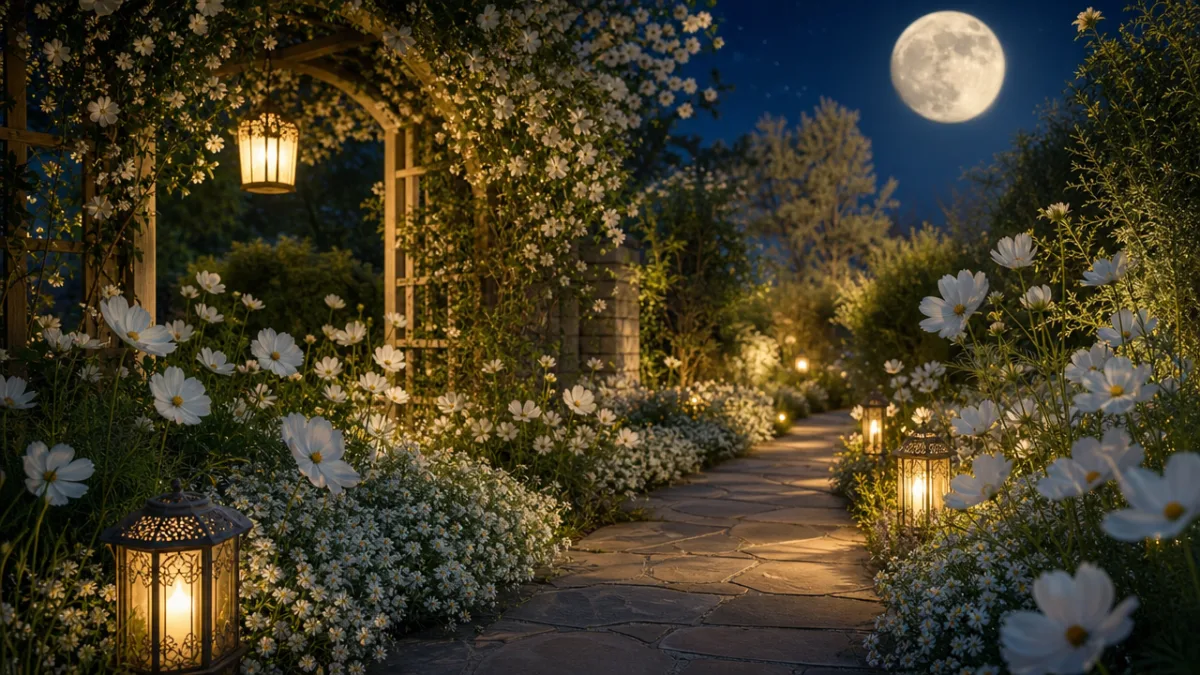
The layout of a moon garden often benefits from curved pathways and circular or crescent-shaped beds, echoing the gentle arc of the moon itself. Pale gravel paths or white stepping stones serve a dual purpose: they guide visitors safely through the space at night while also reflecting ambient light upward onto surrounding plantings. Consider adding a seating area, a water feature with reflective surface, or even wind chimes that engage the senses of sound and touch alongside sight and scent. A moon garden is ultimately a multisensory experience.
When planning your plant palette, aim for a layered effect that includes low ground covers, mid-height perennials, tall structural plants, and climbers or vines on trellises. This layering creates depth and visual interest even under low-light conditions. Mixing plants with different bloom times throughout the growing season ensures that your moon garden has something glowing and fragrant from early spring all the way through the first frost, giving you months of evening enjoyment rather than just a brief window of peak beauty.
Top White and Pale-Flowered Plants for Your Moon Garden
White flowers are the undisputed stars of any moon garden, and the plant world offers a breathtaking range of options spanning annuals, perennials, shrubs, and bulbs. White Moonflower (Ipomoea alba) is perhaps the most iconic choice, a fast-growing vine whose enormous, saucer-shaped blooms unfurl dramatically at dusk and remain open throughout the night. Each flower can reach up to six inches across, and they emit a soft, sweet fragrance that carries beautifully on the evening breeze. Planted against a trellis or fence, moonflowers create a stunning vertical element in the garden.
Nicotiana, or flowering tobacco, is another essential moon garden plant that produces clusters of tubular white or pale pink flowers on tall, graceful stems. What makes nicotiana particularly valuable for evening gardens is its powerful fragrance, which intensifies after dark in a way that many daytime-blooming plants simply cannot match. The blooms tend to close during the heat of the day and open again as temperatures drop in the late afternoon, making them a living timer that signals the transition from day to evening in your garden.
White Phlox is a garden workhorse that delivers dense clusters of bright white blooms over an exceptionally long season. Garden phlox (Phlox paniculata) varieties such as ‘David’ and ‘Mt. Fuji’ produce flowers of near-pure white that practically shimmer in low light, and they carry a sweet, honey-like fragrance that is especially pleasant on warm summer evenings. Phlox is also a reliable perennial that returns year after year, spreading gradually to fill larger spaces in your moon garden with minimal intervention required from you.
Fragrant Bloomers That Shine After Dark
Jasmine is synonymous with evening fragrance, and several species are perfectly suited to moon garden planting. Common jasmine (Jasminum officinale) is a vigorous climbing vine that drapes trellises and arbors with clusters of delicate white flowers from summer into fall. The fragrance is complex and intoxicating, sweet with subtle green and floral undertones that many people find deeply calming and romantic. In warmer climates, jasmine can become nearly evergreen, offering you a longer season of both foliage interest and blooms.
Four o’clocks (Mirabilis jalapa) live up to their name by opening their trumpet-shaped flowers in the late afternoon, just as the sun begins to lower. Available in white, pale yellow, and soft pink varieties, these easy-growing annuals produce abundant blooms throughout the summer without demanding much attention. They have a pleasant, light fragrance and grow into tidy, bushy mounds that work well as mid-height border plants. They also self-seed prolifically, meaning you may find them returning in unexpected and delightful spots each year.
White Roses bring classic elegance to the moon garden and come in an extraordinary range of forms, from compact groundcover types to towering climbers. Varieties like ‘Iceberg,’ ‘Winchester Cathedral,’ and ‘White Eden’ are particularly prized for their abundant white blooms and good disease resistance. Many white roses are also richly fragrant, especially the old-fashioned and David Austin varieties, which release their perfume most generously during the cooler temperatures of evening. Paired with the right companion plants, white roses become the jewels in your moon garden’s crown.
Silver and Gray Foliage Plants for Maximum Moonlight Reflection
One of the most underappreciated secrets of a successful moon garden is the strategic use of silver and gray-leaved plants. These plants, many of which evolved their metallic foliage as a heat and drought adaptation, have surfaces covered in tiny reflective hairs or waxy coatings that bounce light with remarkable efficiency. In a moon garden setting, they act almost like living mirrors, catching the faintest glimmer of moonlight or lamplight and scattering it throughout the planting bed in a way that makes the entire garden seem to glow from within.
Lamb’s Ears (Stachys byzantina) is a beloved perennial ground cover whose leaves are so densely coated in silver-white hairs that they feel as soft as felt and shimmer beautifully even on the darkest nights. It spreads obligingly to fill gaps between other plants, creating a flowing carpet of silver that ties the garden together visually. Lamb’s ears is also remarkably tough and drought-tolerant, requiring very little care once established, which makes it an ideal choice for gardeners of all experience levels who want a high-impact, low-maintenance silvery element.
Dusty Miller (Senecio cineraria) brings a more refined, lacy texture to the moon garden with its deeply cut, silver-white leaves that seem almost frosted in appearance. Often used as an edging plant or to weave between flowering specimens, dusty miller creates elegant contrast against the stark white of flowers while maintaining the pale, reflective palette that a moon garden requires. It is typically grown as an annual in cooler climates but can overwinter successfully in warmer zones, eventually growing into a surprisingly substantial silver shrub.
Structural Plants That Add Drama to Evening Landscapes
Artemisia encompasses a large genus of silver and gray-leaved plants that range from low-growing ground covers to tall, statuesque specimens. ‘Powis Castle’ is a particularly popular cultivar that forms a large, finely textured mound of silvery, feathery foliage that catches every breath of evening breeze and shimmers in response. The soft texture and pale color make it an excellent backdrop for white-bloomed perennials, and its aromatic foliage releases a pleasant, herbal scent when brushed or touched, adding another dimension to the moon garden experience.
White Coneflower (Echinacea purpurea ‘White Swan’ or ‘PowWow White’) offers the moon garden both structural beauty and ecological value, as its flowers attract pollinators during daylight hours and its raised central cones remain visible and interesting well into the night. The large, daisy-like white blooms with their distinctive orange-brown centers provide an interesting contrast against purely white flowering plants, adding just enough warmth to keep the moon garden from feeling cold or clinical. As a bonus, coneflowers are extremely hardy perennials that require almost no maintenance once established.
White Bleeding Heart (Lamprocapnos spectabilis ‘White Gold’) brings a delicate, romantic note to the shade areas of a moon garden with its arching stems hung with heart-shaped white flowers. This spring-blooming perennial is particularly effective planted beneath deciduous trees or along the shaded north side of structures, where it lights up the darker corners of the garden with its pendant white blooms. Though it dies back in summer heat, it can be planted alongside hostas or ferns that will expand to fill the space and continue providing interesting foliage through the warmer months.
Bulbs and Seasonal Bloomers for a Year-Round Moon Garden
Thoughtful use of bulbs is what separates a truly spectacular moon garden from a merely pretty one, because bulbs allow you to orchestrate waves of white bloom from earliest spring through late fall with careful planning. Starting the season off right, white tulip varieties like ‘White Triumphator’ and ‘Purissima’ push through the soil in early spring and open their elegant, cup-shaped flowers just as the evenings are beginning to warm enough for comfortable outdoor sitting. These classic spring bulbs naturalize well in many climates and multiply over the years to create increasingly generous sweeps of white.
White Alliums bring a striking, sculptural quality to the moon garden in late spring and early summer, their spherical flower heads rising on tall, straight stems above the surrounding foliage. The white-flowered variety ‘Mount Everest’ is especially beautiful in moonlight, its perfectly round, snowball-like blooms catching the light from every angle. Because alliums hold their shape well even as the flowers fade to seed heads, they provide months of visual interest, and their dried forms are particularly striking in the slanted golden light of late summer evenings.
Tuberose (Polianthes tuberosa) is perhaps the most luxuriously fragrant of all the evening-blooming bulbs, producing tall spikes of waxy white flowers whose perfume has been prized by perfumers for centuries. The scent is rich, heady, and distinctly nocturnal, intensifying dramatically after sunset and carrying across remarkably large distances on still evenings. Tuberoses require a long, warm growing season and are typically grown as annuals in most climates, but the effort of lifting and storing the tubers over winter is richly rewarded every time they bloom.
Annuals That Keep Your Moon Garden Blooming All Season
Annual plants are invaluable in the moon garden because they bloom continuously and abundantly throughout the growing season, filling in gaps between perennials and bulbs and providing consistent color and fragrance from planting time until frost. White Impatiens are a reliable choice for shady areas of the moon garden, producing a non-stop succession of simple but charming white flowers that hold up beautifully in low light and brighten dark corners significantly. They require almost no deadheading and stay tidy throughout the season.
Sweet Alyssum (Lobularia maritima) is a low-growing annual that carpets the ground with tiny white or cream-colored flowers and releases a sweet, honey-like fragrance that is especially perceptible on warm evenings. It works beautifully as an edging plant along pathways, where visitors will brush against it and release fresh waves of scent as they move through the garden. Sweet alyssum also self-seeds freely, often returning in greater abundance the following year without any effort on the gardener’s part.
White Cosmos (Cosmos bipinnatus ‘Purity’) brings airy, romantic movement to the moon garden with its finely cut, feathery foliage and large, daisy-like white flowers on tall, swaying stems. Few plants are as effortless to grow from direct-sown seed, and few are as graceful in the evening breeze, their flowers nodding and swaying against the darkening sky like tiny moons on slender tethers. Cosmos also blooms prolifically right up until hard frost if regularly deadheaded, giving you months of continuous white bloom from midsummer onward.
Practical Tips for Planting and Maintaining Your Moon Garden
Success with a moon garden begins with soil preparation, just as it does with any garden project. Most of the plants favored for moon gardens prefer well-drained soil enriched with compost, and taking the time to amend heavy clay soils or nutrient-poor sandy soils before planting will pay dividends for years. Work in a generous layer of aged compost or well-rotted manure to a depth of at least twelve inches, which will improve both drainage and moisture retention while providing a slow-release source of nutrients that fragrant and flowering plants particularly appreciate for robust bloom production.
Watering practices matter enormously in the moon garden, especially for the fragrant plants that are central to its character. Many evening-fragrant plants, including nicotiana, jasmine, and four o’clocks, benefit from deep, infrequent watering rather than shallow daily irrigation, as this encourages roots to grow deeply and makes the plants more resilient during dry spells. Water in the early morning rather than in the evening to reduce the risk of fungal diseases, which are particularly prevalent among the white-flowered plants that moon gardens favor, many of which have some susceptibility to powdery mildew.
Consider the following key maintenance tasks to keep your moon garden looking its best throughout the season:
- Deadhead spent blooms regularly on annuals and repeat-blooming perennials to encourage continuous flowering rather than seed production.
- Divide overcrowded perennials like phlox, coneflower, and bleeding heart every three to four years to maintain vigor and prevent the center of clumps from dying out.
- Apply a two-to-three-inch layer of light-colored mulch, such as white gravel or pale wood chips, around plantings to reflect additional light upward and retain soil moisture.
- Provide support for tall plants like nicotiana, white cosmos, and moonflower vines early in the season before they need it, rather than waiting until stems are already bent or broken.
- Monitor white-flowered plants closely for powdery mildew and treat promptly with a diluted neem oil solution or baking soda spray at the first sign of infection.
Lighting is one area where many moon gardeners find that a small investment makes an enormous difference to the overall effect of the space. While the whole concept of a moon garden celebrates natural moonlight, strategically placed low-wattage garden lights, solar lanterns, or string lights can extend the usability of the space on new moon nights or cloudy evenings when natural light is minimal. Choose warm-white or cool-white LED options rather than colored lights, and position them low and within planting beds rather than above them, so the light shines up through foliage and blooms rather than creating harsh overhead glare.
Finally, keep a garden journal to track what worked and what did not across the seasons. Note which plants bloomed simultaneously to create the most beautiful combinations, which fragrances you found most pleasing on summer evenings versus cool autumn nights, and which plants spread aggressively enough to need management. A moon garden is a living, evolving creation that rewards attentive observation and thoughtful adjustment year after year, becoming more beautiful and more perfectly tuned to your tastes and your site’s specific conditions with every passing season.








What do you think?
It is nice to know your opinion. Leave a comment.