










Monstera Plants Free Crochet Patterns You Can Crochet This Weekend
Why Monstera Plants Have Become the Darling of the Crochet World
The Monstera deliciosa, with its dramatic split leaves and bold tropical silhouette, has swept through interior design trends over the past decade, and it was only a matter of time before the crochet community fell deeply in love with this iconic plant. Fiber artists of all skill levels have embraced the challenge of recreating those distinctive fenestrated leaves using yarn, hooks, and a generous dose of creativity. The result is a thriving subculture of plant-inspired crochet that produces everything from tiny amigurumi Monsteras to full-sized statement plants that could fool a casual observer at first glance.
What makes Monstera crochet projects so endlessly appealing is their remarkable versatility. A crocheted Monstera can become a wall hanging that brings tropical energy to a stark apartment wall, a decorative plant that never needs watering, a coaster set that brings the outdoors to your coffee table, or even a wearable accessory like a brooch or hair clip. The iconic leaf shape translates beautifully across scales and yarn weights, meaning the same basic pattern concept can serve a beginner making a simple flat leaf or an advanced crocheter building an elaborate three-dimensional plant sculpture complete with aerial roots and a handmade pot.
The timing could not be better for jumping into Monstera crochet projects. Free patterns have proliferated across blogs, YouTube channels, and pattern-sharing platforms like Ravelry and Lovecrafts, meaning you can start your tropical crochet journey without spending a single penny on patterns. Many of these free offerings are genuinely excellent, created by talented designers who have refined their leaf-shaping techniques through many iterations. Whether you have a full weekend to dedicate to an ambitious project or just a few free hours on a Sunday afternoon, there is a Monstera crochet pattern perfectly sized to fit your available time and current skill level.
Essential Materials and Tools for Your Monstera Crochet Project
Before you cast on your first chain stitch, gathering the right materials will make the difference between a project that flows smoothly and one that frustrates you at every turn. For most Monstera leaf crochet projects, a medium-weight worsted yarn in various shades of green will serve you beautifully. The richness of the Monstera’s real leaves demands attention to color — consider combining a deep forest green for the mature leaf areas with a brighter lime or emerald green for highlights, mimicking the natural variation you see in a healthy living plant. Some crocheters even add subtle yellow-green at the center to suggest the veining pattern that makes real Monstera leaves so visually striking.
Your hook size should correspond to your chosen yarn weight, but many experienced Monstera crochet designers recommend going down one hook size from the yarn’s recommendation to create a tighter, firmer fabric. This is especially important for three-dimensional projects where you want the leaves to hold their shape rather than flopping limply. For a standard worsted yarn, a 4.0mm or 4.5mm hook often gives ideal results. If you are making a large statement plant, consider using chunky yarn with a 6.0mm or larger hook to build the project up quickly over a weekend without sacrificing structural integrity.
Beyond yarn and hooks, a few additional supplies will elevate your finished project considerably. Floral wire or pipe cleaners inserted into crocheted leaves allow you to pose them realistically, bending them into the graceful arc of a real Monstera leaf rather than leaving them flat. Stitch markers are essential for keeping track of rounds in amigurumi-style projects. A darning needle for weaving in ends, scissors, and blocking mats with rust-proof pins round out your basic kit. For potted Monstera projects, a thrifted planter, floral foam, and wooden dowels or bamboo skewers provide the structural support that makes the finished piece look like a genuine houseplant display.

Beginner-Friendly Free Monstera Patterns Perfect for a Weekend Project
If you are new to crochet or returning after a long break, the world of Monstera patterns offers several genuinely accessible starting points that do not require you to already know advanced techniques. The simplest Monstera leaf patterns work in rows rather than rounds, using basic stitches like single crochet, half double crochet, and double crochet combined with strategic increases and decreases to create the leaf’s heart-shaped silhouette. The characteristic splits and holes in the leaf — the fenestrations that make Monstera leaves instantly recognizable — are created using simple chain-space techniques that beginners can master within an hour of practice.
One of the most widely loved beginner-accessible free patterns available online teaches you to crochet a set of Monstera leaf coasters. Each coaster is worked as a flat piece approximately five to six inches across, taking roughly one to two hours per coaster depending on your pace. The pattern uses only single crochet and chain stitches, making it ideal for someone who learned the basics but has not yet attempted more complex stitch patterns. A set of four coasters crocheted in two or three shades of green makes a beautiful and functional home décor item, and the whole set can realistically be completed within a single Saturday or Sunday.
Another excellent beginner option is the crocheted Monstera leaf wall hanging, where you create several individual leaves of varying sizes and then arrange and attach them to a piece of driftwood or a dowel rod. This project is forgiving because each leaf is independent — if one turns out slightly different from the others, it only adds to the organic, natural look of the finished piece. Many free tutorials for this style of project are available on YouTube with step-by-step video guidance, which is enormously helpful for visual learners who struggle to translate written pattern instructions into actual stitches. The finished piece makes a stunning piece of wall art that looks expensive and artisanal despite costing very little to make.
Intermediate and Advanced Monstera Crochet Projects for the Ambitious Crafter
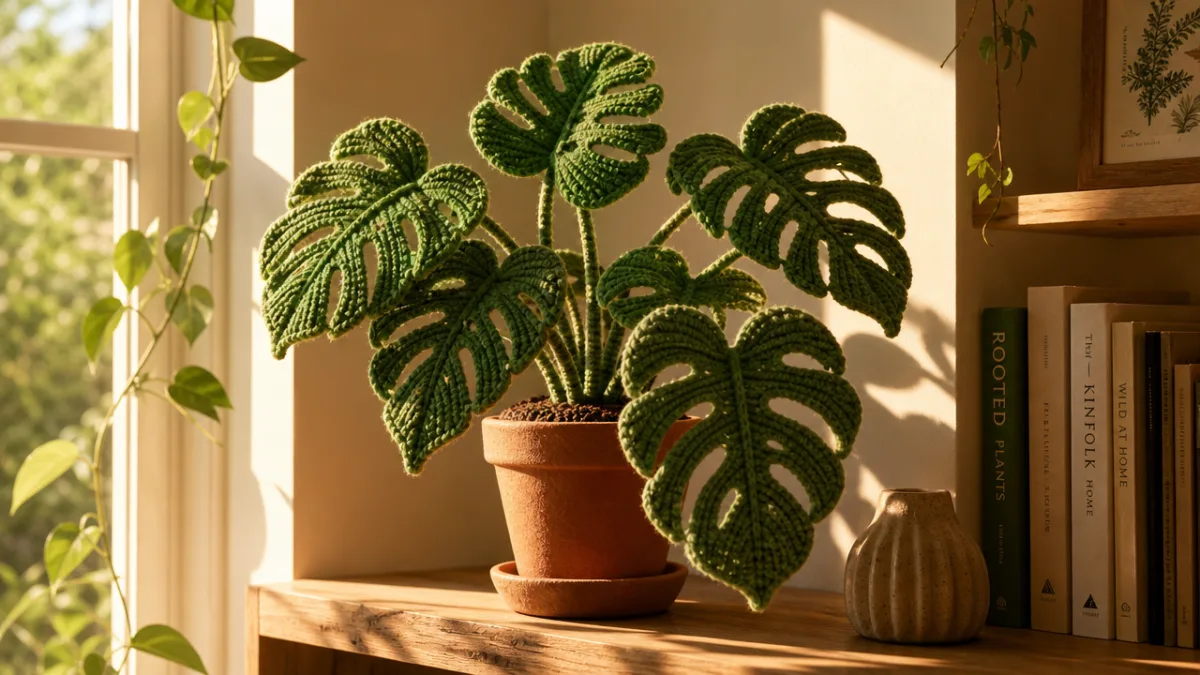
Once you have mastered flat Monstera leaves, a world of more complex and structurally ambitious projects opens up. Intermediate crocheters will find tremendous satisfaction in tackling a full potted Monstera plant, where multiple leaves of varying sizes and stages of maturity are crocheted, wired, and assembled into a convincing three-dimensional plant. These projects typically include mature leaves with extensive fenestration alongside younger, unfurled leaves in a lighter, brighter green, and sometimes even the characteristic brown-tipped aerial roots that Monsteras send out as they mature. The attention to botanical detail in the best free patterns of this type is genuinely remarkable.
Amigurumi-style miniature Monstera plants represent another delightful intermediate challenge. These small, self-contained plants — typically four to eight inches tall — are crocheted in the round using tight tension to create a firm, sculptural result. The tiny fenestrated leaves require careful execution because the split shapes are more fiddly at small scale, but the finished miniature plants are absolutely irresistible and make incredibly popular gifts. Many crocheters find that making a miniature Monstera amigurumi builds the techniques and intuition needed to tackle a full-sized version later. Several excellent free amigurumi Monstera patterns are available on Ravelry, complete with detailed photo tutorials for the trickiest steps.
Advanced crocheters looking for a genuinely ambitious weekend project should consider a Monstera leaf lapghan or throw blanket, where the entire blanket takes the form of a giant Monstera leaf. These dramatic statement pieces use the leaf’s natural shape as the silhouette of the blanket itself, with the fenestrations worked as genuine open spaces using mesh or filet crochet techniques. The result is a functional blanket that doubles as a striking piece of botanical art. Some designers incorporate textured stitch patterns within the leaf sections to suggest the surface texture and veining of a real leaf, adding visual depth that transforms what could be a simple project into an heirloom-quality piece.
Tips and Techniques for Getting Your Monstera Leaves Looking Their Best
The single most impactful technique for improving your crocheted Monstera leaves is blocking, and yet it is also the step that most beginners skip because it requires a little extra time and equipment. Blocking involves wetting your finished crocheted piece, pinning it to a foam mat in the desired shape, and allowing it to dry completely. For Monstera leaves, this process is transformative — it opens up the stitches, clarifies the leaf’s silhouette, evens out any tension inconsistencies, and gives the finished piece a professional, polished appearance that unblocked pieces simply cannot match. Natural fiber yarns like cotton and wool respond most dramatically to wet blocking, making them excellent choices for Monstera projects where you want crisp, defined leaf shapes.
Understanding how to crochet the fenestrations — the splits and holes — convincingly is the central technical challenge of any Monstera leaf pattern. The most common approach uses chains worked across the leaf to create elongated gaps, with subsequent rows working into the tops of those chains. Getting these gaps to look natural rather than geometric requires paying close attention to their placement and size relative to the overall leaf. Some designers use a different technique where they simply cut into a finished leaf and reinforce the cut edges with slip stitches, which can produce very natural-looking results but requires a comfort with cutting your finished work that not all crocheters possess. Studying photographs of real Monstera leaves before you begin will help you understand where the splits and holes naturally occur as the leaf grows.
Color choices can make or break a crocheted Monstera project. Real Monstera leaves range from deep, glossy forest green in mature specimens to pale, almost yellow-green in new growth, with significant variation even within a single leaf. Using a single solid green yarn produces a flat, somewhat unconvincing result, while even just two or three carefully chosen greens can make the finished piece look dramatically more realistic. Some crocheters take the naturalistic approach further by carrying two strands of slightly different green yarns held together, which creates a subtle variegation throughout the piece that mimics the complex coloration of a real leaf. Others use hand-dyed or ombre yarn to achieve a gradient from one green to another across the leaf’s surface.
Displaying and Gifting Your Finished Monstera Creations
A beautifully crocheted Monstera deserves a display setting that showcases it to its full advantage. Potted Monstera plants made from yarn look stunning placed on plant stands, bookshelves, or beside a window where natural light can play across the different green tones of the yarn. Pairing a crocheted Monstera with real plants creates an interesting conversation piece — guests will often do a double-take when they realize that the lush green plant in the corner is actually made from yarn. Grouping crocheted Monstera pieces with real terracotta pots, wooden trays, and woven baskets creates a styled vignette that looks intentional and sophisticated rather than crafty in the pejorative sense.
Crocheted Monstera items make exceptional gifts for a wide range of occasions and recipients. Consider who in your life would appreciate a handmade botanical gift and what format would suit them best. A plant lover living in a space with poor natural light would adore a crocheted Monstera that requires no maintenance. A new homeowner would treasure a Monstera wall hanging as a housewarming gift. A friend who loves hosting dinner parties would use Monstera leaf coasters every single day. The thoughtfulness of creating a gift specifically tailored to the recipient’s taste and lifestyle, combined with the beautiful tropical aesthetic of Monstera designs, makes these projects ideal for birthdays, housewarmings, holidays, and teacher appreciation gifts.
Packaging your finished crochet gift with care elevates the entire experience for the recipient. Wrap a set of coasters with a piece of natural twine and a small dried flower or a real Monstera leaf cutting. Tuck a potted Monstera plant into a basket lined with kraft paper. Include a small hand-written tag with the care instructions — even crocheted plants need occasional dusting! — and perhaps a note about the yarn you used. Sharing the story of how you made the piece, even briefly, transforms a handmade gift from a simple object into something with genuine sentimental weight. People treasure knowing that someone spent their weekend creating something beautiful specifically for them.

Building a Monstera Crochet Collection Over Time
One of the most enjoyable aspects of Monstera crochet is that the theme is rich enough to sustain a long-term collection of related pieces without ever feeling repetitive. You might begin with a simple coaster set one weekend, progress to a wall hanging the next, and eventually tackle a full potted plant, a wearable brooch, a pillow cover featuring a Monstera motif, and a baby blanket with a tropical leaf border. Each project builds on skills and intuitions developed in previous ones, creating a satisfying sense of progression and mastery over time. Dedicated crafters often find that their early Monstera pieces look noticeably simpler than their later work, which is a deeply satisfying record of growth.
Connecting with the wider Monstera crochet community online can dramatically accelerate your learning and keep you motivated between projects. Instagram hashtags like #monsteracrochet and #crochetplants bring you into contact with thousands of crafters sharing their finished projects, works in progress, and pattern discoveries. Ravelry groups dedicated to plant-inspired crochet are active and welcoming communities where members share free pattern recommendations, troubleshoot tricky techniques, and celebrate each other’s finished objects. Many pattern designers are active on social media and genuinely enjoy seeing their patterns made up — tagging them in photos of your finished work often results in encouraging responses and sometimes even features on their own platforms.
As your skills and confidence grow, you might find yourself wanting to move beyond following patterns and begin designing your own Monstera crochet pieces. This is a deeply rewarding step that need not be as intimidating as it sounds. Start by modifying existing free patterns — changing the size, altering the color scheme, adding details like crocheted soil texture or aerial roots — before attempting to draft something from scratch. Keeping a sketchbook of ideas, along with notes about what worked and what did not in each project, will help you develop the design intuition that experienced pattern designers possess. The Monstera leaf shape, with its distinctive architecture, is an endlessly generative starting point for creative exploration in fiber art.








What do you think?
It is nice to know your opinion. Leave a comment.