










Sand Blazing Star: A Complete Guide to Mentzelia involucrata
Introduction to the Sand Blazing Star
If you’ve ever wandered through a desert wash in Southern California or Baja California and spotted a pale, star-shaped bloom glowing against the sand, there’s a good chance you were looking at the Sand Blazing Star — or Mentzelia involucrata, if you want to get technical. This wildflower belongs to the Loasaceae family (commonly called the blazing star or stickleaf family), and it’s the kind of plant that makes you stop and stare. Those creamy-white to pale yellow petals have a way of catching the light that feels almost theatrical, especially late in the afternoon when the desert turns golden. For a plant that thrives in one of the harshest environments on earth, it’s remarkably beautiful.
The name has a story behind it too. Mentzelia honors Christian Mentzel, a German botanist from the 1600s, while involucrata points to the involucre — a ring of leaf-like bracts sitting at the base of each flower — which is one of this plant’s most distinctive calling cards. It’s a fitting name for a plant with such elegant structure. Out in the wild, those blossoms look almost out of place, glowing softly against rocky slopes and sandy washes like something that wandered in from a different, lusher world.
The Sand Blazing Star is mostly at home in California’s desert regions — think the Sonoran and Mojave Deserts — as well as stretches of Baja California. It likes sandy soils, gravelly washes, and the edges of desert roads, generally staying below lower elevations. It’s an annual or short-lived biennial, which means it moves fast: germinate, grow, bloom, set seed, done. That rapid pace isn’t laziness — it’s smart timing, making the most of the narrow windows when desert moisture actually shows up. Given where it lives, producing flowers that lovely takes some doing.
Botanical Characteristics and Identification
Mentzelia involucrata tends to be a fairly compact plant, usually somewhere between 15 and 60 centimeters tall, with a branching, loosely spreading growth habit. The stems are noticeably pale — almost whitish — and rough to the touch because of stiff, barbed hairs covering the whole plant. Those hairs are actually one of the easiest ways to identify it: brush against a leaf and it grabs right back. The broader stickleaf family gets its name from exactly this tendency, and Mentzelia involucrata lives up to it fully. It’s not just a quirky trait, though — those barbs help carry seeds out into the world by hitching rides on fur, feathers, and the occasional hiking sock.
The leaves are alternate and lance- to oblong-shaped, with deeply lobed or toothed edges and the same rough, barbed coating as the stems. They run grayish-green, which is a common desert adaptation — that muted color helps bounce back some of the intense sunlight and slows moisture loss. Toward the base of the plant, the leaves are bigger and more deeply cut; higher up, they get smaller and simpler as you approach the flowers.
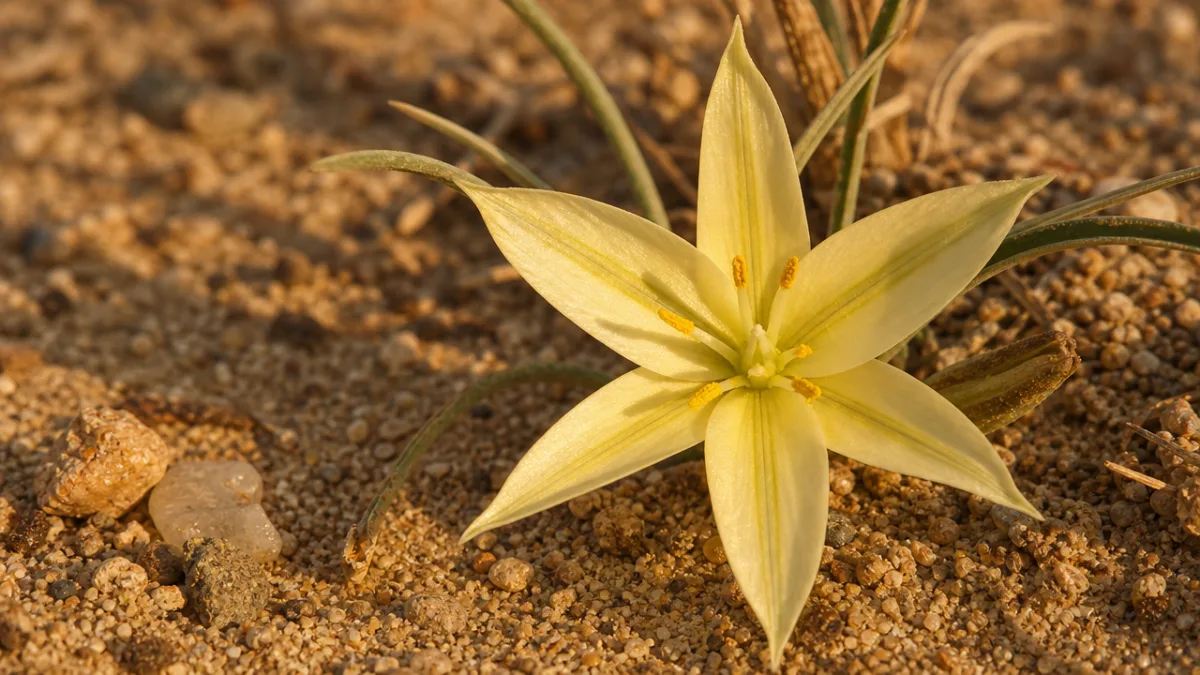
And then there are the flowers, which are the whole reason people seek this plant out. Five broad, elliptical petals open up creamy white to pale yellow, with a slight sheen that really catches the light. A fully open blossom can span up to 4 centimeters across, with a spray of stamens at the center that gives it that classic starburst look. The ring of bracts at the base — the involucre — frames each flower like a little collar. One more interesting detail: the flowers typically open in the late afternoon and into the evening, which hints strongly that moths or other night-flying insects are doing the pollinating.
- Family: Loasaceae (Blazing Star or Stickleaf family)
- Height: 15–60 centimeters
- Stem: Pale, with stiff barbed hairs
- Leaves: Alternate, lance-shaped, deeply lobed, grayish-green
- Flowers: 5-petaled, creamy white to pale yellow, up to 4 cm across
- Bloom time: Late winter through spring (January–May)
- Fruit: Cylindrical capsule containing numerous seeds
Habitat, Range, and Ecological Role
This plant is deeply at home in sandy, well-drained desert terrain — the kind of open washes, alluvial fans, and disturbed roadsides you find throughout the Sonoran and Mojave Desert regions. It mostly stays below 1,000 meters elevation, where it’s warm, dry, and the soil is predominantly sand or gravel. One thing worth knowing about Mentzelia involucrata is that it’s a natural pioneer: when soil gets disturbed, this plant is often among the first to show up and start growing. That makes it a small but meaningful player in desert ecosystem recovery.
In the US, the Sand Blazing Star ranges across much of California’s desert counties — San Diego, Riverside, Imperial, and San Bernardino among them — and continues south through the Baja California Peninsula in similar arid conditions. What makes it particularly valuable ecologically is its early bloom window. Flowering from late winter into early spring, it offers nectar at a time when there simply aren’t many other options for native bees, beetles, and moths. Being an early-season food source in the desert is no small thing.
Its contributions don’t stop at pollination. The root system helps hold sandy soil in place, reducing wind erosion in spots that are already pretty vulnerable. The seeds, packed into cylindrical capsule fruits, get eaten by small rodents and seed-eating birds. And those barbed hairs that make the plant cling to everything? Beyond spreading seeds, they may also discourage browsing animals, letting the plant put more energy toward reproducing rather than regrowing eaten foliage. It’s a well-adapted little plant in a demanding place.
Bloom Season and Desert Wildflower Context
The Sand Blazing Star blooms from January through May, with peak flowering typically landing in February and March across most of its California range. That puts it right at the front of California’s famous desert wildflower season — one of the most spectacular natural events in North America when the winter rains cooperate. In a good year, desert valleys fill with color in ways that are hard to fully describe until you’ve seen them. Mentzelia involucrata isn’t the carpet-forming kind like goldfields or poppies, but individual plants scattered through a wash add their own quiet presence to the whole scene.
How well the Sand Blazing Star blooms in any given year comes down almost entirely to winter rainfall. It needs enough soil moisture to germinate and get established, but once it’s rooted, it can handle the increasing dryness that comes as spring pushes toward summer. In a drought year, you might not see it at all in spots where it’s usually abundant — that boom-and-bust pattern is just part of life for desert annuals. The seeds, though, are patient. They can sit in the soil for years, waiting for exactly the right combination of warmth and moisture before deciding it’s time to grow.
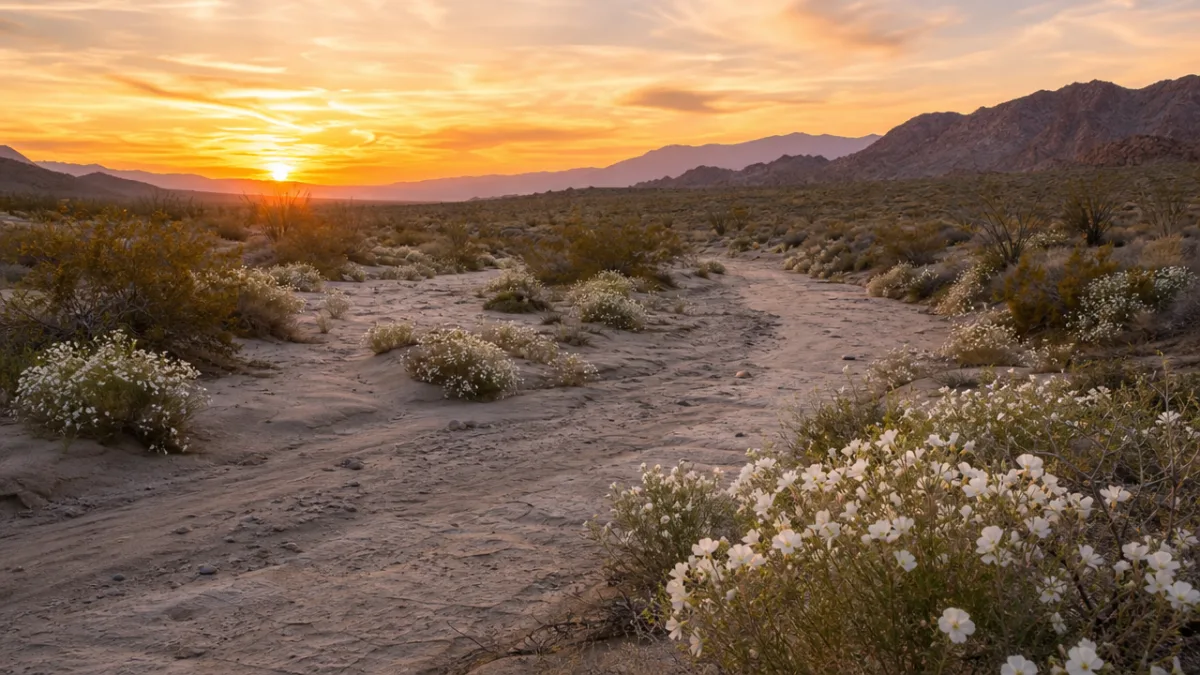
If you want to find Mentzelia involucrata in bloom, plan around wet winters and aim for late winter or early spring. Anza-Borrego Desert State Park in San Diego County is one of the most reliable spots in California — the extensive sandy wash systems there are close to ideal habitat. Time your visit for late afternoon if you can. The flowers open most fully toward evening, and the way the pale petals catch that low desert light is genuinely something special.
Cultural History and Ethnobotanical Significance
The Mentzelia genus has a long history of human use across the American Southwest and Mexico. Documentation specific to Mentzelia involucrata is a bit thinner than for some of its relatives, but the plant belongs to a genus that desert communities clearly valued. The Cahuilla people of Southern California, for example, made use of various Mentzelia species for food, medicine, and practical purposes. The seeds of several blazing stars are edible and nutritious — they could be ground into meal or eaten whole, offering a meaningful calorie source in landscapes where edible plants weren’t always easy to come by.
On the medicinal side, related species have been used across the Southwest for everything from rheumatism and skin conditions to fevers and general pain relief. The specific ethnobotanical uses of Mentzelia involucrata aren’t as thoroughly recorded as those of species found farther east and inland, but it would be surprising if the people who lived within its range overlooked it entirely. Ethnobotanical research is still actively working to document Indigenous plant knowledge before more of it is lost, and there may be more to learn about this particular species yet.
Today, the Sand Blazing Star has a quieter kind of cultural presence — it shows up in wildflower guides, nature photography, botanical art, and the enthusiasm of native plant gardeners who want to work with species that actually belong in their region. It’s not the kind of plant that makes headlines, but it steadily earns fans among people who take the time to look closely at what’s growing in California’s deserts. That growing awareness, even if it’s niche, feeds into broader public support for protecting the wild places where plants like this one still thrive.
Conservation, Threats, and the Future of Desert Wildflowers
The good news is that Mentzelia involucrata isn’t currently threatened or endangered, and its knack for colonizing disturbed ground gives it more flexibility than many desert specialists. The less good news is that the ecosystem around it is under real pressure. Climate change is probably the biggest long-term concern — if winter rain patterns shift and become less reliable, the desert annuals that depend on those rains to trigger germination are going to struggle. Warmer, more erratic winters could quietly reshape which plants show up and how many of them do, year after year.
Habitat loss is an ongoing problem too. Desert areas across Southern California and Baja California keep losing ground to urban expansion, and off-road vehicles can compact and churn up the sandy soils that the Sand Blazing Star calls home. Invasive plants — especially annual grasses introduced from other continents — are another serious issue, crowding out native species by competing aggressively for the small amounts of moisture and nutrients available. Invasive buffelgrass in the Sonoran Desert gets a lot of attention for this reason, though it tends to hit slightly different elevations and temperature zones than where Mentzelia involucrata typically grows.
The things that help this plant and its neighbors are largely the things you’d expect: protecting and properly managing large desert reserves like Anza-Borrego, Joshua Tree National Park, and BLM lands throughout the California desert. Public education about how desert wildflowers work — including why winter rain timing matters so much and why staying on designated trails isn’t just a rule but actually makes a difference — builds the kind of support that makes protective policies stick. Citizen science wildflower monitoring programs are genuinely useful here too, generating the long-term data that researchers need to track how these plant communities are changing over time.
- Support the establishment and funding of desert nature reserves and protected areas.
- Avoid off-road vehicle use in sensitive sandy wash habitats during bloom season.
- Participate in citizen science wildflower monitoring and reporting programs.
- Plant native desert species in appropriate regional landscapes to support pollinators.
- Advocate for policies that address climate change and its effects on arid ecosystems.
- Practice Leave No Trace principles when visiting desert wildflower sites.

Growing and Appreciating Mentzelia involucrata
There’s growing interest among native plant gardeners in bringing California desert annuals into their own landscapes, and Mentzelia involucrata is one worth considering if you’re in the right climate. For gardeners in Southern California’s low desert regions, it can be grown from seed sown directly into sandy, well-drained soil in autumn. Don’t bury the seeds deeply — surface sowing or barely covering them works best, since they need light to germinate well. Once the plants get going, they’re remarkably tough and need very little supplemental water, which makes them a practical as well as beautiful choice for anyone trying to garden responsibly in a dry climate.
That said, the most memorable way to experience the Sand Blazing Star is still out in the desert where it belongs. Planning a wildflower trip to California’s deserts takes some flexibility — bloom timing swings considerably from year to year depending on rainfall — but the Theodore Payne Foundation and the California Native Plant Society both keep wildflower hotlines and online bloom reports updated during the season, which takes a lot of the guesswork out of it. If you can time a late-afternoon visit to a sandy wash when the flowers are fully open and the light is going golden, you’ll understand pretty quickly why people make a point of seeking this plant out.
Whether you come across it on a dusty roadside or crouch down to photograph it at sunset, Mentzelia involucrata has a way of rewarding the attention you give it. The barbed hairs that hitchhike seeds across the desert, the flowers that time their opening to the evening light — every detail reflects an elegance that comes from a very long time spent solving the puzzle of how to live in a difficult place. As the pressures on desert ecosystems keep building, plants like the Sand Blazing Star are a good reminder of what’s at stake and why these landscapes are worth fighting to protect.








What do you think?
It is nice to know your opinion. Leave a comment.