










Handmade Crochet Fingerless Gloves with Star Detail: The Ultimate Guide to Gothic Streetwear Arm Warmers
The Art and Appeal of Handmade Crochet Fingerless Gloves
In a fashion landscape increasingly dominated by mass production and algorithmic trends, handmade crochet fingerless gloves stand as a powerful statement of individuality and craft. These are not merely accessories — they are wearable art, shaped stitch by stitch from yarn and intention. The fingerless glove format has experienced a remarkable resurgence in recent years, moving fluidly between punk revival aesthetics, gothic streetwear, and cozy cottage-core sensibilities. What makes them so enduringly appealing is their ability to occupy multiple style worlds simultaneously without belonging entirely to any single one.
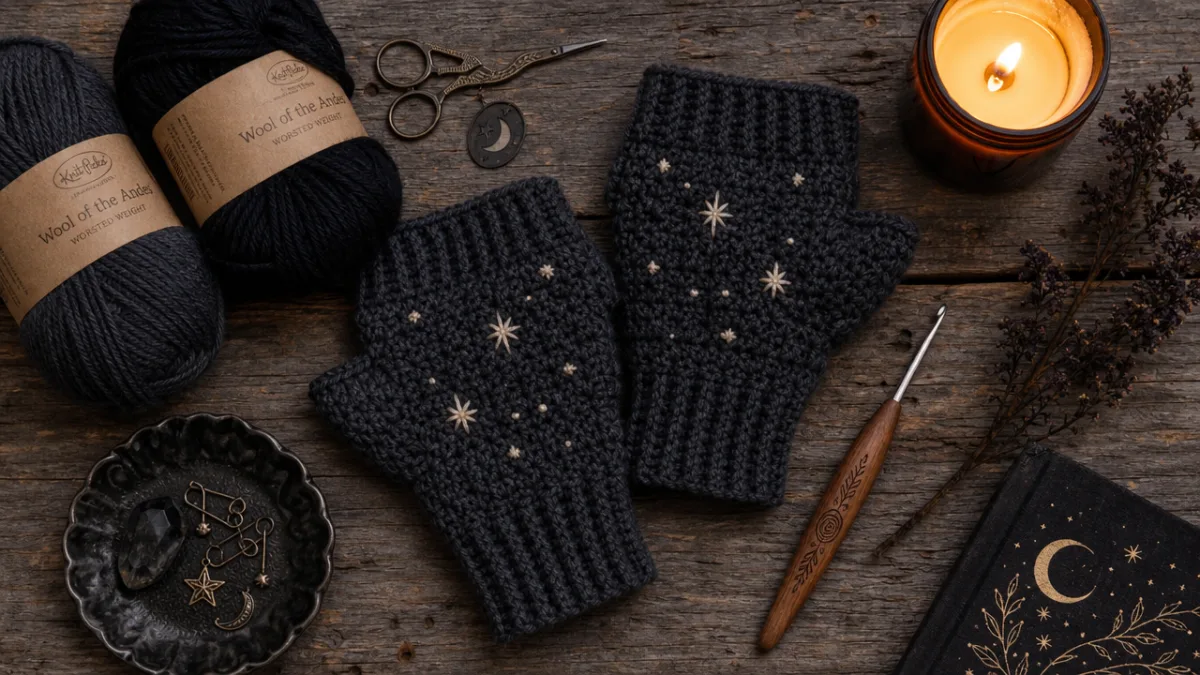
The star detail that defines this particular style elevates the design far beyond a simple hand-warmer. Stars carry centuries of symbolic weight — they appear in mystical traditions, medieval heraldry, punk iconography, and celestial romanticism alike. When rendered in crochet against a dark background, a star motif creates a striking visual contrast that is at once bold and delicate. The textured depth of the crocheted fabric adds dimensionality that printed or embroidered designs simply cannot replicate, making each pair feel genuinely singular rather than replicated from a template.
There is also something deeply satisfying about wearing an item that someone made specifically for human hands. Machine-manufactured gloves are sized to statistical averages; handmade gloves can be tailored to the actual dimensions of the wearer’s palm and wrist. This customizability is a significant part of what draws people to handmade accessories in the first place, and the gothic streetwear community in particular has long valued pieces that feel personal, intentional, and impossible to replicate on a fast-fashion budget. Crochet fingerless gloves check every one of those boxes with remarkable elegance.
Why Fingerless? The Functional Case for an Iconic Design
The fingerless design is not simply an aesthetic choice — it solves a real problem that anyone who has tried to use a smartphone, play guitar, sketch in a journal, or type on a keyboard while wearing gloves has encountered. Full gloves, however beautiful, create an immediate barrier between the wearer and the tactile world. Fingerless gloves preserve warmth across the wrist and palm — the areas most vulnerable to cold — while leaving the fingertips free to interact with the environment. For anyone who works in creative fields or spends long hours at a desk, this distinction is genuinely meaningful.
From a style perspective, the exposed fingertips create a visual contrast that photographers and fashionistas have appreciated for decades. Dark nails against pale knuckles framed by an intricate crochet cuff make for a striking image. The interplay between the structured textile and the organic contours of the hand draws the eye in a way that fully covered gloves cannot. It is a design that invites attention to the hands specifically — which, for musicians, artists, and performers, makes a great deal of expressive sense.
In the gothic and alternative fashion communities, fingerless gloves have long served as something of a signature accessory. They appear consistently across subgenre lines — from Victorian-inspired goth to industrial to nu-metal and beyond — suggesting that their appeal is rooted in something more universal than any particular aesthetic moment. Their continued relevance across decades of evolving subcultural fashion is a testament to a design that genuinely works, both functionally and visually, across an extraordinary range of contexts and body types.
Gothic Streetwear Aesthetics: Understanding the Style Context
Gothic streetwear is a hybrid aesthetic that emerged at the intersection of traditional gothic subculture and contemporary urban fashion. Unlike classical goth, which often reaches toward Victorian or medieval references, gothic streetwear is firmly rooted in the present — it draws on skatewear silhouettes, sneaker culture, and the visual language of modern cities while maintaining the dark color palettes, celestial symbolism, and subcultural attitude of its gothic roots. Oversized hoodies sit alongside platform boots; silver chain jewelry accompanies cropped mesh tops. It is an aesthetic defined by contrast and by the willingness to juxtapose references that do not obviously belong together.
Within this context, handmade accessories carry particular cultural cachet. Gothic streetwear has always had a strong DIY element — the original punk and goth scenes were built on homemade zines, self-constructed outfits, and customized thrift-store finds. That DIY spirit translates directly into appreciation for handmade crochet pieces. A pair of star-detail fingerless gloves signals something important about the wearer: that they value craft over convenience, that they have sought out (or created) something beyond the reach of ordinary retail, and that they understand and participate in a tradition of making and wearing alternative fashion with intention.
The star motif connects gothic streetwear to one of its most persistent visual themes: celestial imagery. Stars, moons, planets, and cosmic symbols appear throughout alternative fashion in ways that have only intensified in recent years. This imagery functions as a kind of visual shorthand for values the community holds dear — mystery, vastness, the beautiful indifference of the universe, and the human impulse to find meaning in darkness. A crocheted star on a black glove distills all of that symbolism into something small enough to wear on your wrist, which is precisely why it works so well as a design element.
How to Style Crochet Arm Warmers in Everyday Looks
One of the greatest strengths of crochet fingerless gloves is their versatility as a styling element. They can function as a focal point in a minimal outfit or as a finishing detail in a heavily layered look. For a streamlined gothic streetwear outfit, consider pairing them with a long black oversized coat, chunky platform sneakers, and minimal silver jewelry. The texture of the crochet provides visual interest without competing with the clean lines of the silhouette. The star detail draws the eye downward in a way that elongates the arm and creates a natural focal point at the wrist.
For those who prefer a more maximalist approach, crochet gloves layer beautifully with other textured accessories. Stacked rings on the exposed fingers complement the handcrafted quality of the gloves, while long sleeves in contrasting textures — satin, velvet, or sheer mesh — create the kind of rich visual layering that gothic streetwear does best. Arm warmers worn over fishnet sleeves are a particularly effective combination, with the open texture of the crochet revealing glimpses of the net beneath for a layered, dimensional effect that photographs extraordinarily well.
Beyond full looks, crochet fingerless gloves are effective as an elevating detail in otherwise casual outfits. Jeans, a band tee, and boots become a considered outfit with the addition of a well-chosen accessory. This is one of the most practical arguments for investing in quality handmade accessories: they do the heavy lifting of making a simple outfit feel intentional. For people who care about their aesthetic but do not have time to construct elaborate looks every day, a standout pair of gloves can carry an entire outfit’s visual interest on its own.
The Craft Behind the Creation: Crochet Techniques and Materials
Creating a pair of fingerless gloves with a star detail requires a meaningful level of crochet skill, patience, and design sensibility. The construction typically begins with a foundation chain sized to the wearer’s wrist circumference, worked in the round to create a seamless tube. The body of the glove is built up through repeated rows of stitches — most commonly a combination of single crochet, half double crochet, and double crochet — with deliberate increases and decreases shaping the piece to fit the narrowing of the wrist and the widening of the palm. A thumb gusset is integrated through careful shaping, often requiring several short rows or specific increase sequences to create the rounded opening without awkward bunching.
The star motif can be created through several different techniques, each with its own visual effect. Surface crochet — where the star is stitched onto the finished glove as a decorative element — allows for precise placement and a slightly raised, dimensional appearance. Alternatively, colorwork techniques such as tapestry crochet or intarsia allow the star to be woven directly into the fabric during construction, creating a smoother finish that is integrated rather than applied. Some makers use separately crocheted star appliqués, which are sewn onto the finished piece for a more sculptural, three-dimensional effect. Each approach produces a distinct look, and experienced makers often develop strong preferences based on the final aesthetic they are trying to achieve.
Material selection is equally important to the finished result. Many makers working in gothic or alternative aesthetics favor black merino wool or superwash wool blends for their color depth, softness, and the way they accept dye. Cotton yarns offer a different hand feel — slightly crisper and more structured — which suits warmer climates or those who prefer a less rustic texture. Acrylic blends bring durability and ease of care, which matters for accessories that will be worn regularly and frequently. Some makers incorporate metallic thread alongside the main yarn to add a subtle shimmer to the star detail, catching light in a way that reads as sophisticated rather than garish against a dark base color.
The Importance of Gauge and Sizing in Handmade Gloves
Gauge — the number of stitches and rows per inch produced by a specific yarn and hook combination — is the foundation of accurate sizing in crochet gloves. Unlike scarves or blankets, where a few extra stitches per inch merely produce a slightly larger or smaller item, gloves must fit a specific anatomical structure. A glove that is even a centimeter too tight across the knuckles becomes unwearable; one that is too loose will slide down and bunch awkwardly at the palm. Experienced makers always crochet a gauge swatch before beginning a glove project, measuring carefully and adjusting hook size as needed to match the pattern’s specified gauge precisely.
For customizable gloves sold on handmade marketplaces, the sizing process typically involves the buyer providing specific measurements: wrist circumference, palm circumference at the widest point, hand length from wrist to the base of the fingers, and sometimes thumb circumference and length. A skilled maker translates these measurements into a custom pattern, adjusting stitch counts and shaping sequences accordingly. This level of personalization is simply not possible with mass-manufactured accessories and represents one of the most compelling arguments for choosing handmade over retail, particularly for buyers who find standard sizing consistently difficult to fit.
The thumb opening requires particular attention in custom sizing. The thumb sits at a natural angle relative to the palm and its gusset must accommodate the unique way each person holds and moves their hand. Some people have proportionally longer thumbs; others have wider thumb bases. A skilled crocheter accounts for these individual variations by shaping the gusset through a carefully calibrated series of increases — typically one increase on each side of the gusset every other round — until the right width is achieved. Getting this detail right is often what separates a truly comfortable, well-fitting glove from one that technically fits but never quite feels right in wear.
Customization Options: Making Your Gloves Truly Your Own
One of the most compelling features of handmade crochet fingerless gloves from independent makers is the range of customization options typically available. Color is the most obvious starting point — while black is the defining color of gothic streetwear, many makers offer their designs in deep jewel tones (burgundy, forest green, midnight blue, plum), in high-contrast combinations (black with silver or white detail), or in completely bespoke colorways chosen by the buyer. The ability to specify a color to match an existing wardrobe piece or to complement a specific outfit is a luxury that retail simply cannot offer.
Beyond color, many makers offer choices regarding the star detail itself. The size of the star, its placement on the glove (centered on the back of the hand, positioned near the wrist, or scattered in a constellation pattern across the glove), and the technique used to create it (surface crochet, appliqué, or integrated colorwork) can all be discussed and decided in collaboration with the maker. Some buyers request additional embellishments — small bead accents at the star’s points, a simple border along the cuff edge, or a secondary motif paired with the star such as a crescent moon or lightning bolt. These collaborative conversations between maker and buyer are part of what makes purchasing handmade accessories a genuinely different experience from retail shopping.
Length is another frequently customizable dimension. Standard fingerless gloves cover the wrist and a portion of the lower palm; arm warmers extend significantly further up the forearm, sometimes reaching as high as the elbow. The extended length dramatically changes the visual effect and the styling possibilities of the accessory. Long arm warmers create a more dramatic, theatrical silhouette that reads clearly as a fashion statement; shorter wrist warmers are more subtle and integrate into everyday outfits with less visual weight. Many buyers order both lengths — one pair for everyday wear and one for occasions where a more striking aesthetic is appropriate.
Caring for Your Handmade Crochet Accessories
Handmade crochet gloves, particularly those made from natural fiber yarns like wool or cotton, require somewhat more attentive care than machine-made synthetic accessories. Wool in particular is susceptible to felting — a process of irreversible shrinkage and matting that occurs when wool fibers are subjected to heat, agitation, and moisture simultaneously. To prevent this, wool crochet gloves should always be hand-washed in cool or lukewarm water with a gentle wool-specific detergent. Squeeze gently to remove excess water without wringing or twisting, then reshape the gloves by hand and lay them flat on a clean towel to dry away from direct heat or sunlight.
Storage also matters for maintaining the shape and integrity of handmade crochet pieces. Avoid hanging crochet accessories, as the weight of the fabric stretched over time will distort the shape, particularly in the wrist and palm areas. Folding the gloves and storing them flat in a drawer or on a shelf preserves the structure much better. If the gloves feature embellishments such as beads or sewn-on appliqués, storing them loosely without compression prevents the embellishments from pressing into the fabric and distorting the surrounding stitches. A small sachet of cedar or lavender placed nearby will deter moths without the chemical smell of mothballs, which can be absorbed by natural fibers and is difficult to remove.
Pilling — the formation of small fiber balls on the surface of the fabric — is a natural occurrence with many yarns, particularly soft wool and merino blends, and should not be interpreted as a sign of poor quality. A fabric shaver or lint roller used periodically will keep the surface looking fresh and well-maintained. Small snags can usually be gently pulled through to the wrong side of the work with a crochet hook or tapestry needle without any lasting damage to the fabric. With appropriate care, high-quality handmade crochet gloves will maintain their appearance and structural integrity for years, making them a genuinely worthwhile investment compared to fast-fashion accessories that disintegrate within a single season.
Supporting Independent Makers: Why Handmade Matters
Purchasing handmade accessories from independent crochet artists is an act with meaningful economic and cultural implications. Independent makers on handmade marketplaces are typically sole proprietors or very small operations, and the income from each sale goes directly toward supporting a person’s livelihood, craft supplies, and ability to continue doing work they have chosen deliberately and with skill. Unlike purchasing from large retailers, where spend is distributed across enormous corporate supply chains with limited traceability, buying handmade connects the buyer directly to the maker — a transparency of provenance that is increasingly rare and increasingly valued.
The pricing of handmade goods often surprises buyers accustomed to retail pricing, but understanding the economics of handmade work explains the difference clearly. A pair of crochet fingerless gloves might take four to eight hours to complete, depending on the complexity of the design, the maker’s experience level, and the customizations involved. When that time is accounted for at even a modest hourly rate — far below what most skilled tradespeople charge — the resulting price reflects the actual value of skilled human labor rather than the artificially suppressed cost of factory production. Choosing handmade is, in this sense, a choice to pay people fairly for skilled work.
There is also a broader cultural argument for supporting handmade craft. Crochet, knitting, weaving, and other fiber arts are knowledge traditions with deep historical roots across many cultures. When these skills are practiced, shared, and economically supported, they remain living traditions rather than museum pieces. Many contemporary crochet artists are actively innovating within the tradition — developing new techniques, exploring unconventional materials, and pushing the aesthetic possibilities of the craft in directions that would surprise anyone who associates crochet only with grandmother’s doilies. Supporting these makers is, in a real sense, supporting the ongoing evolution of a craft form with thousands of years of human history behind it.
Finding and Commissioning the Right Maker for Your Vision
With the popularity of handmade marketplaces and social media platforms for discovering independent makers, finding the right artist for a custom commission has never been more accessible. Pinterest boards dedicated to alternative fashion, gothic accessories, and crochet design are particularly useful starting points, as they aggregate work from many makers in visually searchable formats. When evaluating a potential maker for a custom order, review their existing work closely — look for consistent stitch tension, neat finishing details, and well-shaped thumbs and cuffs in their glove designs specifically. Technique is visible in photographs if you know what to look for.
Communication before committing to a commission is essential. A good maker will ask clarifying questions about your measurements, color preferences, timeline, and intended use before beginning work. They will likely request a deposit before starting a custom project and will provide updates or progress photos at key stages of construction. Be specific about your aesthetic vision — sharing reference images, describing the outfits you plan to wear the gloves with, and noting any elements you specifically want to avoid are all helpful inputs that allow the maker to produce something genuinely aligned with your expectations rather than their interpretation of an underspecified brief.
Leaving a detailed, honest review after receiving your commission is one of the most valuable things you can do for an independent maker. The review economy on handmade marketplaces operates as a form of reputation currency — positive, specific reviews that describe the quality of the work, the accuracy of the sizing, and the responsiveness of the maker during the commission process help future buyers make confident purchasing decisions and directly support the maker’s visibility on the platform. In a marketplace where independent makers compete for attention against high-volume sellers with massive review counts, a thoughtful review from a satisfied customer carries genuine weight and contributes meaningfully to a maker’s ability to sustain their craft as a livelihood.








What do you think?
It is nice to know your opinion. Leave a comment.