










Dragon Scale Fingerless Mitts: The Ultimate Guide to Knitting a Stunning Textured Classic
Introduction to Dragon Scale Fingerless Mitts
Few knitting projects capture the imagination quite like Dragon Scale Fingerless Mitts. These remarkable accessories blend the ancient craft of hand knitting with a fantastical, almost mythological texture that makes every pair feel like something pulled from the pages of a fairy tale. Whether you are an experienced knitter looking for your next showpiece project or an intermediate crafter ready to level up your skills, dragon scale mitts offer an incredibly rewarding journey from cast-on to bind-off.
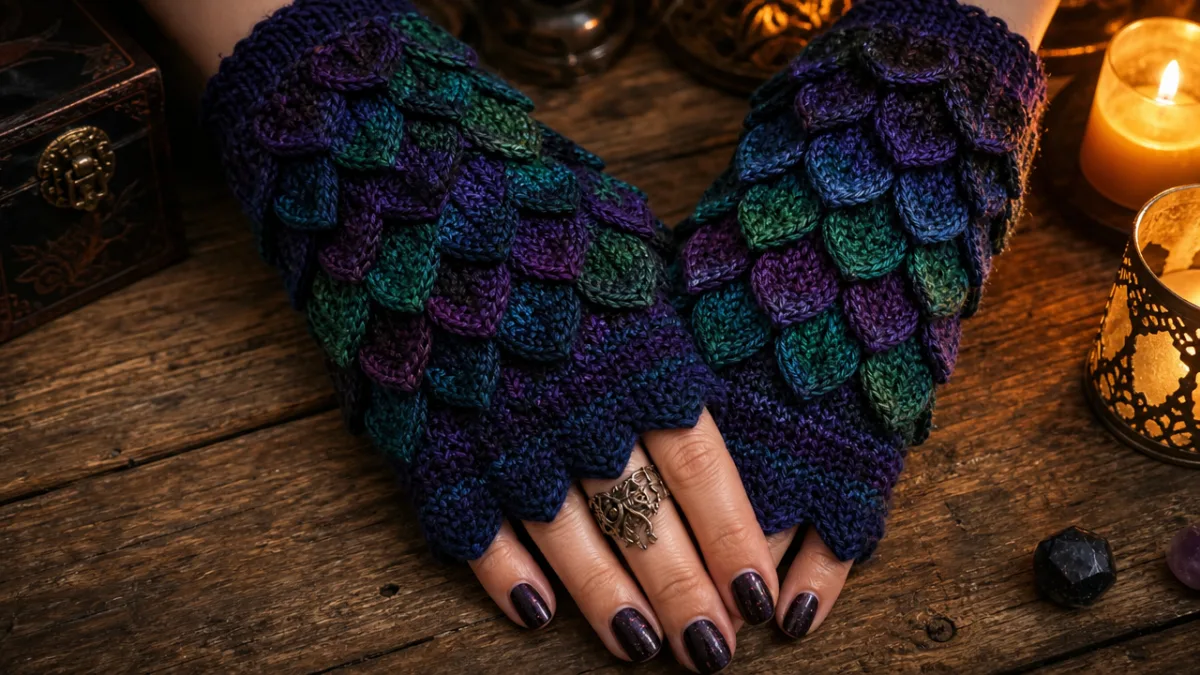
The distinctive scale pattern is achieved through a clever combination of increases, decreases, and strategic stitch placement that creates overlapping, dimensional layers across the back of the hand. When worked correctly, the finished fabric genuinely resembles the armored hide of a dragon, complete with a satisfying depth and dimensionality that flat knitting simply cannot achieve. The texture catches the light beautifully, making these mitts a true showstopper at any gathering or market.
Beyond their visual appeal, fingerless mitts are extraordinarily practical. They keep your hands and wrists warm while leaving your fingers free to type, scroll, write, and engage with the world around you. This balance of function and artistry is one reason dragon scale fingerless mitts have become one of the most pinned and shared knitting patterns on platforms like Pinterest, inspiring thousands of crafters to pick up their needles and attempt this breathtaking technique for themselves.
Understanding the Dragon Scale Stitch Pattern
Before you cast on a single stitch, it pays enormous dividends to spend time understanding the mechanics behind the dragon scale stitch. At its heart, the pattern relies on what knitters call a leaf or petal motif worked in a staggered, overlapping arrangement. Each individual scale begins as a small number of stitches that are increased outward and then decreased back down, creating a rounded, convex shape that sits proud of the background fabric. When these motifs are arranged in offset rows, they interlock and stack like true scales on a reptile.
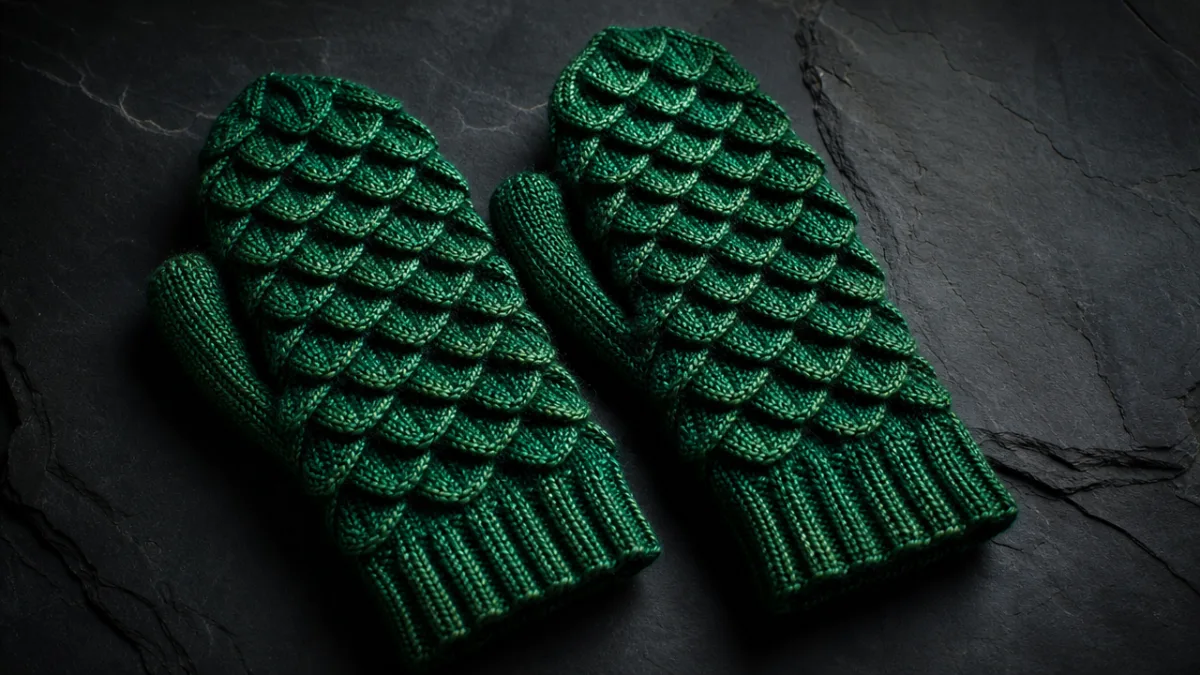
The background of the mitt is typically worked in a simple stockinette or reverse stockinette fabric, which provides a smooth, receding surface that allows the dimensional scales to pop forward visually. The contrast between the smooth background and the raised, textured scales is what creates that dramatic, three-dimensional effect. Some knitters choose to work the background in a slightly contrasting color to further emphasize the depth, while others prefer a tonal approach for a more subtle, sophisticated look.
It is important to note that the dragon scale pattern does not behave like standard flat knitting. Because of the extra stitches created by the increases and then removed by the decreases, the stitch count on your needle will fluctuate significantly as you move through each scale row. This is completely normal and intentional. Keeping a stitch marker at the beginning of each scale group will help you stay oriented and ensure that each motif begins and ends with the correct number of stitches before moving on to the next repeat.
Key Stitch Techniques You Will Use
- Knit front and back (KFB) or yarn over increases to build each scale outward from its base
- Central double decreases (sl2, k1, p2sso) or paired decreases to shape the top of each scale
- Picking up and knitting stitches from the row below to anchor scales into the background fabric
- Twisted stitches through the back loop (TBL) for a tighter, neater scale edge
- Short rows in some variations to create additional curvature and depth within individual scales
Materials and Tools for Your Dragon Scale Mitts
Choosing the right yarn is perhaps the single most important decision you will make before beginning your dragon scale fingerless mitts. Because the pattern is entirely about texture and dimension, you want a yarn that will hold its shape beautifully and show off the sculptural quality of each individual scale. A smooth, plied yarn with good stitch definition is your best ally here. Yarns that are too fuzzy or halo-heavy, such as certain mohair blends, will obscure the crisp edges of the scales and leave you with a blurry, indistinct fabric rather than the crisp, architectural effect you are aiming for.
In terms of fiber content, a wool or wool-blend yarn is strongly recommended for several reasons. Wool has natural memory and elasticity, which helps the scales hold their raised, dimensional shape over time and through repeated wear. Superwash treated wool offers the added benefit of easy machine washing, which is a practical consideration for an accessory that will be worn frequently. Many knitters favor a fingering or sport weight yarn for dragon scale mitts, as the finer gauge allows for intricate, delicate-looking scales, though DK or worsted weight yarn will produce chunkier, bolder scales that work up more quickly.
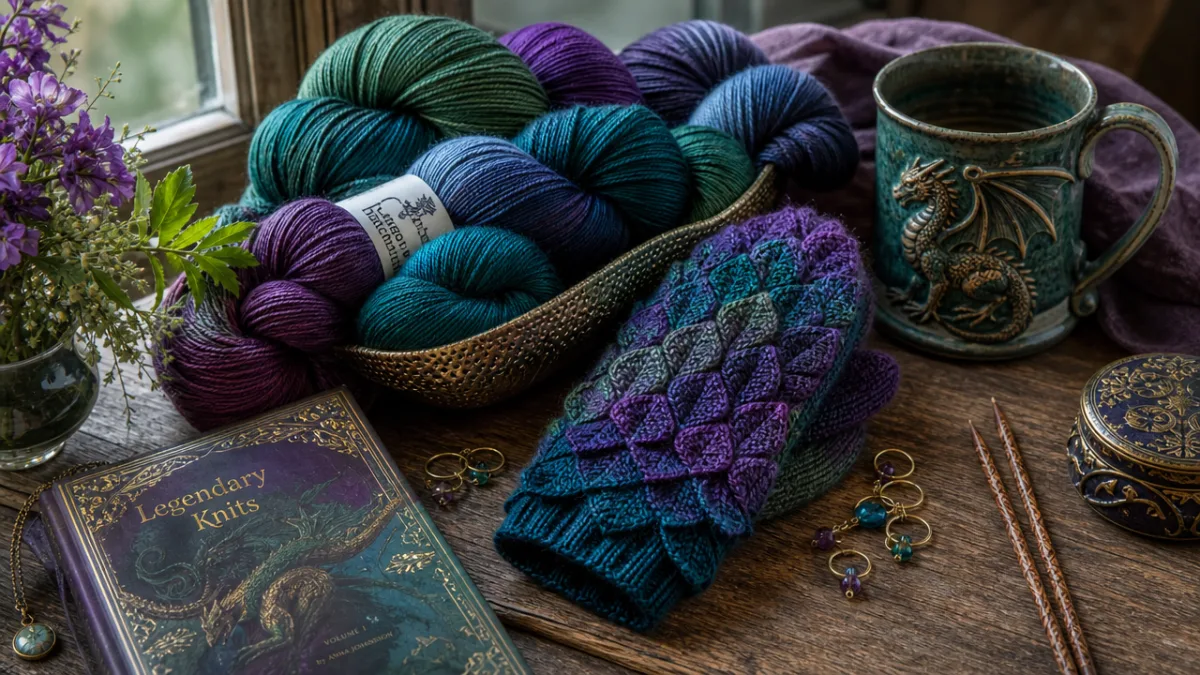
Color is another crucial consideration. Deep, saturated jewel tones — think emerald green, sapphire blue, deep burgundy, and rich purple — are perennial favorites for dragon scale mitts because they evoke the fantasy aesthetic of actual dragon hide. Variegated or hand-dyed yarns can produce spectacular results, with color transitions that move from scale to scale in unexpected and beautiful ways. Metallic thread held alongside your main yarn is a popular embellishment technique that adds a shimmering, iridescent quality to the finished fabric.
Essential Tools Checklist
- Set of double-pointed needles (DPNs) or a short circular needle in the appropriate size for your chosen yarn
- Stitch markers in two different colors — one for the beginning of round, others for scale placement
- A cable needle or spare DPN if your pattern variation requires it
- Tapestry needle for weaving in ends and seaming if necessary
- Measuring tape and a knitted gauge swatch to confirm sizing before beginning
- Scissors and a row counter to track your progress through the scale repeats
Step-by-Step Knitting Process
The construction of dragon scale fingerless mitts typically begins at the wrist cuff, which is worked in the round on double-pointed needles or a short circular needle. The cuff is often knitted in a simple 2×2 or 1×1 ribbing pattern, which provides gentle elasticity and ensures a snug, flattering fit around the wrist. The length of the cuff can be adjusted easily — a longer cuff rising partway up the forearm is especially popular for the fantasy aesthetic, providing additional warmth and a dramatic, gauntlet-like silhouette.
Once the cuff has reached the desired length, you will transition into the dragon scale body of the mitt. This is where the pattern becomes more complex and engaging. Most patterns designate specific stitches on the back of the hand as the scale field, while the palm-facing stitches continue in stockinette or a simple knit stitch. This asymmetrical approach keeps the palm smooth and comfortable against your skin while presenting the spectacular textured surface on the back of the hand where it will be seen and admired.
Working the scale rows themselves requires careful attention and a slow, methodical approach, particularly for the first few repeats while you are becoming familiar with the rhythm of the pattern. It helps enormously to work through the instructions one scale at a time rather than trying to read ahead or anticipate the next step. Many experienced knitters recommend using a printed copy of the pattern so you can mark off each completed scale and track your position in the repeat. With practice, the sequence of increases and decreases will begin to feel intuitive and the work will progress with increasing confidence and speed.
Thumb Gusset Construction
One of the most important technical elements of any fingerless mitt is the thumb gusset, and dragon scale mitts are no exception. The gusset creates the three-dimensional shaping needed to accommodate the base of the thumb comfortably, preventing the mitt from pulling across the hand or restricting movement. In most dragon scale patterns, the gusset is worked on the palm side of the mitt in a simple stockinette fabric, keeping the scale design undisturbed on the back of the hand where it belongs.
The gusset is built through a series of paired increase rows worked every two to three rounds, gradually expanding the number of stitches dedicated to the thumb opening. When the gusset has reached the appropriate width for your hand size, the thumb stitches are placed on a holder or a length of waste yarn, and the mitt body is rejoined and worked to the desired length above the thumb opening. The thumb stitches are then returned to the needles and worked for a short tube of ribbing or stockinette to finish the thumb opening neatly.
Proper fit in the thumb gusset area is critical for comfortable wear, and this is one area where swatching and measuring your own hand pays real dividends. Take careful measurements of the circumference of your hand both at the knuckles and at the base of the thumb before beginning, and compare these measurements against the finished dimensions specified in your chosen pattern. Most patterns offer multiple sizes or guidance on how to adjust the number of gusset increase rows to customize the fit for different hand shapes and sizes.
Finishing Techniques and Blocking
Finishing is where a merely good pair of dragon scale mitts becomes a truly exceptional one. Once you have worked the final bind-off row and snipped your yarn, you will need to weave in all the yarn ends left by color changes, the beginning of round, and any joins you made during knitting. With a textured pattern like dragon scales, there are often more ends than usual because each individual scale can create its own short tail, depending on how the pattern is structured. Take the time to weave each end in securely using a tapestry needle, working the tail through several inches of the surrounding fabric in different directions to prevent it from working loose with wear.
Blocking is an absolute non-negotiable step for dragon scale fingerless mitts, and it is the single technique that most dramatically transforms the finished object. Before blocking, the scales may appear slightly bunched, uneven, or flattened by the tension of working the increases and decreases. Wet blocking — soaking the finished mitts in cool water, gently pressing out excess moisture in a towel, and then pinning each scale individually to shape on a foam blocking mat — opens up the fabric, evens out the stitches, and allows each scale to settle into its proper raised, rounded shape.
Pinning dragon scale mitts during blocking requires patience and a generous supply of blocking pins. Each scale should ideally be pinned at its tip and at its two lower corners to hold it in the fully opened, rounded position as the fabric dries. The effort is absolutely worthwhile: once dry and unpinned, the scales will have set beautifully in their dimensional position and the overall fabric will have a professional, polished appearance that is truly breathtaking. Many knitters photograph their blocked-but-unpinned mitts specifically because this is the moment when the full impact of the dragon scale texture is most visible and dramatic.
Care Instructions for Your Finished Mitts
- Hand wash gently in cool water with a wool-safe detergent to preserve the fiber’s elasticity and the scales’ dimensional shape
- Never wring or twist the wet fabric; instead press gently between dry towels to remove excess moisture
- Re-block lightly after each wash if needed to restore the full dimensionality of the scale pattern
- Store flat rather than folded to prevent permanent creasing of the textured surface
- Avoid prolonged exposure to direct sunlight, which can fade even the deepest jewel-tone dyes over time
Customization and Creative Variations
One of the greatest joys of the dragon scale fingerless mitt pattern is its extraordinary flexibility as a creative canvas. Once you have mastered the basic scale construction technique, you are free to begin experimenting with modifications that make your mitts truly unique. Colorwork is one of the most popular avenues of customization: by working the scales themselves in a contrasting color against the background fabric, you can create a two-toned effect that emphasizes the architectural quality of the pattern and produces a result that looks far more complex than it actually is to knit.
Scale size is another variable that can be adjusted to dramatic effect. Standard dragon scale patterns produce scales of a fairly uniform medium size, but it is entirely possible to work larger scales by increasing the number of stitches in each motif, or smaller, more delicate scales by reducing them. Some adventurous knitters combine multiple scale sizes in a single pair of mitts, working larger scales across the center of the hand and smaller scales along the edges for a tapered, organic effect that mimics the way real reptile scales vary in size across different parts of the body.
Embellishment opens up yet another world of creative possibility. Beads threaded onto individual scales before they are worked can produce a stunning jeweled effect, particularly when glass seed beads in iridescent or metallic finishes are used against deep-colored yarn. Embroidery added after the knitting is complete — tiny French knots at the tip of each scale, or fine metallic thread couched along the scale outlines — can push the fantasy aesthetic even further and create a pair of mitts that feels genuinely precious and heirloom-worthy.
Popular Variations to Explore
- Full gloves with knitted fingers worked in the round using the same scale technique on the back of each finger
- Arm warmers and gauntlets extending to the elbow for dramatic cosplay or fantasy-inspired fashion wear
- Matching dragon scale hat or cowl worked in the round to create a coordinated accessory set
- Asymmetrical mitts with scales covering only one side of the hand for a more wearable, everyday aesthetic
- Baby and child versions scaled down in size, offering a beginner-friendly way to practice the technique before committing to a full adult pair
Community, Resources, and Next Steps
The dragon scale knitting community is vibrant, generous, and genuinely enthusiastic about sharing knowledge with newcomers. Platforms like Ravelry host hundreds of individual pattern variations for dragon scale fingerless mitts, ranging from completely free patterns shared by indie designers to polished, professionally photographed paid patterns with detailed photo tutorials and video support. Searching Ravelry’s pattern database for “dragon scale mitts” or “dragon scale fingerless gloves” will yield an extensive and inspiring collection of options suitable for every skill level and aesthetic preference.
YouTube is another invaluable resource for visual learners tackling the dragon scale technique for the first time. Numerous experienced knitters have posted detailed, step-by-step video tutorials specifically covering the scale construction method, and watching the increases and decreases worked in real time can make the written pattern instructions click into place in a way that reading alone sometimes cannot achieve. Many of these tutorial creators also host active comment sections and social media communities where you can post questions, share works in progress, and receive encouragement from fellow crafters around the world.
Once you have completed your first pair of dragon scale fingerless mitts, the sense of accomplishment is difficult to overstate. These are not quick, mindless projects — they demand attention, patience, and a willingness to learn new techniques and sit with the discomfort of unfamiliarity. But the finished object you hold in your hands at the end of that process is something genuinely extraordinary: a wearable piece of textile art that demonstrates real skill, creativity, and dedication to the craft. Many knitters report that their first pair of dragon scale mitts marks a clear turning point in their relationship with knitting, opening the door to an entire world of dimensional, sculptural techniques that transform yarn and needles into something that feels almost like magic.
Skill Building Progression
- Begin by swatching the scale stitch in flat knitting to understand the increase and decrease sequence without the complexity of working in the round
- Practice the gusset technique separately on a simple tube of stockinette before incorporating it into the full pattern
- Work a small swatch in the round on DPNs to become comfortable with managing the fluctuating stitch count across multiple needles
- Complete your first full pair using a single solid color yarn to keep the stitch-reading as clear as possible while you learn
- Experiment with colorwork, embellishment, and size variations on subsequent pairs as your confidence and skill grow
The world of dragon scale knitting is waiting for you. Pick up your needles, choose a yarn that makes your heart sing, and take the first step into one of the most rewarding knitting adventures available to any crafter willing to embrace a little complexity in pursuit of something truly beautiful. Your hands — and everyone who sees them — will thank you for it.








What do you think?
It is nice to know your opinion. Leave a comment.