










The Enchanting World of Walnut Shell Doll Houses: Tiny Libraries and Miniature Worlds Inside Nature’s Perfect Vessel
The Ancient Art of Miniature Worlds: A Brief History
Long before the age of mass-produced toys and digital entertainment, artisans across cultures discovered something almost magical about creating entire worlds in miniature. The human fascination with tiny, detailed replicas of everyday life stretches back thousands of years, with evidence of miniature objects found in ancient Egyptian tombs, Roman households, and medieval European courts. These tiny creations were not merely playthings but representations of aspiration, craftsmanship, and the deeply human desire to hold an entire world within the palm of one’s hand.
Among the most intimate and charming expressions of this tradition is the walnut shell doll house — a form of miniature art that transforms one of nature’s most structurally perfect objects into a vessel for extraordinary imagination. A walnut shell, with its two symmetrical halves and richly textured exterior, presents itself almost as a ready-made tiny room waiting to be furnished and inhabited. Craftspeople who work with walnut shells often describe a feeling of collaboration with nature, as though the shell itself is already halfway to becoming something wonderful.
The tradition of crafting miniature scenes inside walnut shells gained particular prominence in Victorian England, where elaborate shell scenes were exchanged as tokens of affection and displayed in curio cabinets alongside other wonders of the natural world. Ladies of leisure and professional craftspeople alike would spend hours creating impossibly detailed furniture, bedding, and tiny figures to nestle inside these natural enclosures. Today, contemporary artisans are revisiting and reinventing this tradition, bringing with them modern tools, new materials, and a global community of miniature enthusiasts who share their work online, inspiring countless others to pick up tweezers and tiny brushes and try their hand at this meditative craft.
The Walnut Shell as Nature’s Perfect Miniature Architecture
There is something profoundly satisfying about the walnut shell as a material choice for miniature making, and it is not merely aesthetic. The shell itself is an engineering marvel — two perfectly matched halves that lock together with surprising precision, creating a protective enclosure that has kept the delicate nut within safe through seasons of weather, animal activity, and the general rough-and-tumble of the natural world. When an artisan cracks a walnut carefully and deliberately, preserving both halves intact, they are working with a material that has already demonstrated extraordinary structural integrity. The interior cavity, once cleaned of its nut, offers a smooth, gently curved surface that functions almost like a tiny room with an arched ceiling.
The dimensions of a typical English walnut shell are remarkably consistent, generally ranging between four and five centimeters in length, which creates a creative constraint that many miniature artists find liberating rather than limiting. Every element placed inside must be considered carefully: a tiny sofa, a minuscule stack of books, a microscopic lamp, a woven rug no larger than a thumbnail. This enforced economy of scale demands an extraordinary level of planning and intentionality. Nothing can be included that does not serve the composition, and every element must earn its place within the tiny world being constructed.
Beyond its practical dimensions, the walnut shell brings an irreplaceable aesthetic quality to any miniature scene created within it. The exterior of the shell, with its deep brown furrowed surface and organic asymmetry, creates a beautiful contrast with whatever carefully crafted interior world lies hidden within. When the two halves are opened to reveal a tiny library, a miniature bedroom, or a fairy’s living room, the effect is one of genuine surprise and delight — a reminder that extraordinary things often hide inside humble exteriors. Many artists choose to leave the exterior of the shell completely natural, allowing the roughness of nature to frame the smoothness and precision of their handmade interior.

Creating the Miniature Library: Books, Shelves, and the Architecture of Knowledge
Of all the tiny worlds that artisans choose to create within walnut shells, perhaps none is more beloved or more visually compelling than the miniature library. There is something deeply poetic about the idea of a library within a library — the walnut itself, after all, is sometimes called the “brain nut” for the way its interior resembles the folds of human gray matter, that original repository of all knowledge and memory. To fill this natural vessel with tiny books, reading chairs, and shelves lined with minuscule volumes is to create a layered metaphor about knowledge, enclosure, and the infinite worlds that exist within the finite space of a single story.
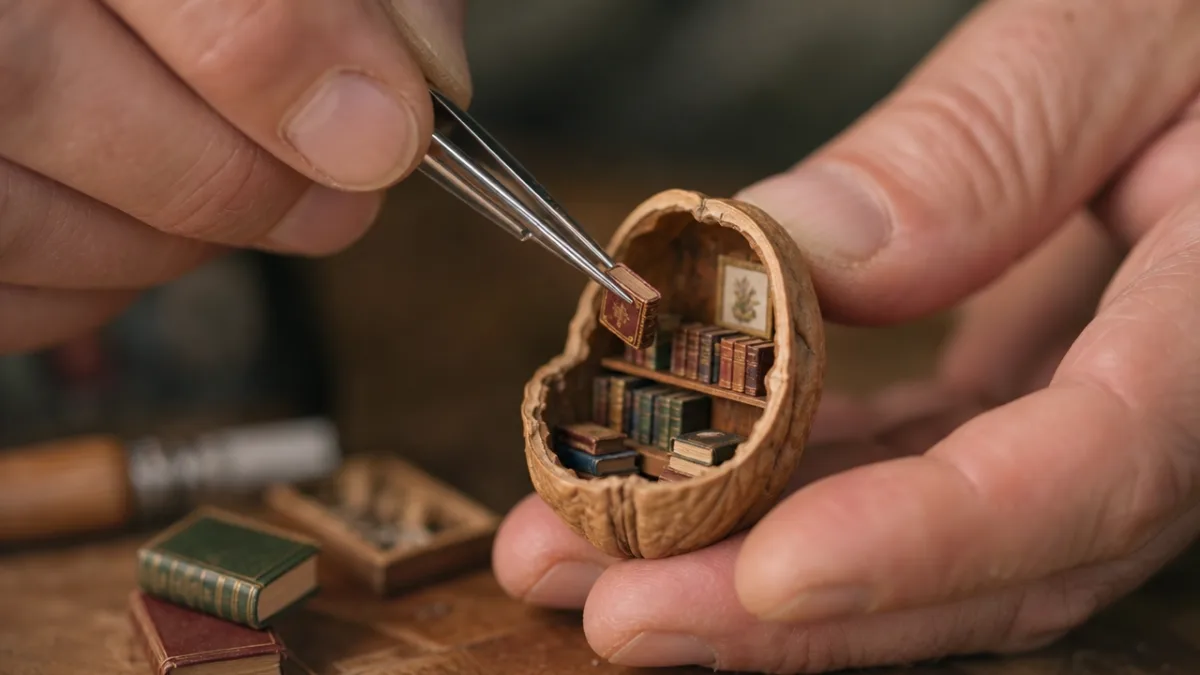
Crafting the books themselves is one of the most technically demanding and rewarding aspects of creating a walnut shell library. Skilled miniaturists use several techniques to create convincing tiny tomes, including folding and cutting painted paper into book-shaped forms, using polymer clay to sculpt and paint individual volumes complete with titles on their spines, or even printing microscopic text onto cardstock before assembling each little book by hand. The spines of these books, arranged on shelves no wider than a finger, are often painted in jewel tones — deep burgundy, forest green, midnight blue, and warm amber — creating the kind of rich, saturated palette that evokes the atmosphere of a beloved old library.
The shelving itself presents its own creative challenges within such a confined space. Artisans typically use balsa wood, toothpicks, popsicle sticks, or even cardboard painted to resemble wood grain to construct the tiny bookcases that line the interior walls of the shell. Some artists create curved shelves that follow the natural arc of the shell’s interior, while others prefer to create flat-backed cases and fill the remaining space with a tiny reading chair, a miniature desk with a lamp made from a bead and a pin, or even a tiny fireplace constructed from sculpted clay and painted brick by tiny painted brick. A magnifying glass is often a necessary tool both for the maker during construction and for the viewer upon examination.
- Tiny books can be made from folded paper, polymer clay, or even printed miniature covers wrapped around matchstick-sized paper blocks, each one painted with individual detail including readable spine titles in the finest possible script.
- Shelving units are typically constructed from balsa wood, thin cardboard painted with wood-grain texture, or repurposed wooden coffee stirrers carefully cut and sanded to achieve smooth, even edges.
- Lighting effects are achieved using tiny LED fairy lights, warm amber nail art gems, or carefully placed metallic beads that mimic the glow of candlelight or a tiny desk lamp.
- Flooring within the shell is often created using painted paper patterned to resemble hardwood planks, Persian carpet designs, or even tiny mosaic tiles made from cut pieces of decorative scrapbook paper.
- Decorative details such as miniature globes, potted plants made from green clay, framed artwork no larger than a grain of rice, and tiny ladders leaning against bookshelves complete the sense of an inhabited and loved space.
What elevates a miniature library from a charming novelty to a genuine work of art is the quality of storytelling embedded within its tiny details. The best walnut shell libraries tell a story about their imaginary inhabitant — perhaps a stack of books left open on the tiny desk suggests a scholar in the middle of research, or a miniature teacup placed on a side table implies a reader who has just stepped away for a moment and will return. These narrative details transform the static miniature scene into something dynamic and alive, inviting the viewer to imagine the tiny person who calls this infinitesimal library home.
Tools, Materials, and Techniques for Walnut Shell Miniature Making
The craft of walnut shell miniature making sits at a fascinating intersection of disciplines, drawing on skills from model making, jewelry crafting, painting, carpentry, textile arts, and even food decoration. A practitioner need not be expert in all of these areas to begin, but a willingness to learn and experiment with a wide variety of materials and techniques is essential. Many experienced miniaturists describe their practice as one of constant discovery, finding unexpected uses for everyday materials and learning new skills with each project they undertake.
The foundational tools for walnut shell miniature making are surprisingly accessible, though their application requires considerable patience and a steady hand. A quality set of fine-tipped tweezers — ideally both straight and curved varieties — is perhaps the single most important tool in any miniaturist’s kit, allowing the placement and adjustment of elements too small to be handled safely with fingertips. A craft knife with a fine blade, precision scissors, a set of tiny paintbrushes including sizes 0000 and even smaller, and a good magnifying glass or visor loupe round out the essential toolkit. Many artisans also use dental tools, which offer the perfect combination of fine tips and ergonomic handles for working at miniature scale.
Materials for walnut shell miniatures span an enormous range, from the humble and inexpensive to the specialized and occasionally precious. Common household materials that find new purpose in miniature making include toothpicks and cocktail sticks for structural elements, fabric scraps for upholstery and soft furnishings, seed beads and costume jewelry findings for decorative details, and air-dry clay or polymer clay for sculpting furniture, pottery, food items, and figures. Specialist materials available through miniature and dollhouse suppliers include scale lumber cut to specific dimensions, printed miniature wallpapers and flooring, tiny hinges and hardware, and even scale-accurate light fixtures connected to hair-fine wire and a small battery pack.
- Begin by carefully cracking your walnut using a nut cracker positioned at the seam, working slowly to preserve both halves intact. Clean the interior thoroughly, removing all traces of the nut and the papery membrane.
- Sand the interior of both halves lightly with fine-grit sandpaper to create a smooth surface that will accept glue and paint more readily, then apply a base coat of paint in your chosen wall color using a fine brush.
- Plan your scene on paper before beginning construction, making a simple sketch that establishes where furniture will be placed and what decorative elements will be included, keeping careful track of scale.
- Build larger structural elements such as shelving and flooring first, allowing each piece to dry completely before adding the next layer, working from the back of the shell toward the front.
- Add furnishings and larger decorative elements next, securing each piece with a small amount of strong craft glue or jewelry adhesive, adjusting placement with tweezers before the glue sets.
- Complete the scene with the finest detail work last, including tiny books on shelves, decorative objects, lighting effects, and any textile elements such as miniature rugs or cushions.
- Finish by adding any exterior decoration to the shell itself, which might include a tiny hinged mechanism, painted designs on the outer surface, or a small handle or clasp to keep the two halves together.
The Community and Culture of Miniature Art Worldwide
The global community of miniature artists and enthusiasts is a vibrant, generous, and deeply creative one, connected increasingly through social media platforms and online marketplaces that allow artisans from every corner of the world to share their work and find appreciative audiences. What might once have been a solitary hobby practiced in relative isolation has become a richly interconnected community of practice, with miniaturists from Japan, the United States, the United Kingdom, Russia, Brazil, and dozens of other countries exchanging techniques, celebrating each other’s work, and collaborating on shared projects. The walnut shell miniature has become a particular favorite for sharing on visual platforms, where its dramatic scale and rich detail photograph beautifully and inspire extraordinary engagement.
The culture surrounding miniature art is characterized by an unusual combination of fierce technical ambition and warm collaborative spirit. Unlike some craft communities where knowledge and technique are guarded, miniaturists tend to be remarkably open about their methods, sharing tutorials, responding to questions from beginners, and actively encouraging newcomers to attempt increasingly complex projects. This generosity of knowledge has contributed significantly to the rapid growth of the craft in recent years, with many practitioners crediting a specific artist or tutorial video they encountered online as the beginning of their miniature journey. The community has also developed its own vocabulary, aesthetic standards, and historical canon, with certain legendary miniaturists celebrated for their extraordinary technical achievements.
Professionally, walnut shell miniatures occupy an interesting position in the art market, appreciated both as collectible craft objects and as genuine artworks commanding significant prices when created by recognized makers. The most accomplished walnut shell artists can spend dozens of hours on a single piece, and their completed works — with furniture that moves, books with readable pages, working lighting systems, and extraordinarily fine painted detail — sell for prices that reflect the true skill and time invested. At the same time, the accessibility of the craft at its most basic level means that beginners can create their first walnut shell scene with materials costing just a few dollars, creating an unusually democratic entry point into what can become a serious artistic practice.
Finding Meaning in Miniature: Why Tiny Worlds Matter in a Large World
There is a question worth asking about why miniature making, and walnut shell art in particular, resonates so deeply with so many people across such diverse cultures and circumstances. The practical answer might point to the meditative quality of the work — the intense focus required to place a tiny bookshelf inside a walnut shell occupies the mind completely, crowding out anxiety, intrusive thoughts, and the overwhelming noise of contemporary life. Many miniaturists describe entering a state of flow during their work, a condition of absorbed attention and quiet joy that is increasingly difficult to achieve in a world of constant digital interruption. In this sense, the tiny world inside the walnut shell creates a kind of mental refuge as much as a physical one.
Beyond its therapeutic value, miniature making connects practitioners to a much longer tradition of human making and craftsmanship that many people feel has been lost in an age of mass production and disposable goods. There is profound satisfaction in creating something with your own hands that could not have been produced by any machine — something that bears the unique marks of your particular skill, your personal aesthetic choices, and the hundreds of hours of practice that allowed you to place that tiny book on that tiny shelf with steadiness and precision. Each walnut shell library is irrefutably, verifiably handmade, and that fact carries a weight and meaning that no amount of manufacturing can replicate.
The miniature library specifically taps into a set of cultural associations that run particularly deep for many people. Libraries represent knowledge, sanctuary, intellectual freedom, and the accumulated wisdom of human civilization. They are places associated with childhood wonder, adult contemplation, and the transformative power of stories. To hold all of that symbolism within an object small enough to rest in your palm is to engage in a kind of visual poetry — a compression of meaning that forces the viewer to slow down, look closely, and consider what they value. In a world that often seems too large and too fast and too loud, the walnut shell library offers a counter-argument: that the most important worlds are sometimes the ones small enough to hold in your hand.
For those who receive a walnut shell miniature as a gift, the experience carries its own particular emotional resonance. Unlike a mass-produced object, a handmade walnut shell scene represents a specific and irreplaceable investment of time, attention, and care. The giver has spent hours, perhaps days, creating something that will fit in the recipient’s palm, and that disproportion between the object’s physical size and the labor it represents is itself a powerful statement of affection and esteem. It is a gift that says: I thought about what delights you, and then I made it — carefully, slowly, with my own hands — just for you.
Getting Started: Your First Walnut Shell Miniature Project
For anyone inspired to attempt their first walnut shell miniature, the most important advice is deceptively simple: begin. The craft has a steeper learning curve than it first appears, and the first attempt will almost certainly not match the polished perfection of the work that inspired the effort, but that is entirely acceptable and in fact necessary. Every accomplished miniaturist has a collection of early attempts tucked away somewhere, pieces that showed promise but also all the signs of developing skill — slightly uneven shelves, books that are a little too large for their scale, paint that bled slightly at the edges. These early pieces are not failures but evidence of growth, and they make the eventual mastery all the more meaningful.
Choosing a simple subject for a first project is strongly recommended. Rather than attempting a full library with twenty tiny books and working lighting, consider beginning with a tiny bedroom, a miniature garden scene, or even just a single beautifully furnished room with three or four carefully chosen elements. The goal at the beginning should not be complexity but rather scale consistency and neatness of execution — two skills that will serve every subsequent project. Many experienced miniaturists suggest spending time simply practicing the construction of tiny furniture pieces outside the shell before attempting to work within its confined interior, building confidence and dexterity before adding the constraints of the shell’s curvature and limited space.
The internet offers an extraordinary wealth of resources for beginning miniaturists, from step-by-step tutorial videos on platforms like YouTube to curated communities on social media where makers of all skill levels share work, ask questions, and offer encouragement. Specialist miniature making suppliers can be found online and will ship tiny materials directly to your door, while many of the most useful materials — toothpicks, small beads, polymer clay, fine brushes — are available at any craft store. The barrier to entry is genuinely low, and the potential for creative satisfaction is genuinely high. All that is required to begin is a walnut, a careful hand, and the willingness to discover what extraordinary world might be waiting inside.








What do you think?
It is nice to know your opinion. Leave a comment.