










Summer Footprint Craft: A Complete Guide to Creating Lasting Memories with Little Feet
Introduction: Why Footprint Crafts Are a Summer Tradition Worth Keeping
Summer is a season defined by warmth, freedom, and the kind of unhurried time that allows families to slow down and connect in meaningful ways. Among the many activities that parents and caregivers can share with young children during these golden months, footprint crafts stand out as one of the most cherished and enduring. There is something uniquely magical about capturing the tiny impression of a child’s foot — a snapshot frozen in paint, clay, or plaster that speaks volumes about a single moment in time.
Footprint crafts have been enjoyed by generations of families, and for good reason. They are accessible to virtually everyone, requiring minimal supplies and no prior artistic experience. Whether you are a seasoned crafter or someone who has never picked up a paintbrush, you can guide even the youngest child through the process and walk away with something genuinely beautiful. The tactile nature of the activity also makes it deeply engaging for children, who delight in the sensation of paint squishing between their toes and the surprise of seeing their own impression appear on paper.
Beyond the fun of creation, these crafts serve as a profound keepsake. Children grow with breathtaking speed, and parents often find themselves lamenting how quickly small feet become larger ones. A summer footprint craft gives families a tangible, physical record of a child at a specific age and size — something that becomes more precious with every passing year. When tucked into a memory box or framed on a wall, these simple impressions carry an emotional weight that far exceeds their modest materials.
Choosing the Right Materials for Your Summer Footprint Project
The success of any footprint craft begins long before the first foot touches paint. Selecting the right materials is essential not only for achieving a beautiful result but also for ensuring the safety and comfort of the children involved. Since feet will be coming into direct contact with paints, clays, or other mediums, it is critical to choose products that are non-toxic, skin-safe, and washable. Most craft stores stock a wide range of child-friendly options, but it is always worth reading labels carefully and doing a small patch test if you have any concerns about sensitivities.
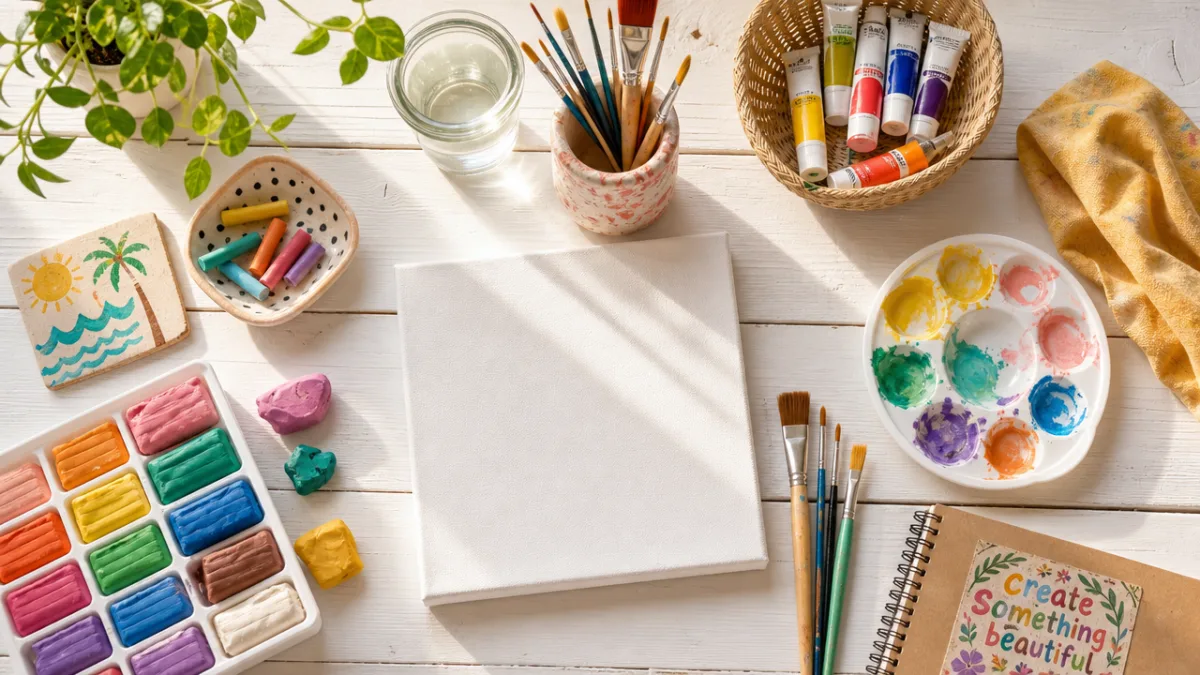
For paint-based footprint crafts, washable tempera paints are the gold standard. They come in a dazzling array of colors, spread smoothly across the surface of the foot, and — crucially — wash off skin and fabric with minimal effort. Acrylic paints can produce sharper, more vibrant impressions on certain surfaces such as canvas or wood, but they dry quickly and can be harder to remove from skin, so extra care is needed. Fabric paints are an excellent choice if you are working on textiles like pillowcases, tote bags, or T-shirts, as they are specifically formulated to bond with cloth fibers and withstand repeated washing.
Beyond paint, the surface you choose will dramatically influence the final look and longevity of your craft. Here are some popular options to consider:
- Watercolor paper or cardstock: Affordable and widely available, these surfaces absorb paint well and work beautifully for framed keepsakes or greeting cards.
- Canvas panels or stretched canvas: Ideal for a more polished, gallery-ready result that can be displayed proudly in any room of the home.
- Air-dry clay or salt dough: Perfect for three-dimensional impressions that capture depth and texture in a way flat surfaces cannot.
- Wooden plaques or boards: A rustic option that pairs especially well with acrylic paints and can be sealed for lasting durability.
- Ceramic tiles: With the right type of paint or permanent marker, tiles can be turned into stunning, one-of-a-kind decorative pieces.
Do not overlook the importance of having the right prep supplies on hand before you begin. A shallow tray or foam pad for applying paint to the foot, a bucket of warm soapy water for rinsing, plenty of paper towels, and a drop cloth or old newspaper to protect your work surface will all make the process smoother and far less stressful. Good preparation transforms a potentially chaotic crafting session into a joyful, memorable experience for everyone involved.
Step-by-Step Guide to Creating a Classic Summer Footprint Print
Once your materials are gathered and your workspace is prepared, the actual process of making a footprint craft is wonderfully simple. Begin by setting up your paint station in a spot that is easy to clean — outdoors on a patio or deck is ideal during summer months, as the warm air speeds drying and any mess can be rinsed away easily with a garden hose. Lay down your protective covering, arrange your paint trays and paper or canvas, and have your rinse bucket close at hand before you bring your little one into the equation.
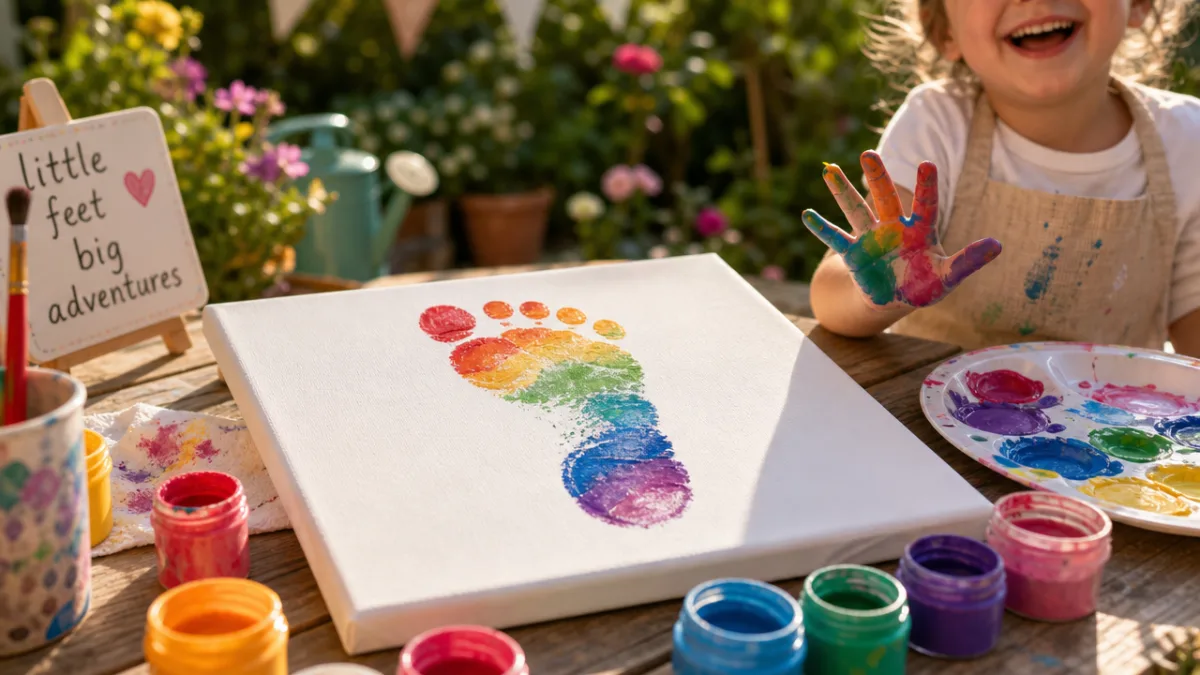
Apply a generous, even layer of paint to your chosen tray or foam pad, then help your child step onto the paint surface with steady, gentle support. For toddlers and younger children, holding both hands while they step ensures they feel secure and reduces the chance of an accidental stumble. Once the foot is evenly coated, guide it firmly down onto the paper or canvas, applying light pressure across the heel, arch, and toes to ensure a complete impression. Lift the foot straight up rather than sliding it, which helps maintain crisp, clean edges in the print.
After the initial print is made, the real creativity begins. Here is a simple sequence to follow for the most satisfying results:
- Allow the footprint to dry completely before adding any embellishments — this usually takes between fifteen and thirty minutes depending on the paint and surface used.
- Once dry, use fine-tipped brushes or paint pens to add details such as eyes, petals, fins, or other features that transform the footprint into an animal, flower, or character.
- Write the child’s name, age, and the date of creation somewhere on the piece — future you will be very glad you did.
- If desired, add a short caption or seasonal message to give the piece additional context and personality.
- Seal the finished piece with a clear varnish or Mod Podge once everything is fully dry to protect it from fading, moisture, and general wear over time.
The beauty of this process is that no two prints are ever exactly the same. Each child’s foot has a unique shape and size, and the slight variations in pressure, paint distribution, and angle all contribute to a result that is entirely one of a kind. Embrace the imperfections — the slightly smudged toe or the cheeky extra fingerprint that somehow appeared on the canvas — because these unexpected details are often what make homemade crafts so deeply personal and irreplaceable.
Creative Ideas for Transforming Footprints into Summer Art
One of the most exciting aspects of footprint crafting is the sheer range of creative directions you can take with a single impression. The elongated shape of a foot, combined with the rounded curves of individual toes, lends itself to an almost endless variety of interpretations. Summer, with its themes of sunshine, beaches, gardens, and wildlife, provides particularly rich inspiration for turning footprints into imaginative works of art that capture the spirit of the season in a truly unique way.
Animal-themed footprint art is perennially popular with children and adults alike. A footprint turned upside down with toes pointing downward becomes the body and legs of a flamingo when paired with a long pink neck and a curved beak. Turn it sideways and add scales and fins to create a tropical fish swimming through a coral reef scene. A simple green footprint can become a frog sitting on a lily pad, while a brown one with the addition of a fluffy tail transforms into a squirrel. The key is to look at the footprint with imaginative eyes and allow its natural shape to suggest the creature rather than forcing it into a predetermined mold.
For something with a botanical flavor, consider turning footprints into flowers, trees, or garden scenes. A cluster of small footprints arranged in a circle, toes facing outward, can form the petals of a giant sunflower when a round yellow center is added. A single footprint with the heel serving as the trunk and toes forming the canopy makes a charming little tree. Multiple overlapping prints in shades of green and yellow can be layered to suggest tall summer grass or a meadow in full bloom. These nature-inspired interpretations work particularly well as large-format pieces on canvas or as a collaborative mural project for groups of children.
Beyond individual artwork, footprint crafts can be incorporated into a wide variety of functional and decorative projects that families will use and treasure for years. Some particularly popular options include:
- Personalized greeting cards: A footprint stamped onto folded cardstock and decorated to look like a crab, butterfly, or flower makes a birthday or holiday card that grandparents will keep forever.
- Custom T-shirts or onesies: Using fabric paint, a baby’s or toddler’s footprint on a white garment creates a wearable keepsake that is both adorable and practical.
- Memory books or scrapbook pages: Including footprints alongside photographs and journaled notes creates a richly textured chronicle of childhood that goes far beyond a standard photo album.
- Garden stepping stones: Cast in concrete or hypertufa, a footprint embedded in a garden path becomes a permanent, weatherproof monument to a summer well spent.
- Decorative tiles or coasters: With the right sealant, painted ceramic tiles bearing a child’s footprint become both a functional household item and a beautiful display piece.
Tips for Crafting with Children of Different Ages
One of the great strengths of footprint crafting is its remarkable adaptability across a wide range of ages and developmental stages. From newborns to school-age children, every age group can participate in some form, though the level of adult involvement and the complexity of the project will naturally vary. Understanding these differences and tailoring your approach accordingly will help ensure that the experience is positive, age-appropriate, and genuinely enjoyable for everyone taking part.
With newborns and young infants, the adult does virtually all of the work, but the result is no less meaningful. In fact, many parents find that capturing a newborn’s impossibly tiny footprint is one of the most emotionally resonant things they can do in those early weeks. Use a very soft brush to apply a thin layer of non-toxic paint rather than pressing the foot into a tray, as newborns have sensitive skin and little tolerance for unfamiliar sensations. Work quickly and calmly, preferably when the baby is fed, rested, and content, and be prepared for a less-than-perfect impression — the slight smudges and irregularities of a newborn print only add to its charm.
Toddlers between the ages of one and three bring wonderful energy and enthusiasm to the crafting table, along with an equally wonderful tendency toward creative chaos. Embrace this by simplifying the process as much as possible — pre-pour paint into shallow trays, have everything set up in advance, and keep the session short, ideally no longer than fifteen to twenty minutes. Give toddlers a degree of autonomy by letting them choose their paint colors or decide where on the page to place their print. The sense of ownership this creates translates directly into pride and excitement about the finished product, and the memory of the experience itself becomes part of the keepsake.
Older children, particularly those aged five and above, can take on a much more active and creative role in the project. At this stage, children are capable of applying their own paint, making deliberate choices about composition and color, and adding their own painted details to the finished print. Encourage them to plan their design in advance with a quick pencil sketch, think about the story they want their artwork to tell, and take responsibility for cleaning up after themselves. Projects that challenge their growing skills — such as multi-layer compositions, textile printing, or three-dimensional clay impressions — will hold their attention and result in work they are genuinely proud to display.
Preserving and Displaying Your Summer Footprint Creations
Creating a beautiful footprint artwork is only half the journey — the other half is ensuring it is properly preserved and displayed so that it can be enjoyed for years and even decades to come. Paper-based prints are particularly vulnerable to fading, moisture damage, and yellowing over time if they are not given appropriate care. The good news is that with a few straightforward steps, you can dramatically extend the lifespan of even the most casually made footprint craft and keep its colors bright and vivid long into the future.
For flat prints on paper or canvas, the most important protective step is applying a clear sealer once all paint and embellishments are completely dry. A spray-on UV-resistant varnish is ideal for paper and canvas works, as it creates an invisible barrier against moisture, dust, and the fading effects of sunlight. Mod Podge, applied with a soft brush in two or three thin coats, is another excellent option for paper projects and has the added benefit of adding a slight stiffness that helps prints hold their shape. For works on fabric, a hot iron set to the appropriate temperature for the material can heat-set the paint and dramatically improve its washability and longevity.
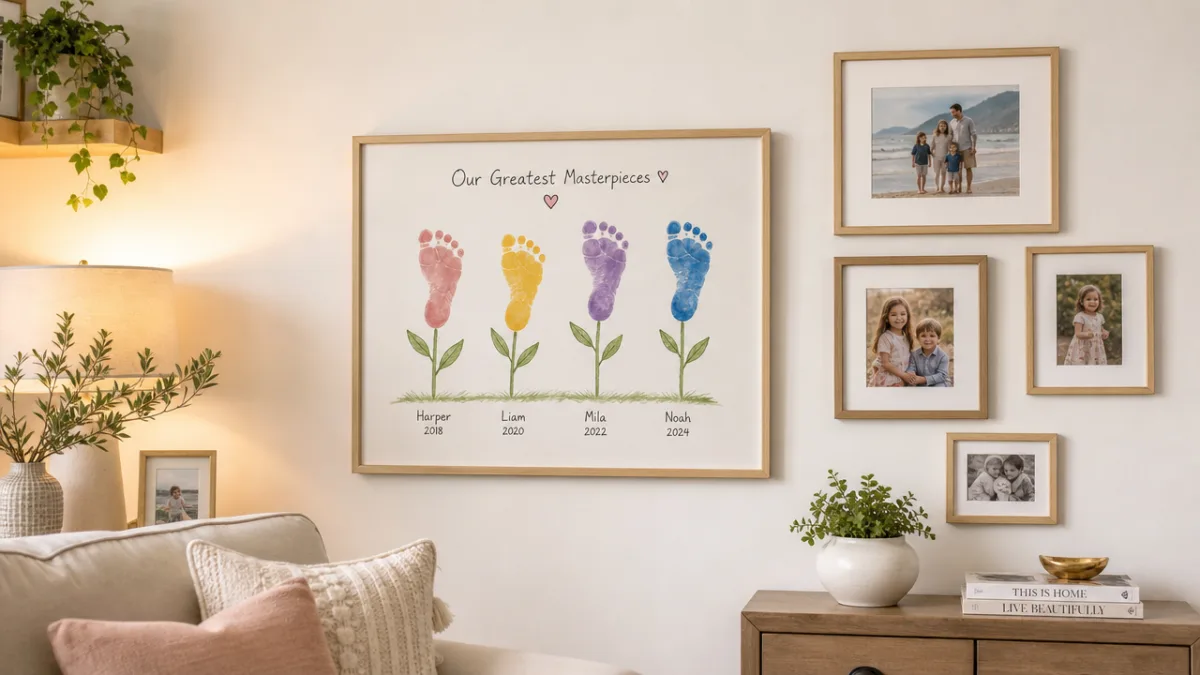
When it comes to display, framing is the single most effective way to both protect and showcase a footprint artwork. Acid-free mats and UV-protective glass will guard against yellowing and fading, while a well-chosen frame elevates even the simplest print into something that looks genuinely gallery-worthy. Consider creating a dedicated wall in your home for rotating seasonal craft displays, updating it with new prints each summer to create a visual timeline of your children’s growth. Alternatively, a deep shadow box frame can accommodate three-dimensional pieces like clay impressions or mixed-media works that cannot be pressed flat under conventional glass.
Beyond framing, there are many other creative ways to incorporate footprint crafts into your home and daily life. Digitizing your prints by scanning or photographing them in good natural light opens up a world of additional possibilities — you can have them printed onto mugs, phone cases, calendars, or photo books, creating functional items that bring the keepsake into everyday use. Sharing digital versions with extended family members allows grandparents, aunts, uncles, and friends who may live far away to feel connected to the child’s growth and the special moments captured in each print. In this way, a simple summer afternoon spent with paint and paper can ripple outward in warmth and connection far beyond the original moment of creation.
Making Footprint Crafts a Summer Tradition
The true power of a footprint craft is fully realized when it becomes not a one-time activity but an annual tradition — a ritual that families return to each summer with growing intentionality and excitement. When children know that every June or July they will press their feet into paint and create something together, the activity takes on layers of meaning that deepen with each repetition. They begin to anticipate it, to suggest creative directions in advance, and to take genuine pleasure in comparing their new print to the ones made in previous years.
Establishing a consistent framework for your annual tradition helps anchor it in memory and makes the year-over-year comparison more meaningful. Choose the same type of surface and roughly the same size each year so that prints can be displayed together as a series. Use the same background color or decorative theme across multiple years to create visual cohesion. Take a photograph of the child next to their completed artwork each time, creating a parallel photographic record that captures not just the tiny foot but the whole growing person. Over the course of five, ten, or fifteen summers, this collection becomes one of the most extraordinary documents of childhood imaginable.
It is also worth extending the tradition beyond immediate family to create something genuinely communal. Grandparents who contribute their own enormous footprints to a multi-generational piece create a visual story about family that children find endlessly fascinating. Friends gathered for a summer birthday party can each add a print to a large canvas, creating a collaborative artwork that commemorates the occasion. Preschool and elementary school classes can undertake group footprint projects that celebrate community and belonging. In every case, the activity remains simple, accessible, and inexpensive — but its emotional and artistic returns are immeasurable, growing richer and more resonant with every summer that passes.








What do you think?
It is nice to know your opinion. Leave a comment.