










Giant Buttons: The Bold Craft Trend That’s Taking DIY and Design by Storm
What Are Giant Buttons and Why Are They Having a Moment?
Giant buttons — oversized, statement-making fasteners ranging from a few inches to well over a foot in diameter — have burst onto the crafting and interior design scene with remarkable energy. Once relegated to theatrical costumes and novelty shops, these larger-than-life versions of an everyday object have found a new home in home décor, fashion accessories, children’s spaces, and handmade art installations. Their appeal lies in the way they transform something utterly ordinary into something delightfully unexpected and visually arresting.
The trend draws from a long tradition of scale manipulation in art and design — think Roy Lichtenstein’s comic-strip paintings or Claes Oldenburg’s monumental soft sculptures. When you take a humble, familiar object and blow it up to an extraordinary size, it invites viewers to look again, to reconsider, and often to smile. Giant buttons carry that same playful energy. They whisper a kind of visual joke: you know exactly what this is, and yet somehow it surprises you every single time you encounter it in an unexpected context.
Social media platforms like Pinterest have played a significant role in amplifying the giant button trend, with crafters sharing their creations and inspiring thousands of others to try their hand at making or incorporating these oversized pieces. The hashtags and boards dedicated to giant buttons reveal an incredibly diverse community — from fiber arts enthusiasts using them as statement closures on handmade coats, to interior decorators using painted wooden buttons as wall art, to educators using them as tactile teaching tools for young children learning about shapes, colors, and counting.
A Brief History of the Button: From Utility to Art
To fully appreciate the giant button phenomenon, it helps to understand just how ancient and culturally significant the humble button really is. Archaeological evidence suggests that decorative buttons date back over five thousand years, with some of the earliest examples found in the Indus Valley civilization. These early buttons were made from shells, bones, and carved stone, and were used primarily as ornamental fasteners on clothing. It wasn’t until the thirteenth century in Europe that buttons became functional closures paired with buttonholes, revolutionizing garment construction forever.
Throughout history, buttons have served as powerful status symbols. In medieval and Renaissance Europe, wealthy nobility adorned their garments with buttons made from precious metals, gemstones, and hand-painted enamel. A person’s button collection could represent considerable wealth — some aristocrats owned thousands of intricately crafted buttons that were passed down through generations as heirlooms. The button trade became so significant that button makers formed their own guilds, fiercely protecting their craft and their economic interests against competition from other trades.
The Industrial Revolution brought mass production to button manufacturing, democratizing access but also stripping away much of the handcrafted artistry that had defined buttons for centuries. Materials like Bakelite, celluloid, and eventually plastic replaced ivory, horn, and shell. In many ways, the contemporary movement toward giant, handmade buttons can be seen as a cultural corrective — a deliberate return to the idea of the button as a meaningful object worthy of attention, craftsmanship, and even celebration. Making something big forces you to slow down and reconsider it.
Materials and Methods: How Giant Buttons Are Made
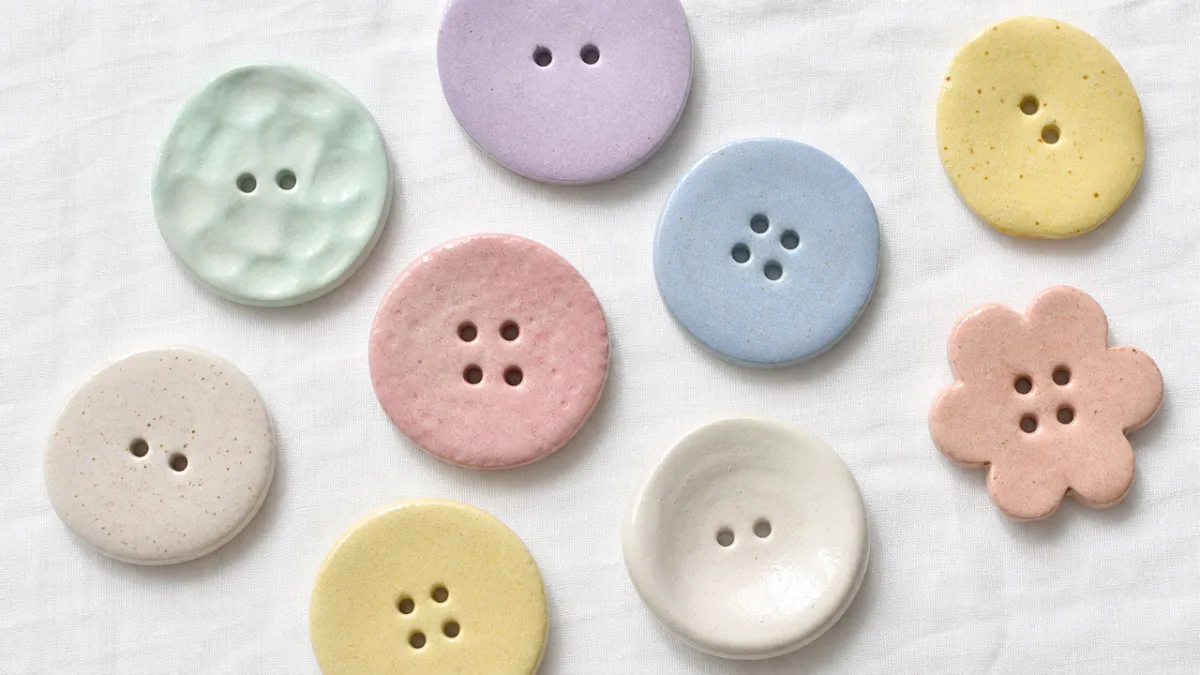
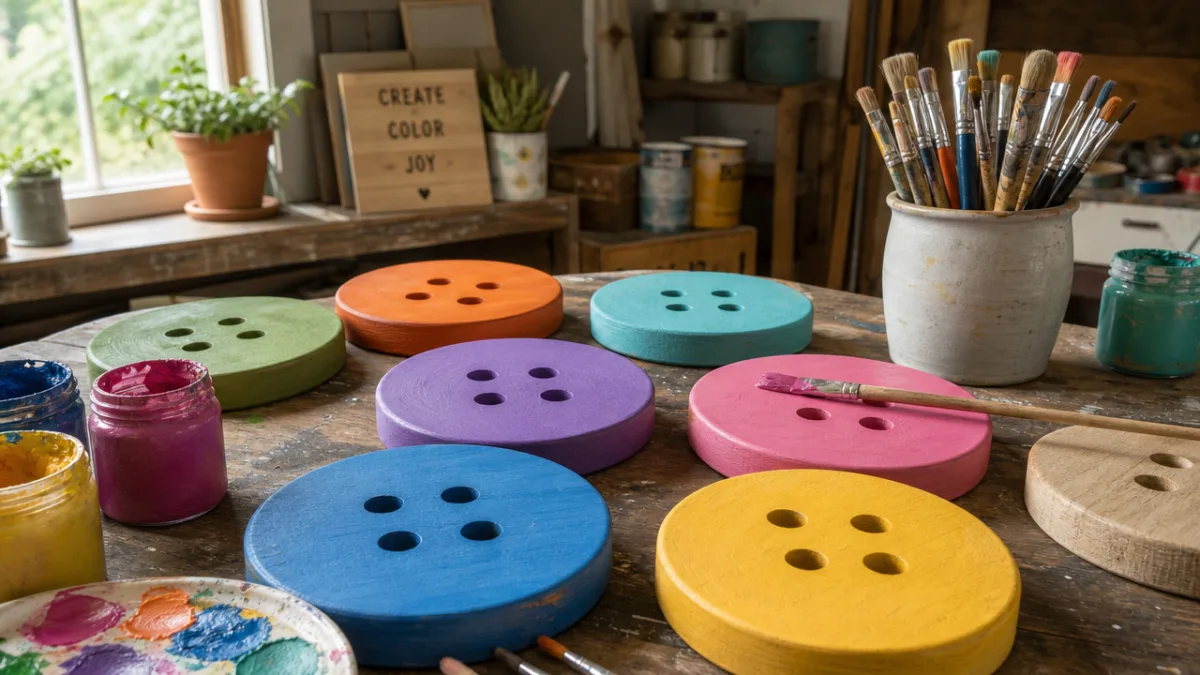
One of the most appealing aspects of the giant button trend is the sheer variety of materials that crafters use to bring these statement pieces to life. Wood is perhaps the most popular substrate, with crafters cutting circles from plywood or MDF using a jigsaw or scroll saw, then drilling the characteristic two or four holes that make a button instantly recognizable. Wooden giant buttons can be sanded smooth, painted in bold colors, stained to show off the natural grain, or even decoupaged with fabric or paper for added texture and visual interest.
Beyond wood, crafters have experimented with an impressive range of materials. Air-dry clay and polymer clay are popular choices for smaller giant buttons — say, three to five inches in diameter — because they allow for intricate detailing, surface textures, and a wide range of painted finishes once dry. Felt and thick craft foam are accessible options for beginners and are particularly popular in educational settings because they’re safe, lightweight, and easy for children to handle. Some ambitious makers have even cast giant buttons from concrete or resin, creating stunning, durable pieces suitable for outdoor garden installations.
The tools required vary considerably depending on the chosen material, but here are some of the most commonly used items in giant button projects:
- Jigsaw or scroll saw for cutting circular shapes from wood or foam boards
- Hole saw drill bit attachments for creating clean, perfectly round buttonholes
- Sandpaper in various grits for smoothing wood surfaces before painting
- Acrylic craft paints and sealants for durable, weather-resistant finishes
- Hot glue guns for assembling multi-layered or fabric-covered buttons
- Silicone molds for resin or clay casting projects
- Router tools for adding beveled or decorative edges to wooden buttons
The finishing stage is where giant buttons truly come alive, and many crafters consider it the most enjoyable part of the process. A single coat of bright acrylic paint can transform a plain wooden circle into a cheerful, eye-catching decoration. More advanced crafters might layer multiple paint colors to create an ombre effect, use stencils to add patterns, or apply metallic leaf to achieve a luxurious look reminiscent of those historic jeweled buttons worn by Renaissance nobility. The finishing possibilities are almost limitless, and the large surface area of a giant button makes it a genuinely satisfying canvas to work with.
Giant Buttons in Interior Design and Home Décor
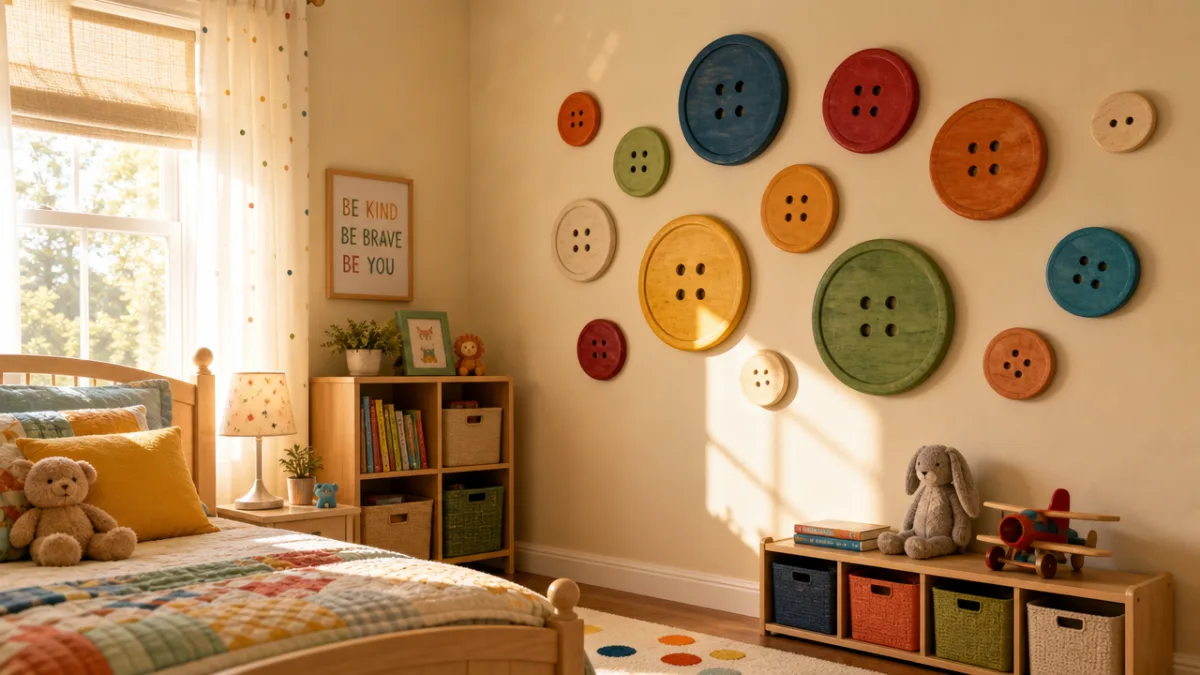
Perhaps the most visually impactful application of the giant button trend is in interior design, where these oversized objects can serve as focal points, wall art, and functional decorative accents. A grouping of painted wooden giant buttons in coordinating colors can transform a blank wall into a dynamic, conversation-starting installation. Unlike conventional wall art, buttons bring an element of texture, dimensionality, and playful charm that prints or paintings often cannot achieve. They work particularly well in children’s rooms, craft studios, and eclectic living spaces where visual wit is welcomed.
Interior designers have also found creative ways to incorporate giant buttons as functional elements within a space. Oversized upholstered buttons — the kind traditionally used in tufted furniture — have been scaled up dramatically and used as floor cushions, poufs, and ottomans. These pieces serve the double purpose of seating or footrest and decorative sculpture, and their familiar button shape adds a subtle layer of whimsy to what would otherwise be an ordinary piece of furniture. When upholstered in rich velvets or tactile boucle fabrics and finished with a thick cord or ribbon through the center holes, they become genuinely luxurious statement pieces.
The nursery and children’s bedroom market has embraced giant buttons enthusiastically, recognizing their educational potential alongside their decorative appeal. Sets of giant buttons in primary colors, arranged on a wall or shelf at child height, create a stimulating visual environment while also teaching children about shapes and patterns. Some designers have incorporated giant button motifs into custom wallpaper designs, fabric prints, and even painted murals, building entire room themes around this charming, universally recognized motif. The button’s inherent simplicity — circle, holes, that’s essentially it — makes it remarkably versatile as a design element that doesn’t overwhelm a space.
For those who prefer a more sophisticated, understated approach, giant buttons in neutral tones — natural wood finishes, matte white, soft greys, and warm creams — can integrate seamlessly into minimalist and Scandinavian-inspired interiors. A single large wooden button mounted on a wall as standalone sculptural art, or used as an oversized drawer pull on a custom cabinet, makes a quiet but distinctive statement. The key is allowing the unexpected scale to do the work, trusting that the viewer’s eye will recognize the familiar form and take a moment of delighted pause before moving on.
Giant Buttons in Fashion, Textiles, and Fiber Arts
In the world of fashion and fiber arts, giant buttons have become a beloved tool for making bold statements on garments and accessories. Knitwear designers in particular have embraced the oversized button as a way to give handmade coats, cardigans, and capes a finishing touch that is as much about decoration as function. A chunky hand-knitted coat fastened with three or four enormous buttons — perhaps five or six inches across, in a contrasting color — immediately elevates the garment from cozy and homespun to genuinely design-forward and intentional. The button becomes part of the garment’s personality.
Fiber artists working in weaving, macramé, and mixed media textile art have incorporated giant buttons as both structural and decorative elements. In wall hangings, an oversized button can serve as an anchor point for fiber elements, a framing device for a central composition, or simply a textural accent that draws the eye and invites touch. The contrast between the smooth, hard surface of a painted wooden button and the soft, organic texture of wool, cotton rope, or silk ribbon creates a satisfying tactile and visual tension that many fiber artists find irresistible to explore.
Bag makers and accessory designers have also discovered the dramatic potential of giant buttons. An oversized button closure on a handmade tote bag or clutch transforms a utilitarian fastening into the defining design detail of the entire piece. Some designers work with buttons that are so large they serve primarily as decorative appliqués rather than functional closures, affixed to the surface of bags, hats, and even shoes to create instant visual interest. The range of styles achievable is extraordinary:
- Classic four-hole buttons in bright primary colors for a playful, retro aesthetic
- Fabric-covered buttons in luxurious materials for elegant, couture-inspired looks
- Natural wood or shell buttons for earthy, artisanal, sustainable fashion pieces
- Resin buttons with embedded flowers, glitter, or color swirls for maximalist statement accessories
- Vintage-inspired painted metal or enamel buttons for a nostalgic, heritage-brand feel
The intersection of giant buttons and sustainable fashion is worth noting as well. Many crafters who gravitate toward making and using oversized buttons are deeply embedded in the slow fashion and upcycling movements. Repurposing large buttons salvaged from old curtains, upholstery, or discarded garments — or crafting new ones from reclaimed wood and natural materials — aligns perfectly with the values of conscious consumption and handmade culture. In this context, the giant button is not merely a trend but a small act of resistance against the disposability of mass-produced fashion.
Giant Buttons for Education, Play, and Therapeutic Crafting
Beyond aesthetics and fashion, giant buttons have found a meaningful place in educational and therapeutic settings, where their oversized format offers practical advantages that standard buttons simply cannot provide. For young children developing fine motor skills, large buttons are ideal learning tools. Threading a thick cord through the holes of a giant button requires the kind of deliberate, focused hand movement that strengthens the finger and hand muscles children will later need for writing, drawing, and other precision tasks. When the button is large enough to handle comfortably, the activity becomes achievable and satisfying rather than frustrating.
Occupational therapists working with older adults, individuals recovering from injuries, or people living with conditions that affect dexterity — such as arthritis, Parkinson’s disease, or stroke — have long recognized the value of button-related fine motor exercises. Giant buttons make these exercises more accessible by providing a larger target and requiring less precision. Beyond the purely physical benefits, the familiar, comforting nature of button shapes and the sense of accomplishment that comes from successfully manipulating them can have genuine psychological benefits, providing a sense of capability and control that is deeply important for wellbeing during rehabilitation.
In classroom settings, giant buttons serve as wonderfully versatile teaching props. A set of buttons in multiple colors, sizes, and hole configurations can be used to teach counting and basic arithmetic, introduce concepts of sorting and categorization, explore patterns and sequences, and even spark discussions about history and cultural heritage. Because buttons are universally familiar objects, they make an immediately accessible entry point into a lesson, requiring no explanation of what they are — just an invitation to look at them differently, to count the holes, to notice the colors, and to start asking questions.
The therapeutic crafting community — which encompasses art therapy, craft therapy, and the broader wellness-through-making movement — has embraced giant button making as a particularly rewarding activity for groups and individuals alike. The process of creating a giant button involves a satisfying sequence of clearly defined steps: cutting or molding the shape, creating the holes, smoothing the surface, and applying color and finish. This structured, goal-oriented process is intrinsically calming for many people, offering a gentle form of mindfulness that keeps the hands busy, quiets anxious thoughts, and produces a tangible, pleasing result. The finished giant button, sitting proudly in one’s hand, feels like genuine evidence of one’s own creativity and capability.
Getting Started: Your First Giant Button Project
If the world of giant buttons has sparked your creativity and you’re eager to dive in, the good news is that entry-level projects are genuinely accessible regardless of your crafting experience or budget. The simplest possible giant button project requires nothing more than a piece of plywood, a jigsaw or access to a woodcutting service at a hardware store, a drill with a one-inch bit, sandpaper, and whatever paint happens to be in your craft cabinet. From these basic materials, you can produce a bright, cheerful wall decoration in a single afternoon that will draw compliments for years to come.
Before you begin cutting wood, it’s worth spending a little time planning your project with some straightforward considerations in mind. Think about where the finished button will live — a child’s bedroom calls for different colors and finishes than a sophisticated living room or a garden installation. Consider scale carefully: a button that looks adequately large in your workshop may feel surprisingly small once it’s hung on a spacious wall, so when in doubt, go bigger. Sketch your design on paper first, including the placement and size of the buttonholes, which are as central to the button’s visual identity as the overall shape.
Here is a simple step-by-step overview for a beginner wooden giant button wall decoration:
- Cut a circle approximately 10 to 12 inches in diameter from half-inch plywood using a jigsaw
- Sand the edges and surfaces thoroughly, starting with 80-grit sandpaper and finishing with 220-grit for a smooth finish
- Mark the center of the circle and measure out two or four evenly spaced hole positions
- Drill the buttonholes using a one-inch spade bit or Forstner bit for clean, neat circles
- Apply a base coat of white or light-colored primer and allow to dry completely
- Paint with two coats of your chosen acrylic color, allowing full drying time between coats
- Seal with a matte or satin varnish to protect the surface
- Thread thick yarn, ribbon, or twine through the holes in the traditional cross-stitch pattern and tie at the back
- Attach a picture-hanging hook or sawtooth hanger to the back and display proudly
Once you’ve completed your first giant button, the odds are high that you’ll immediately start planning the next one — perhaps a set of five in graduated sizes, or a collection exploring different color palettes, or an experiment with a new material like clay or resin. The giant button, for all its apparent simplicity, turns out to be a remarkably deep rabbit hole of creative possibility. It is a project that rewards both the beginner seeking a quick, satisfying craft win and the experienced maker looking for a canvas for genuine artistic expression. In its perfect combination of familiarity, charm, and open-ended potential, the giant button is one of crafting’s most quietly brilliant ideas.








What do you think?
It is nice to know your opinion. Leave a comment.