










Creative Hands: The Transformative Power of Making Things by Hand
The Ancient Human Impulse to Create
Long before written language, before cities or agriculture, human beings were making things with their hands. Cave paintings in Lascaux and Chauvet speak to an impulse so fundamental it predates civilization itself — the drive to shape raw material into something that carries meaning, beauty, or utility. This creative instinct is not a luxury or a hobby; it is one of the defining characteristics of our species. When we pick up a brush, a needle, a lump of clay, or a block of wood, we are participating in an unbroken thread of human expression stretching back tens of thousands of years.
Modern life has gradually outsourced the act of making to factories, algorithms, and automated systems. We buy rather than build, stream rather than perform, consume rather than construct. And yet, something remarkable is happening in kitchens, garages, community studios, and online communities around the world: people are choosing to make things by hand again. The resurgence of craft — from sourdough baking and hand-lettering to woodworking, embroidery, and ceramics — is not nostalgia. It is a deeply human response to a world that has become increasingly abstract and screen-mediated. Our hands want work that they can feel.
There is neurological evidence behind this longing. Psychologist Kelly Lambert has spent years studying what she calls “effort-based rewards” — the satisfaction the brain derives specifically from using the hands to create something tangible. When we work with our hands, we activate networks in the brain associated with pleasure, learning, and emotional regulation in ways that passive activities simply cannot replicate. The phrase “creative hands” is not merely poetic; it points to something real about how our minds and bodies are wired to find meaning through making.
The Psychology of Craft and Mental Well-Being
Research into the relationship between creative handwork and mental health has grown substantially over the past two decades, and the findings are consistently encouraging. Activities like knitting, drawing, pottery, and woodworking have been shown to reduce cortisol levels, lower heart rate, and produce states of calm focus that researchers sometimes compare to meditation. The repetitive, rhythmic motions involved in many crafts — the back-and-forth of a crochet hook, the smooth stroke of a hand plane across wood grain — create what psychologist Mihaly Csikszentmihalyi famously described as a “flow state”: a condition of absorbed, effortless concentration in which time seems to dissolve and anxiety recedes.
Occupational therapists have long incorporated craft activities into treatment programs for depression, anxiety, trauma, and chronic pain. The reasons are multiple and interconnected. Handwork provides a sense of agency and control, which is deeply restorative when mental illness or difficult life circumstances have made people feel helpless. Completing even a small creative project — finishing a knitted square, glazing a pot, assembling a collage — delivers a genuine sense of accomplishment that can interrupt cycles of negative thinking. Making something visible and tangible out of effort and intention is, in its quietest way, an act of self-affirmation.
Creative handwork also offers a unique relationship with imperfection that is profoundly therapeutic. Unlike digital work, which can be endlessly undone and corrected, handmade objects carry their history in their surfaces — the uneven stitches, the thumbprint in the clay, the slightly wobbly line. Learning to work with and even embrace these imperfections trains a gentler, more compassionate relationship with oneself. Many people who struggle with perfectionism and self-criticism find that craft becomes a practice ground for self-acceptance. The object does not need to be flawless to be beautiful, useful, or meaningful. That lesson, once learned in the studio, has a way of spreading into the rest of life.
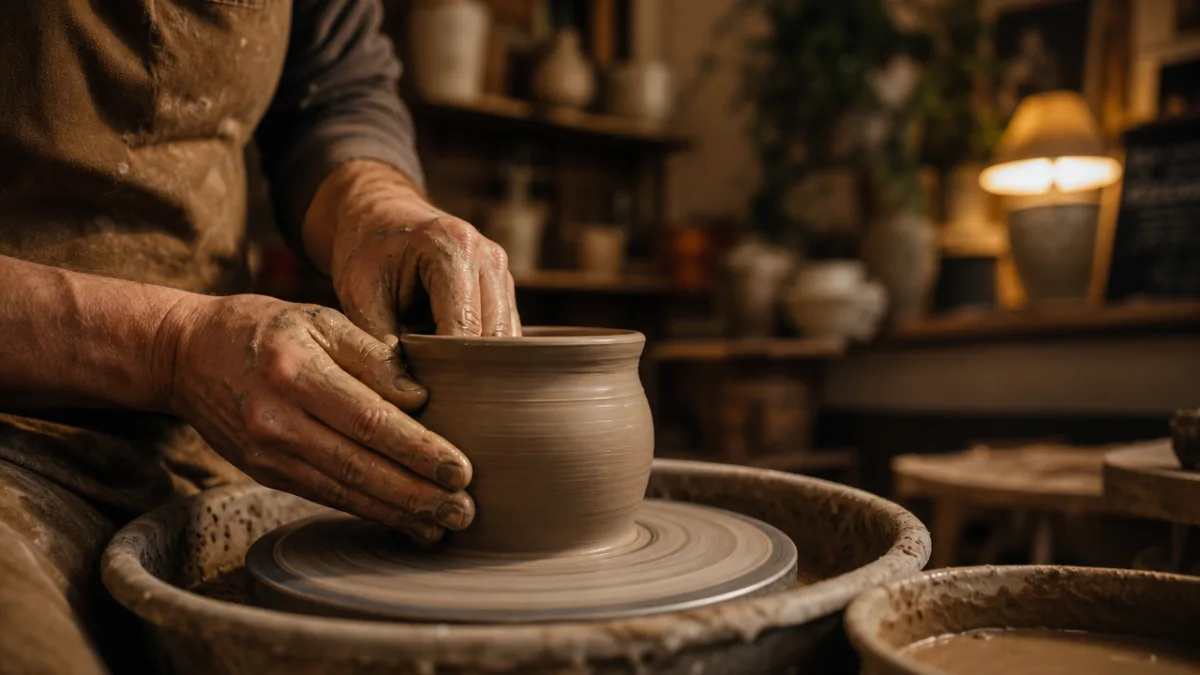
The Many Faces of Creative Handwork
One of the most wonderful things about creative handwork is its extraordinary diversity. There is no single path into a practice of making, and the range of crafts available to explore is almost limitless. Fiber arts alone encompass knitting, crocheting, weaving, spinning, embroidery, needlepoint, quilting, macramé, and felting — each with its own distinct history, community, and technical vocabulary. For those drawn to harder materials, woodworking, leathercraft, metalwork, and stone carving offer their own deep traditions. Paper arts, bookbinding, printmaking, painting, drawing, glassblowing, and jewelry-making represent still more avenues into the world of making by hand.
What unites all of these disparate practices is a common set of rewards: the pleasure of developing skill over time, the satisfaction of problem-solving through direct material engagement, and the particular joy of producing something that can be held, worn, given, or used. Whether someone gravitates toward the geometric precision of woodjoinery or the free expressive energy of abstract painting, the fundamental experience of hand meeting material and producing something new is shared across all of these traditions. This commonality is why crafters and makers of wildly different disciplines so often feel an immediate kinship with one another.
In recent years, the maker movement has added a new dimension to this landscape, blending traditional craft with modern technology in fascinating ways. Laser cutters, 3D printers, and CNC routers have become tools in the hands of craftspeople who combine digital design with physical fabrication. Weavers write code to generate complex patterns on digital looms. Ceramicists use 3D scanning to create precise molds for hand-finished pieces. Rather than displacing traditional handcraft, these technologies have expanded the definition of what it means to make something, welcoming a new generation of makers who might not have found their way into craft studios otherwise.
- Fiber Arts: Knitting, crochet, weaving, embroidery, and quilting offer meditative repetition alongside rich cultural traditions from communities around the world.
- Woodworking and Joinery: From furniture-making to spoon carving, working with wood develops patience, spatial reasoning, and a deep appreciation for natural materials.
- Ceramics and Pottery: The interaction of hand, clay, water, and fire produces objects that are simultaneously utilitarian and deeply personal.
- Drawing and Painting: Accessible entry points into visual art that reward sustained practice and offer infinite expressive possibility.
- Printmaking: Relief printing, screen printing, and etching combine design thinking with physical process in ways that produce unique, reproducible images.
- Jewelry and Metalwork: The craft of shaping precious and non-precious metals into wearable objects blends engineering precision with artistic vision.
Learning to Make: Starting a Creative Practice
One of the most common barriers people face when considering a creative hand practice is the fear of being “not artistic enough.” This belief — usually absorbed in childhood from a careless comment or a bad grade — is both widespread and almost entirely mistaken. Skill in any craft is not an innate gift distributed at birth to a lucky few; it is a capability developed gradually through practice, instruction, attention, and repetition. Every master ceramicist, woodworker, or embroiderer began as a complete beginner who made lopsided, clumsy, imperfect things. The gap between beginner and expert is not talent — it is time spent with hands engaged in the work.
Beginning a creative practice requires far less investment than most people assume. Many crafts can be started with minimal equipment and modest expense. A sketchbook and a set of pencils open the door to drawing. A beginner’s knitting kit can be assembled for the price of a restaurant meal. Basic woodcarving requires only a few inexpensive gouges and a piece of soft wood. Community resources — library programs, maker spaces, community colleges, local craft guilds, and online platforms like YouTube and Skillshare — have made instruction more accessible than at any previous point in history. The tools and the knowledge are within reach; what is needed most is the willingness to begin badly and continue anyway.
Building a sustainable creative practice means finding a rhythm that fits into real life rather than waiting for ideal conditions that never quite arrive. This might mean fifteen minutes of drawing before bed, a knitting project kept by the sofa for evenings, or a Saturday morning reserved for the pottery studio. The frequency of practice matters less than its consistency. Regular, even brief engagement with a craft builds skill faster than occasional marathon sessions, and the habit of returning again and again to one’s making creates a through-line of creative identity that gradually becomes central to how a person understands themselves. “I am someone who makes things” is a powerful and sustaining self-concept.
- Choose a craft that genuinely interests you, even if you cannot fully explain why — curiosity is a reliable guide.
- Gather only the most basic tools and materials to start; resist the urge to buy everything at once before you know what you need.
- Find at least one source of instruction, whether a book, a video series, a class, or a knowledgeable friend willing to teach.
- Set aside regular, protected time for your practice, even if the sessions are short.
- Commit to finishing beginner projects even when they disappoint you — completion is its own form of learning.
- Seek community, whether locally or online; making alongside others accelerates growth and makes the practice more sustainable.
- Document your progress through photographs or a journal so you can see how far you have come over time.
Craft as Community and Cultural Inheritance
Handcraft has always been a fundamentally social practice. Before industrialization, making things was woven into the fabric of community life. Women gathered to quilt, spin, and weave together. Men learned woodworking and blacksmithing in apprenticeships that built relationships across generations. These gatherings were not merely productive; they were occasions for storytelling, the transmission of cultural knowledge, mutual support, and the reinforcement of shared identity. When we look at traditional textiles, pottery, or basketry from cultures around the world, we are looking not just at objects but at the accumulated wisdom and creativity of entire communities passed down through careful hands across generations.
Many craft traditions carry within them the history, values, and worldview of specific peoples and places. The geometric patterns of Navajo weaving encode cosmological meaning. The indigo-dyed textiles of West Africa speak of trade routes, social status, and communal celebration. Japanese shibori dyeing reflects an aesthetic philosophy that values impermanence and the beauty of process. Norwegian rosemaling painting, Moroccan zellige tilework, Indian block printing, Appalachian chair-caning — each of these traditions represents a living inheritance that connects contemporary makers to the hands and minds of their ancestors. To learn a traditional craft is to enter a conversation that has been ongoing for centuries.
The digital age has created new forms of creative community that complement and sometimes revitalize these older traditions. Online platforms like Ravelry for knitters, Instructables for makers, and countless Instagram and TikTok communities have connected crafters across geographic and cultural boundaries, creating global conversations around shared practices. Patterns and techniques that might once have been confined to a single region or family now circulate freely. Young makers in cities around the world are learning traditional crafts from tutorial videos, then adapting and innovating in ways that generate new hybrid traditions. The community of creative hands has never been larger or more interconnected than it is today.
The Sustainable and Ethical Dimensions of Handcraft
In an era of fast fashion, planned obsolescence, and mountains of disposable goods, handcraft represents a meaningful — if partial — alternative model of production and consumption. When someone makes a garment, a piece of furniture, or a ceramic bowl by hand, they inevitably develop a deep relationship with that object — understanding its materials, the effort it embodies, the decisions that shaped it. This intimacy tends to produce objects that are cherished and maintained rather than discarded, and makers who are attentive consumers of materials and tools rather than unreflective purchasers of the cheapest available option. The culture of making is broadly, though not universally, aligned with values of quality over quantity, durability over disposability.
Many contemporary makers are actively engaged with questions of environmental sustainability in their practice. Natural dyeing with plant-based pigments, sourcing locally milled or reclaimed wood, using recycled or deadstock fabric, choosing materials that are biodegradable or long-lasting — these are choices that thoughtful makers make deliberately and often discuss in their communities. Craft supply chains are not automatically ethical or sustainable, and the maker community has important ongoing conversations about issues like the labor conditions of yarn and fabric production, the environmental impact of synthetic craft materials, and the cultural appropriation risks of borrowing from craft traditions that belong to marginalized communities. Engaged making involves thinking carefully about where materials come from and what values one’s creative practice embodies.
There is also a political and economic dimension to the question of handcraft and labor. The arts and crafts movement of the late nineteenth and early twentieth centuries, led by thinkers like William Morris and John Ruskin, was an explicit critique of industrial capitalism’s degradation of both labor and the goods it produced. Morris argued passionately that mass production had robbed workers of the joy and dignity of skilled making, and that the objects produced by alienated industrial labor were correspondingly impoverished in beauty and meaning. While the world has changed enormously since Morris’s time, his critique retains real force. When we value handmade objects, seek out the work of skilled craftspeople, and invest time in making things ourselves, we are, in however modest a way, affirming the value of skilled human labor and the kind of meaningful work that industrial efficiency tends to eliminate.
Supporting independent craftspeople and artisans — through markets, direct purchases, fair trade platforms, and simply valuing handmade work enough to pay prices that reflect its true cost — is one of the most direct ways consumers can align their spending with their values. A handmade ceramic mug costs more than a mass-produced one because it represents hours of skilled human attention, quality materials, and genuine creative investment. Understanding and honoring that reality is part of what it means to participate, as both maker and appreciator, in the broader culture of creative hands. Every object made with care, and received with appreciation, is a small act of resistance against a world that has forgotten what human skill and attention are truly worth.
The Future of Making: Why Creative Hands Matter More Than Ever
As artificial intelligence becomes capable of generating images, writing stories, composing music, and designing objects with increasing sophistication, a question is being asked with new urgency: what is the value of human creativity and handmade work in a world where machines can produce polished outputs faster and at lower cost than any human? The answer, when one thinks carefully about it, is not actually very difficult to find. The value of a handmade object has never resided solely in its appearance or function — it resides equally in its origin, in the story of the hands that made it, the choices that were made along the way, and the relationship between maker and material that every handmade thing embodies. An AI can generate a photorealistic image of a ceramic bowl, but it cannot make the bowl. The irreplaceable value of handcraft lies precisely in its humanity.
Moreover, the act of making things by hand develops capacities of mind and character that are becoming ever more valuable as automation changes the nature of work. Creative problem-solving, material intelligence, spatial reasoning, patient attention, tolerance for failure, iterative thinking, and the ability to learn through direct physical engagement with the world — these are the qualities that handcraft cultivates, and they are not qualities that can be automated. Young people who grow up making things with their hands develop a kind of resourceful confidence — a sense that problems can be approached, materials can be mastered, and skills can be built — that serves them well across every domain of life, from professional challenges to personal ones.
The future of creative hands is, in many ways, the future of human flourishing. A world in which people make things — in which the gap between conception and physical realization is bridged by skilled, attentive human hands — is a world that remains meaningfully connected to the material reality we inhabit. It is a world in which people know the satisfaction of genuine competence, the pleasure of earned skill, and the particular kind of pride that comes from being able to say: I made this. That statement — simple, quiet, and ancient — carries within it everything that is most human about the act of creation. It is not merely a claim about an object. It is an assertion of presence, of agency, of the irreducible value of a human being who has put their hands to work and brought something new into the world.








What do you think?
It is nice to know your opinion. Leave a comment.