










Counter-Height Worktable Ideas for Artists: A Complete Guide to Designing Your Perfect Studio Space
Why Counter-Height Worktables Are a Game-Changer for Artists
For artists who spend long hours at their workspace, the height of a worktable is far more than a minor detail — it fundamentally shapes posture, endurance, and creative flow. Counter-height tables, which typically sit between 34 and 36 inches tall, allow artists to work standing up or perched on a stool, distributing weight differently than a traditional seated desk setup. This shift in physical positioning can reduce the chronic back and shoulder tension that plagues so many studio practitioners who spend hours hunched over a conventional table.
Standing or semi-standing positions at a counter-height surface also encourage a broader range of motion. When painting, drawing, or assembling mixed-media work at a higher surface, your arms move more freely from the shoulder rather than being anchored to a fixed elbow position. This freedom of movement is especially beneficial for large-format work, gestural painting, printmaking, or any discipline requiring sweeping strokes and expansive reach across a surface. Many professional artists report that transitioning to a counter-height workspace noticeably improved the energy and looseness of their work.
Beyond ergonomics, there is a psychological dimension to working at a counter-height table. Standing tends to increase alertness and creative engagement — many artists describe feeling more “active” and present when they are not fully seated. The slight elevation also changes how you view your work, giving a more natural top-down perspective for flat pieces and making it easier to step back and assess compositions without having to fully stand up from a chair. Choosing the right worktable height is, in many ways, choosing the right relationship between your body and your art.
Who Benefits Most from Counter-Height Tables
While virtually any artist can benefit from experimenting with counter-height surfaces, certain disciplines gain the most immediate advantage. Illustrators, ink artists, and watercolorists working on flat boards find that a raised surface brings the work closer to eye level, reducing neck strain from constant downward gazing. Sculptors and ceramicists benefit from the ability to walk around a raised piece with ease, assessing form and proportion from multiple angles without awkward crouching. Even digital artists who work with drawing tablets often find a counter-height desk paired with a drafting stool to be more comfortable during long rendering sessions.
Artists with existing back issues, hip problems, or circulation concerns may find counter-height setups particularly transformative. The ability to shift from sitting on a tall stool to standing upright — or even to perch on a leaning support bar — throughout the day prevents the stiffness that accumulates from hours in a single position. Occupational therapists who work with creative professionals frequently recommend adjustable or counter-height surfaces as a proactive measure against repetitive strain and musculoskeletal discomfort associated with studio work.
Choosing the Right Counter-Height Table for Your Medium
Not every counter-height worktable is created equal, and the right choice depends heavily on your primary artistic medium and workflow. For painters working with heavy canvases, oil paints, and solvents, a table with a durable, chemical-resistant surface — such as high-density polyethylene, stainless steel, or sealed hardwood — is essential. These materials can withstand the inevitable spills, scrapes, and staining that come with an active painting practice without warping, discoloring, or degrading over time.
For fiber artists, textile workers, and quilters, a wide, flat counter-height cutting table with an integrated measuring grid is a beloved investment. Tables specifically designed for fabric work often include drawers or shelves at reachable heights, making it easy to access rotary cutters, rulers, and pattern pieces without breaking workflow. The sheer width of these tables — often 60 inches or more — means large fabric pieces can be cut and pinned without hanging awkwardly off the edges, reducing waste and improving precision considerably.
Mixed-media artists and those who work across multiple disciplines often benefit most from modularity. A counter-height worktable with a clean, bare top combined with a pegboard backing, side hooks, and rolling carts at counter level creates a highly adaptable command center. Surfaces can be quickly protected with kraft paper or silicone mats, and tool storage can be reconfigured as the project demands. For these artists especially, thinking of the worktable not as a single piece of furniture but as the anchor of an evolving system is the key to long-term studio satisfaction.
Materials and Surface Finishes to Consider
The surface material of your worktable will directly influence how you work on a daily basis. Butcher block or solid hardwood tops provide warmth, durability, and a pleasant tactile quality, but they require periodic sealing to resist moisture and staining. Many artists love the character that develops over time on a well-used wood surface — the paint marks, tool scratches, and worn patches become a kind of artistic record. For those who prefer a clean slate, wood surfaces can be fitted with removable glass or acrylic overlays.
Industrial and commercial options such as laminate, stainless steel, and poured concrete offer their own distinct advantages in a studio context. Laminate is affordable, easy to clean, and available in a wide range of colors and textures, making it a practical choice for artists on a budget. Stainless steel, while more of an investment, is nearly indestructible, fully waterproof, and easy to sterilize — ideal for printmakers, encaustic artists, or anyone working with wax or chemicals. Concrete countertops can be custom-poured and sealed to create a truly unique studio surface with outstanding durability.
DIY Counter-Height Worktable Builds for the Budget-Conscious Artist
Building your own counter-height worktable is one of the most rewarding studio projects an artist can undertake, and it need not require advanced carpentry skills or expensive tools. The simplest approach involves purchasing a pre-cut butcher block or laminate countertop from a home improvement store and pairing it with adjustable metal legs sourced from furniture hardware suppliers. This combination delivers a professional-looking result at a fraction of the cost of a custom-built piece, and the adjustable legs mean you can fine-tune the height to your exact ergonomic preference.
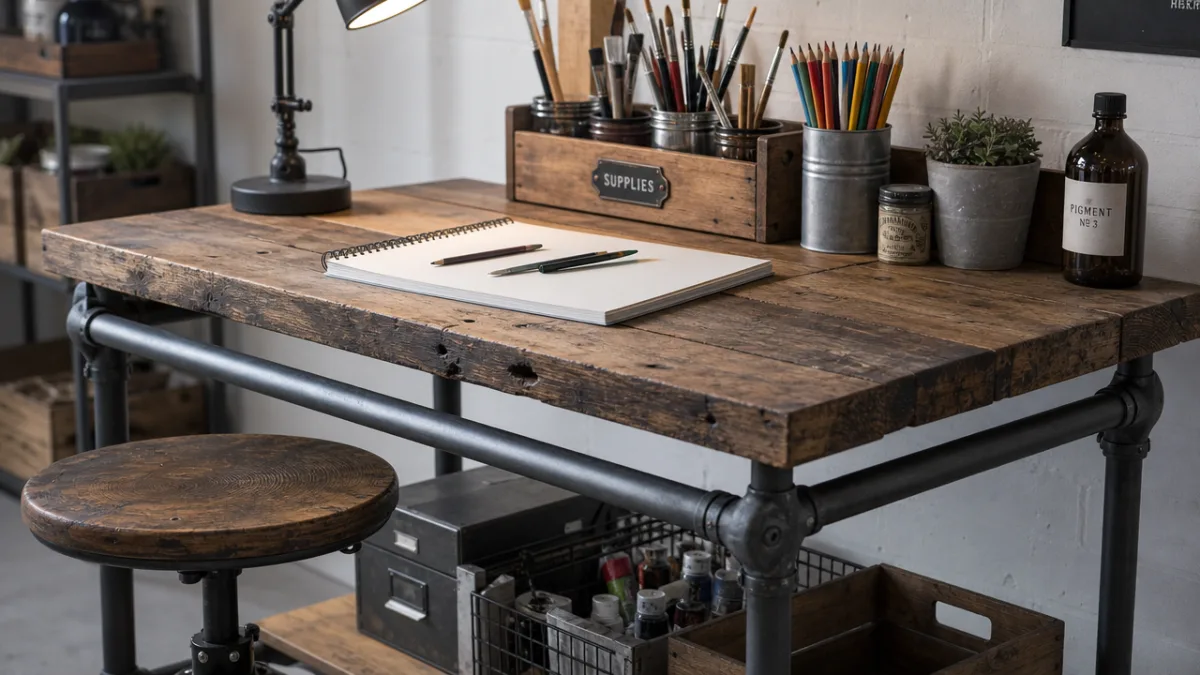
For artists who enjoy a more industrial aesthetic, pipe and reclaimed wood builds have become enormously popular in studio spaces. Black iron pipe fittings from hardware stores can be assembled into sturdy, visually striking table frames that pair beautifully with reclaimed barn wood, old door panels, or even thick plywood tops that have been sanded and stained. These builds are highly customizable in terms of width and depth, and the pipe frame can be designed to include built-in shelving, hanging rods for tools, or clamping points for lights and magnification equipment.
Another accessible DIY option is the IKEA hack approach that has become a staple of creative studio communities online. Pairing IKEA kitchen base cabinets — which stand approximately 35 inches tall with a countertop attached — creates an instant counter-height workstation with abundant built-in storage. Artists frequently customize these units with pull-out drawers for paper and canvas storage, deep interior shelves for paint and supply organization, and custom-cut tops of butcher block, marble contact paper over MDF, or glass for an elevated finish that belies the budget-friendly foundation.
Step-by-Step Tips for a Simple DIY Build
Planning a DIY counter-height table begins with careful measurement of your studio space and your own body. The ideal surface height for most people working in a standing or semi-standing position is at hip height — typically between 34 and 38 inches depending on your stature. Before purchasing materials, stand at your kitchen counter or a similar surface and assess whether you feel comfortable working there for an extended period. Adjust your target height accordingly, keeping in mind that the type of stool or drafting chair you plan to use will also influence the ideal surface level.
- Measure your studio space carefully before purchasing lumber or a countertop, accounting for traffic flow, door clearance, and natural light direction.
- Select leg hardware rated for at least twice the expected load — art supplies, equipment, and wet materials can be surprisingly heavy.
- Sand and seal any raw wood surface with at least two coats of polyurethane or oil finish before using the table, protecting it from moisture and chemical spills from day one.
- Consider installing a lower shelf or stretcher bar between the legs approximately 12 inches from the floor to brace the structure and provide a convenient foot rest when seated on a stool.
- If adding a backsplash or pegboard panel, attach it before placing the tabletop to avoid awkward drilling angles later in the build process.
Once your basic structure is assembled, the real creativity begins with customization. Adding a strip of LED lighting beneath the countertop edge illuminates your work surface beautifully during evening studio sessions and creates a professional atmosphere without expensive overhead lighting changes. Magnetic knife strips mounted at the back edge of the table hold metal tools, palette knives, and scissors within reach without cluttering the work surface. Small bungee cord systems strung between the table legs can hold rolled paper, canvas, or fabric vertically, making the most of under-table space that might otherwise go unused.
Organizing Your Counter-Height Workspace for Maximum Creativity
A well-organized counter-height worktable is not merely a tidy workspace — it is a carefully engineered environment that reduces friction between your creative impulses and the physical execution of your ideas. When every tool is accessible, every supply is visible, and the surface itself is clear of unnecessary clutter, the mental energy that might otherwise go toward searching, shuffling, and improvising can flow directly into the work. Artists who design their storage systems with the same intentionality they bring to their creative work consistently report higher output and greater satisfaction in their studio time.
At counter height, vertical organization becomes your greatest ally. The wall space directly behind and above your worktable is prime real estate for pegboards, magnetic panels, deep shelving, and hanging systems that keep your most frequently used supplies at eye and shoulder level. Pegboard panels are particularly versatile — hooks, bins, shelves, and holders can be rearranged at any time as your needs change, making the system as dynamic as your practice itself. Many artists color-code their pegboard storage by medium or project, creating an intuitive visual language that speeds up setup and breakdown between different types of work.
Drawer organization beneath or beside the counter-height surface should be stratified by frequency of use. Items used daily — primary brushes, preferred pencils, mixing tools — deserve the most accessible drawers at the most convenient height. Supplies used weekly or monthly can sit in deeper or harder-to-reach storage. Materials purchased in bulk for future use belong in labeled bins or boxes that can be stored entirely out of the immediate workspace. This hierarchy keeps the work surface itself free of accumulation and ensures that the energy of the studio space remains focused and purposeful rather than chaotic and overwhelming.
Smart Storage Solutions for Counter-Height Setups
Rolling carts positioned at counter height are among the most beloved organizational tools for artists working at raised surfaces. A cart whose top shelf aligns with your worktable surface essentially functions as an extension of your table when brought close, doubling your usable surface area for large projects. Rolled away, it tucks beneath a standard shelf or into a closet, freeing the studio floor for movement and other activities. Look for carts with at least three tiers and locking casters; models originally designed for salons, medical offices, or restaurant kitchens are often sturdier and more generously sized than products marketed specifically to artists.
Transparent storage is particularly valuable in a studio context because it allows you to locate supplies visually without opening every drawer and bin. Glass jars arranged on a raised shelf behind the worktable display brushes, pens, and tools attractively while making it instantly clear when supplies are running low. Clear acrylic drawers and stackable containers reveal their contents at a glance, eliminating the frustrating archaeology that can consume precious studio time when supplies are buried in opaque bins. A combination of open, visible storage for active supplies and closed storage for bulk materials and finished work strikes the most practical balance for most artists.
Lighting Strategies for Counter-Height Artist Worktables
Lighting is arguably the single most important environmental factor affecting the quality and accuracy of work done at an artist’s worktable, and counter-height setups create both unique challenges and wonderful opportunities in this regard. Because the work surface is elevated relative to a standard desk, under-cabinet and strip lighting solutions that are common in kitchen design translate beautifully to the studio context. A warm-white or full-spectrum LED strip mounted to the underside of an overhead shelf or cabinet creates even, shadow-free illumination across the entire work surface without the harsh contrast of a single overhead fixture.
Color-accurate lighting is essential for artists working with pigment, and counter-height setups make it particularly easy to integrate adjustable task lighting at the ideal angle and distance. Look for light sources rated between 5000K and 6500K color temperature — this range approximates natural daylight and renders colors most accurately, preventing the common frustration of mixing a perfect tone under warm indoor light only to discover it reads entirely differently in natural conditions. Full-spectrum bulbs designed for artist studios are widely available and make a tangible difference in color accuracy during indoor work sessions.
For artists working in the evening or in studios without abundant natural light, a combination of ambient, task, and accent lighting creates a layered environment that is both functional and inspiring. Ambient lighting from overhead fixtures or floor lamps establishes the general light level of the space. Adjustable task lights — either clamped to the table edge or mounted on articulating arms from a nearby wall — provide targeted illumination for detail work. Accent lighting such as LED strips behind shelving or under the table edge adds depth and visual warmth to the studio environment, making time spent there genuinely pleasurable rather than merely utilitarian.
Natural Light Considerations and Window Placement
Artists have long understood the irreplaceable quality of natural light in the studio, and positioning a counter-height worktable to take advantage of available daylight should be a primary consideration when designing or arranging your space. North-facing windows provide the most consistent, diffuse natural light throughout the day, free from the color shifts and direct glare that east- and west-facing windows introduce as the sun moves across the sky. If you have the flexibility to choose your table’s orientation, placing it near a north-facing window is the classic studio arrangement for good reason.
When direct sunlight is unavoidable, translucent window film, sheer curtains, or adjustable blinds can diffuse harsh beams without blocking the overall light level. Some artists install a simple white reflective panel on the opposite wall from their primary window to bounce diffused light back across the work surface, effectively doubling their usable natural illumination without any electrical investment. Skylights, where possible, offer perhaps the most desirable natural lighting for a worktable — the overhead angle eliminates shadows caused by the artist’s own body and provides remarkably even, true-color illumination throughout the working day.
Inspiring Counter-Height Worktable Setups from Real Artist Studios
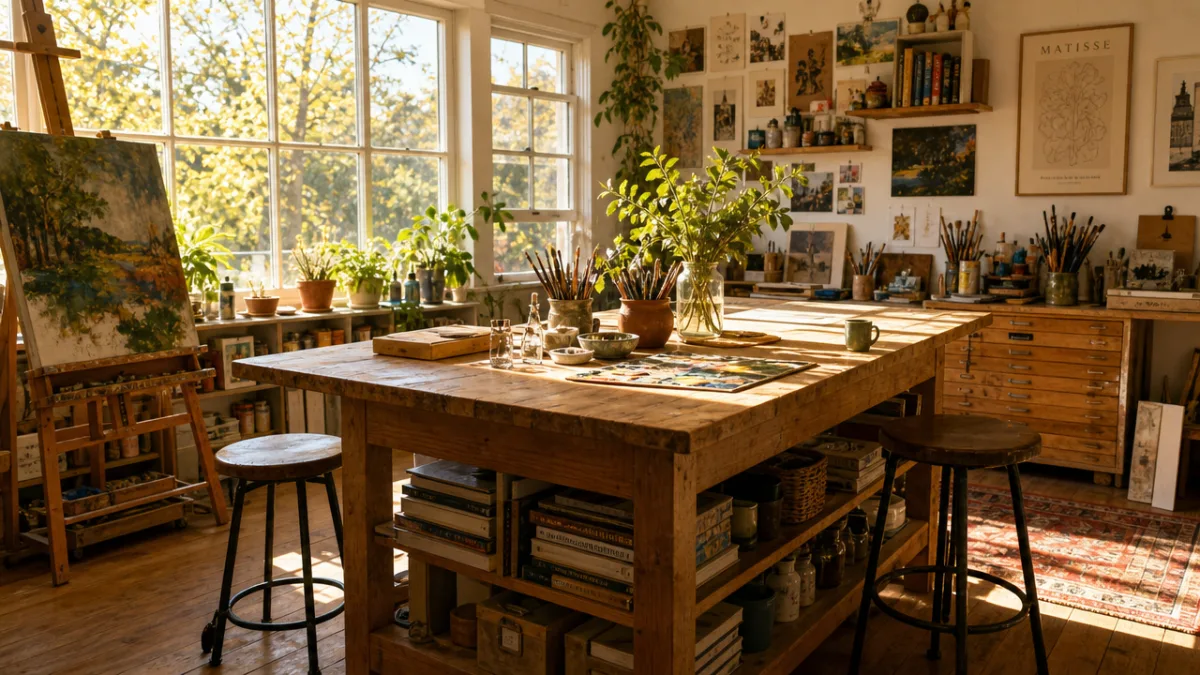
Across disciplines and studio sizes, artists have found remarkably creative ways to incorporate counter-height worktables into spaces ranging from expansive live-work lofts to compact apartment corners. Urban painters in small studios often build counter-height tables into window alcoves, making use of natural light and creating a defined workspace within a multifunctional room. The elevated surface also serves as a visual barrier between living and working areas — a psychological boundary that helps signal to the brain that it is time to create, even in a studio that doubles as a living room or bedroom.
Printmakers and bookbinders, who require substantial flat workspace and the ability to apply even pressure across large surfaces, often opt for industrial steel counter-height tables originally designed for commercial kitchens or laboratories. These surfaces can be found affordably through restaurant supply stores and used equipment dealers, and they bring enormous durability and easy cleanability to demanding studio practices. The stainless steel top reflects overhead lighting beautifully and provides an almost surgical precision to work that requires registration, alignment, and consistent measurement.
Jewelry artists and fine craftspeople who work at microscopic scale sometimes create counter-height setups that integrate a jeweler’s bench pin, magnification lamp, and micro-storage system into a single cohesive unit no wider than 30 inches. This compact, intensely organized approach demonstrates that counter-height work is not exclusively about having a large surface — it is about bringing your body into an optimal relationship with your work, whatever its scale. A well-designed jewelry station at counter height can hold every tool and supply needed for an entire day’s work while occupying less floor space than a single dining chair.
Adapting Your Existing Furniture to Counter Height
Not every artist has the budget or space for a dedicated new worktable, and the good news is that many existing pieces of furniture can be adapted to function at counter height with relatively modest investment. Standard dining tables, which sit around 30 inches tall, can be raised to counter height using furniture risers — sturdy platforms that slip under each leg to add 4 to 6 inches of height. While not ideal for very heavy studio use, this approach works well for artists who primarily work with lightweight materials such as paper, pen, and ink.
Adjustable-height standing desks, which have become widely available and increasingly affordable in recent years, offer the ultimate flexibility for artists who want the option of working at multiple heights throughout the day. Many models adjust from standard desk height all the way to standing counter height with the push of a button, and some include memory settings for different saved positions. For artists who shift between detailed seated work and broad standing work within a single session, an electric height-adjustable desk can be among the most transformative studio investments available.
Ultimately, the best counter-height worktable for any artist is the one that fits their body, their medium, their space, and their workflow most naturally. Whether you invest in a custom-built professional surface, construct a thoughtful DIY version from hardware store materials, or adapt what you already own, the core principle remains the same: your worktable should serve your creative process, support your physical wellbeing, and make the daily practice of art feel accessible, comfortable, and genuinely joyful. With the right surface at the right height, the studio becomes not just a place you work, but a place you want to be.








What do you think?
It is nice to know your opinion. Leave a comment.