










Caricature: The Art of Exaggeration, Expression, and Cultural Commentary
The Origins and History of Caricature Art
Caricature has a surprisingly long and colorful history — one that stretches back several centuries and has its roots firmly planted in European artistic tradition. The word itself comes from the Italian caricare, meaning “to load” or “to exaggerate,” which pretty much nails what the art form is all about. From the very beginning, caricature has been a way for artists to make a point — about people, about politics, about society — by pushing recognizable features just past the point of reality until something true and often a little uncomfortable comes into focus.
Most art historians trace the formal beginnings of caricature as a serious discipline back to the Carracci brothers — Annibale and Agostino — working in Bologna in the late 1500s. These guys started producing exaggerated portrait sketches mostly as an intellectual exercise, a kind of high-minded amusement, and in doing so accidentally launched one of the most enduring traditions in Western art. Their method was straightforward but clever: zero in on whatever physical trait made a person look most like themselves, then turn up the volume on it — dramatically — while keeping just enough of the rest accurate that you’d still recognize the face.
By the 1600s and 1700s, caricature had spread across Europe, and nowhere did it take hold more enthusiastically than England. Artists like William Hogarth used visual satire to hold up a mirror to Georgian society’s moral failures and social pretensions, laying the groundwork for what became a golden era of British caricature. The printing press was a huge part of this — suddenly these images could be reproduced as broadsides and pamphlets and passed around, taking the art form well beyond wealthy collectors and straight into the streets.
The nineteenth century turned caricature into something almost institutional. Satirical publications like Punch in Britain and Le Charivari in France gave caricaturists a regular platform and a mass readership. This era produced legends — James Gillray, Thomas Rowlandson, Honoré Daumier — whose work didn’t just entertain but genuinely shaped public opinion. A sharp caricature in the right publication could do real political damage, and everyone knew it.
Techniques and Tools of the Caricature Artist
Making a great caricature is harder than it looks. It takes sharp observational skill, solid artistic technique, and a kind of intuitive psychological read on your subject. Before touching pen to paper, a caricaturist has to really study the face in front of them — not just glance at it, but understand how the features relate to each other geometrically, how the person naturally holds their expression, and what specific combination of details makes their face instantly theirs. It’s almost like you’re building a mental map of the person before you draw a single line.
The central challenge is knowing what to exaggerate and what to leave alone. A beginner might just distort everything, but that’s not caricature — that’s just a weird drawing. Real skill means amplifying the features that are most distinctive to that particular person while keeping the less remarkable ones closer to realistic proportions. Big nose? You lean into it. Unremarkable ears? Those stay relatively normal. The test of a good caricature is whether the subject is still instantly recognizable even as they look nothing like a photograph of themselves.
Today’s caricature artists have a wide range of tools at their disposal. On the traditional side, there’s pencil, ink, watercolor, and charcoal — each with its own feel and expressive range. On the digital side, drawing tablets and software like Procreate, Adobe Illustrator, and Photoshop have opened up a whole new world of creative possibilities and made the art form more accessible to people still learning the ropes. Plenty of working caricaturists move comfortably between both worlds, combining the warmth of hand-drawn lines with the convenience of digital editing.
The following approaches represent the most commonly employed techniques in professional caricature work:
- Feature Analysis: Before you draw anything, take stock of the face — figure out which features are the most distinctive and which ones are fairly average. You’re building a mental priority list of what gets exaggerated and what gets dialed back.
- Proportion Adjustment: Deliberately shift the sizes and spatial relationships between features to put the spotlight on what makes this face unique, while keeping the overall image recognizable.
- Line Quality Variation: The weight and confidence of your lines can say a lot about personality. Bold, decisive strokes work well for forceful subjects; lighter, more delicate lines can suggest a gentler character.
- Color and Shading: Smart use of color and shadow can amp up the emotional punch of a piece and reinforce your read on the subject’s personality.
- Gesture and Posture: A great face caricature gets even better when the body language matches — the right pose or characteristic gesture can make the whole thing click into place.

Caricature as Political and Social Commentary
Caricature has always been one of the sharpest tools available to anyone wanting to critique power. There’s something uniquely effective about reducing a politician or a social phenomenon down to its essential absurdity in a single image — it lands faster, sticks longer, and often cuts deeper than a thousand words of editorial prose. In the right hands, a well-placed caricature could do more damage to a public figure’s reputation than a lengthy exposé, simply because the message hit you in the gut before your brain even had time to process it.
That effectiveness has made caricature a target throughout history. Plenty of powerful figures and authoritarian governments have tried to suppress it, which usually just made it more powerful. Napoleon, famously thin-skinned about his depictions, tried to limit caricature’s circulation in France. More recently, governments around the world have imprisoned and persecuted caricaturists whose work hit too close to home. The attempts at censorship almost always backfire — a caricature that someone is trying to ban tends to take on a life of its own.
Political caricature is very much alive today. Editorial cartoonists are still doing what Gillray and Daumier did — using exaggeration and visual metaphor to cut through the noise of modern media and say something true and immediate about the people in power. Artists like Gerald Scarfe and Ralph Steadman, along with a new generation working largely in the digital space, carry that tradition forward with every piece they publish.
Social caricature — which takes aim at cultural trends and collective behaviors rather than specific individuals — has its own equally rich history running alongside the political tradition. From Hogarth skewering gin-soaked Georgian society to today’s cartoonists taking shots at smartphone addiction and social media self-obsession, this kind of work holds up a mirror to how we all behave and dares us to laugh at what we see. It works because it targets archetypes — situations and types that almost anyone in the audience will recognize from their own life.
Portrait Caricature: From Street Art to Entertainment
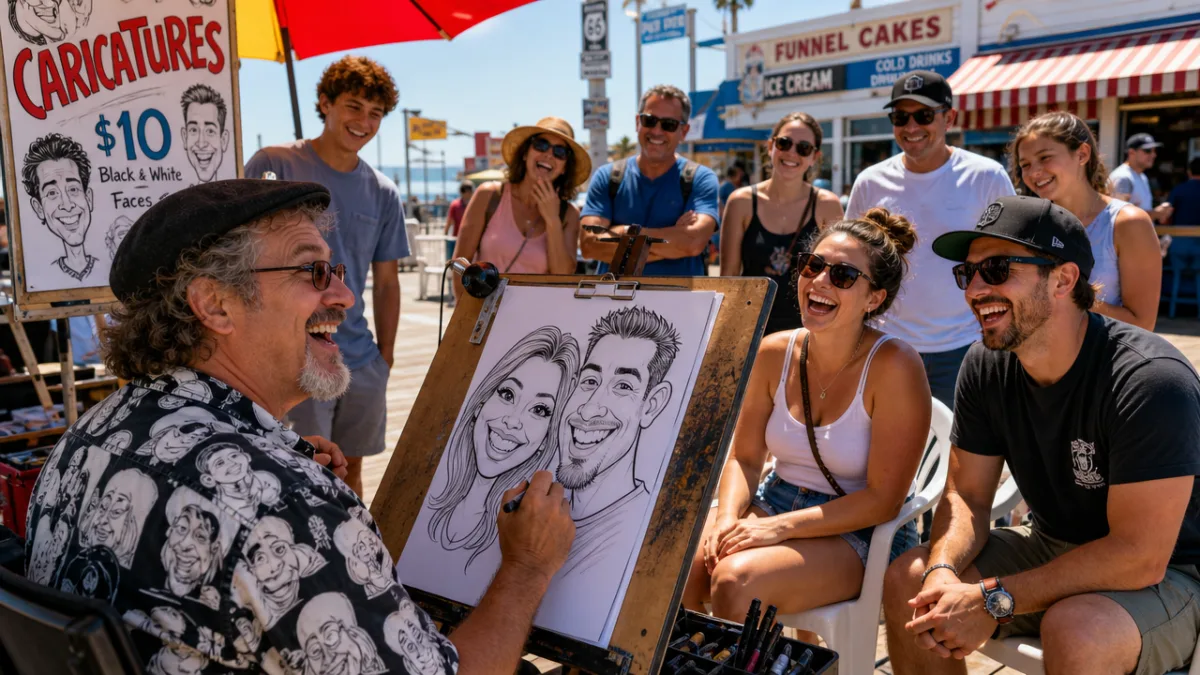
At the other end of the spectrum from political caricature sits portrait caricature — the kind made for private individuals, for fun and for keeping. From boardwalk artists sketching tourists in five minutes flat to portrait caricaturists hired for corporate events and milestone celebrations, this branch of the art form has developed its own conventions, techniques, and cultural place over the centuries.
There’s something genuinely special about watching a skilled caricaturist work live. In just a few minutes, they read a stranger’s face, decide what to amplify, and produce a likeness that’s both obviously exaggerated and unmistakably accurate. The subject usually goes through an interesting emotional ride — somewhere between delight, recognition, and mild horror — which is a big part of why the experience is so memorable. It’s one of the more immediate and human forms of artistic encounter you can have in everyday life.
Digital platforms have reshaped portrait caricature in a big way. Custom caricature commissions now thrive online, with artists all over the world taking photo submissions and delivering finished digital portraits for birthdays, retirements, weddings, and all kinds of other occasions. It’s a natural fit — the personal quality of a custom artwork, combined with the convenience of sending and receiving everything digitally. AI caricature generators have also appeared, and while they’re technically impressive, they consistently fall short of what a skilled human artist produces. Capturing genuine personality, finding the right balance between exaggeration and recognition — that still requires a human eye and a human hand.
The Psychology of Caricature: Why Exaggeration Works
Here’s something interesting: caricature works as well as it does because of the specific way our brains are wired to recognize faces. We don’t identify people by memorizing every detail of their face with photographic precision — we pick out a handful of distinctive features and use those as anchors. Caricature exploits this beautifully by cranking up exactly the features our recognition systems already lean on, while stripping away the noise. In a strange way, a great caricature can actually be more recognizable than a photograph, because it highlights the things our brains were already doing the work of noticing.
The psychologist Susan Carey, building on ideas from the art historian Ernst Gombrich, helped give this a theoretical foundation. Her research showed that faces are processed relative to a mental average — a kind of internal prototype of what a “normal” face looks like. Caricature works by exaggerating the ways a specific face deviates from that average. In other words, a skilled caricaturist is doing intuitively and artistically exactly what face-recognition science has confirmed: finding and amplifying the deviations from the norm that make each face distinct.
The humor in caricature also has a clear psychological logic. A lot of comedy depends on the sudden recognition of a truth that’s been presented in an unexpected or exaggerated way — the laugh you get when something is both surprising and obviously right. When you see a caricature of a familiar politician and it makes you laugh, it’s often because the exaggeration confirms something you’d already sensed but hadn’t quite put into words. That “it’s funny because it’s true” response is the art form doing exactly what it’s supposed to do.
Being caricatured is its own psychological experience. People react in all sorts of ways — some find it delightful, some find it genuinely unsettling, some get a little defensive. How a person responds to their own caricature tends to say something about them. Politicians who take it in stride, or even laugh along, come across much better than those who respond with outrage or legal threats. In that way, caricature isn’t just commentary on its subjects — it’s also a kind of low-stakes character test.
Caricature in the Digital Age: New Frontiers and Continuing Traditions
The digital revolution has changed caricature in ways that would probably astonish Gillray and Daumier. Social media platforms — Instagram, Twitter, TikTok — have become the primary spaces where contemporary caricaturists share their work and build their audiences, without needing a newspaper or gallery to act as gatekeeper. The result has been a genuine explosion of diversity and experimentation, with artists from all over the world developing distinctive personal styles and finding their people online in ways that simply weren’t possible before.
AI has entered the picture too. Automated caricature generators can now produce something recognizable from a photograph in seconds, which naturally raises questions about what that means for human artists. The general consensus, though, seems pretty clear: AI caricatures are technically passable, but they lack the interpretive intelligence and genuine artistic vision that make great human work great. The best caricaturists understand personality, cultural context, and visual storytelling in ways that current AI just can’t replicate, and that understanding is exactly what gives their work its punch and staying power.
Animation and game design have also developed rich traditions that draw directly on caricature principles. Classic Disney characters, beloved video game protagonists, memorable animated villains — many of the most enduring visual characters in popular culture are built on exaggerated proportions, simplified but expressive features, and characteristic poses that are pure caricature at heart. The relationship has been genuinely two-way, with caricaturists working in animation and game studios, and character designers borrowing liberally from caricature’s toolkit.
The future looks like a mix of challenges and real opportunities. As AI tools keep improving, the human caricaturists who thrive will be the ones whose work offers something AI can’t — genuine insight, creative personality, stylistic distinctiveness, and the kind of interpretive depth that only comes from truly understanding another human being. At the same time, digital tools keep expanding what human artists can do, opening up new modes of expression that earlier generations couldn’t have imagined. And underneath all of it, the basic human impulse that caricature has always served — the desire to see through the clutter and find the clarifying, sometimes uncomfortable truth that a little strategic exaggeration can reveal — doesn’t seem to be going anywhere.








What do you think?
It is nice to know your opinion. Leave a comment.