










Your Magical Orb of Christmas Cheer: A Complete Guide to Holiday Ornament Magic
The Timeless Tradition of Christmas Ornaments
There’s just something about a Christmas ornament, isn’t there? Whether it’s a fragile blown-glass sphere that’s been in your family for generations or a sparkly bauble you picked up at the store last week, ornaments have a kind of magic that other holiday decorations just can’t quite match. They catch the light in ways that feel almost deliberate, slowly spinning on their hooks and scattering tiny rainbows across your walls. For millions of families, pulling ornaments out of storage every December is every bit as meaningful as any other holiday tradition.
The history of Christmas ornaments actually goes back centuries, rooted in both pagan winter festivals and early Christian celebrations. The whole idea of decorating trees with round objects is thought to have grown out of a medieval tradition where apples were placed on evergreen branches to represent the fruit of the Garden of Eden during mystery plays. Over time, as glassblowing techniques improved in places like Lauscha, Germany, those symbolic apples gave way to the shimmering glass spheres we know today. By the late 1800s, Christmas ornaments had become a genuinely coveted item, and the demand for those gleaming little baubles had spread across Europe and all the way to North America.
So why has the round sphere become the enduring symbol of Christmas cheer? Its shape is thought to represent wholeness, eternity, and the endless turn of the seasons. Unlike anything with sharp corners or hard angles, a sphere has no beginning and no end — which makes it a quietly meaningful thing to hang on a tree that itself symbolizes everlasting life. And whatever the surface looks like, matte, shiny, glittered, or painted, an ornament reflects the world around it, pulling the warmth and color of a room into its own tiny little universe.
Choosing the Perfect Ornament for Your Holiday Vision
Before you start loading up your tree, it really helps to have a sense of the look you’re going for. Are you dreaming of a classic red-and-gold tree straight off a Victorian Christmas card? A cool, wintry palette of silver, white, and deep blue? Or maybe a wonderfully chaotic collection where every single ornament tells its own story, no matching required? Getting clear on your vision early makes the whole shopping process a lot more fun and a lot less overwhelming — especially when you’re faced with the truly staggering variety out there in stores and online.
When you’re picking ornaments, think about how the finish will interact with your lighting. High-gloss and mirror-finish ornaments are absolutely showstopping under warm incandescent or Edison bulbs, bouncing reflections all over the room. Matte ornaments work the other way — they absorb light and create a softer, almost velvety depth that feels right at home on minimalist or Scandinavian-inspired trees. Glittered ornaments land somewhere in the middle, scattering light in a soft, dreamy way that photographs beautifully and gives any tree a fairy-tale glow after dark.
Size is something a lot of people underestimate. A tree hung exclusively with same-sized ornaments can end up feeling flat and a little dull, but mix in some large statement pieces, medium fillers, and small accent baubles, and suddenly you’ve got rhythm and visual interest. A good rule of thumb: tuck your biggest, most dramatic ornaments deeper into the tree where they can really benefit from the depth, put medium ornaments on mid-length branches, and save the small, delicate ones for the tips where their lightness actually works in their favor. That layered approach is what gives a finished tree that lush, intentional look.
- Glossy ornaments: best suited to trees lit with warm white or vintage Edison bulbs, maximizing reflection and drama.
- Matte ornaments: ideal for modern, minimalist, or Scandinavian-themed trees where texture takes precedence over shine.
- Glittered ornaments: versatile and photogenic, working well in both traditional and whimsical holiday displays.
- Hand-painted ornaments: best showcased on branches with room for the design to be seen clearly, away from dense foliage.
- Mercury glass ornaments: particularly stunning when clustered together, as their antique finish creates a cohesive, vintage-inspired vignette.

DIY Magic: Crafting Your Own Orbs of Christmas Cheer
There’s a special kind of satisfaction in hanging an ornament you actually made yourself. Handmade ornaments turn a tree from a pretty display into something personal — a little gallery where every piece carries the memory of how it came to be. The great news is that you don’t need advanced artistic skills or a big craft budget to make ornaments that are genuinely beautiful. With a bit of imagination and some basic supplies, you can create pieces that are completely one-of-a-kind and feel totally true to your family’s personality.
Clear fillable glass or plastic ornament balls are the starting point for so many popular DIY projects. These hollow spheres — easy to find at most craft stores in a range of sizes — can be filled, painted, or decorated in what feels like endless ways. One of the most beloved techniques is swirling acrylic paint inside the ball, capping it, and slowly rotating it until the interior is coated in a marbled wash of color. Once the paint dries, you’re left with something that looks sophisticated and gallery-worthy, even though it only took a few minutes to make. For a snow globe vibe, a dusting of artificial snow and a few sprigs of dried botanicals tucked inside create this ethereal, wintry effect that’s just gorgeous.
Of course, the outside of the ball is just as fun to work with. Try decoupaging jewel-toned tissue paper onto the surface and sealing it with Mod Podge for a stained-glass look that practically glows against tree lights. Or grab a gold paint pen and draw geometric patterns, little botanical illustrations, or holiday motifs directly onto the surface for a hand-lettered, personalized feel. Monogrammed ornaments make especially meaningful gifts, even more so when you include a little handwritten note about the story behind the design.
- Gather your clear fillable ornament balls and remove the metal caps before starting any interior decoration.
- For painted interiors, pour a small amount of acrylic paint into the ball and rotate gently until fully coated, then leave cap-side down to drain and dry completely.
- For decoupage exteriors, tear tissue paper into small irregular pieces, brush the ball lightly with Mod Podge, and apply the tissue pieces with overlapping edges for full coverage.
- Seal all exterior decorations with a clear matte or gloss sealant spray to protect the finish through the entire holiday season.
- Reattach the metal cap firmly and loop ribbon or wire through the hook for hanging, making sure the connection point is secure before placing on the tree.
Displaying and Styling Your Ornament Collection
A great ornament collection deserves more than just a tree, and honestly the tree is just the beginning. Ornaments that are too precious or fragile to survive a busy household can look absolutely stunning displayed in glass bowls, apothecary jars, or wooden trays scattered around the house. A large glass cloche filled with vintage ornaments and a few sprigs of preserved eucalyptus makes an instantly elegant centerpiece that looks like it took real effort — even when it really didn’t.
When it comes to the tree itself, placement is genuinely an art form, and it’s worth slowing down a little rather than rushing through it. Always start with your lights fully in place before any ornaments go on — trying to rearrange lights around already-hanging ornaments is a guaranteed frustration. Once the lights are set, work through your ornaments in order of size: largest and most significant pieces first, spread evenly around the tree so the visual weight feels balanced from every angle. Then add your medium ornaments, then the small accent pieces, and finally any delicate toppers, finials, or novelty items that deserve a moment in the spotlight.
Ribbon, garland, and picks are the secret weapons that fill the gaps no amount of ornaments can fully address. Wired ribbon woven loosely in and out of the branches creates this lovely flowing vertical movement, while beaded garland traces horizontal lines that give the eye a path to follow and give your ornaments a sense of structure to hang within. Picks — those little decorative sprays of berries, stars, or feathers — add texture and dimension at a small scale and are especially useful for filling in those inner branches that ornaments rarely reach.
- Glass bowls and trays: perfect for displaying a curated collection of ornaments as a centerpiece on a dining or coffee table.
- Vintage wire baskets: ideal for stacking ornaments in a rustic, farmhouse-inspired arrangement near the fireplace.
- Floating shelves: a modern approach to ornament display, where individual ornaments are propped or hung along a shelf for a gallery-style presentation.
- Wreaths: ornaments wired into a wreath form add color, sparkle, and dimensionality to this classic holiday accent.

The Emotional and Nostalgic Power of Holiday Ornaments
Ask anyone about their favorite Christmas ornament and you’ll almost always get a story in return. Maybe it’s a hand-painted wooden disk with a toddler’s smudged fingerprint pressed into it, or a little ceramic angel bought on a honeymoon trip somewhere far from home, or a glittery silver ball that always went on the tree first because the family decided it was the lucky one. Ornaments are one of the rare categories of home décor that carry real personal narrative — they’re not just decoration, they’re a physical record of a life lived and loved across many, many Decembers.
Psychologists who study memory and emotion have long recognized how powerful the sensory triggers of holiday rituals can be. The smell of pine, the sound of familiar carols, the sight of beloved ornaments — together they create a kind of multisensory memory experience that’s uniquely moving. Research in affective neuroscience suggests that objects tied to positive, ritualized experiences — like unwrapping ornaments from their tissue paper every December — actually activate the brain’s reward circuits in ways that feel genuinely comforting and grounding. It’s a big part of why even a cheap, simple ornament can hold extraordinary meaning for the person who owns it.
Building traditions around ornament giving is one of the most meaningful ways to create a family heirloom collection over time. Lots of families adopt the practice of giving each child one new ornament every Christmas, chosen to reflect that child’s interests, milestones, or personality during the year. By the time those kids are grown and setting up homes of their own, they leave with a whole collection of ornaments that functions like a visual biography of their childhood. It costs very little money but pays off enormously in meaning and connection across generations.
Caring for Your Ornaments: Storage, Preservation, and Longevity
Beautiful ornaments — especially antique or handmade ones — deserve to be taken care of properly so they can keep bringing joy for decades. The main enemies in storage are pressure, moisture, and temperature swings, all of which can crack glass, fade paint, and slowly degrade delicate finishes over time. A little bit of effort in January pays off enormously the following December, when you open your boxes and find everything exactly as you left it, ready to go back on the tree.
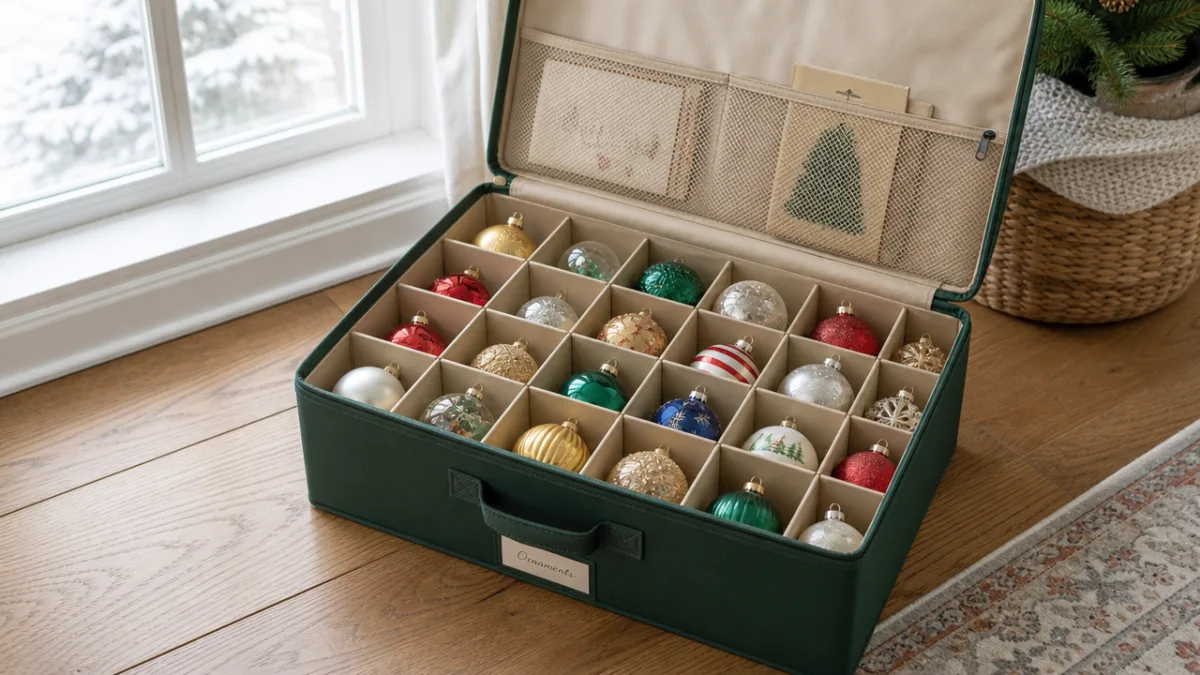
Dedicated ornament storage boxes with individual compartments are the gold standard here. Whether they’re cardboard, plastic, or fabric-covered, these boxes keep ornaments separated so they can’t knock against each other and chip or crack. For pieces that are especially fragile or precious, wrapping each one individually in acid-free tissue paper before it goes into its compartment adds an extra layer of protection. Steer clear of newspaper — the ink can transfer onto light-colored ornament surfaces and leave permanent stains over time.
Where you store ornaments matters just as much as how you pack them. Attics and garages are the go-to storage spots for a lot of households, but they’re actually pretty bad environments for ornaments — the temperature swings are extreme and moisture can be a real problem. A climate-controlled indoor closet is a much better option, keeping conditions stable enough to preserve glass, paint, and metallic finishes far more effectively. If the attic is truly your only option, putting the ornament boxes inside sealed plastic totes with a silica gel packet tucked in will go a long way toward protecting against the worst of it.
- Wrap each ornament individually in acid-free tissue paper, starting with any protruding hooks or decorative elements that could snag neighboring pieces.
- Place wrapped ornaments in divided storage boxes, filling empty compartments with crumpled tissue to prevent shifting during transport and storage.
- Label each box clearly with its contents, including any relevant notes about fragility or special handling requirements.
- Store boxes flat rather than on their sides to prevent ornaments from settling unevenly against the compartment walls under their own weight.
- Check on stored ornaments once during the off-season if possible, particularly in the first year of storage, to catch any moisture or pest issues before they spread through the collection.
It’s also worth taking a few minutes to photograph your collection. Even just a simple album on your phone gives you a record of your most meaningful or valuable pieces. If something ever gets lost, broken, or stolen, a clear photo makes it much easier to describe the piece accurately for insurance purposes or to track down a replacement. For heirloom or antique ornaments with real monetary or sentimental value, consider tucking a brief handwritten note into the tissue alongside the ornament — a few lines about where it came from, how old it is, and why it matters. That way, the story never gets separated from the object it belongs to.








What do you think?
It is nice to know your opinion. Leave a comment.