










Why Your Candle Smells Different Sometimes: The Complete Guide to Fragrance Variation
The Science Behind Candle Fragrance
If you’ve ever lit what you thought was your favorite candle only to find it smells weaker or just… off somehow, you’re not imagining things. Candle fragrance is surprisingly complex — it’s a mix of chemistry, physics, and environmental factors, and even the most carefully made candles can perform differently from one burn to the next. To understand why, it helps to know how fragrance actually works inside a candle.
Candles release scent through a process called volatilization — heat from the flame causes fragrance molecules to evaporate and float into the air around you. The wax holds the fragrance oil in suspension until heat is applied, and then those molecules start releasing at different rates based on their molecular weight. Light top notes like citrus or mint escape first and fast, while heavier base notes like musk or sandalwood take longer and need more sustained heat to really come through.
Then there’s fragrance load — the percentage of fragrance oil blended into the wax. Most quality candles land somewhere between six and twelve percent by weight. Too little, and the candle will smell faint even under perfect conditions. Too much, and the oil can’t properly bond with the wax, leading to what chandlers call fragrance pooling, where oil separates and collects on the surface. Either way, you end up with a candle that smells noticeably different from batch to batch, or even from itself at different points in its life.
How Wax Type Affects Scent Throw
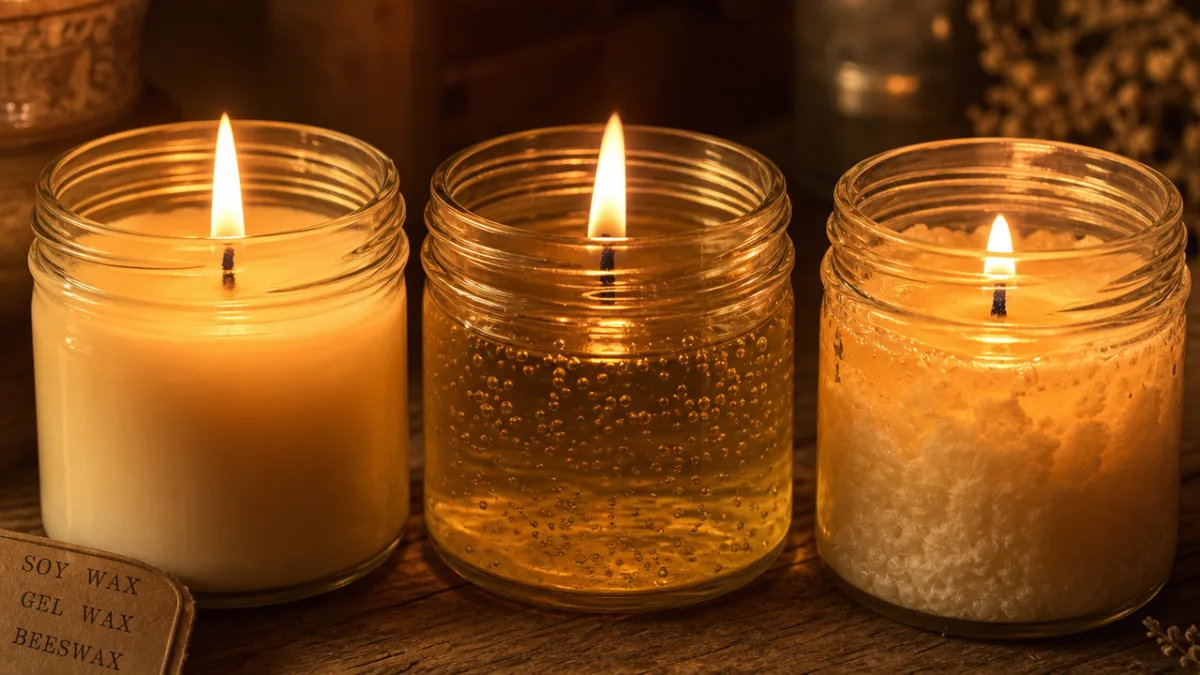
Not all waxes are created equal when it comes to holding and releasing fragrance. The type of wax in a candle is one of the biggest factors in how strong and true a scent smells when it burns. The three types you’ll run into most often are paraffin, soy, and beeswax, and each one has a different relationship with fragrance oils that plays out in real, noticeable ways.
Paraffin, which comes from petroleum, has a high oil absorption capacity and tends to produce a strong hot throw — meaning it puts out a lot of scent while burning. That’s a big reason why so many commercial candles use it: it’s predictable, affordable, and great at projecting fragrance. Soy wax is a natural alternative made from hydrogenated soybean oil. It typically produces a softer, more diffuse scent that many people find pleasant, though noticeably quieter than paraffin. Because soy has a lower melting point and a different crystalline structure, it holds and releases fragrance molecules in a pretty different way.
Beeswax candles are naturally the most fragrant of the three, bringing their own gentle honey-like scent to the table. When you add fragrance oils to beeswax, though, the results can be unpredictable since beeswax has a naturally lower fragrance retention capacity. Coconut wax and blended waxes have gotten increasingly popular in artisan candle making because they try to combine the best qualities of multiple wax types. So if your favorite candle maker has switched wax suppliers or adjusted their blend, that alone can explain why your candle smells different — even if nothing else on the label changed.
The Role of Fragrance Oils and Their Ingredients
Fragrance oils aren’t a single ingredient — they’re complex blends of aroma chemicals, natural essential oils, fixatives, and carrier solvents that can contain dozens or even hundreds of individual components. Because fragrance formulation is its own art and science, even a small shift in sourcing one of those components can change the overall smell in ways that are subtle but totally perceptible to a sensitive nose. That’s one reason a candle that smelled a certain way six months ago might smell slightly different today, even if the label looks exactly the same.
Fragrance houses — the companies that manufacture the oils candle makers use — occasionally reformulate their blends when ingredients become harder to source, prices shift, or regulations change. The International Fragrance Association (IFRA) regularly updates its guidelines on safe usage levels for specific aroma chemicals. When an ingredient gets restricted or banned, the fragrance house has to reformulate, and that reformulation can alter the character of a scent. A candle maker might have no idea this happened and keep ordering what they think is the same oil, only to have customers notice something’s different.
Natural essential oils are even more variable because they’re literally agricultural products. Lavender essential oil harvested in Provence during a dry summer will smell different from lavender grown through a wet season or from a different farm entirely. Vanilla, rose, jasmine, and many other beloved scent profiles rely heavily on naturally derived ingredients whose character shifts with growing conditions, harvest timing, and processing methods. If a candle maker works with a high percentage of natural essential oils, some natural batch-to-batch variation isn’t a flaw — it’s just the reality of working with ingredients that come from the earth.
Environmental and Storage Conditions That Change Scent
Even a perfectly made candle can smell completely different by the time you light it if it’s been stored badly. Heat, light, humidity, and air exposure are the four biggest enemies of candle fragrance. Fragrance oils are volatile by nature — that’s literally what makes candles work — but that same volatility means the oils will start to degrade or evaporate if the candle isn’t stored correctly. Most people seriously underestimate how much the storage environment shapes what they ultimately smell.
UV light is particularly hard on fragrance molecules. A candle sitting on a sunny windowsill or even under strong fluorescent lighting for an extended period can experience photodegradation of the aromatic compounds inside. The result is a candle that smells faded, flat, or just off in a way that’s hard to pin down but immediately noticeable. Some fragrance ingredients also cause discoloration when exposed to UV, which is why many candle makers add UV inhibitors to their formulas — though these tend to protect color more than they protect how the candle actually smells.
Temperature swings cause the wax to repeatedly expand and contract, which disrupts the fragrance binding within the wax over time. Candles stored in garages, car trunks, or near heat sources like ovens or radiators are especially vulnerable to this. High humidity can cause the wax surface to develop a film called frosting or bloom, and while that doesn’t necessarily wreck the scent throw on its own, it can signal that the wax structure has been compromised in ways that do affect performance. For the best experience, store candles somewhere cool, dark, and dry — and keep the lid on between burns to slow surface evaporation of the fragrance oil.
- Keep candles away from direct sunlight and UV sources to prevent photodegradation of fragrance molecules.
- Store candles at a stable room temperature, ideally between 60 and 75 degrees Fahrenheit, to prevent wax expansion and contraction.
- Always replace lids or covers between burns to reduce surface evaporation of fragrance oils.
- Avoid storing candles near strong-smelling substances that could be absorbed into the wax and alter the scent profile.
- Use candles within 12 to 18 months of purchase for the most reliable fragrance experience.
How Burning Practices Impact Fragrance Perception
How you burn a candle has a huge effect on how much fragrance it releases and how that fragrance actually smells to you. A lot of people assume you just light the wick and let the candle do its thing — but burning technique is actually one of the most controllable variables in the whole experience. A few small adjustments can be the difference between a scent that fills a room and one that barely reaches your nose.
The first burn is often called the memory burn because it sets the melt pool — the ring of liquefied wax that forms around the wick as the candle burns. If you blow the candle out before that melt pool has reached the edges of the container, the wax will tunnel straight down around the wick on every burn after that. A big chunk of your fragrant wax never melts, never heats up, and never releases its scent. Many candle fans are genuinely surprised by how much stronger their candle smells once they commit to that full first burn, which can take anywhere from one to four hours depending on how wide the container is.
Wick maintenance is another thing most people overlook, and it directly affects scent release. A wick that’s grown too long produces a larger, hotter, more chaotic flame that burns through wax too fast and can actually combust the fragrance rather than letting it gently volatilize. Instead of smelling clean and true, the candle can smell acrid or sooty. Trimming your wick to about a quarter of an inch before each burn encourages a steady, controlled flame that heats the wax pool gradually and releases fragrance the way the candle was designed to deliver it. Room size matters too — a small candle in a large, open space simply won’t be able to fill it the way it would in a cozier, more enclosed room.
Nose Fatigue and Psychological Factors in Scent Perception
Sometimes the candle hasn’t changed at all. You have. The human olfactory system is remarkably powerful but also deeply susceptible to something called olfactory fatigue, or nose blindness. When you’re continuously exposed to a particular scent, the receptors in your nose responsible for detecting it gradually become desensitized. The signal they send to your brain weakens, and your perception of the smell fades dramatically — even though the actual concentration of fragrance molecules in the air hasn’t changed, or might even be higher.
This is why you can walk into a room that smells intensely of something to a fresh visitor while you notice absolutely nothing after twenty minutes inside. With candles, this means a scent that feels overwhelming when you first light it can seem to vanish entirely half an hour later, even though the candle is still burning and putting out just as much fragrance. The fix is simple: step outside or into another room for a few minutes, then come back. Your olfactory receptors will partially reset, and the scent will likely hit you noticeably harder when you walk back in.
Psychological and emotional factors play a meaningful role too. Research in psychophysics has shown that our emotional state, expectations, and memories tied to a particular scent can dramatically shape how we experience it. If you associate a candle with a happy occasion from the first time you burned it, every subsequent burn carries that memory with it. If you burned the same candle during a stressful or difficult stretch, you might unconsciously perceive it less favorably now. Seasonal mood shifts, hormonal changes, medications, and even diet can all alter the sensitivity and character of your sense of smell in ways that are real and measurable. The candle might be perfectly consistent while your perception of it shifts based on things that are entirely internal to your own experience.
- Step outside briefly between candle burns to reset your olfactory receptors and restore scent sensitivity.
- Try smelling coffee beans, which are a traditional scent palate cleanser used in perfumeries, to clear your nasal receptors.
- Note whether you are experiencing congestion, taking medications, or feeling emotionally stressed, all of which can alter scent perception.
- Rotate your candle scents rather than burning the same one every day to reduce nose fatigue and maintain sensitivity.
- Burn candles in appropriate room sizes and ensure the space is lightly ventilated to allow fragrance to circulate properly.

Batch Variation and the Human Element in Candle Making
Candle making, even at a professional level, involves a significant human element that naturally introduces variation. Unlike mass-produced goods made under strict automated quality controls, most artisan and small-batch candles are made by hand — individual people measuring, mixing, pouring, and labeling each one themselves. Even with the best intentions and careful habits, hand-poured candles are subject to small differences in fragrance load, pour temperature, wick placement, and cure time that can all affect how the finished candle performs and smells.
Cure time is especially important and frequently underestimated. After a candle has been poured and cooled, it needs time to cure — the fragrance oil molecules need to fully bind with and integrate into the wax. A soy candle that’s cured for two weeks will typically smell stronger and truer to its intended fragrance profile than the same candle burned just two days after pouring. Many retailers sell candles before they’ve hit their optimal cure, and customers who burn them right away may be experiencing an underdeveloped version of the scent. If you can hold off for one to two weeks before lighting a new candle, it really can make a noticeable difference.
Seasonal production changes can also introduce batch variation in ways that aren’t obvious from the outside. A candle maker producing large quantities during the holiday rush may be working faster, sourcing from different fragrance suppliers due to high demand, or tweaking formulas to account for colder ambient temperatures — all of which affect the final product. Some makers note on their labels or websites that slight batch variation is a natural part of hand-poured candles and should be expected. Knowing that doesn’t make the difference less noticeable, but it does help you see it as part of the nature of artisan goods rather than a defect. If total consistency is your top priority, larger manufacturers with industrial production standards might serve you better than small-batch makers — though you might find yourself trading away some of the character and uniqueness that makes artisan candles worth buying in the first place.








What do you think?
It is nice to know your opinion. Leave a comment.