










The Citronella Candle That Actually Kept My Summer Patio Party Mosquito-Free
<h2 id="section-1-why-most-citronella-Candles-fail-you”>Why Most Citronella Candles Fail You
If you have ever hosted a summer gathering only to watch your guests slap at their arms while mosquitoes feast freely, you already know the heartbreak of a citronella candle that simply does not perform. The market is flooded with products that promise protection and deliver little more than a pleasant lemon-grass scent and a flickering flame. Understanding why most of these candles fall short is the first step toward finding one that actually works for your outdoor space.
The core problem lies in concentration. Most mass-market citronella candles contain only a fraction of the citronella oil needed to create an effective deterrent zone. Manufacturers often prioritize fragrance appeal over functional repellent strength, leaving consumers with something that smells nice during a spa day but offers almost no defense against determined, bloodthirsty mosquitoes on a warm July evening. The citronella concentration in budget candles typically hovers around one percent or less, far below what entomologists generally recommend for noticeable efficacy.
There is also the issue of burn pool size and heat distribution. A candle that burns unevenly or has a narrow melt pool releases far less aromatic compound into the surrounding air. Without sufficient heat to volatilize the citronella oil, the molecules never reach the concentration in the air necessary to confuse or repel mosquitoes. This is why you can have three cheap candles burning simultaneously and still end up with bite marks covering your ankles by the time dessert is served.
The Science Behind Citronella as a Repellent
Citronella oil, derived from specific varieties of lemongrass, works primarily by masking the carbon dioxide and lactic acid signals that mosquitoes use to locate their human targets. When the oil is present in sufficient concentrations in the surrounding air, it essentially creates an olfactory fog that makes it difficult for insects to navigate toward warm-blooded hosts. This is a passive repellent mechanism rather than a toxic one, which is part of what makes citronella appealing to people seeking a more natural approach to pest control.
Research from institutions including the University of Guelph has found that the effectiveness of citronella products is genuinely dose-dependent, meaning more oil in the air translates directly to better protection. The challenge with candles is that they are an inherently inefficient delivery mechanism compared to topical repellents or diffusers. However, when a candle is properly formulated with a high oil load and a wax blend that releases the citronella at an optimal rate during combustion, it can create a meaningful buffer zone of roughly two to three feet around each burning vessel.
Wind is the great enemy of any citronella candle setup. Even the most potent candle loses its protective cloud almost instantly when a strong breeze scatters the volatilized oil before it can accumulate near your guests. This is worth keeping in mind as you plan your party layout, since strategic placement in relation to typical wind direction can dramatically improve real-world performance regardless of how good the candle itself is.
What Makes a High-Performance Citronella Candle Different
After testing what felt like every citronella candle available online and at local garden centers, the differences between a genuinely effective product and a decorative disappointment became very clear. The best performers share a set of characteristics that set them apart immediately, from the weight of the jar to the color and Texture of the wax. Once you know what to look for, you will find it nearly impossible to impulse-buy a useless candle ever again.
The most important factor is the citronella oil concentration, which in premium candles typically ranges from five to ten percent of the total wax weight. This sounds like a modest difference from the one percent found in drugstore brands, but in practice it represents five to ten times more active repellent compound being released per hour of burn time. You can sometimes detect this concentration difference just by smelling an unlit candle — a truly loaded citronella candle has a sharp, almost medicinal lemon-green scent that is noticeably more intense than its weaker competitors.
Wax type also plays a significant role. Soy wax and coconut wax blends tend to hold fragrance oil better than paraffin and release it more evenly during the burn. They also typically produce a wider melt pool at a given wick size, which means more surface area releasing oil-infused vapor into the air around the flame. Many of the best outdoor citronella candles on the market today use a soy-coconut blend for exactly this reason, and the difference in throw — the candle industry’s term for how far the scent travels — is quite noticeable in side-by-side comparisons.
Key Features to Look for When Buying
When you are shopping for a citronella candle that will actually protect your outdoor entertaining space, there are several specific things worth evaluating before you commit to a purchase. Paying attention to these details will save you money and frustration over the course of a summer.
- Look for candles that list citronella oil as a primary ingredient, not just a fragrance note blended with other scents that dilute the active compound.
- Choose vessels with wide openings relative to their depth, since a wide melt pool maximizes the surface area releasing vapor into the air.
- Prioritize candles with multiple wicks, as these create more heat and a larger melt pool much faster after lighting than single-wick versions.
- Check for burn time ratings of at least forty hours, which usually indicates a sufficient wax load and a well-made wick that will not tunnel or self-extinguish.
- Consider weight — a genuinely loaded candle with high oil concentration will feel heavier than a comparable candle with minimal fragrance oil content.
Container design matters more than most people realize, especially for outdoor use. A candle in a wide, shallow vessel will outperform a tall, narrow jar every time because heat concentrates better and the melt pool forms more quickly. Some of the best outdoor citronella products come in squat, wide-mouthed containers that look almost industrial — and that design is entirely intentional. Aesthetics are secondary to function in this category, even if a beautiful candle on your tablescape would be a welcome bonus.

The Candle That Changed My Summer Hosting
Last summer, after two consecutive outdoor dinner parties that ended with guests retreating indoors by eight o’clock, I decided to approach the problem more methodically. I spent several weeks reading product reviews, academic articles on insect repellent efficacy, and candle-making forums where small-batch producers discussed their oil loading techniques in granular detail. By the time I made my next purchase, I had a clear picture of what I was actually buying and why it should perform differently than what I had tried before.
The candle that ultimately won me over was a small-batch soy-coconut blend made by an artisan producer who sources steam-distilled citronella oil directly from Sri Lanka, where the citronella grass variety known as Ceylon type is considered the most potent available commercially. The candle came in a wide, matte-black ceramic vessel with three wicks and hit a full melt pool within about fifteen minutes of lighting. The scent was immediately and almost aggressively present — not unpleasant, but unmistakably functional rather than decorative.
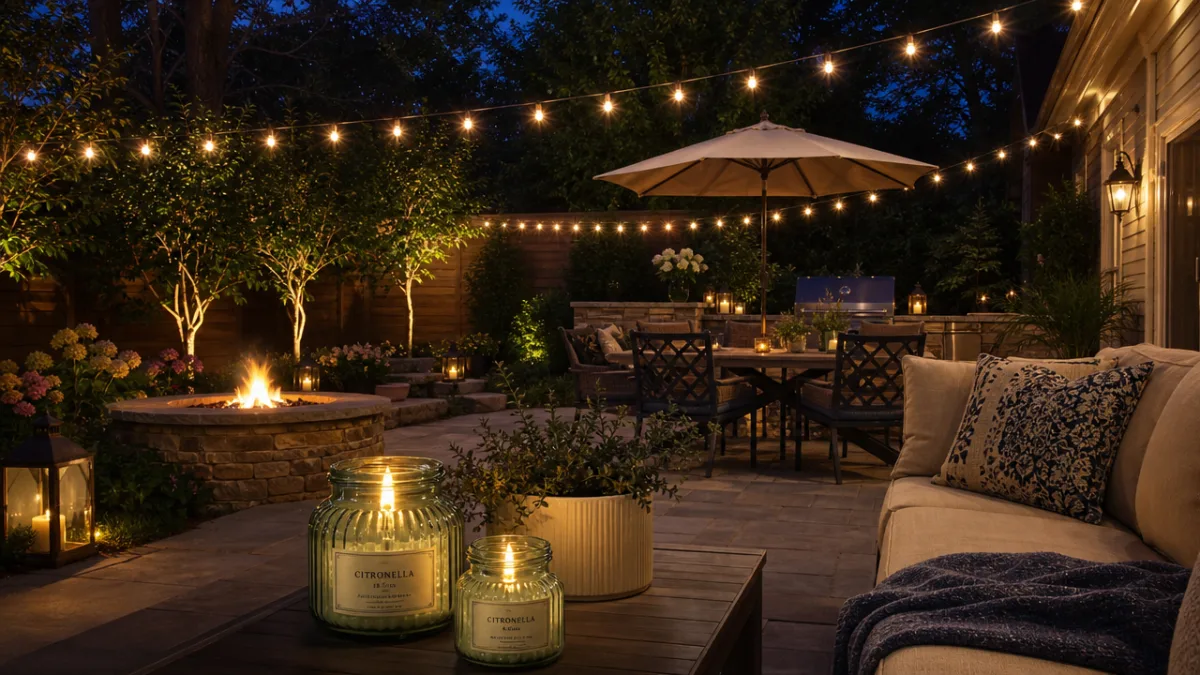
I placed four of these candles strategically around my patio during a birthday dinner for twelve people, positioning them at the perimeter corners of the seating area and two in the center of the table. The evening was warm and only mildly breezy, which admittedly favored the candles. But the result was genuinely remarkable. Two hours into the party, one of my friends — a woman who typically has to leave outdoor events early because mosquitoes specifically seek her out — remarked that she had not been bitten once. We stayed outside until nearly eleven, and the collective bite count for the entire group was fewer than five. That was the night I became a true believer in the difference that candle quality makes.
How I Set Up the Candle Perimeter for Maximum Coverage
Effective placement strategy matters as much as candle quality when you are trying to protect a specific outdoor area. Thinking about your patio like a zone you need to fill with airborne repellent, rather than simply adding a decorative element to the table, will help you deploy your candles in a way that actually creates overlapping protection bubbles around every seat.
- Begin by identifying the prevailing wind direction for your location during the time of your event — typically early evening in summer months — and place candles upwind so the scent is carried toward and across the seating area rather than away from it.
- Use a perimeter-plus-center approach, placing candles at the outer edges of your gathering space as well as at the center of dining tables so coverage overlaps from multiple directions.
- Elevate candles slightly when possible, placing them on small pedestals, plant stands, or stacked books to bring the heat and vapor release closer to guest breathing height rather than keeping it at ground level.
- Light candles at least twenty minutes before guests arrive so the melt pool is established and vapor release is already at maximum output when people sit down.
- Replace or supplement candles that have burned below the halfway point, as melt pool depth increases and vapor release efficiency tends to decrease as the wax level drops deep into the vessel.
One additional tip that made a real difference for me was combining the perimeter candles with a single citronella oil diffuser plugged into an outdoor-rated extension cord near the main seating cluster. This is not cheating — it is layering your defenses, which is exactly what pest management professionals do when they treat outdoor spaces. The diffuser provides a steady baseline of oil in the air while the candles add thermal lift and visual anchoring around the table. Together, they create a far more robust protection zone than either could manage alone.
Managing Expectations: What Citronella Candles Can and Cannot Do
Even the best citronella candle on the market is not a force field. Setting realistic expectations before your party will prevent disappointment and help you use these products in a way that genuinely serves you. Citronella, in candle form, works best as part of a layered defense strategy rather than as a standalone solution, particularly in areas with very high mosquito pressure or during peak mosquito activity hours around dawn and dusk.
Experts generally agree that citronella candles provide meaningful protection within a radius of roughly two to three feet of the flame under calm conditions. This is enough to make a real difference at a dining table or a small seating arrangement, but it is not enough to protect a large, open lawn area where guests are moving around freely. For sprawling outdoor events, you would need so many candles that you would essentially be building a campfire-level infrastructure, which is neither practical nor safe on most residential patios.
It is also worth acknowledging that individual mosquito species vary in their sensitivity to citronella. The oil is most effective against the common Culex mosquitoes that dominate suburban summer evenings. The Aedes aegypti species, responsible for transmitting dengue and Zika, has been shown in some studies to be considerably less deterred by citronella than other species. If you live in an area with significant Aedes populations, supplementing your candles with DEET or picaridin-based personal repellent on exposed skin is a smart additional layer of protection.

Complementary Strategies to Boost Your Overall Defense
Combining your citronella candles with a few additional measures can dramatically improve your overall mosquito management during outdoor events. None of these strategies require significant expense or preparation time, but together they create an environment that is genuinely hostile to mosquitoes while remaining comfortable and beautiful for your guests.
- Eliminate standing water in your yard at least forty-eight hours before any outdoor event, since even a bottle cap of water is enough for mosquitoes to breed in, and clearing it reduces the local population before the party begins.
- Consider a portable fan or two pointed at low angles across seating areas — mosquitoes are weak fliers and even a moderate breeze is enough to prevent them from landing on stationary targets like seated guests.
- Dress your table with small pots of fresh basil, lavender, or rosemary, which have mild natural repellent properties and also contribute to a beautiful, aromatic tablescape that looks intentional rather than defensive.
- Offer guests a natural insect repellent spray made with lemon eucalyptus oil, which the CDC recognizes as an effective plant-based alternative to DEET for personal skin application.
Timing your event thoughtfully is perhaps the single most effective non-candle strategy available to any outdoor host. Mosquitoes are most active during the hour after sunset and again around dawn, so structuring your gathering to begin later in the afternoon and wind down before full dark — or to move indoors or under screened enclosures as dusk approaches — can reduce mosquito contact more than any product combination. When timing is not flexible, however, the layered approach described above will give you the best possible chance of an enjoyable evening.
The Best Citronella Candles Worth Buying This Season
The market for high-quality citronella candles has expanded significantly in recent years as small-batch candle makers have entered the category with better formulations than the legacy brands that dominated hardware store shelves for decades. If you are ready to invest in candles that will actually perform, there is now a genuine range of well-made options available at price points from affordable to premium, all of which offer substantially better mosquito deterrence than the classic yellow bucket candles most of us grew up with.
For pure functional performance, look toward artisan producers who specifically discuss their citronella oil sourcing and concentration in their product descriptions. Brands that mention Ceylon-type citronella, steam distillation, and oil percentages by weight are generally operating at a different level of seriousness than those whose marketing focuses primarily on scent character or jar aesthetics. Price per ounce is a reasonable rough guide — genuinely high-oil-content candles cost more to make and are priced accordingly, so deeply discounted citronella candles are almost always reflecting a compromised formulation.
If budget is a priority, buying two or three mid-range candles with wide openings and multiple wicks will outperform a single expensive candle placed in the center of the table. Coverage is additive, and distributing your burning surface area around the perimeter of your space is always preferable to concentrating it in one spot. Several well-reviewed options in the thirty to fifty dollar range offer solid citronella oil content and multi-wick designs that deliver genuinely useful performance without requiring you to spend boutique prices on every candle in your arsenal.
Candle Care Tips That Extend Performance and Life
Getting the most out of your citronella candles requires a small amount of maintenance that many people skip, and that skipping is often what leads to tunneling, uneven burns, and wasted wax that still contains plenty of unspent citronella oil that never makes it into the air where it can do any good. Proper candle care is quick, simple, and genuinely extends both the life of your investment and the quality of its mosquito-repelling performance.
- Trim wicks to approximately one quarter of an inch before every burn session, as an overlength wick produces a large, smoky flame that burns through wax too quickly and can create uneven heat distribution that leads to tunneling.
- Allow a full melt pool to form on the first burn, which typically means burning the candle for at least one hour per inch of its diameter — skipping this step sets a tunneling pattern that is very difficult to correct in subsequent burns.
- Store unused candles in a cool, dark location between uses to slow the natural oxidation of the citronella oil and preserve its potency for your next outdoor event.
- Use a snuffer rather than blowing out the flame, since blowing can push debris into the melt pool and disturb the wick’s centered position, both of which affect the quality of future burns.
With the right candle, the right placement strategy, and a few complementary measures in place, there is absolutely no reason your summer patio parties should be defined by mosquito misery. The difference between a magical outdoor evening and one that drives your guests inside before the main course is often just a matter of choosing products that are genuinely formulated to perform, understanding how to deploy them effectively, and approaching the problem with the same thoughtfulness you would bring to any other aspect of hosting. Your outdoor space deserves to be enjoyed fully, from the first light of evening all the way through to the stars.








What do you think?
It is nice to know your opinion. Leave a comment.