










The Art and Science of Soy Candles: A Complete Guide
Soy candles have quietly revolutionized the candle-making world over the past two decades, offering a cleaner, more sustainable alternative to traditional paraffin wax candles. Made from hydrogenated soybean oil, these candles burn cooler, last longer, and release fewer toxins into the air you breathe every day. Whether you’re a curious beginner or a seasoned crafter looking to refine your craft, understanding the full story behind soy candles opens up a world of creativity, wellness, and conscious living.
What makes soy candles particularly compelling is the intersection of simplicity and chemistry. The process of turning a humble soybean into a fragrant, glowing centerpiece involves surprisingly nuanced decisions about wax blends, wick sizing, fragrance loads, and pour temperatures. Each choice cascades into the final product, affecting burn quality, scent throw, and appearance in ways that can feel almost magical once you begin to understand them. This guide will walk you through everything you need to know.
Beyond the technical aspects, soy candles carry a cultural and emotional resonance that pure paraffin candles rarely achieve. They evoke a sense of intentionality — someone chose a renewable resource, likely a small-batch fragrance oil, and perhaps hand-poured each vessel with care. That story matters to modern consumers who want their purchases to reflect their values. Soy candles are, in many ways, the perfect emblem of the slow living movement that continues to gain momentum around the world.
Why Soy Wax Beats Paraffin Every Time
Paraffin wax, derived from petroleum, has been the dominant candle-making material for well over a century, and for good reason — it’s inexpensive, widely available, and easy to work with. However, when it burns, paraffin releases a cocktail of chemicals including benzene and toluene, both of which are known carcinogens. For people who burn candles regularly in enclosed spaces, that chemical exposure adds up significantly over time, making the switch to soy wax not just an environmental choice but a personal health decision as well.
Soy wax, by contrast, burns much cleaner. Studies have consistently shown that soy candles produce significantly less soot than their paraffin counterparts, which means fewer black marks on your walls and ceilings and less particulate matter floating in your indoor air. The lower melting point of soy wax also means the candle burns at a cooler temperature, extending the life of the candle considerably — often by 30 to 50 percent compared to an equivalently sized paraffin candle. That longer burn time translates directly into better value for the consumer.
There’s also the matter of fragrance. Soy wax has a natural affinity for fragrance oils, holding them in a way that allows for a more consistent and nuanced scent throw both cold (when the candle is unlit) and hot (when it’s burning). Many candle makers report that soy candles require less fragrance oil to achieve the same scent intensity as paraffin candles, which can offset the higher cost of soy wax itself. The result is a more balanced, less overwhelming scent experience that fills a room subtly rather than aggressively.
Choosing the Right Soy Wax for Your Project
Not all soy waxes are created equal, and the variety available to candle makers today can feel overwhelming at first. Container waxes, pillar waxes, and blended soy waxes each serve different purposes and produce noticeably different results. Container soy wax, such as the popular 464 or 444 varieties, is specifically formulated to adhere to glass or tin vessels as it cools, minimizing the frosting and sinkholes that can plague improperly matched wax-and-vessel combinations. This is the variety most beginners should start with.
Pillar soy wax is a firmer formulation designed for freestanding candles that don’t rely on a container for structural support. It has a higher melt point and contracts slightly as it cools, allowing it to release cleanly from molds. Working with pillar soy wax requires more precision in temperature management, as the narrower window between optimal pour temperature and the point at which issues arise can catch newcomers off guard. However, the sculptural possibilities it opens up — from tapers to elaborate shaped molds — make the learning curve worthwhile.
Blended soy waxes combine soy with small amounts of other natural waxes such as coconut wax or beeswax to achieve specific performance characteristics. Coconut-soy blends, for instance, tend to produce a creamier, more opaque finish with excellent scent throw and a very smooth top surface. Beeswax-soy blends offer a slightly honey-like natural fragrance undertone and enhanced structural rigidity. Understanding what you want from your finished candle — its appearance, performance, and price point — will guide you toward the right wax choice before you ever heat your first pour pot.
Understanding Fragrance Oils vs. Essential Oils
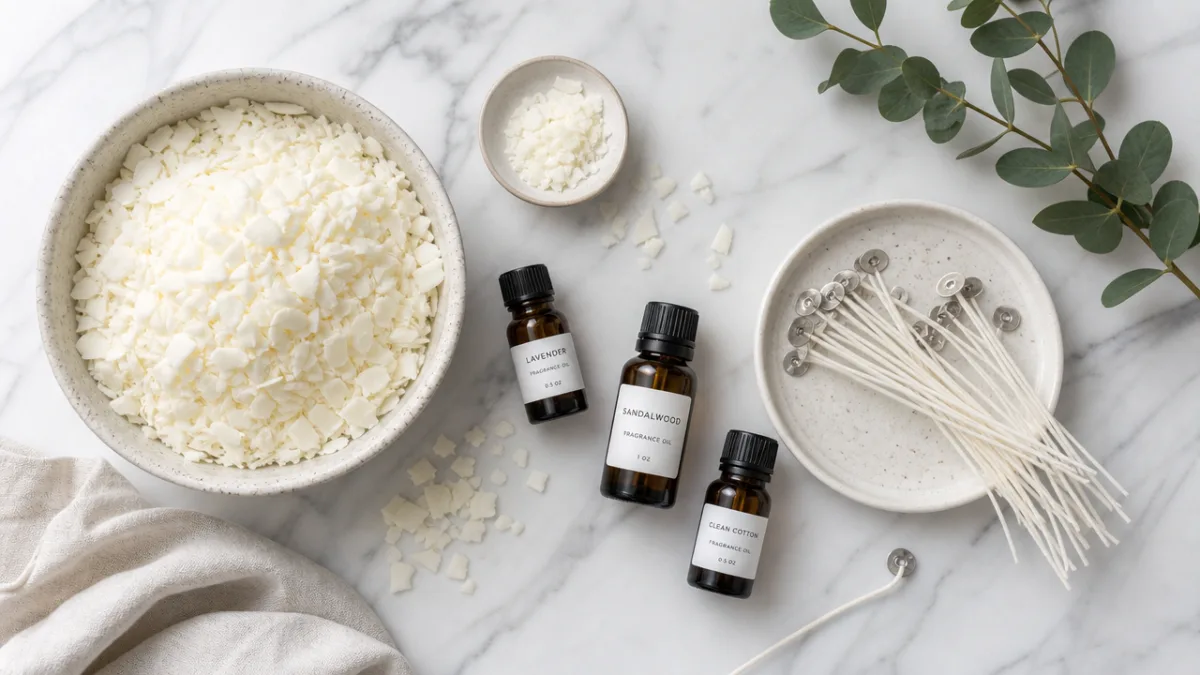
One of the first major decisions every soy candle maker faces is whether to scent their candles with fragrance oils, essential oils, or a combination of both. Fragrance oils are synthetically produced or naturally derived aromatic compounds that are specifically designed for candle making. They are formulated to withstand high temperatures without degrading and are tested for skin and respiratory safety. The range of available fragrance oils is essentially limitless — from classic scents like vanilla and lavender to complex, unexpected compositions like petrichor, black sea salt, or smoked oud.
Essential oils, by contrast, are steam-distilled or cold-pressed extracts from actual plants. They carry the genuine botanical complexity that synthetic fragrances attempt to replicate, and for many makers, the authenticity of essential oils is non-negotiable. However, essential oils present real challenges in candle making. Many have low flash points, meaning they can combust or simply evaporate at the temperatures needed to blend them properly into melted soy wax. Citrus essential oils in particular are notorious for this, often providing little to no scent throw in a finished candle despite smelling powerfully in the bottle.
The fragrance load — the percentage of fragrance added relative to the weight of the wax — is another critical variable. Most soy waxes can hold between 6 and 10 percent fragrance by weight, with some premium waxes accommodating up to 12 percent. Exceeding the recommended fragrance load doesn’t produce a stronger-smelling candle; it produces a candle that seeps oil, creates fire hazards, and performs poorly overall. Testing your specific wax-and-fragrance combination at different load percentages is the only reliable way to find the sweet spot for each unique formulation you create.
Mastering the Candle-Making Process Step by Step
The actual process of making a soy candle is deceptively simple in outline but rewards careful attention to detail at every stage. You begin by measuring your wax by weight rather than volume — a digital kitchen scale is one of the most important tools in any candle maker’s kit. Once weighed, the wax is melted in a double boiler or a dedicated pour pot set over medium heat. Monitoring the temperature with a reliable thermometer is essential; most soy container waxes should be melted to between 170 and 180 degrees Fahrenheit before fragrance is added.
Fragrance is added when the melted wax cools slightly, typically between 140 and 160 degrees Fahrenheit depending on the specific wax and fragrance combination. Adding fragrance at too high a temperature can cause it to flash off, reducing scent throw in the finished candle. Stir the fragrance into the wax slowly and thoroughly for at least two minutes, ensuring complete integration. This stirring step is one that beginners often rush, and the consequence — uneven fragrance distribution or pooling oil — is almost always traceable back to insufficient mixing at this stage.
The pour itself requires attention to both temperature and technique. Pouring too hot can cause the wax to pull away from the vessel walls as it cools, while pouring too cool can introduce air bubbles and uneven texture. Most experienced makers recommend pouring soy container wax between 120 and 140 degrees Fahrenheit, then allowing the candles to cure at room temperature undisturbed for at least 24 to 48 hours before assessing the surface. A full cure of one to two weeks is recommended before burning, as the fragrance continues to bind to the wax molecules during this period, dramatically improving scent throw.
Wick Selection: The Make-or-Break Decision
If there is one single variable that determines whether a soy candle performs beautifully or fails completely, it is wick selection. The wick is responsible for drawing the liquid wax up into the flame to sustain combustion, and its diameter, construction, and material all influence how much wax it can move per unit of time. An under-wicked candle tunnels down the center, leaving a ring of unused wax on the sides and producing minimal scent throw. An over-wicked candle burns too hot, produces excessive soot, mushrooms at the tip, and can become a fire hazard.
Wick sizing is influenced by the diameter of the vessel, the type of wax used, and the fragrance load. Cotton wicks, wooden wicks, and cotton-paper wicks all behave differently in soy wax. Cotton wicks are the most traditional and widely tested, coming in a vast range of sizes and series (CD, ECO, LX, and more) each suited to different applications. Wooden wicks have surged in popularity for their distinctive crackling sound and wide, flat flame that suits the aesthetic of modern, minimalist candle design. They require more careful priming and are generally less forgiving than cotton wicks for beginners.
The only reliable method for selecting the right wick is burn testing — a process that every serious candle maker must embrace as a fundamental part of their workflow rather than an optional afterthought. A burn test involves lighting the candle for a set period (usually four hours) and observing the melt pool, flame height, soot production, and wick behavior. Ideally, the melt pool should reach the edges of the vessel within four hours on the first burn without the flame exceeding one inch in height. If these criteria aren’t met, you adjust the wick size up or down and test again.
Troubleshooting Common Soy Candle Problems
Even experienced candle makers encounter problems, and understanding the root causes of common soy candle issues is what separates those who improve from those who repeat the same mistakes. Frosting is perhaps the most frequently complained-about characteristic of soy candles — that white, powdery crystalline coating that appears on the surface or sides of the candle. Frosting is actually a natural property of soy wax and a sign that you’re working with a natural product, but its appearance can be minimized by pouring at slightly lower temperatures, avoiding temperature fluctuations during cooling, and choosing wax varieties specifically formulated to resist it.
Sinkholes are another common frustration, appearing as craters or depressions in the surface of the candle after it has cooled. They form because soy wax contracts as it solidifies, and air pockets get trapped beneath the surface. The solution is a second pour — after the first pour has cooled and a sinkhole appears, you gently warm a small amount of additional wax and pour just enough to fill and level the depression. Pouring the second pour at a slightly lower temperature than the first helps it adhere properly without creating new surface problems.
Wet spots — those clear, glossy patches that appear where the wax has pulled away from the glass — are cosmetic rather than functional issues but can undermine the perceived quality of a finished candle. They are caused by the wax contracting and re-adhering unevenly to the vessel as it cools. Pre-warming your containers slightly before pouring, pouring at a lower temperature, and allowing candles to cool in a room with minimal temperature variation can all reduce the frequency and severity of wet spots, though they can rarely be eliminated entirely with soy wax in glass containers.
Sustainability and the Soy Candle Industry
The environmental credentials of soy candles are compelling but deserve a nuanced examination rather than blanket acceptance. Soy is a renewable crop, which gives soy wax an inherent sustainability advantage over petroleum-derived paraffin. Soy candles are also biodegradable, and soy wax spills clean up with soap and water rather than requiring solvents. For consumers who prioritize reducing their reliance on fossil fuels in every aspect of their lives, soy candles represent a meaningful choice rather than a trivial one.
However, the soy industry is not without its environmental complications. The vast majority of soybeans grown globally are genetically modified, and soy agriculture has historically been linked to deforestation, particularly in South America, where the conversion of rainforest and cerrado to soy farmland has had devastating ecological consequences. Candle makers who want their soy commitment to be genuinely sustainable should seek out wax suppliers who can verify that their soy is sourced from North American farms operating under responsible agricultural practices, and ideally that are certified non-GMO or organic.
The containers themselves represent another dimension of the sustainability conversation. Glass jars, while infinitely recyclable, are energy-intensive to produce and ship. Tin containers are lightweight and widely recyclable. Ceramic vessels are durable and reusable but have a substantial carbon footprint in production. Many small-batch soy candle makers now encourage customers to return empty vessels for cleaning and refilling, creating a closed-loop model that genuinely reduces waste. This kind of producer-consumer relationship is where the soy candle industry’s sustainability promise is most fully realized.

Building a Soy Candle Business or Hobby Practice
Whether your ambition is to sell soy candles professionally or simply to create beautiful, personalized candles for your home and as gifts, establishing a consistent practice requires both creative vision and operational discipline. On the creative side, developing a signature scent palette and aesthetic identity — the kinds of vessels you use, your label design, the fragrance families you work within — gives your candles a coherent story that resonates with people. Even hobbyists benefit from this kind of intentionality, as it transforms candle making from a series of disconnected experiments into an evolving creative practice.
On the operational side, record keeping is indispensable. Every batch you make should be documented with the exact wax weight, fragrance name and percentage, wick type and size, pour temperature, cure time, and burn test results. This documentation allows you to replicate successful batches exactly and to diagnose problems systematically rather than through trial and error. A simple spreadsheet or dedicated candle-making notebook serves this purpose perfectly; the specific tool matters far less than the discipline of using it consistently after every single pour.
For those who want to sell their soy candles, regulatory compliance is an important consideration that many enthusiastic beginners overlook. In the United States, candles are classified as consumer products and fall under the jurisdiction of the Consumer Product Safety Commission. Proper labeling — including burn warnings, fragrance disclosures, and manufacturer contact information — is legally required. Many candle makers also choose to pursue certification through organizations like the National Candle Association, which demonstrates a commitment to safety standards that builds consumer trust and can open doors to retail partnerships and craft market participation.
Gifting and Personalizing Soy Candles
One of the most joyful applications of soy candle making is the creation of personalized gifts that carry genuine meaning. Because soy candles can be made in virtually any vessel — a vintage teacup, a geode, a concrete planter, a hand-thrown pottery bowl — the possibilities for customization are essentially limitless. Choosing a vessel that reflects the recipient’s personality or aesthetic, filling it with a fragrance that evokes a shared memory or a place they love, and labeling it with a personal message transforms a simple candle into a deeply considered, one-of-a-kind gift that a commercial product can never replicate.
Scent is perhaps the most powerful personalization tool available to the soy candle maker, given the well-documented connection between olfactory experience and emotional memory. A candle that smells like the sea salt air of a place someone considers home, or like the cedar and leather of a beloved grandfather’s workshop, or like the warm vanilla and cardamom of a cherished recipe — these are not mere candles but olfactory time machines. Taking the time to learn what scents hold meaning for the people you love and translating those into a handmade soy candle is an act of genuine emotional intelligence and care.
Seasonal and occasion-based candle collections offer another avenue for meaningful gifting and personal enjoyment. A winter collection might feature balsam fir, clove, and smoked amber; a spring collection might emphasize freesia, clean linen, and fresh cut grass. Curating these collections thoughtfully — thinking about how the scents work together, how they transition through a season, and how they make a space feel — elevates soy candle making from a craft into something closer to interior design. It is this breadth of creative possibility, combined with the tangible satisfaction of creating something beautiful and useful with your own hands, that makes soy candles such an enduring and beloved pursuit.








What do you think?
It is nice to know your opinion. Leave a comment.