










Dark Academia Perfume Aesthetic & Vintage Books: A Sensory Journey Through Timeless Elegance
The Essence of Dark Academia: Where Scent Meets Scholarship
Dark academia isn’t just something you see — it’s something you feel, hear, and smell. It lives in the flicker of candlelight across a stone wall, in the texture of a wool coat, in the particular hush of a library so full of books there’s barely room to breathe. And fragrance? Fragrance is the invisible thread that holds all of it together. You can’t really call a space dark academia if it smells like laundry detergent. The scent of the room, the perfume on your skin — these aren’t decorative details. They’re the whole atmosphere.
When people talk about dark academia perfume, what they’re really describing is a whole philosophy of scent. These fragrances aren’t bright or breezy — they’re deep, mysterious, and they evolve over hours the way a great essay reveals more of itself each time you read it. Think woody, smoky, resinous, and green. Think old forests, aged paper, beeswax, ink, and cold stone floors in buildings that have been standing for centuries.
The appeal makes a lot of sense when you consider how thin and overstimulating modern life can feel. People are hungry for sensory richness, for things that connect them to history and slowness and depth. A dark academia perfume is almost like a form of time travel — one spritz and you’ve stepped out of the fluorescent glare of the present and into a world of warm lamplight and ideas worth losing sleep over.
Vintage Books and Their Unmistakable Fragrance Language
There’s a reason the smell of old books is so universally beloved, and it turns out the chemistry behind it is genuinely fascinating. As paper ages, it releases a mix of volatile organic compounds — benzaldehyde, which has a faint almond quality; furfural, which brings a warm caramel note; and vanillin, the same compound that makes vanilla smell the way it does. Together, these molecules create what book lovers just call “that smell” — sweet, woody, a little musty, and somehow deeply comforting in a way that’s hard to articulate but impossible to mistake.
Perfumers working in the dark academia tradition often try to capture exactly this quality. Cedar, which echoes the woody structure of aging paper, gets layered with musks, dry ambers, and aldehydes to approximate the experience of opening a book that hasn’t been touched in decades. Some niche houses go even further, working with accords meant to suggest ink, leather bindings, or the specific dryness of antique bookbinding glue. It sounds niche — and it is — but the results can be extraordinary.
There’s also something deeply psychological about what old books smell like. That scent carries an implicit story with it: all the hands that turned those pages, all the eyes that moved across those sentences, all the thoughts those words stirred up across generations. When a perfume manages to capture that quality, it stops being just something that smells nice and starts being something that tells a story. It becomes a kind of olfactory fiction — a way of inhabiting an imagined world of quiet scholarship and candlelit evenings with brilliant company.
- Vanillin and benzaldehyde create the warm, sweet base note of aged paper
- Cedar and sandalwood approximate the woody structure of book covers and shelves
- Dry musks and aldehydes add the characteristic dusty quality of old volumes
- Leather accords reference the traditional materials used in fine bookbinding
- Smoky and resinous notes evoke the candlelit libraries where these books were once read

Signature Notes of the Dark Academia Fragrance Palette
Once you start recognizing the building blocks of dark academia perfumery, you’ll notice them everywhere. At the top of a fragrance, you might get something cold and mineral — rain on old stone, fog drifting across a campus courtyard, the chill of a metal door handle in a centuries-old building. These opening notes don’t stick around long, but they set the scene beautifully before warmer, more complex things take over. Some compositions open with something sharper — green ivy on old brick, or the slight bitterness of black tea and bergamot, like an afternoon study session just getting underway.
The heart notes are where the real storytelling happens. This is where you find tobacco flower — not pipe tobacco exactly, but carrying that same thoughtful, slightly bookish connotation — alongside iris, with its powdery, chalky edge that somehow suggests both old cosmetics and the dust of a lecture hall blackboard. Violet leaf, oud wood, and dark rose show up frequently too, adding complexity and a quiet sweetness that never becomes pretty in any conventional sense. These fragrances aren’t trying to be nice. They’re trying to be interesting.
The base notes are where dark academia perfumes really separate themselves from the mainstream. The foundations here tend to be labdanum — a resin with a slightly animalic, medicinal depth — alongside vetiver, which is smoky and earthen and green all at once, and oakmoss, whose use is heavily restricted now but whose effect is almost irreplaceable: a deep, forest-floor greenness that nothing quite matches. Benzoin adds warmth without tipping into sweetness. Historically, castoreum, ambergris, and civet appeared here too, their animalic richness giving fragrances a sense of lived-in humanity that synthetics, however clever, still struggle to fully capture.
- Top notes: Cold minerals, bergamot, black tea, green ivy, aldehydes
- Heart notes: Iris, violet leaf, tobacco flower, dark rose, oud, incense
- Base notes: Vetiver, labdanum, oakmoss, benzoin, leather, amber, musks
Curating Your Dark Academia Fragrance Wardrobe
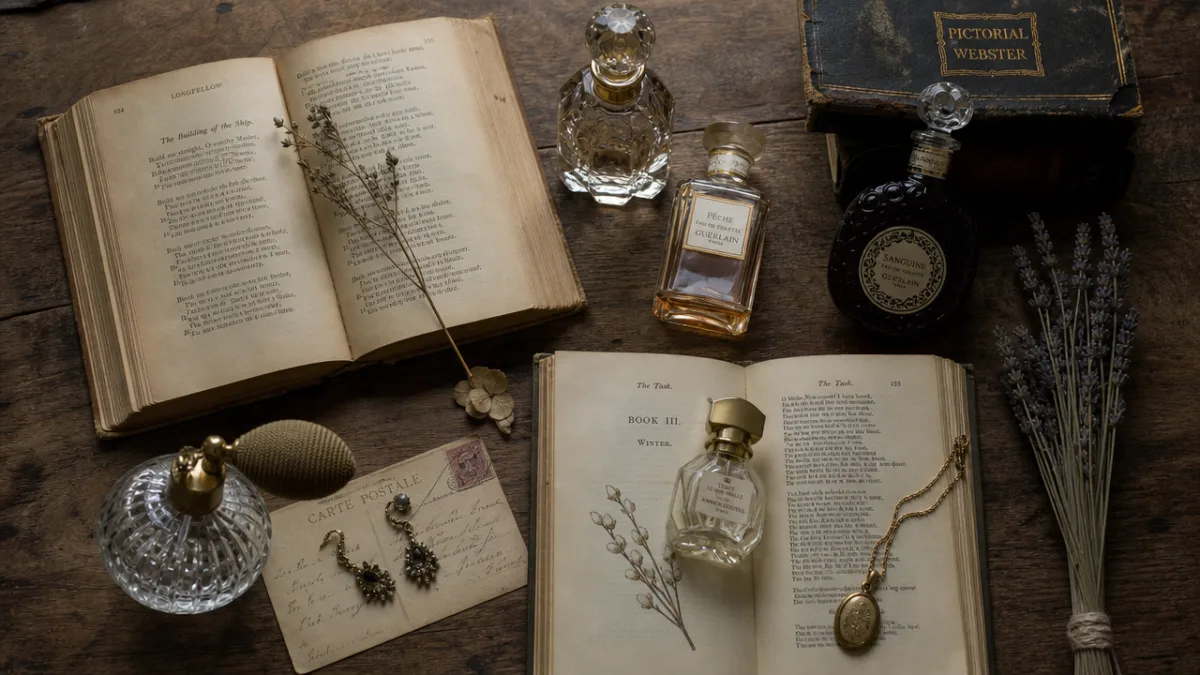
Building a dark academia fragrance collection is itself one of the most authentically dark academia things you can do — it requires research, patience, and a willingness to move slowly and thoughtfully rather than just buying whatever’s easiest to find. The ideal collection isn’t large. It’s considered. Each bottle earns its place by covering a specific mood, season, or occasion within the aesthetic: something for rainy autumn afternoons with a book, something for candlelit evenings writing by hand, maybe something for walking through fallen leaves to a stone library.
Niche perfume houses are overrepresented in dark academia collections for a reason — they tend to prioritize depth and narrative over mass-market accessibility. Houses like Serge Lutens, Comme des Garçons Parfums, Diptyque, L’Artisan Parfumeur, and smaller independents like Papillon Artisan Perfumes or DS & Durga have each made things that feel genuinely at home in this world. Vintage fragrances are also hugely appealing here — older formulations of classics like Guerlain Jicky, Caron Pour Un Homme, or early Chanel compositions carry a historical authenticity that fits the aesthetic’s reverence for the past in a way no modern fragrance can entirely replicate.
If you’re new to niche and vintage fragrance, the dark academia framework is actually a really useful way in. Starting with something that immediately feels right — a good vetiver soliflore, a classic leather chypre, an incense-forward oriental — and building outward from there lets you develop your nose alongside your collection. Each new fragrance becomes an education as much as an acquisition, deepening both your olfactory literacy and your aesthetic sensibility. Which is, honestly, very on-brand for dark academia.
The Ritual of Application: Fragrance as Intellectual Ceremony
In the dark academia world, putting on perfume isn’t just grooming — it’s preparation. It’s a deliberate act of stepping into a particular version of yourself before you sit down with your books or your writing or your thoughts. The process is treated with the same intentionality as choosing a coat or arranging a desk: you think about what you’re reaching for based on the day’s mood, the weather outside, what you’re planning to do. You apply it to your pulse points, maybe to your hair or the collar of your jacket. Then you take a moment to let it open before you go anywhere.
This approach isn’t just romantic posturing — there’s real neuroscience behind it. Smell is uniquely wired to memory and emotion because it has a direct line to the limbic system, bypassing the thalamus that handles every other sense. What that means in practice is that a fragrance you wear consistently while reading can become genuinely associated with the act of reading itself, creating a kind of conditioned focus response. A lot of serious readers and writers have figured this out on their own, without knowing the science, and deliberately use specific scents to signal to themselves that it’s time for deep, concentrated work.
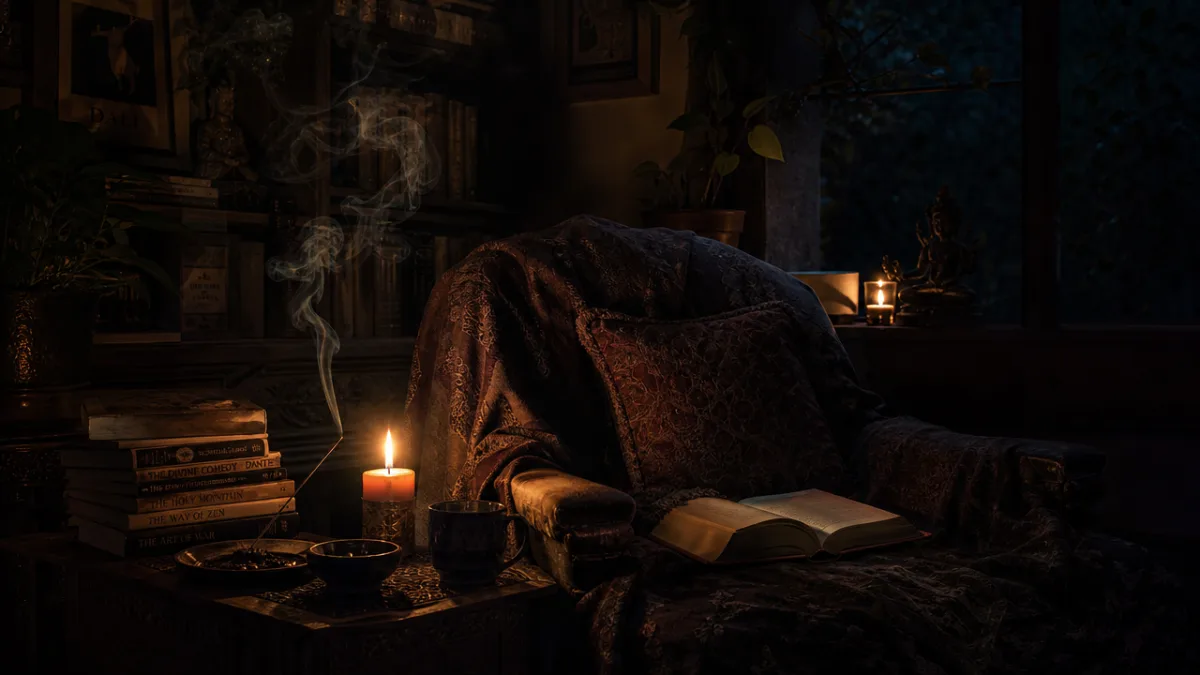
This ritualistic thinking around fragrance extends beyond the skin, too. Room fragrances, incense, candles, sachets tucked among books — all of these become part of how a carefully constructed reading space communicates its identity. The scent of a room does at least as much as its visual arrangement, maybe more, because it works below the threshold of conscious attention. You feel it before you name it. A room that smells of woodsmoke, old paper, cedar, and beeswax announces what kind of space it is the moment you walk through the door.
Building an Atmosphere: Dark Academia Spaces and Their Olfactory Dimension
The dark academia relationship with fragrance doesn’t stay on the skin — it spreads into every corner of the spaces where you read, think, and create. Those images that define the aesthetic — the window seat buried in books, the oak desk crowded with papers and cold teacups, the walls hung with botanical prints and faded maps — all of those spaces have a scent, whether you think about it consciously or not. To fully realize a space in this aesthetic is to take its smell as seriously as its look.
Candles are probably the most accessible place to start. There’s no shortage of candles designed specifically with this aesthetic in mind, built around notes of black tea, tobacco, dark florals, leather, woodsmoke, and aged paper. But beyond what they smell like, candles belong in a dark academia space simply because of what they are — the warm, slightly unsteady light, the faint smokiness when you blow one out, the slow puddle of warm wax. The light and the scent work together in a way that electric lights and room sprays, no matter how well chosen, genuinely cannot replicate.
Incense holds its own important place in this toolkit. It carries connotations of ceremony and contemplation — monasteries, old universities, the sense that knowledge is something almost sacred. Japanese incense in particular has found a devoted following among dark academia enthusiasts, with its restrained, meditative approach to woods, resins, and florals that feels worlds away from the heavier sweetness of many Western traditions. And the thin ribbon of smoke rising from a burning stick is, itself, a visual detail that belongs perfectly in this world.
- Layer candles, incense, and personal fragrance for a fully immersive atmosphere
- Consider seasonal adjustments — heavier, smokier scents for winter, greener accords for autumn
- Use fragrance sachets among books to give the collection its own distinctive scent identity
- Allow certain scents to become associated with specific activities — one fragrance for reading, another for writing
- Explore unscented beeswax candles for ambiance without olfactory competition with personal fragrance
At its core, the dark academia approach to fragrance reflects something true about the broader aesthetic: nothing in it is accidental. Every choice is deliberate. Every layer is considered. Even the things you can’t see deserve attention — especially those, maybe, because they shape how a space feels before anyone consciously registers why. In a world that moves fast and loud and doesn’t ask you to pay attention to much of anything, there’s something quietly radical about stopping to think about how your life smells, and choosing — with full intention — to make it smell of old books, dark wood, and rooms full of candlelight and ideas.








What do you think?
It is nice to know your opinion. Leave a comment.