










Perfect Cozy Crochet Kindle Sleeves: Handmade Protection for Every Reader
The Art of Handmade Kindle Protection
There is something deeply satisfying about pairing a beloved book-reading device with a sleeve crafted entirely by hand. Crochet Kindle sleeves have emerged as one of the most charming intersections of fiber arts and modern technology, offering readers a way to protect their devices while expressing genuine creativity and personal style. Unlike mass-produced cases that fill store shelves, a handmade crochet sleeve carries with it the warmth of intention — every stitch placed deliberately, every color chosen with care, every texture the result of someone’s time and skill.
The appeal of crochet as a protective medium might seem counterintuitive at first. After all, yarn is soft and pliable, not exactly the rigid material most people associate with device protection. But the structure that emerges from interlocked crochet stitches is surprisingly resilient. A well-made crochet sleeve creates a dense, padded layer of cushioning around a Kindle that absorbs light impacts, protects against surface scratches, and shields the screen from the everyday hazards that readers encounter — tossed into a bag, slid across a nightstand, or tucked beside a cup of tea.
Beyond pure function, these sleeves speak to a growing cultural desire for objects that feel meaningful. In an era of algorithmic recommendations and identical products, a crochet Kindle sleeve stands apart. It might be made by the reader themselves as a satisfying weekend project, gifted by a friend who spent hours choosing the perfect yarn color, or purchased from an independent maker whose craft supports their livelihood. Whichever path it takes to reach a reader’s hands, the sleeve carries a story that no factory-made case ever could.
Choosing the Right Yarn and Materials
The success of any crochet Kindle sleeve begins long before the first stitch — it starts at the yarn shop, or the online cart, or the stash basket tucked in the corner of a crafting room. Yarn selection is one of the most consequential decisions a maker will face, because the material determines not only how the finished sleeve looks and feels, but how well it actually protects the device inside. Cotton yarn is widely considered the gold standard for Kindle sleeves, and for good reason. It is firm, non-stretchy, and creates a sturdy fabric that holds its shape even after repeated use and washing.
Wool and wool blends offer their own advantages, particularly for readers who live in cooler climates or who simply love the plush, cozy aesthetic that wool brings to any project. A sleeve worked in a soft merino wool has an almost tactile warmth to it — picking it up feels like reaching for a favorite sweater. However, makers working with wool should consider the care requirements, since some wools require gentle hand-washing and may felt if exposed to heat and agitation. Superwash wool varieties solve this problem neatly, offering the warmth and softness of wool with the practical washability that everyday items demand.
Beyond fiber content, weight and ply matter enormously. A worsted weight yarn produces a satisfying thickness and works up quickly, making it ideal for makers who want to complete a project in an afternoon or evening. DK and sport weight yarns allow for finer detail and a slightly more lightweight result. Whatever weight is chosen, pairing it with a hook one or two sizes smaller than the yarn label recommends will produce a tighter, denser fabric that better protects the device inside. Stitch markers, a tapestry needle for weaving in ends, and a button or snap for the closure round out the essential supply list.
Popular Stitches and Patterns for Kindle Sleeves
One of the great joys of crochet is the sheer variety of stitches available to the maker, and Kindle sleeves are an ideal canvas for exploring that variety. The humble single crochet stitch remains the most popular choice for device sleeves precisely because it produces the tightest, most protective fabric of any basic crochet stitch. Rows of single crochet worked in a continuous spiral create a smooth, dense fabric that grips the device snugly and resists stretching over time. It is a stitch that rewards beginners with professional-looking results and remains a genuine pleasure even for experienced makers.
For those seeking more visual texture, the moss stitch — alternating single crochets and chain stitches — creates a subtle, elegant grid pattern that elevates the sleeve from simple utility to something genuinely beautiful. The linen stitch, similarly constructed, produces a woven appearance that many makers describe as their favorite for gifted items because it photographs so beautifully and looks almost professional in its finish. Bobble stitches and popcorn stitches add three-dimensional texture that feels lovely in the hand, though makers should ensure these stitches are worked on the exterior of the sleeve rather than the interior, where raised bumps could potentially press against the device screen.
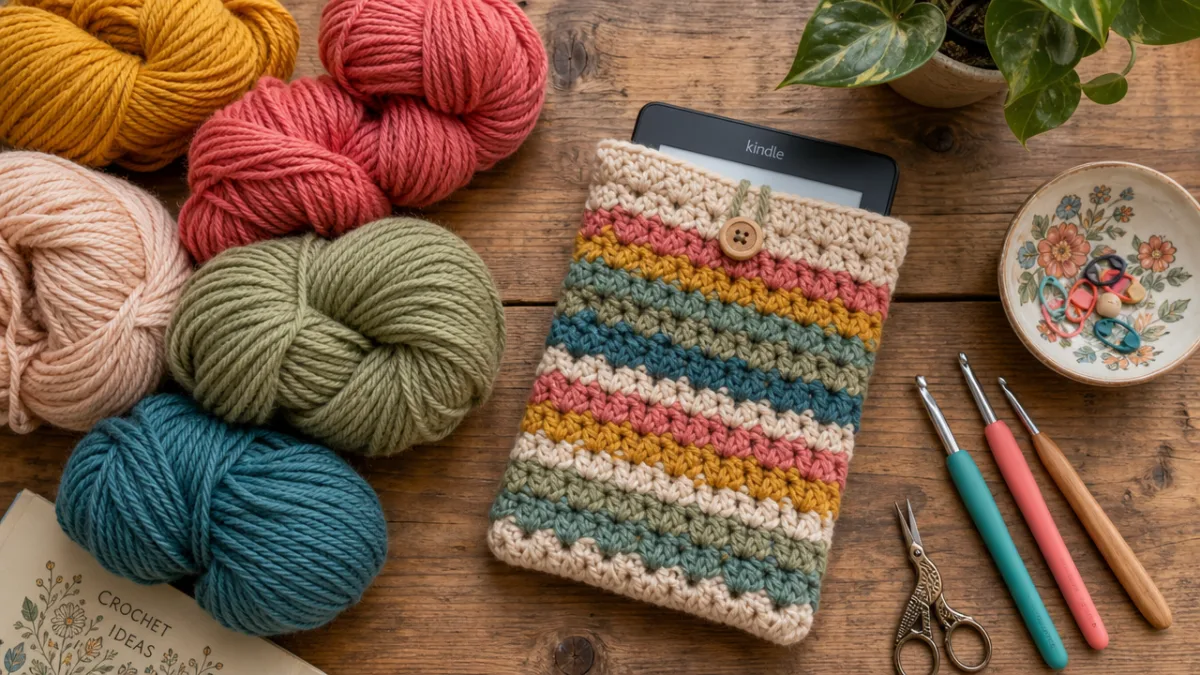
Color work opens yet another dimension of creative possibility. Simple stripes are the most accessible introduction to multi-color crochet, requiring only a color change at the end of each row and producing cheerful, graphic results. Tapestry crochet, which carries unused yarn along the inside of the work, allows for intricate geometric patterns, tiny books, reading cats, or any motif that speaks to the maker’s imagination. Many pattern designers in the crochet community have developed dedicated Kindle sleeve patterns, freely available through platforms like Ravelry and YouTube, ranging from absolute beginner-friendly rectangles to complex colorwork designs worthy of a gallery display.
Sizing Your Sleeve Perfectly for Every Kindle Model
A crochet Kindle sleeve that fits perfectly is both more protective and more pleasurable to use than one that is too loose or too tight, which makes accurate sizing one of the most important technical skills a maker can develop. The challenge is that Amazon has released numerous Kindle models over the years, each with slightly different dimensions, and the difference between models can be as little as a few millimeters — enough to make a sleeve that fits a Kindle Paperwhite feel uncomfortably snug around a Kindle Oasis. Before beginning any sleeve project, the maker should measure their specific device carefully with a ruler or calipers, noting the height, width, and depth.
Gauge swatching, while sometimes skipped by impatient makers, is genuinely essential for a project where fit is critical. A gauge swatch is a small sample of the planned stitch worked with the chosen yarn and hook, then measured to determine how many stitches and rows equal a given measurement. Crochet gauge varies from maker to maker based on individual tension, even when using identical materials, so the numbers printed on a yarn label or pattern are only starting points. Working a four-inch square swatch, measuring it carefully, and adjusting hook size or tension accordingly will pay dividends when the finished sleeve slides onto the Kindle with a satisfying, precise fit.
A useful general approach for makers designing their own sleeves is to add approximately half an inch to the device’s measured width and height to allow for ease — the small amount of extra room that makes insertion and removal smooth without causing the device to rattle around inside. The sleeve’s depth should comfortably accommodate the device’s thickness with a little room to spare. Many makers add a folded or crocheted-in bottom seam for extra cushioning at the base, where the device is most vulnerable to impact if the sleeve is accidentally dropped. Common Kindle dimensions worth knowing include these approximate measurements:
- Kindle Basic (11th generation): approximately 157mm tall, 108mm wide, 8mm thick
- Kindle Paperwhite (11th generation): approximately 174mm tall, 125mm wide, 8.1mm thick
- Kindle Oasis (10th generation): approximately 159mm tall, 141mm wide, 3.4–8.4mm thick
- Kindle Scribe: approximately 196mm tall, 230mm wide, 5.8mm thick
Closures, Finishing Touches, and Customization
The closure is where a crochet Kindle sleeve transforms from a simple pouch into a finished, polished object — and it is also where a maker’s personality most clearly shines through. Button closures are perhaps the most beloved option in the handmade community, offering both security and charm in equal measure. A single large button worked through a crocheted loop keeps the Kindle safely inside while adding a decorative focal point that can be matched to the yarn’s color palette or deliberately contrasted for visual pop. Wooden buttons bring a natural, organic warmth; resin buttons in jewel tones add playful color; vintage buttons found at estate sales or thrift stores add genuine history to the object.
Magnetic snap closures offer a more modern, streamlined aesthetic and are particularly practical for readers who reach for their Kindle frequently throughout the day. They open and close with satisfying ease, require no button-through dexterity, and lay flat against the sleeve without adding bulk. Sewn-in magnetic snaps are available at most fabric and craft stores and can be attached to the crochet fabric using small squares of interfacing to distribute the snap’s pressure across the stitches. Velcro is another practical option, though many makers find it less aesthetically pleasing than buttons or snaps, and it can occasionally snag delicate yarns over time.
Beyond closures, the interior of a Kindle sleeve is an often-overlooked opportunity for thoughtful finishing. Some makers sew a soft fabric lining into the sleeve — a scrap of quilting cotton, a square cut from an old flannel shirt, or a piece of felt — that prevents any interior stitch texture from touching the device screen directly. Others crochet a second, slightly smaller rectangle and join it to the outer sleeve, creating a double-layered construction with enhanced padding. A small exterior pocket, worked as a separate panel and seamed on, can hold a charging cable, a bookmark, or a folded piece of paper for notes.
Crochet Kindle Sleeves as Meaningful Gifts for Readers
Few handmade gifts communicate care and attentiveness as clearly as a crochet item made specifically for the recipient. A Kindle sleeve crafted for a particular reader demonstrates that the giver has thought about that person’s daily life — the mornings they read on the train, the evenings spent with a novel before sleep, the device that serves as a portal to hundreds of worlds — and has invested their own time and skill in honoring those habits. This quality of witnessed, personalized thoughtfulness is something no gift card or purchased item can replicate, which is why handmade Kindle sleeves have become such popular gifts within crafting communities.
Customization is where gift-giving potential truly blossoms. A sleeve in someone’s favorite color, worked in a stitch they once mentioned admiring, finished with a button shaped like a tiny cat or a stacked books — these details demonstrate a quality of listening and attention that moves the gift beyond the merely practical into the genuinely touching. Makers who sell their work through platforms like Etsy often offer custom color choices, personalized embroidery of initials or names, and made-to-order sizing for specific Kindle models, making bespoke sleeves accessible even to those who do not crochet themselves.
Occasions well-suited to a crochet Kindle sleeve gift include birthdays, holidays, graduation presents for avid student readers, retirement gifts for colleagues who have finally earned their leisure reading time, and simple gestures of friendship that need no occasion at all. A sleeve paired with a gift card for an e-book service, a packet of favorite tea, or a handwritten list of book recommendations becomes a small, cohesive celebration of the reading life — practical, personal, and made with genuine affection. In a world of hurried, impersonal gifting, such a package carries meaning far beyond its modest materials.
Caring for Your Crochet Kindle Sleeve
A well-made crochet Kindle sleeve, given proper care, will last for years of daily use and only grow more beloved with time as it softens and takes on the small character marks of a well-used object. Care requirements depend almost entirely on the fiber content of the yarn used, which is one reason why checking the yarn label before beginning a project is so important for makers who want to ensure their finished sleeve is practical to clean. Cotton sleeves are among the most carefree: most cotton yarns are machine washable on a gentle cycle, and the finished sleeve can be laid flat to dry in an hour or two.
Wool sleeves require more attentive care but repay that attention with exceptional longevity. Hand washing in cool water with a small amount of gentle wool wash or mild shampoo, followed by careful pressing between towels to remove excess water and flat drying away from direct heat, will keep a wool sleeve in beautiful condition for many years. Superwash wool is an excellent compromise, allowing gentle machine washing while retaining the warmth and texture that makes wool so appealing. Acrylic yarn, popular for its affordability and wide color range, is typically fully machine washable and dryable, making it a genuinely practical choice for a frequently handled everyday object.
Storage and everyday handling also contribute to the sleeve’s longevity. Keeping the Kindle in its sleeve rather than loose in a bag prevents the abrasion that gradually scratches screens and scuffs bezels. If the sleeve will be stored for an extended period — during travel, for instance, when an e-reader might be packed away — placing it inside a small cloth bag protects the yarn from snagging on other items. With sensible care, a crochet Kindle sleeve becomes one of those quietly reliable everyday objects that readers reach for without thinking, the way one reaches for a favorite mug or a well-worn pair of glasses: instinctively, gratefully, and with a small, unexamined sense of pleasure at its familiar presence in hand.








What do you think?
It is nice to know your opinion. Leave a comment.