










Egg Carton Jellyfish Craft – Easy Ocean Animal Craft for Kids
Introduction: Bringing the Ocean to Your Kitchen Table
There is something wonderfully magical about watching a child transform a humble piece of recycled packaging into a colorful sea creature. The egg carton jellyfish craft is one of those timeless activities that blends creativity, learning, and sustainability into a single joyful afternoon project. Whether you are a parent looking for a rainy-day activity, a teacher planning an ocean-themed unit, or a caregiver searching for something engaging and low-cost, this craft delivers on every front with minimal preparation and maximum fun.
Jellyfish are among the most fascinating creatures in the ocean, drifting gracefully through the water with their translucent bells and trailing tentacles. By recreating them using egg cartons, children get a hands-on introduction to marine biology while also developing fine motor skills, creative thinking, and an appreciation for recycling. The finished product makes a charming decoration that can be hung from a ceiling or displayed in a window, letting light filter through the painted surfaces just like sunlight through ocean water.
This craft is suitable for a wide age range, from toddlers working with parental supervision to older elementary-school children who can tackle the project more independently. The materials are inexpensive and easy to source, and the steps are straightforward enough to complete in a single sitting. By the end of this guide, you will have everything you need to run a smooth, creative session that leaves kids proud of what they have made and eager to learn more about ocean life.
Why Ocean Crafts Matter for Early Childhood Development
Ocean-themed crafts do far more than keep little hands busy. They open a window into a world that most children rarely experience firsthand, sparking curiosity about marine ecosystems, animal behavior, and environmental conservation. When a child paints their jellyfish body pink and purple and asks why real jellyfish glow in the dark, you have a perfect teachable moment that no worksheet could replicate. Crafts create emotional anchors for learning, making facts more memorable and discussions more meaningful.
From a developmental standpoint, cutting, painting, gluing, and threading materials all strengthen the small muscles in a child’s hands and fingers, which are the same muscles needed for writing and other fine-detail tasks. Following a sequence of steps also builds executive function skills like planning, attention, and working memory. When children work alongside peers on the same project, they practice collaboration, communication, and patience, all of which are foundational social-emotional skills.
Choosing an ocean theme specifically connects children to one of the planet’s most important and threatened ecosystems. Simple conversations about why jellyfish float, what they eat, and how pollution affects them can plant seeds of environmental stewardship that grow for a lifetime. A craft that starts as simple fun can become the beginning of a child’s identity as someone who cares about the natural world.
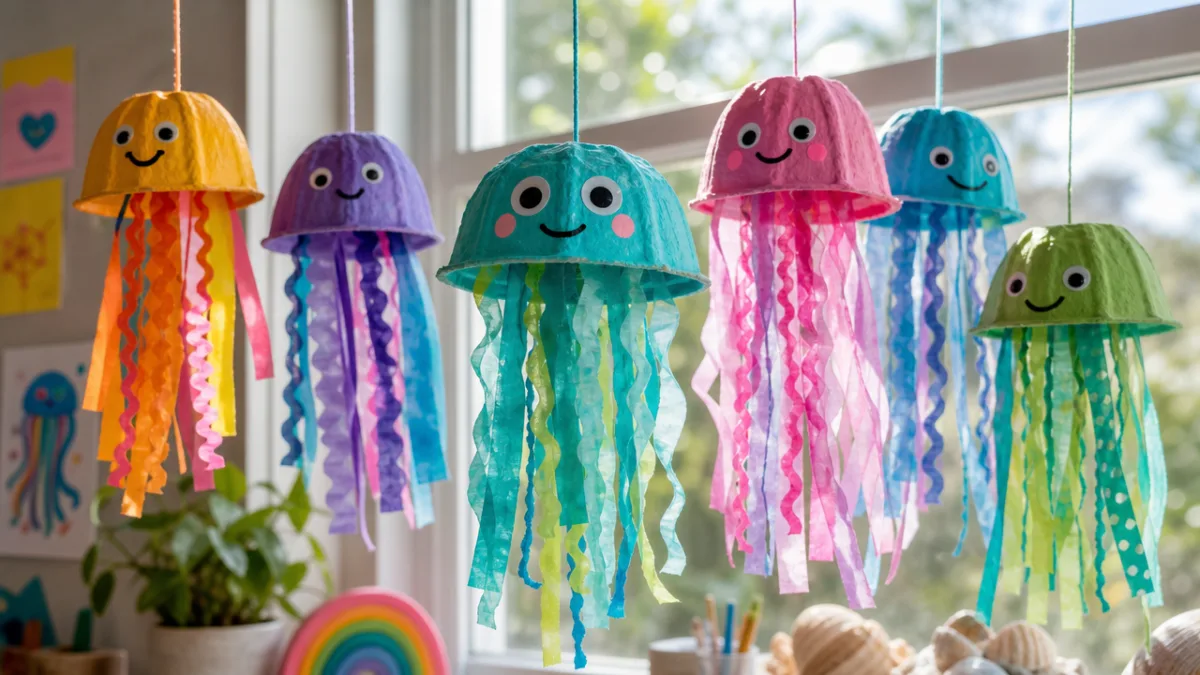
Materials You Will Need
One of the greatest strengths of this project is how accessible the materials are. Most of what you need is either already in your home or available at any dollar store or craft supply shop for just a few dollars. Gathering everything before you begin makes the crafting session run smoothly and keeps younger children from losing focus during a mid-project supply hunt. Set everything out on a covered table or a large piece of newspaper to protect your work surface.
The star of the show is the egg carton itself. Standard cardboard egg cartons work best because they absorb paint well and hold their shape reliably. Each cup from the carton becomes the rounded bell of one jellyfish, so a single twelve-egg carton can yield up to twelve individual jellyfish, making this an ideal activity for a classroom or party setting. Styrofoam egg cartons can also be used but may require different paint types and are less eco-friendly, so cardboard is the preferred choice whenever possible.
Beyond the egg carton, you will need a solid collection of basic craft supplies. Below is a full list of what to gather before you begin:
- One cardboard egg carton per group of children, cut into individual cups
- Acrylic or washable tempera paint in a variety of ocean-inspired colors such as pink, purple, blue, teal, and white
- Paintbrushes in small and medium sizes
- Crepe paper streamers, ribbon, yarn, or strips of tissue paper for tentacles
- White craft glue or a low-temperature glue gun for adult use
- Googly eyes in assorted sizes
- Scissors suitable for the age group
- A hole punch or a sharp pencil for making holes in the top of the cup
- String, fishing line, or thin ribbon for hanging the finished jellyfish
- Glitter, sequins, or metallic paint for decorative details (optional but highly recommended)
- A drying rack, clothesline, or flat surface covered in paper for drying painted cups
If you want to add an extra sensory dimension to the project, consider having iridescent cellophane strips available alongside the crepe paper for tentacles. These catch the light beautifully and give the finished jellyfish an ethereal, underwater quality that children absolutely love. Metallic paints or glitter glue applied over a base coat can mimic the bioluminescent glow that many real jellyfish produce, adding another opportunity to discuss marine biology in a natural, engaging way.
Preparing Your Workspace for Success
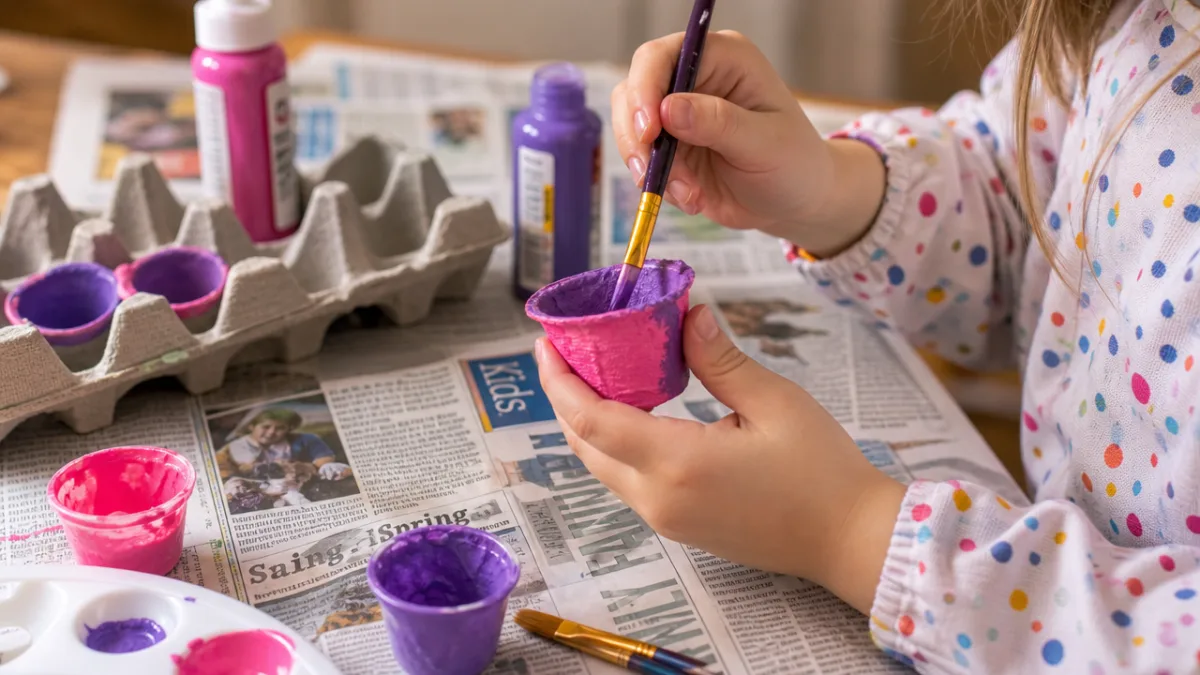
A well-organized workspace makes all the difference between a smooth crafting session and a chaotic one. Cover your table with newspaper, a vinyl tablecloth, or craft paper before setting out any materials. Pour paint into small paper plates or a muffin tin to give children easy access without the risk of large bottles tipping over. Keep a cup of water and a folded paper towel at each child’s station for rinsing and wiping brushes between colors.
For groups of younger children, consider pre-cutting the egg carton cups in advance and pre-punching the holes in the tops. This reduces frustration and allows the children to dive straight into the most engaging parts of the craft, which are the painting and decorating steps. Having everything at an appropriate height so that children can reach comfortably and work without strain also makes a significant difference in their focus and enjoyment.
If you are working with a mixed age group, assign older children as helpers for specific tasks like threading string through the holes or managing the glue gun under supervision. This not only manages the workflow efficiently but also gives older children a sense of responsibility and leadership. The more ownership each child feels over their individual creation, the more pride they will take in the finished result.
Step-by-Step Instructions for Making Your Egg Carton Jellyfish
Now comes the heart of the activity. Follow these steps carefully, and feel free to pause at any point to let children explore and make creative decisions. There is no single correct way for a jellyfish to look, and encouraging individual expression within the basic structure of the craft produces a far more rewarding experience than trying to replicate an exact model. Remind children frequently that their jellyfish is their own unique sea creature, and that all choices are valid.
Begin by separating the individual cups from the egg carton if you have not done so already. Each cup should have smooth or slightly ridged exterior walls that will hold paint well. Some cartons have decorative edges on the cups that add natural texture to the jellyfish bell, which is a lovely bonus. Trim any ragged edges with scissors so the cup sits cleanly and looks neat. At this stage, use a hole punch or a sharp pencil to create a small hole in the center of the rounded top of the cup, through which the hanging string will later be threaded.
Follow this ordered sequence of steps to complete the jellyfish from start to finish:
- Paint the jellyfish bell: Apply one or two coats of your chosen base color to the outside of the egg cup. Allow the first coat to dry before adding a second for a more vibrant finish. Acrylic paint dries quickly, usually within fifteen to twenty minutes, while tempera may need longer.
- Add decorative details: Once the base coat is dry, use a contrasting color, glitter glue, or a fine brush to add spots, swirls, stripes, or other patterns to the bell. Encourage children to look at reference images of real jellyfish for inspiration.
- Attach the tentacles: Cut six to twelve strips of crepe paper, ribbon, or yarn, each approximately twenty to thirty centimeters long. Apply a line of glue around the inside rim of the egg cup opening, then press the tops of the tentacle strips into the glue and hold until secure. For extra variety, mix textures by combining curly ribbon with flat crepe paper strips.
- Add googly eyes: Once the paint is fully dry, glue one or two googly eyes to the front of the bell. Children can choose their eye size and placement freely, which often leads to wonderfully expressive and personality-filled jellyfish faces.
- Thread the hanging string: Cut a length of string or fishing line approximately forty centimeters long. Thread one end through the hole in the top of the cup and tie a knot on the inside to secure it. Tie a loop at the other end for easy hanging.
- Allow everything to dry completely before hanging, usually at least thirty minutes to one hour for all glued elements to set firmly.
Once the jellyfish are complete, hanging them at varying heights from a length of blue or teal ribbon creates a stunning ocean mobile effect. Groups of three to five jellyfish clustered together on a single hanger look particularly impressive and give classrooms or playrooms an immersive underwater atmosphere. Adding hand-cut paper fish, starfish, or seaweed to the same display extends the project into a full ocean scene that children can contribute to over several sessions.
Tips for Different Age Groups and Skill Levels
For toddlers aged two to three, the painting stage is where most of the engagement will happen. Thick-handled brushes, large googly eyes, and pre-cut tentacles make the craft manageable without overwhelming small hands. Adult assistance with gluing and threading is essential at this age, but children can still feel the full pride of authorship over their painted and decorated bell. Keep sessions short, around fifteen to twenty minutes, and celebrate every result enthusiastically.
Children aged four to six can manage most steps independently with light guidance. Introduce child-safe scissors at this stage and encourage them to cut their own tentacle strips to a desired length. This is also a great age to introduce the concept of symmetry by encouraging children to place eyes and patterns evenly on both sides of the bell, connecting the craft to early math concepts in a hands-on way.
For older children aged seven and above, you can raise the complexity by introducing weaving techniques for tentacles, encouraging the use of reference photographs of real jellyfish species, or challenging them to create a specific named species like a moon jellyfish or a lion’s mane jellyfish. At this level, the craft becomes an exercise in research, observation, and technical skill as much as it is a creative activity.
Educational Extensions and Cross-Curricular Connections
An egg carton jellyfish craft is a natural springboard into a rich variety of learning experiences across multiple subject areas. In science, children can explore the anatomy of a real jellyfish, learning about the bell, oral arms, tentacles, and the fact that jellyfish have no brain, heart, or bones. Comparing the simplified craft version to a realistic diagram helps children understand the difference between artistic representation and scientific accuracy, a concept that forms the foundation of scientific illustration.
In literacy, the craft can inspire a range of writing activities. Younger children might dictate or copy a label for their jellyfish, naming it and identifying one fact they have learned. Older students might write a short narrative from the perspective of their jellyfish drifting through the ocean, incorporating vocabulary from a word wall of ocean terms assembled during the project. Writing a how-to guide based on the craft steps is another excellent exercise that reinforces procedural text structure and sequencing skills.
In mathematics, children can measure tentacle lengths, count the number of egg cups in a carton, sort materials by color or texture, or explore patterns and symmetry in their designs. For older students, a discussion of the geometric shapes found in natural jellyfish forms, including radial symmetry and circular bell structures, can connect to geometry concepts in an unexpected and memorable way. Cross-curricular connections like these are what elevate a simple craft from a fun activity to a meaningful educational experience.
Connecting the Craft to Ocean Conservation
Using a recycled material like an egg carton as the foundation of this craft is itself a conversation starter about sustainability and environmental responsibility. Children are naturally curious about why we reuse things instead of throwing them away, and explaining the concepts of waste reduction and recycling in simple terms during a craft session plants important environmental values early. The fact that jellyfish populations are actually increasing in some parts of the ocean due to climate change and overfishing makes them a surprisingly relevant species to discuss in the context of environmental stewardship.
Introduce children to the concept of ocean pollution by discussing how plastic waste in the ocean affects marine animals. Sea turtles, for instance, often mistake plastic bags for jellyfish and eat them, causing serious harm. This connects the craft directly to a real conservation issue and gives children a tangible reason to care about how their family manages plastic waste at home. Even very young children can understand the idea that taking care of our rubbish means taking care of ocean animals.
Consider extending the project into a community action component, such as a bulletin board display in a school hallway with facts about ocean conservation, or a donation drive for a local marine conservation organization. When children feel that their creative work has a purpose beyond the classroom, their engagement and pride in the project deepens significantly. The egg carton jellyfish becomes not just a decoration but a symbol of their commitment to the natural world they are learning to love and protect.
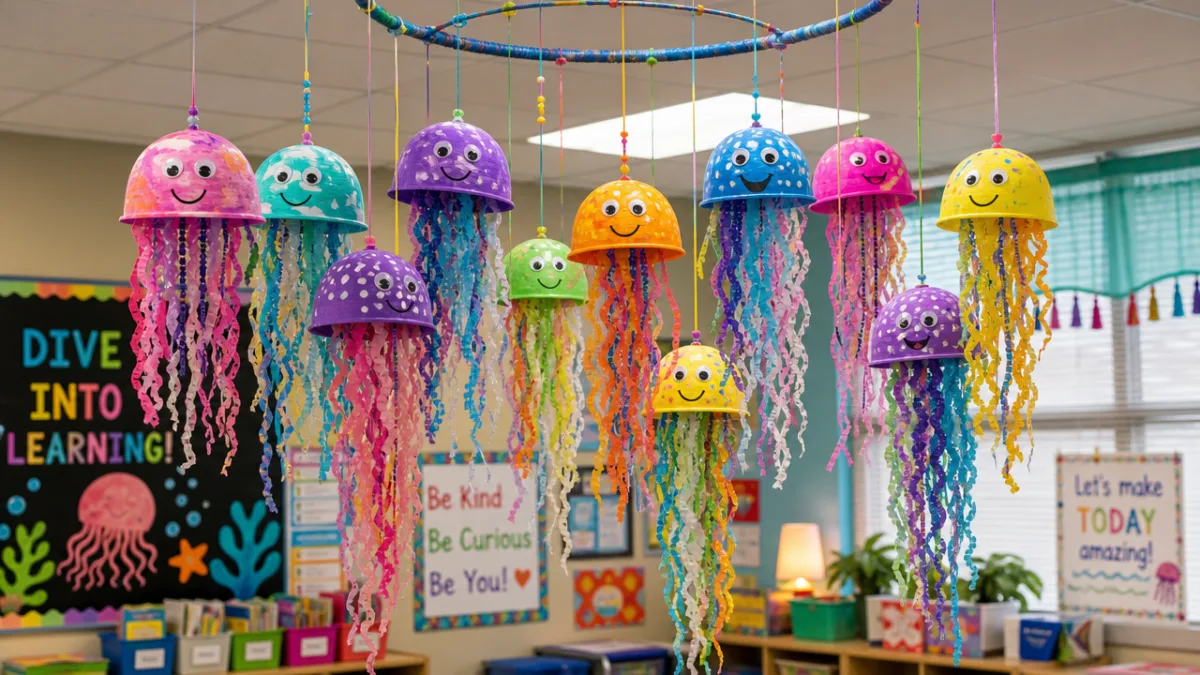
Variations and Creative Adaptations
One of the most exciting aspects of this craft is how many directions you can take it. While the basic egg carton jellyfish is perfect as a standalone project, it also serves as an excellent foundation for themed variations and more elaborate creative endeavors. Adjusting materials, scale, or color palette can completely transform the aesthetic of the finished pieces, allowing you to revisit the craft multiple times without it ever feeling repetitive.
For a nighttime or deep-sea theme, paint all the jellyfish in dark blues, purples, and blacks, then use glow-in-the-dark paint for accents and tentacle tips. Displayed in a darkened room, these jellyfish create a stunning bioluminescent ocean effect that feels almost magical. This variation works wonderfully for Halloween-themed classroom displays or night-sky science units where the concept of natural light production in animals is being explored.
For a party or celebration setting, use metallic and iridescent materials throughout, including foil crepe paper for tentacles and pearl-finish paints for the bell. A group of a dozen shimmering jellyfish hanging together at a birthday party or school event creates a show-stopping focal point that doubles as an activity and a decoration. Children can take their jellyfish home as party favors, giving the celebration a personal, handcrafted quality that store-bought decorations simply cannot match.
Combining the Craft with Sensory Play and Storytelling
Pairing the finished jellyfish with a sensory bin transforms the craft into an immersive, multi-day learning experience. Fill a shallow bin or tray with blue-tinted water, aquarium gravel, shells, and small plastic sea creatures, then suspend the completed jellyfish above it or float waterproof versions in it for dramatic play. Children can invent stories about the jellyfish, name them, give them personalities, and act out ocean adventures, all of which builds language, imagination, and narrative thinking.
Storytelling sessions that incorporate the finished crafts as props can be structured as guided tales led by an adult or as free imaginative play. Read-aloud books about jellyfish and ocean life, such as nonfiction titles from the library, pair beautifully with this craft and extend the learning into literacy time. Creating a small ocean-themed book corner with books, craft displays, and sensory materials creates a fully immersive learning environment that reinforces the same concepts from multiple angles.
You can also invite children to give each jellyfish a scientific-sounding name of their own invention, blending creativity with early science vocabulary in a playful way. Labeling cards placed beside each jellyfish in a display, featuring the child’s invented name, one made-up fact, and one real fact, make for a charming exhibition that parents and visitors will love. This combination of imagination and information is at the heart of great early science education and shows children that learning can be as creative and joyful as any art project.
Final Thoughts: The Lasting Value of Simple Crafts
In a world of screens, apps, and digital entertainment, there is something profoundly grounding about sitting down with a child, a pile of materials, and nothing but time and imagination. The egg carton jellyfish craft is a reminder that some of the most valuable educational and creative experiences require nothing more elaborate than what is already in your recycling bin. Its simplicity is not a limitation but a feature, one that places the focus entirely on the child’s own creativity and curiosity.
The skills built through this kind of open-ended, hands-on craft work, including patience, fine motor control, creative problem-solving, and the ability to follow multi-step instructions, are foundational skills that support success across every area of learning. Children who regularly engage in craft activities tend to demonstrate greater perseverance, stronger spatial reasoning, and more flexible thinking, all qualities that serve them well far beyond the classroom and long into adulthood.
Perhaps most importantly, crafts like this one create memories. Years from now, a child who made an egg carton jellyfish with a parent, teacher, or grandparent will carry that experience as a warm, sensory-rich memory tied to connection and creativity. The jellyfish itself may eventually be lost, but the conversation it sparked, the pride of making something with one’s own hands, and the sense of wonder about the ocean it cultivated will last a lifetime. That is the true and lasting value of a simple craft done well.
Encouraging a Lifelong Love of Making
The best way to nurture a child’s creative confidence is to celebrate effort over outcome consistently and enthusiastically. When children hear adults express genuine delight in their creative choices, even the unexpected or imperfect ones, they learn that their ideas have value and that mistakes are simply part of the making process. An egg carton jellyfish with lopsided eyes and uneven tentacles is not a failure; it is evidence of a child who tried, chose, and created, and that deserves celebration every single time.
Keeping a portfolio or photograph collection of a child’s crafts over time gives them a tangible record of their creative growth and development. Looking back at an early egg carton jellyfish alongside more recent, complex projects helps children see how much they have learned and how far their skills have come. This kind of reflective practice builds self-awareness and metacognitive skills that are among the most valuable educational outcomes any activity can produce.
So gather your egg cartons, set out the paint, and let the ocean come alive on your kitchen table. Whether you are making a single jellyfish on a quiet afternoon or running a full classroom ocean safari, this craft offers something meaningful for every child who takes part in it. The ocean is vast and full of wonders, and with a little cardboard, some paint, and a willing imagination, it is never more than an arm’s reach away.








What do you think?
It is nice to know your opinion. Leave a comment.