










What Do You Do With a Junk Journal? 10 Creative Ways to Use Yours!
If you’ve ever stumbled upon the world of junk journaling, you know how quickly it pulls you in. There’s something deeply satisfying about transforming scraps of paper, old book pages, fabric snippets, and forgotten ephemera into a handmade book that is entirely your own. But once you’ve bound those pages together and decorated your cover, a common question arises: what exactly do you do with a junk journal? The answer, as it turns out, is wonderfully open-ended and endlessly creative.
Junk journals are not like traditional diaries or planners. They don’t come with rules, and there’s no wrong way to fill their pages. They exist at the beautiful intersection of art, memory, and personal expression, making them one of the most versatile creative tools you can keep on your desk. Whether you’re a seasoned mixed-media artist or someone who just loves collecting pretty paper scraps, a junk journal can become a meaningful part of your everyday creative life.
In this article, we’ll explore ten of the most inspiring and practical ways to use your junk journal, from recording daily memories to building artistic vision boards. By the time you finish reading, you’ll likely have more ideas than you have pages — and that’s exactly the kind of problem every junk journal lover is happy to have.
1. Use It as a Memory Keeping Journal
One of the most beloved ways to use a junk journal is as a deeply personal memory keeper. Unlike a traditional scrapbook, a junk journal allows you to layer textures and materials organically, giving your memories a tactile, lived-in quality that photographs alone simply cannot capture. You might tuck a ticket stub behind a vellum pocket, glue a pressed flower from a special afternoon onto a torn book page, or write a heartfelt note in the margins of vintage sheet music. Every element works together to tell the full sensory story of a moment.
Memory keeping in a junk journal doesn’t have to be reserved for big, milestone events. In fact, some of the most cherished journal pages are the ones dedicated to ordinary, everyday moments — a quiet Sunday morning, the smell of coffee on a rainy day, a funny thing your child said at breakfast. These small snapshots of daily life become extraordinarily precious over time, offering a window back into seasons of life you might otherwise forget. A junk journal gives these fleeting moments a permanent, beautiful home.
To make your memory journal pages even richer, consider incorporating handwriting in different pens and ink colors, washi tape to frame photos, and stamped images that echo the mood of the memory. You can also include short journal entries alongside your visual elements, giving future readers — or your future self — context and emotion. The combination of written word, visual art, and physical mementos creates a multi-dimensional record of your life that is unlike anything else you can create.
2. Create a Daily Gratitude and Reflection Journal
Gratitude journaling has been shown time and again to improve mood, reduce anxiety, and shift perspective toward the positive. Doing it inside a junk journal, however, elevates the practice from a simple written list into something that feels like a genuine ritual. When you sit down each evening to decorate a page and write three things you’re grateful for, you’re not just noting facts — you’re creating a moment of intentional beauty in your day. The act of layering papers, choosing colors, and applying stamps or stickers becomes a form of meditation in itself.
A junk journal gratitude practice doesn’t need to be elaborate or time-consuming. Even a ten-minute session where you glue a piece of patterned paper, add a stamped quote, and jot down a few words can be enough to shift your mindset before bed. Over weeks and months, these pages accumulate into a visual testament to the abundance in your life. Flipping back through them during difficult times can be a powerful reminder of all the goodness that surrounds you, even when it feels hidden.
You can also use your junk journal for deeper reflection prompts beyond simple gratitude. Questions like “What challenged me today and what did it teach me?” or “Where did I feel most like myself this week?” invite a level of self-inquiry that grows richer the longer you maintain the practice. Pairing these written reflections with meaningful visual choices — a color palette that matches your emotional state, a torn image that feels symbolic — makes the experience more holistic and creatively fulfilling than a plain lined notebook ever could.

3. Design a Vision Board or Dream Journal
Traditional vision boards are often large poster boards covered in magazine clippings, hung on a wall and then largely forgotten. A junk journal vision board, by contrast, is something you return to again and again — adding to it, adjusting it, and sitting with it in a quiet, intentional way. The act of curating images, words, and textures that represent your dreams and goals becomes a form of creative visualization, and the journal format makes it portable, private, and ever-evolving. You can have a vision section for different areas of your life, from your career to your home to your relationships.
What makes a junk journal ideal for this purpose is the layering process itself. You might start a page with a collage of travel imagery, then add handwritten affirmations over the top, then layer a piece of lace or tissue paper for texture, and finally stamp a meaningful word in gold ink. Each layer represents a deeper commitment to the vision. The resulting page is not just a picture of what you want — it’s a physical artifact of your intention, made with your own hands, which carries an entirely different kind of power than something printed or pinned on Pinterest.
Dream journals can also be used in a more literal sense — to record the vivid imagery of your sleeping mind. Many people find that writing and sketching their dreams immediately upon waking helps them process subconscious thoughts and emotions. A junk journal is perfect for this because its pages are already visually rich and slightly surreal, making them a natural home for the strange, beautiful, and symbolic content of dreams. You can sketch a scene, write fragments of dialogue, and glue in an image from a magazine that echoes the feeling of the dream — all before your morning coffee.
4. Use It as a Recipe and Food Memory Book
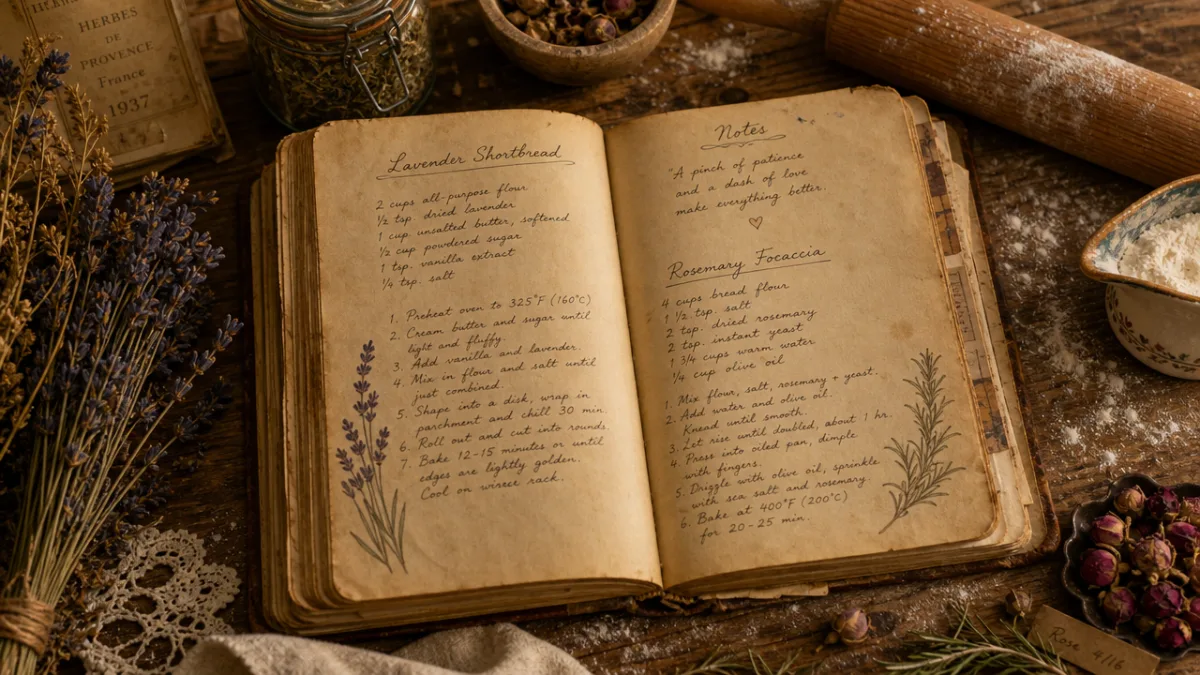
Food is one of the most powerful triggers for memory and emotion, and a junk journal dedicated to recipes and food experiences is a creative project with deeply personal rewards. Rather than a clean, functional recipe card system, this approach invites you to tell the story behind the food. You might copy out your grandmother’s chicken soup recipe in your own handwriting onto aged paper, surround it with images of the kitchen where you learned it, and add a small note about the first time you made it on your own. The recipe becomes a portal back in time.
You don’t have to limit your food journal to family heirlooms, either. You can document restaurant experiences, farmers market finds, seasonal cooking adventures, or the story of finally mastering a dish that defeated you for years. Pressed herb sprigs, tea bag wrappers, labels from favorite olive oil bottles, or a stained napkin from a memorable meal can all become elements on your pages. The messiness and imperfection that might ruin a traditional recipe book is entirely welcome and even celebrated in a junk journal format.
A food-focused junk journal also makes a wonderful gift. Imagine presenting a new bride with a journal filled with family recipes from both sides of the family, each written and decorated by a different relative. Or giving a friend who has just moved abroad a journal packed with recipes for the hometown foods they’ll miss most. The combination of practical information and heartfelt artistry makes this kind of gift unforgettable, and the junk journal format gives it an heirloom quality that a printed cookbook simply cannot replicate.
5. Build a Nature Journal or Botanical Collection
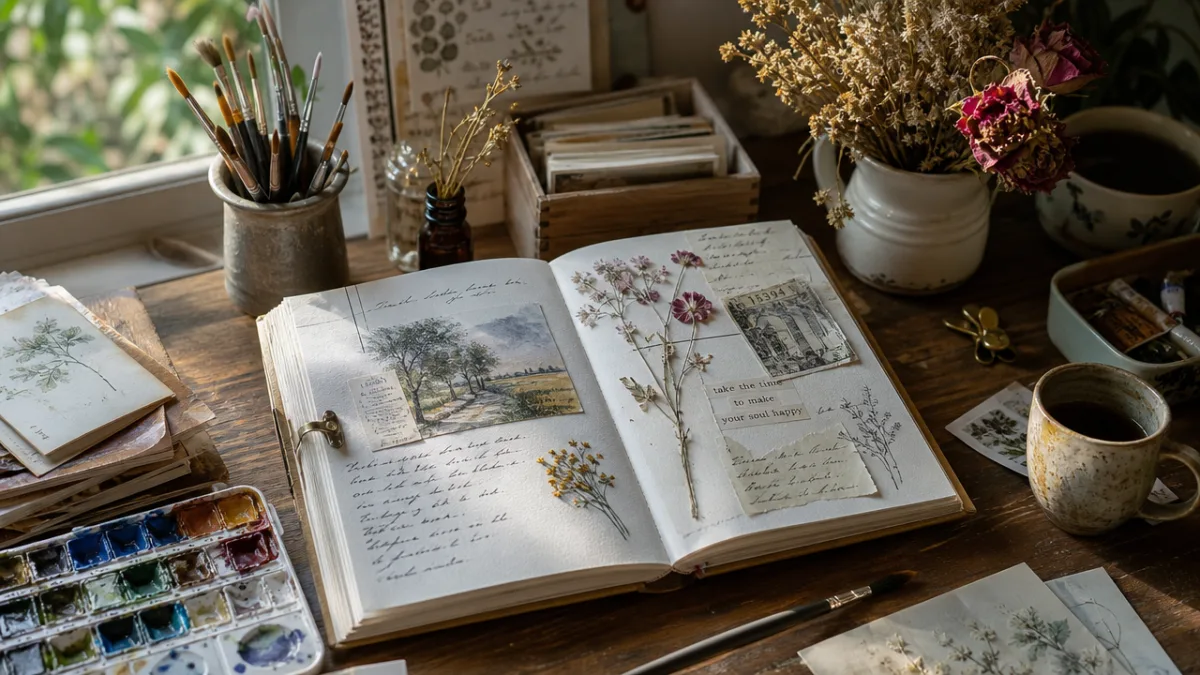
Nature journals have a long and beautiful history, from the meticulous field notebooks of Victorian naturalists to the loose, impressionistic sketchbooks of modern botanists. A junk journal brings this tradition into a contemporary, mixed-media context, allowing you to blend scientific observation with artistic interpretation and personal reflection. You can press wildflowers and leaves between your pages, sketch birds you’ve spotted on a morning walk, watercolor paint a landscape that moved you, and write down the sounds, smells, and temperature of a particular place and season.
What sets a junk journal nature record apart from a traditional field notebook is its willingness to embrace the emotional and the poetic alongside the observational. You’re not just cataloguing what you saw — you’re capturing how it made you feel, what it reminded you of, and why it mattered. A single afternoon in a park could yield pages of material: the particular quality of the light through the leaves, a feather you found, a rough sketch of a duck on the pond, and a few lines of poetry that came to you while you sat quietly on a bench.
Seasonal nature journals are especially wonderful to look back on over time. Tracking the first snowdrop of spring, the progression of summer wildflowers, the dramatic colors of autumn foliage, or the stark beauty of a winter tree against a grey sky creates a living record of the natural world’s rhythms as experienced from your own particular corner of it. Over years, these journals become a deeply personal almanac — a record not just of nature, but of yourself within it, noticing and responding to the world around you with attention and care.
6. Transform It Into an Art Practice Journal
For artists of any medium, a junk journal can serve as an invaluable practice space — a place where experimentation is not only allowed but actively encouraged by the very nature of the materials. Because junk journal pages are made from repurposed and imperfect papers, there’s a built-in permission to make mistakes, try new techniques, and play without pressure. You might use your pages to practice watercolor washes, experiment with different mark-making tools, test out collage compositions, or try your hand at lettering styles before committing them to more polished work.
An art practice journal also becomes a valuable archive of your creative development over time. Looking back at early pages compared to recent ones, you can see the evolution of your style, your increasing confidence with certain tools, and the recurring themes and imagery that seem to define your artistic voice. This kind of self-documentation is genuinely useful, not just sentimental — it helps you understand what you’re drawn to, what you’re good at, and where you want to push yourself next. It’s a creative diary as much as a sketchbook.
Many artists also use junk journals as a space to work through creative blocks. When you feel stuck or uninspired in your main creative practice, sitting down with a junk journal and a pile of materials without any particular goal can loosen the grip of perfectionism and reignite your creative instincts. The tactile pleasure of tearing paper, the surprise of how colors bleed into one another, and the delight of an unexpected collage combination can remind you why you fell in love with making things in the first place — and send you back to your main practice refreshed and inspired.
7. Use It to Document Travel Experiences
Travel journals have long been a beloved tradition, but a junk journal takes the concept to an entirely new level of richness and creativity. Instead of simply writing about the places you visit, you can incorporate the physical remnants of your journey: a metro ticket from Paris, a sugar packet wrapper from a café in Lisbon, a fragment of a map you used to navigate a winding old town, or a pressed flower from a garden you wandered into by accident. These tangible pieces of your trip become embedded in the pages, turning your journal into a three-dimensional souvenir unlike anything you could buy in a gift shop.
You don’t have to be traveling internationally for a junk journal travel log to be worthwhile. Day trips, weekend getaways, and even explorations of your own hometown with fresh eyes can yield wonderful material. The discipline of looking for small, collectible, documentable things — a particular color of door, a funny street sign, a beautiful pattern on a tile floor — actually changes the quality of your attention while you travel, making you more present and curious than you might otherwise be. The journal becomes a reason to notice more.
For those who travel frequently, a junk journal series organized by destination or year creates an extraordinary personal library over time. Each volume is a world unto itself, packed with the specific textures, colors, and stories of a particular journey. Sharing these journals with friends and family who weren’t there gives them a far more intimate and immersive sense of your experience than a photo slideshow ever could, and returning to them yourself years later is like stepping back through a door into another time and place entirely.
8. Create a Seasonal or Holiday Celebration Journal
Many junk journal enthusiasts create dedicated volumes for specific seasons or holidays, and it’s easy to understand why. The visual vocabulary of each season — the pastels and botanicals of spring, the bright patterns and heat of summer, the rich russet and gold of autumn, the quiet whites and deep greens of winter — translates beautifully into mixed-media pages. A seasonal junk journal becomes a way of honoring the particular atmosphere and emotion of each time of year, slowing down to appreciate what makes this season different from the last and the next.
Holiday celebration journals are especially popular around Christmas, but the concept works beautifully for any cultural or personal celebration that holds meaning for you. You might dedicate pages to the traditions you uphold, the foods you make, the music you play, and the specific feelings that a particular holiday evokes. Over the years, these journals document how your celebrations evolve — children who grow up, traditions that shift, new ones that are born — creating a family chronicle that is far more emotionally resonant than a standard photo album.
A seasonal journal also gives you a creative project that is naturally time-bounded, which many people find motivating. Knowing that you’re building an autumn journal over the course of October and November, for example, gives you a focused creative goal and a natural endpoint. The pages you fill during that time become infused with the specific energy of that season in that particular year, making them a time capsule of sorts — one that captures not just the aesthetics of autumn, but the particular texture of your life during that time.
9. Use It as a Reading or Media Journal
For book lovers, film enthusiasts, or anyone who consumes and wants to reflect on creative works, a junk journal makes an extraordinary reading or media log. Rather than a simple list of books read or movies watched, this approach invites you to create a visual and written response to each work that captures its emotional impact on you. You might choose a color palette that reflects the mood of a novel, incorporate a quote that struck you in a particularly beautiful way, or sketch an image from a film scene that stayed with you long after the credits rolled.
A junk journal media log also becomes a place to make connections between different works you’ve consumed — noticing recurring themes, finding unexpected parallels between a nineteenth-century novel and a contemporary film, or tracing your own evolving tastes and interests over time. These connections and observations are the kind of intellectual and creative work that deepens your relationship with the stories and ideas you encounter, turning passive consumption into active, engaged reflection. The journal becomes a companion to your reading life rather than just a record of it.
You can organize your media journal in a variety of ways depending on your preferences — chronologically, by genre, by medium, or entirely organically with no system at all. Many people find that the lack of a rigid system is itself one of the joys of this approach: a film might remind you of a book, which leads you to a page about a piece of music, and suddenly your journal has become a creative map of your inner world, with art, literature, film, and music all woven together in ways that reveal something true about who you are and how you think.
10. Build a Personal Inspiration and Mood Board Collection
Finally, one of the most practical and endlessly useful ways to use a junk journal is as a personal inspiration and mood board collection. Creatives of all kinds — interior designers, fashion enthusiasts, writers, photographers, crafters — benefit from having a curated visual reference of images, colors, textures, and words that spark their imagination and clarify their aesthetic. A junk journal is the perfect format for this, because its handmade, layered quality means your inspiration pages don’t just show you what you love — they demonstrate it through the way they’re made.
Unlike a digital mood board saved in a folder on your computer, a physical junk journal inspiration collection is something you can touch, smell, and return to with all your senses engaged. There is growing evidence that physical interaction with creative materials enhances creative thinking and memory in ways that screens cannot replicate. Flipping through the pages of a journal you’ve filled with images and colors and textures that move you activates a different kind of inspiration than scrolling through a saved collection on your phone — it feels more personal, more embodied, and ultimately more powerful.
Your inspiration journals can be broad and general, or highly specific to a particular project or creative direction you’re exploring. You might keep a general “things I love” volume alongside a project-specific volume for a room you’re redesigning or a creative collection you’re developing. Over time, these journals reveal the deep consistencies in your aesthetic preferences — the colors you return to again and again, the textures that always excite you, the imagery that never fails to spark something in you. That self-knowledge is one of the most valuable things a junk journal can give you, and it’s something that only grows richer with time and practice.








What do you think?
It is nice to know your opinion. Leave a comment.