










Weaving Remnants with Intention: How Mindful Textile Crafting Transforms Scraps into Art
The Philosophy Behind Intentional Weaving
We live in a world drowning in fast fashion and throwaway materials, so there’s something quietly radical about sitting down to weave with intention. It’s a practice that asks you to slow down, pay attention, and look at your leftover yarns, fabric scraps, and salvaged fibers not as junk to be cleared out but as raw material full of possibility. It’s as much a philosophy as it is a technique — built on the idea that every thread carries something worth honoring, and that real beauty can emerge from the overlooked and the cast-off.
This idea has deep roots. Textile traditions from the Andean highlands to West African villages have long understood that a remnant isn’t waste — it’s a material in transition, waiting for its next life. Modern makers are rediscovering that wisdom and weaving it together with contemporary design to create work that’s both beautiful and ethically grounded. There’s something meaningful about a practice that bridges generations in every warp and weft.
At its heart, weaving with intention means pausing before you ever reach for a shuttle or dig into your scrap basket. It means asking yourself what story these materials tell, what color relationships they’re suggesting, and what kind of structure will actually do them justice. That pause slows things down in the best way — it builds a meditative relationship between you and your materials that results in richer, more considered work than you’d get by just diving in. The course that inspired this approach is built around exactly that: teaching weavers to see, feel, and work with deeper awareness.
Understanding Your Remnant Materials
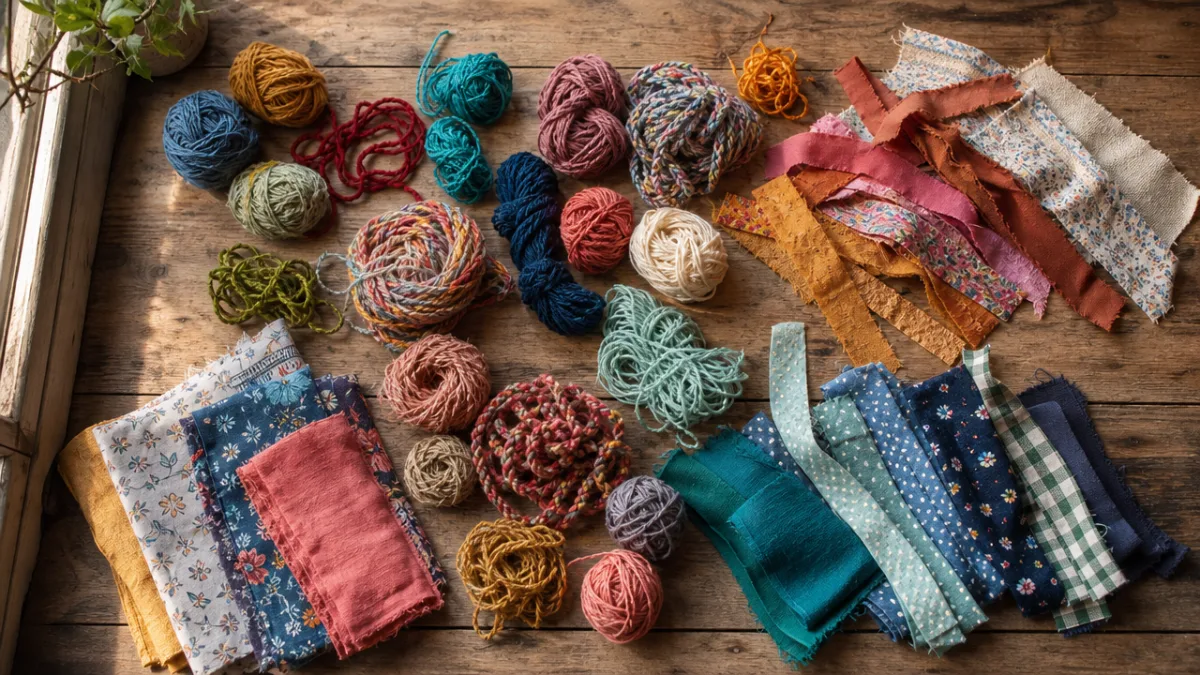
Before a single thread goes on the loom, intentional weaving starts with a good, honest look at what you’ve actually got. That means gathering every leftover skein, every cut end, every strip of salvaged fabric, and spreading it all out somewhere with decent light. It feels a little archaeological — you’re digging through your own creative history, tracing the trail left by past projects and impulse purchases. And what you find in that pile will almost always surprise you. Those surprises are where your next piece begins.
Remnants tend to fall into a few broad categories, and getting familiar with them is one of the first things serious remnant weaving courses cover — because knowing what you have and knowing what’s possible are really the same thing.
- Yarn ends and partial skeins: Leftover wool, cotton, linen, and synthetic blends from previous weaving or knitting projects, often too short for a full warp but perfect for weft passages.
- Fabric strips: Cut or torn lengths of fabric from garments, linens, or upholstery that can be woven as rags, creating dense and tactile surfaces with beautiful variation.
- Natural fibers and found materials: Dried grasses, reeds, paper twine, and even strips of plastic bags that bring texture, sustainability, and surprise to a composition.
- Roving and unspun fiber: Locks of fleece or combed rovings that can be woven in directly for a dimensional, sculptural quality unlike anything a spun yarn produces.
Once you’ve sorted everything out, the next step is to actually handle it — really handle it. Feel how a fabric strip sits against a wool yarn. See what happens when a raw fiber gets pulled through a shed. Notice how colors shift when you lay them next to each other. This kind of tactile, unhurried investigation isn’t procrastination; it’s the research phase of your artistic process. The things you notice during that quiet handling will quietly shape every decision you make once you sit down at the loom. Your materials are telling you something, if you’re willing to listen.
Color Theory and Composition in Remnant Weaving
Working with remnants means working with colors that were never meant to go together — and that’s exactly what makes it both tricky and exciting. You’re not building a palette from scratch; you’re looking for the harmony that already exists in the materials you’ve got. That requires a different kind of color fluency. Less about applying theory from the top down, more about reading the specific, quirky relationships that show up in your particular pile of scraps.
Color in weaving behaves differently than it does in painting or graphic design, because woven colors optically mix. When weft threads in two different colors alternate in close succession across a warp, the eye blends them at a distance into a third, perceived color. This means a pile of seemingly clashing remnants can, woven thoughtfully, resolve into a surface of real visual complexity and unexpected unity. Once you understand that, you start to see those “impossible” combinations very differently — they become opportunities.
Compositional decisions go beyond color, though. You’re also thinking about rhythm and proportion. How wide should a run of one material be before you shift to another? Should transitions feel abrupt or gradual? How does the visual weight of a chunky fabric strip balance against the airiness of a loosely spun yarn? These are the same kinds of questions any visual artist grapples with, and learning to ask and answer them in real time — right there at the loom — is one of the most valuable things a weaving course can teach. It’s what turns technical craft into actual artistic decision-making.
Structural Approaches: From Simple Tabby to Complex Interlacement
The structure of a weave — the system by which warp and weft threads interlace — is both a constraint and an invitation, and intentional remnant weaving asks you to treat it as a creative choice rather than a default. The simplest structure, plain weave or tabby, alternates each weft thread over and under successive warp ends, and it’s often the best choice for remnant work precisely because of that simplicity. When your weft is already doing a lot — all that variety, all that texture — an elaborate structure can compete with your materials rather than support them.
Even within simple structures, though, there’s a huge range of approaches that can change a textile completely. How tightly you pack the weft affects drape, weight, and surface. Leaving deliberate gaps creates transparency and visual lightness. Stacking up many picks of the same material builds a ridge. Each of these choices is a tool, and you build your toolkit through practice, experimentation, and paying close attention to how each decision shifts the piece in front of you.
More advanced structural moves in remnant weaving include soumak, where the weft wraps around warp threads to create a rope-like texture that really shows off a beautiful yarn. Rya knots, borrowed from Scandinavian tradition, introduce sections of cut pile that add dramatic dimensional contrast. Brooks Bouquet and similar lace weaves gather warp threads to create open, organic patterning. Any of these can be worked from remnants, and knowing when to reach for them — and when to leave them alone — is part of what sets a thoughtful weaver apart from someone who’s just filling in the warp.
- Plain weave (tabby): The foundational structure, versatile and material-forward, ideal for letting remnant variety speak for itself.
- Soumak wrapping: Adds textural richness and dimension, particularly effective with thicker, more characterful remnant yarns.
- Rya pile: Creates lush, sculptural sections of cut fiber, transforming remnant locks and yarn ends into dramatic surface elements.
- Clasped weft: A technique for joining two weft threads mid-row, allowing color and material transitions within a single pick.
- Brooks Bouquet and lace weaves: Structural lace techniques that create openwork patterning, adding visual complexity without dense packing.
Choosing among these structures with intention means coming back, again and again, to the question of what your materials need and what your emerging composition is asking for. No technique is universally right; each is a response to specific conditions, specific materials, specific creative goals. A good remnant weaving course doesn’t just tell you which structure to use — it helps you develop the perceptual sensitivity and structural understanding to make that call yourself, piece after piece, with growing confidence and ease.

The Loom as a Place of Meditation and Presence
There’s a reason weavers across centuries and cultures have described their practice in almost spiritual terms. The rhythm of throwing a shuttle, beating the weft, advancing the warp — those repetitive physical gestures create a kind of focused attention that a lot of practitioners genuinely compare to meditation. Working with remnants deepens that quality, because the variety of materials keeps you alert and engaged, making small decisions continuously rather than executing a plan you’ve already locked in. Every moment at the loom is a moment of active noticing.
Good intentional weaving courses acknowledge and actively cultivate this meditative dimension, because the state of mind you bring to a piece isn’t incidental to the outcome — it’s part of it. Work made in a rush or with half your attention elsewhere tends to show it, not necessarily in technical mistakes but in a certain flatness, a lack of coherence that attentive viewers can feel. Work made in genuine presence and care has a different quality — hard to define but easy to sense. It feels alive in the way that truly handmade things can be alive, carrying the attention of the person who made it in every passage of weft.
That understanding has real, practical implications for how you structure your studio time. Rather than weaving in stolen moments between other things, intentional practitioners set aside dedicated periods where they can actually settle into the work without divided attention. They might begin a session by handling their remnants — reconnecting with the materials before sitting down at the loom. They might end by stepping back and really looking at what they’ve made, noticing what’s working and what’s asking for something different. These rhythms of making and reflecting aren’t luxuries. For work made with genuine intention, they’re necessities.
Finishing, Living with, and Sharing Your Woven Work
The work doesn’t stop when you cut the piece off the loom. Finishing — washing, fulling, pressing, hemming, fringing — is its own set of decisions, and getting them right can elevate everything you did on the loom, just as getting them wrong can quietly undermine it. Different remnant materials behave very differently once they’re off the loom and in water: wool may bloom and soften dramatically; cotton tends to tighten and square up; linen often gains drape and a subtle luster. Knowing how your specific materials will respond lets you work with those transformations rather than being caught off guard by them.
Thinking ahead about how a piece will actually live in the world — as a wall hanging, a table runner, a garment panel, a bag, a cushion cover — shapes your finishing choices and can even influence structural decisions you make while weaving. A piece going on a wall might benefit from a weighted dowel pocket woven right into the structure. Something that gets handled every day needs edges built to last. A soft, wearable panel needs a hand that moves with the body. That forward-thinking is another dimension of intention — it connects the making of a piece to the life it’ll have beyond your studio.
And then there’s sharing: through exhibition, sale, gift, or teaching. When you give someone a piece made from remnants, you’re giving them a compressed record of many previous creative acts — a textile with layers of history woven into it. When you teach someone to work with remnants, you pass on not just a technique but a way of seeing and valuing material that can genuinely change how they move through a world full of overlooked, discarded things. That transmission of both skill and perspective might be the deepest purpose of a course like this. It doesn’t just produce objects. It cultivates a lasting, generous relationship between makers, materials, and the world they share.
- Wet finishing: Washing and gentle agitation that allows fibers to bloom, breathe, and settle into their final character and hand.
- Pressing and blocking: Using steam and tension to even the structure, square the corners, and set the weave for longevity.
- Hemstitching and fringing: Hand-finishing techniques that secure weft threads and create clean or decorative edges appropriate to the piece’s intended use.
- Mounting and display: Thoughtful presentation of wall pieces that honors the work and invites sustained looking from viewers.
Ultimately, a course in weaving remnants with intention offers something that reaches beyond any single lesson or technique. It offers a framework — a way of engaging with materials, with time, with making, and with beauty — that you carry into every project you work on, whether or not remnants are involved. The habit of really seeing, the patience developed at the loom, the sensitivity to material and composition that comes from working with the unpredictable variety of scraps and leftovers: these are gifts that travel with you. To weave a remnant with intention is to practice, in concentrated form, the art of finding value in what others have already used up and left behind.








What do you think?
It is nice to know your opinion. Leave a comment.