










My Expanding Pinetum: A Journey Into the World of Conifer Collecting
What Is a Pinetum, and Why Build One?
A pinetum is a specialized garden or arboretum dedicated entirely to the cultivation of conifers — pines, spruces, firs, cedars, larches, and their many relatives. The word itself comes from the Latin pinetum, meaning pine grove, and the tradition of creating these living collections dates back to the great estates of nineteenth-century Britain and Europe, where wealthy landowners and botanists competed to grow the most exotic and diverse specimens from around the world. Today, the pinetum has evolved from an aristocratic curiosity into a deeply personal gardening pursuit embraced by enthusiasts at every scale, from modest suburban backyards to sweeping country properties.
Building a pinetum is more than simply planting a collection of evergreen trees. It is an act of long-term stewardship, a commitment to growing living things that may outlast the gardener by decades or even centuries. Conifers are among the most ancient plant families on earth, with lineages stretching back hundreds of millions of years before flowering plants ever existed. When you plant a dawn redwood or a ginkgo — technically not a conifer but often included in pinetum collections — you are participating in a continuum of botanical history that connects you to something far larger than any single garden or lifetime.
For Martha Stewart and many serious garden makers, the decision to expand an existing pinetum is not made lightly. It begins with a vision: a landscape that changes with every season, offering texture, structure, color, and drama even in the depths of winter when most other parts of the garden have gone dormant. Conifers provide the bones of a garden, the architectural framework around which everything else is arranged. An expanding pinetum signals not just a love of trees, but a commitment to the garden as a living, growing, ever-deepening project without a fixed endpoint.
Choosing the Right Conifers for Your Collection
Selecting conifers for a pinetum requires balancing aesthetic ambition with practical horticultural reality. Climate, soil type, drainage, and available space all play decisive roles in determining which species will thrive and which will struggle. In the northeastern United States, for example, gardeners have access to an extraordinary range of species, from native Eastern white pines and Atlantic white cedars to exotic Japanese umbrella pines and Himalayan blue spruces. Understanding your hardiness zone and microclimate conditions is the essential starting point before any purchasing decision is made.
Beyond climate compatibility, the experienced pinetum builder thinks carefully about growth habits and ultimate size. Conifers are famously variable in this regard. A Korean fir might grow slowly to fifteen feet over thirty years, while a giant sequoia planted in the same garden could eventually dwarf every structure on the property. Dwarf and slow-growing cultivars have become increasingly popular in contemporary pinetum design, allowing collectors to include a far greater diversity of species and forms within a limited footprint. Weeping forms, globe-shaped specimens, groundcovers, and fastigiate varieties all add visual interest and textural contrast that a collection of standard-sized trees alone cannot achieve.
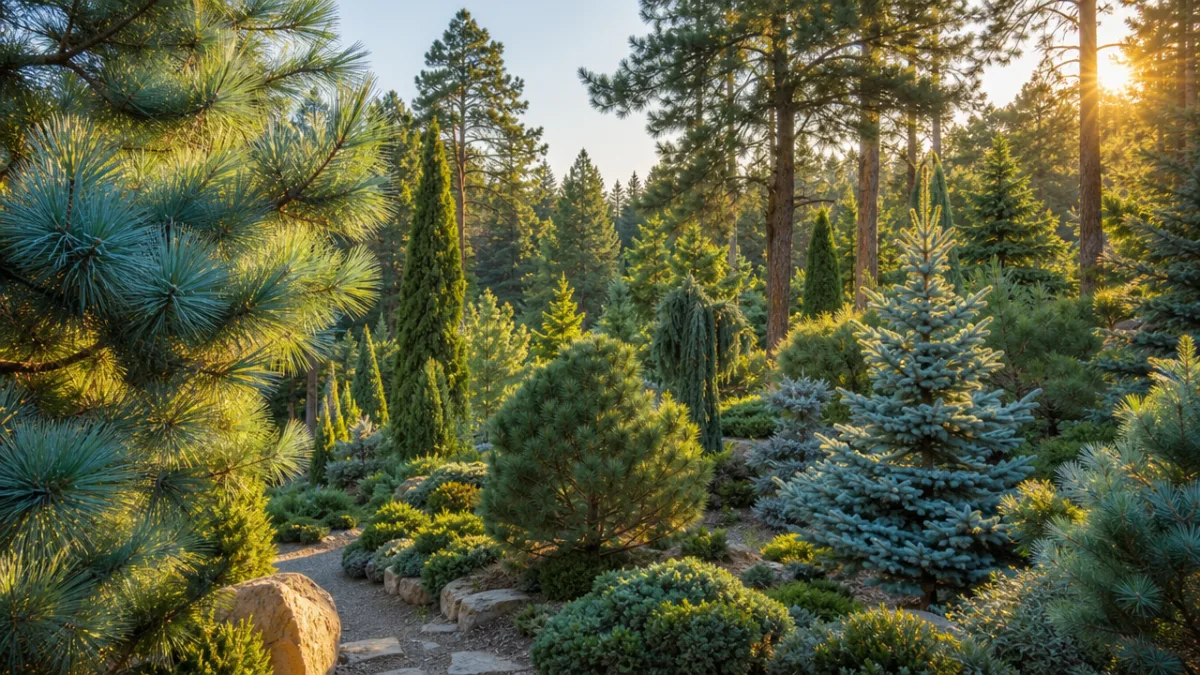
Color is another dimension that elevates a thoughtfully assembled pinetum beyond a simple tree collection. Conifers offer a surprising palette, from the silver-blue needles of the Colorado blue spruce to the golden foliage of Chamaecyparis obtusa ‘Crippsii’, the warm amber of Cryptomeria japonica in winter, and the fresh lime-green new growth of many pines in spring. Layering these colors deliberately across the landscape creates a composition that rewards close inspection throughout the year. Foliage texture matters equally: fine-needled pines read very differently from broad-scaled junipers or the feathery softness of bald cypress.
- Pinus strobus (Eastern White Pine): A graceful native with soft, bluish-green needles and an elegant, open form that develops beautifully with age.
- Abies koreana (Korean Fir): A slow-growing, compact fir prized for its striking purple cones that appear even on young trees.
- Picea pungens ‘Glauca’ (Colorado Blue Spruce): One of the most recognizable ornamental conifers, with intensely silver-blue needles and a formal pyramidal habit.
- Cryptomeria japonica (Japanese Cedar): A stately, fast-growing tree with rich reddish-brown bark and foliage that bronzes beautifully in winter cold.
- Metasequoia glyptostroboides (Dawn Redwood): A deciduous conifer and living fossil, turning brilliant orange in autumn before shedding its soft needles.
Designing the Layout and Landscape Framework
The layout of a pinetum should be conceived as a landscape design problem first and a horticultural collection second. This distinction matters enormously. A garden that is organized purely by botanical taxonomy — all the pines together, all the spruces in another block — may satisfy the scientific mind but rarely produces a beautiful or emotionally resonant landscape. The most successful pinetums, including those at great public gardens, arrange their trees with an eye toward vistas, seasonal interest, path experience, and the way light moves through the canopy at different times of day and year.
Paths are the essential organizing element of any large pinetum. They determine how visitors move through the space, what they see first and last, and what emotional rhythm the garden creates. Gently curving paths that disappear around corners generate a sense of discovery and mystery. Straight allées of matched specimens create formality and drama. A combination of both approaches, with open meadow clearings between planted groves, gives the pinetum a varied and dynamic quality that keeps the experience fresh across many visits. The path surface itself — gravel, grass, bark mulch, stone — contributes significantly to the overall character of the space.
Topography, whether naturally occurring or deliberately created, adds another dimension to pinetum design. A slight rise planted with weeping conifers creates a focal point visible from across the garden. A low, moist hollow becomes the perfect habitat for bald cypress and dawn redwood, species that tolerate or even prefer wet conditions. Berms and swales can be engineered to improve drainage in heavy clay soils or to create microclimates that allow the cultivation of species slightly outside the normal hardiness range. Working with the land rather than against it is a principle that experienced garden designers return to again and again, and nowhere is it more important than in a long-term project like an expanding pinetum.
Soil Preparation and Planting Techniques
Conifers are often described as tough and adaptable, and while this is broadly true compared to many flowering plants, they nonetheless have preferences and vulnerabilities that the attentive gardener must respect. Most conifers prefer well-drained, slightly acidic soil with a pH between 5.5 and 6.5. Heavy clay soils that retain water around the root zone are among the most common causes of conifer decline, leading to root rot and the slow deterioration that can be difficult to diagnose until significant damage has already occurred. Raised planting beds, generous incorporation of organic matter, and attention to drainage are not optional refinements but fundamental requirements for long-term success.
Planting depth is a detail that beginning gardeners frequently get wrong with conifers and trees generally. The root flare — the point where the trunk begins to widen and transition into the root system — must sit at or slightly above the finished soil grade after planting. Burying the root flare, even by just a few inches, creates conditions that encourage bark disease, fungal infection, and gradual decline over many years. When planting balled-and-burlapped specimens, it is important to remove or pull back all burlap, wire baskets, and twine from the top of the root ball before backfilling. These materials, even those marketed as biodegradable, can impede establishment and damage feeder roots during the critical first years of growth.
Mulching newly planted conifers provides significant benefits that compound over time. A three-to-four-inch layer of shredded bark or wood chips applied in a wide ring around each tree moderates soil temperature, retains moisture during dry periods, suppresses competing weeds and grass, and gradually improves soil structure as it decomposes. The mulch should never touch the trunk directly — a gap of several inches around the base prevents moisture accumulation against the bark and discourages the rodent and insect activity that can damage young trees. Refreshing the mulch layer annually and expanding it as the tree grows is one of the highest-value maintenance tasks in any young pinetum.
- Test soil pH and amend as needed to achieve a slightly acidic range of 5.5 to 6.5 before planting.
- Improve drainage in heavy soils by incorporating organic matter or installing French drains where necessary.
- Plant at the correct depth, ensuring the root flare remains at or above grade.
- Remove all burlap, baskets, and twine from the root ball before backfilling.
- Apply a generous ring of organic mulch, keeping it away from direct contact with the trunk.
- Water deeply and consistently during the first two growing seasons to encourage deep root establishment.

Seasonal Care and Long-Term Maintenance
One of the great appeals of conifers for the busy gardener is their relatively modest maintenance requirements once they are properly established. Unlike herbaceous perennials that must be divided, deadheaded, and replanted, or roses that demand regular feeding, spraying, and pruning, most conifers ask only for correct siting, good establishment care, and occasional attention to keep them looking their best. That said, neglect is never entirely without consequence, and a thoughtful seasonal maintenance routine makes a meaningful difference in the long-term health and appearance of a growing pinetum.
Spring is the most active season for pinetum maintenance. As temperatures rise and new growth begins, this is the moment to inspect every tree carefully for winter damage, pest activity, and signs of disease. Deer browsing, ice storm breakage, and desiccation from cold winter winds are common issues in exposed gardens. Light corrective pruning to remove damaged wood should be done before new growth has fully extended, as cuts heal more quickly during this period of active growth. Spring is also the ideal time to apply a balanced, slow-release fertilizer formulated for acid-loving plants, particularly for young specimens that benefit from the additional support during their establishment years.
Summer care centers primarily on irrigation management and pest monitoring. Newly planted conifers require consistent moisture throughout their first two or three summers, even species that will eventually prove quite drought-tolerant. Deep, infrequent watering that encourages roots to grow downward is far preferable to frequent shallow watering that keeps roots near the surface. Spider mites are a common summer pest on stressed conifers, particularly spruces, and infestations can escalate rapidly in hot, dry weather. Early detection through regular inspection, combined with targeted miticide application when necessary, prevents the significant aesthetic damage that heavy mite populations can cause to an otherwise beautiful specimen.
Autumn brings its own quiet rewards to the pinetum, as the deciduous members of the collection — dawn redwood, bald cypress, larch, and ginkgo — turn stunning shades of gold, amber, and orange before shedding their needles or leaves. This seasonal transformation is one of the most underappreciated aspects of a diverse conifer collection and provides a spectacular counterpoint to the evergreen majority. Late autumn, after the ground has begun to cool but before it freezes, is an excellent time for planting new acquisitions, as soil temperatures remain warm enough to support root establishment while reduced transpiration demands ease the stress on newly planted trees.
Expanding the Collection: Sourcing Rare and Unusual Conifers
For the committed pinetum builder, the search for new and unusual specimens is an ongoing and deeply pleasurable pursuit. Specialty nurseries focusing on conifers have proliferated in recent decades, driven by growing collector demand and advances in propagation techniques that have made rare cultivars more widely available than ever before. Organizations such as the American Conifer Society maintain directories of specialty nurseries and host garden tours, plant sales, and educational events that connect enthusiasts with sources for uncommon varieties. These communities also serve as invaluable networks for sharing knowledge, trading cuttings, and learning from the experience of gardeners who have been growing conifers for decades.
Visiting botanical gardens and arboreta with significant conifer collections is one of the most educational and inspiring activities available to the aspiring pinetum builder. Seeing mature specimens of rare species in person conveys information about scale, habit, color, and seasonal character that no photograph or catalog description can fully replicate. Many public gardens also offer guided tours focused specifically on their conifer collections, and staff horticulturists are often generous with practical advice about cultivation, sourcing, and the particular characteristics of species that have performed well or poorly in conditions similar to your own garden.
Expanding a pinetum is also an opportunity to participate in conservation. Many conifer species are threatened in their native habitats by logging, climate change, and disease. Growing these species in cultivation contributes to the preservation of genetic diversity and supports the broader botanical community’s efforts to document, study, and protect these ancient plant families. Some specialty nurseries partner directly with conservation organizations and can trace their propagation material to documented wild sources, adding provenance and meaning to specimens that might otherwise seem simply ornamental. For a garden maker like Martha Stewart, whose passion for both beauty and authenticity runs deep, this dimension of conifer collecting adds a layer of purpose that elevates the entire enterprise beyond mere decoration.

The Pinetum as a Living Legacy
Perhaps more than any other type of garden, the pinetum invites reflection on time, impermanence, and legacy. The trees planted today may take thirty, fifty, or even a hundred years to reach their full magnificence. Many of the most celebrated pinetums in the world were created by gardeners who never lived to see their grandest specimens mature. This long view is both humbling and inspiring: to plant a pinetum is to make a gift to the future, to create something whose full beauty will be realized by people not yet born, who will walk beneath canopies grown from seeds and saplings installed by hands they may never know.
This long-term perspective shapes every decision in the expanding pinetum, from the selection of species to the arrangement of paths and the scale of plantings. Trees that seem small and inconsequential at the moment of installation will eventually define the character of the landscape for generations. Getting the spacing right, anticipating ultimate size, thinking about the views and shadows that a mature specimen will create — all of these considerations require the gardener to project forward in time and make choices that sacrifice immediate gratification for long-term excellence. It is a discipline that rewards patience and punishes impulsiveness, and it develops in the gardener a kind of temporal humility that is rare and valuable.
For Martha Stewart and for every gardener who has committed to building and expanding a pinetum, the ongoing work is its own reward. Each new specimen added to the collection is a small but meaningful act of creation, a statement of faith in the future and in the enduring power of living things to bring beauty, meaning, and solace to human life. The pinetum grows season by season, decade by decade, accumulating depth and complexity with every year that passes, becoming not just a garden but a record of a gardener’s vision, passion, and care — a green and growing autobiography written in bark and needles against the open sky.








What do you think?
It is nice to know your opinion. Leave a comment.