










Upcycling a Colourblock Shirt: A Thomas Burberry Vintage Transformation Guide
The Art of Upcycling: Why Vintage Fashion Deserves a Second Life
Upcycling has come a long way from being a niche hobby for crafters tucked away in small studios — it’s become one of the most meaningful ways fashion can push back against fast fashion and the mountains of textile waste it generates. When you stumble across a vintage Thomas Burberry shirt at a car boot sale, a charity shop, or an online marketplace, you’re holding a piece of clothing history that deserves a much better fate than the bin. Transforming it into something you’ll actually wear is both a creative act and a quietly responsible one.
Thomas Burberry — the brand’s diffusion line that brought the iconic Burberry aesthetic into slightly more accessible territory — made clothes throughout the late twentieth century that were genuinely well-constructed. The fabrics held up, the cuts were thoughtful, and many of the colourblock designs had a boldness to them that actually feels pretty fresh today. Spotting that potential is half the battle when it comes to upcycling — you have to look at a garment not just as it is right now, but as what it could be with a bit of imagination and effort.
There’s also something personal about reworking a named vintage piece. You’re entering into a kind of conversation with the people who designed it and everyone who wore it before you. A colourblock Thomas Burberry shirt has a real visual identity built into it — those panels of contrasting colour are deliberately placed to create geometry and movement — and figuring out how to work with that identity rather than against it is honestly what makes the whole project so enjoyable. You’re not trying to erase what it was. You’re trying to find out what it could become next.
Understanding the Thomas Burberry Colourblock Aesthetic
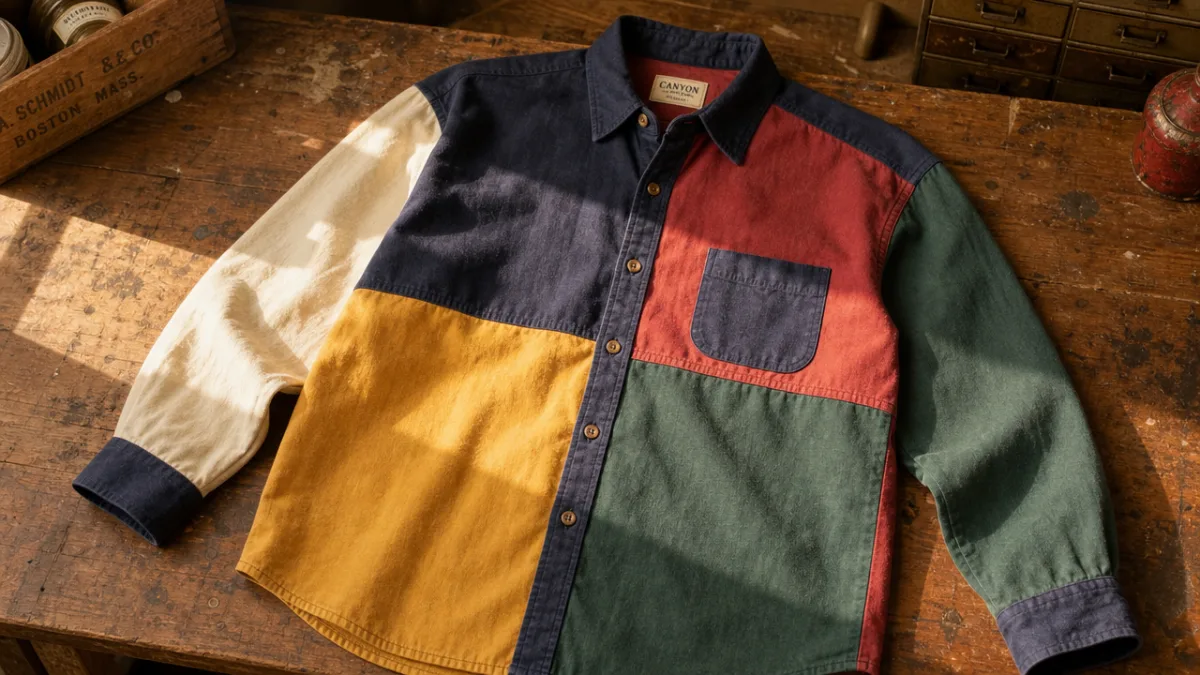
Before you reach for the scissors or thread a needle, it’s really worth sitting with the garment for a bit and actually studying it. Vintage Thomas Burberry colourblock shirts typically feature two to four distinct colour panels — often a neutral like cream, camel, or navy paired with something bolder, like red, forest green, or a warm tan. Those panels aren’t placed randomly; they follow the architecture of the shirt itself, framing the chest, sleeves, or placket with deliberate contrast. You need to understand that logic before you start making changes.
The Burberry colour palette has always drawn heavily from the British countryside — earthy tones, heathered greys, deep winter navy, the warm russet of autumn leaves. Even in the diffusion Thomas Burberry line, that sensibility tends to show up. When you look at a colourblock shirt from this era, you’re essentially seeing that aesthetic distilled into geometric form. Colourblocking was big in the late 1980s and early 1990s, when bold sportswear influences were making their way into mainstream fashion, and Thomas Burberry leaned into that moment with a characteristically British restraint.
Take a good look at where the colour panels actually sit on your shirt specifically. Some versions have a strong contrast yoke across the shoulders, others divide the body vertically, and others use the collar and cuffs as the accent zones. Each layout suggests a different path forward. A shirt with bold shoulder panels might be perfect for turning into a cropped jacket, while one with contrasting cuffs might work better with the sleeves removed altogether and repurposed as a sleeveless waistcoat. If you pay attention, the garment will usually point you toward what it wants to become.
- Identify the number and placement of colour panels before planning your transformation.
- Note the fabric composition — many Thomas Burberry shirts are cotton or a cotton-polyester blend, which behaves differently under heat and tension.
- Check the condition of seams, buttons, and buttonholes, as these can become design features rather than problems.
- Research the approximate production era of your shirt to understand its construction methods.
Tools, Materials, and Preparation for Your Upcycling Project
Good preparation is honestly what separates an upcycling project that feels exciting from one that ends in a frustrated heap on the floor. Before you make a single cut, gather what you need and set up a proper workspace. At the very least, you’ll want sharp fabric scissors — not the kitchen pair that’s been through cardboard and string and seen better days, but a dedicated pair kept purely for fabric. A seam ripper is just as essential; so many of the best upcycling techniques involve carefully taking apart the shirt’s original construction before putting it back together in a new way.
For a colourblock transformation, you’ll also want to think about any additional materials that might work with the existing palette. Iron-on interfacing can stabilise raw edges if you’re planning to leave them exposed as a deliberate design detail. Contrasting thread in a colour that picks up one of the shirt’s existing tones can turn functional stitching into something decorative — a technique borrowed from visible mending that’s been having a well-deserved moment in contemporary fashion. If you’re thinking about dyeing any part of the shirt, always test on a hidden seam allowance first, since different fabric panels can absorb dye at quite different rates.
Preparation also means giving the garment a proper wash before you do anything else. Vintage clothing can carry all sorts of residues from previous storage, and washing it first means any residual shrinkage happens before your alterations rather than after. Press it carefully with an iron, paying attention to the seams, so you have a clear and accurate sense of its actual dimensions. It’s worth measuring the shirt at this stage and writing down the key numbers — chest width, shoulder seam length, sleeve length, shirt length — so you can refer back to them as you go and make sensible decisions about proportions.
- Wash and press the vintage shirt before beginning any work.
- Record all key measurements and sketch the garment’s panel layout on paper.
- Gather sharp fabric scissors, a seam ripper, pins, and appropriate thread.
- Decide on your transformation concept before making any irreversible cuts.
- Source any additional materials — interfacing, dye, buttons, or trim — in advance.
Creative Transformation Techniques: From Shirt to Statement Piece
The upcycling transformations that feel most satisfying are the ones that work with a garment’s existing identity rather than trying to hide it. For a Thomas Burberry colourblock shirt, there are a few approaches that honour the original design while genuinely creating something new. One of the most elegant is converting it into a cropped boxy jacket. Cut straight across just below the natural waist, stabilise the new hem with a visible topstitch in contrasting thread, and suddenly a dated silhouette becomes something that reads as entirely contemporary. The colourblock panels, now framed differently, take on a whole new kind of visual weight.
Another really compelling option is patchwork deconstruction — using a seam ripper to carefully separate the colourblock panels along their original seams and then reassembling them in a new configuration. You might swap the front and back panels, or work sections of the sleeves into the body of the garment. It takes patience and a steady hand, but the results can be extraordinary: something that retains the original fabric’s quality and visual character while looking nothing like it did when you started. It’s a bit like architectural salvage, finding new form within existing material.
If you’re less confident with construction, simpler changes can be just as striking. Removing the collar and finishing the neckline with a neat rolled hem shifts the shirt’s whole mood without requiring complex pattern work. Cutting and rehemming the sleeves to three-quarter length changes the proportions more than you’d expect. Adding visible topstitching along the existing seams in a bold contrasting thread amplifies the colourblock geometry by drawing the eye along lines the original designer already established. Sometimes the most restrained intervention is the one that changes everything — a small shift in context that makes the garment feel completely transformed.
Dyeing opens up another layer of possibility, especially if the original colourblock panels include lighter or neutral tones. An ice dye or tie-dye applied over a cream or white panel introduces organic texture that plays really nicely against the shirt’s structured geometry. Or a dip-dye of the lower half in a complementary — or deliberately clashing — colour can extend the colourblock logic outward, adding a new layer of intention on top of the original design. Just make sure you research the dye requirements for your specific fabric, and remember that uneven absorption across different panels can itself become a feature worth leaning into.
Styling Your Upcycled Thomas Burberry Piece in a Modern Wardrobe
Once the transformation is done, the fun question becomes: how do you actually wear it? A colourblock shirt — whether you’ve kept it as a shirt, turned it into a jacket, or reimagined it as a waistcoat — makes a strong visual statement, and the best styling choices are the ones that meet that energy with confidence rather than trying to tone it down. If the palette is warm — cream, tan, and rust, say — lean into that with wide-leg trousers in a complementary earthy tone, or ground the whole thing with a simple pair of dark indigo jeans and just let the shirt do the talking.
There’s also something interesting about the heritage dimension of a Thomas Burberry piece. Wearing a reworked vintage Burberry item in a contemporary context creates what some fashion writers call a temporal collage — the garment carries its own history, the upcycling adds a layer of your present, and the way you style it places both within your current moment. That layering of different times is a big part of what makes vintage and upcycled fashion so culturally interesting, and it’s worth leaning into rather than smoothing over. You could pair it with other vintage pieces from different eras for something deliberately eclectic, or set it against a very minimal, contemporary wardrobe so its heritage roots really stand out.
Proportion matters more than usual when you’re styling colourblock pieces, because distinct colour panels shift how the body reads in space. A cropped colourblock jacket over high-waisted wide trousers creates a nicely balanced silhouette where the jacket’s visual energy sits above the waist. The same jacket over slim trousers creates a completely different dynamic — the leg looks longer and the eye travels up toward the colourblock panels. Play around with different combinations before committing, and don’t shy away from unexpected pairings. Sometimes the most surprising combinations turn out to be the best ones.
- Use the shirt’s existing palette as a starting point for building the rest of the outfit.
- Consider the transformed garment’s silhouette when choosing complementary separates.
- Mix vintage pieces from different eras for an intentionally layered aesthetic.
- Let the colourblock geometry guide accessory choices — simple, geometric jewellery often works well.
- Photograph the finished piece and document the transformation process for reference and inspiration.
The Broader Context: Upcycling as a Sustainable Fashion Practice
Upcycling one vintage shirt might feel like a small gesture against fashion’s enormous environmental footprint, but individual choices really do add up more than it seems. The global fashion industry accounts for roughly ten percent of annual carbon emissions and is one of the biggest contributors to water pollution on the planet. Every garment that gets transformed and worn again rather than binned is a direct reduction in demand for new production — and new production is where the real environmental costs are concentrated. That’s not a reason to feel smug about it, but it is a genuine reason to keep going.
Vintage heritage pieces like Thomas Burberry shirts bring an extra dimension to the sustainability argument: they were already made well. Fast fashion’s low price point is subsidised by low material quality and even lower labour costs, and those garments fall apart quickly as a result. A vintage Thomas Burberry shirt was built to last — woven from fabric meant to handle repeated wear and washing, sewn using construction methods that had longevity in mind. Upcycling something like that means you’re working with quality materials that took real resources to produce, and making sure that investment doesn’t go to waste.
There’s a skills argument to be made here too. The techniques involved in upcycling — seam ripping, pattern adjustment, hand and machine stitching, dyeing, fabric manipulation — have been quietly disappearing from everyday life as fashion became increasingly industrialised and disposable. Learning them through a fun, personally meaningful project like reworking a vintage colourblock shirt reconnects you with the material reality of clothing in a way that shopping rarely does. Once you’ve unpicked a seam with your own hands, you understand garment construction differently. And once you understand it differently, your whole relationship with clothing tends to shift in ways that stick.
Sharing upcycling projects through social media and community platforms also has a real multiplying effect. When a beautifully reworked vintage piece is photographed well and shared with some context — where it came from, what techniques you used, how long it took — it encourages other people to look at their own wardrobes differently. Upcycling culture grows not through corporate campaigns but through individual creativity made visible, and every project you share contributes to a broader shift in values: that creativity and care are more interesting than novelty and speed, and that what already exists is usually more than enough to work with.
Documenting, Sharing, and Continuing Your Upcycling Journey
One of the best things you can do after finishing an upcycling project is to document it properly. Take photos at every stage — the original garment before any work begins, the shirt mid-transformation with pins and chalk marks still visible, and the finished piece both laid flat and worn. These process shots serve several purposes at once: they give you a reference archive for future projects, they let you share the full story of the transformation with others, and they make you look carefully at what you did and why — which is itself a kind of creative reflection that quietly improves your practice over time.
Written notes are equally valuable. Record the techniques you used, the decisions you made at key moments, what went well and what you’d do differently next time. Note where the original garment came from and what you paid for it, so you can track the economics of your practice as it develops. A lot of experienced upcyclers find that keeping a project journal — even just a simple notebook kept with their sewing kit — transforms a series of one-off projects into a real creative practice, with a visible arc of developing skill and growing confidence in aesthetic decisions.
Connecting with the broader upcycling and slow fashion community, whether through online platforms, local maker spaces, or clothing swap events, brings both inspiration and a sense of accountability. The community of people working creatively with vintage and second-hand clothing is large, generous, and genuinely knowledgeable, and there’s always more to learn from people who have been at it longer or who work with different materials and techniques. A Thomas Burberry colourblock shirt might be the start of one interesting project, or it might be the beginning of a completely different relationship with fashion — one built on creativity, care, and the quiet satisfaction of making something that’s truly your own.
Ultimately, the most important thing is just to start. Vintage garments aren’t museum pieces — they’re made to be worn, and a bit of reworking in service of that is always better than careful storage followed by eventual discard. The Thomas Burberry colourblock shirt sitting in your wardrobe or on your wishlist is a starting point, a set of possibilities in fabric form, waiting for someone curious and brave enough to pick up a seam ripper and see what lies on the other side of its original construction. That someone might as well be you.








What do you think?
It is nice to know your opinion. Leave a comment.