










The Art of Upcycled Denim Jackets: Transforming Old Into Gold
The Rise of Upcycled Fashion and Why Denim Leads the Way
In recent years, the fashion industry has undergone a profound reckoning with its environmental impact. Fast fashion’s consequences — overflowing landfills, polluted waterways, exploited labor — have pushed consumers and creators alike toward more intentional choices. Among the many responses to this crisis, upcycling has emerged as one of the most exciting and creatively rich movements. Rather than discarding old garments, upcyclers transform them into something entirely new, imbuing worn fabric with fresh purpose and personality. Nowhere is this renaissance more visible than in the world of denim.
Denim is uniquely suited to upcycling for several reasons. It is one of the most durable fabrics ever woven, capable of withstanding decades of wear before it truly surrenders. Its texture takes paint, embroidery thread, bleach, and embellishment with remarkable generosity, making it a near-perfect canvas for artistic intervention. A denim jacket that has lived through a decade of adventures already carries character — faded stress lines, softened cuffs, subtle creases — that no brand-new garment can replicate. This lived-in quality is precisely what upcycle artists prize most.
The global marketplace for upcycled denim has exploded in parallel with growing environmental awareness. Platforms like Etsy have become thriving hubs where independent creators sell one-of-a-kind pieces to buyers who want something no mass manufacturer can offer. An upcycled denim jacket purchased on Etsy is not simply a garment; it is a collaboration across time, between the original wearer, the fabric itself, and the artist who saw new potential where others saw an ending. This article explores that collaboration in depth, from the history and philosophy behind upcycled denim to practical guidance for creating your own masterpiece.
A Brief History of Denim as a Canvas for Self-Expression
Denim’s story as a medium for personal expression stretches back to at least the 1950s, when motorcycle subcultures in the United States began customizing their jackets with painted club insignia, studs, and patches. These early customizers were, in every meaningful sense, the first upcyclers — people who took a utilitarian garment and transformed it into a statement of identity and belonging. The practice deepened through the 1960s counterculture, when tie-dye, embroidery, and peace symbols turned denim into the uniform of a generation demanding social change. Every patch sewn onto a pair of bell-bottom jeans was a small act of creative resistance.
By the 1970s and 1980s, punk and heavy metal communities had taken denim customization to more aggressive heights. Studded jackets covered in band patches, hand-painted band logos, and deliberate distressing became badges of belonging in those tight-knit subcultures. These so-called “battle jackets” are now collected and preserved as genuine cultural artifacts, proof that what begins as informal craft can evolve into recognized art. Academic institutions have mounted exhibitions showcasing these garments alongside formal fine art, acknowledging the skill, vision, and cultural significance embedded in every stitch and rivet.
Today’s upcycled denim movement inherits all of these traditions while adding new layers of meaning drawn from sustainability ethics and the maker movement. Contemporary artists working with vintage denim jackets are simultaneously participating in a lineage of subcultural creativity and responding to an urgent environmental moment. They are, in a sense, the latest chapter in a very long book — one that began whenever a human being first looked at a worn thing and imagined it differently. Understanding this history makes the upcycled jacket hanging on your wall or worn on your back feel even more significant.

Techniques That Define Upcycled Denim Jacket Art
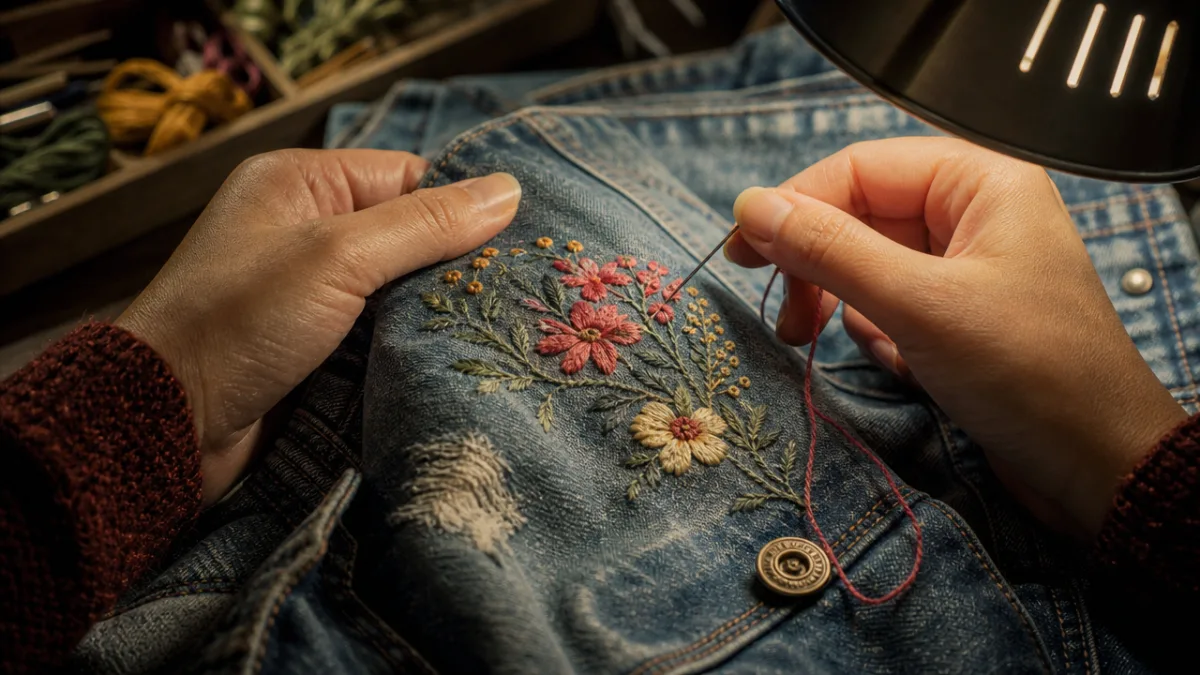
The range of techniques available to upcycled denim artists is staggering, and skilled creators typically combine several methods in a single piece to achieve layered visual complexity. Embroidery is perhaps the most time-honored approach, with artists using floss, yarn, or even wire thread to build intricate scenes across jacket backs and shoulders. A single large-scale embroidered panel on a denim jacket back can represent dozens of hours of meticulous handwork, with each stitch placed deliberately to build color, texture, and narrative depth. The result is wearable textile art of the highest order.
Painting is another cornerstone technique, ranging from delicate fine-line illustration using fabric markers to bold acrylic applications that give a jacket the visual weight of a mural. Some artists layer paint over bleach treatments, creating backgrounds of graduated color before adding painted imagery. Others use heat-transfer methods, screen printing, or hand-cut stencils to achieve effects somewhere between illustration and graphic design. The physical properties of denim — its weave creating a subtle texture beneath any paint layer — mean that painted denim always retains a warmth and tactility that printed fabric cannot fully replicate.
Beyond embroidery and painting, upcycled denim artists employ an impressive range of additional methods:
- Patchwork and piecing: Combining panels from multiple denim garments to create entirely new silhouettes or bold color-block compositions that tell the story of several garments at once.
- Bleaching and dyeing: Using bleach pens, resist techniques, indigo overdyeing, or botanical dyes to dramatically alter the jacket’s color story and create gradient or pattern effects impossible to achieve on new fabric.
- Studding and hardware: Applying metal studs, grommets, rings, and chains to add dimension, weight, and an edge that speaks directly to punk and rock traditions.
- Appliqué and mixed media: Attaching fabric pieces, lace, leather, velvet, or even found objects to create dimensional collage effects that push the boundary between garment and sculpture.
- Distressing and deconstruction: Strategically cutting, fraying, and reconstructing the jacket’s structure to alter its silhouette while celebrating rather than hiding evidence of the original garment’s age.
The most compelling upcycled denim pieces tend to combine multiple techniques in ways that feel integrated rather than additive. An artist might bleach a jacket to create a stormy sky effect, then embroider constellations over the bleached area, then stud the collar and cuffs to frame the celestial scene. Each decision builds on the last, creating a coherent visual language that elevates the whole beyond the sum of its parts. This kind of thoughtful integration is what separates truly exceptional upcycled pieces from simple decoration.
Sourcing and Selecting the Perfect Denim Jacket for Upcycling
Every great upcycled jacket begins with the right raw material, and sourcing that material is itself an art form. Thrift stores, estate sales, vintage markets, and online resale platforms are the primary hunting grounds for upcycle artists, and developing an eye for promising candidates takes time and experience. The ideal jacket for upcycling is structurally sound — seams intact, no irreparable tears in areas that will remain visible — but carries enough history to have developed character in its fabric. A jacket that is simply old but has never been worn lacks the softness and personality that make vintage denim so compelling as a creative base.
Weight and weave matter enormously in denim selection. Heavier denim, typically fourteen ounces per yard or above, provides a stiffer, more structured canvas that holds embroidery and hardware particularly well without distorting under the weight of additions. Lighter denim offers more drape and movement, which suits painted designs and fabric appliqué that need to flow with the body. Mid-weight denim, the most commonly available in vintage markets, offers a versatile balance suitable for most techniques. Learning to assess denim weight by feel — running fabric between fingers, checking how it holds its shape when draped over a hand — is a foundational skill for any serious upcycler.
Color and existing fade patterns are equally important considerations. A uniformly medium-blue jacket offers maximum flexibility because it accepts most treatments without unexpected results. Heavily faded jackets bring their own atmospheric quality — that particular silvery-grey denim achieves with age is impossible to manufacture — but they may respond less predictably to dyeing or bleaching. Very dark or very light denim each present their own opportunities and challenges. Some artists deliberately seek out stained, marked, or unevenly worn jackets because those existing variations become part of the finished artwork rather than flaws to overcome.

The Etsy Marketplace and the Economy of Upcycled Creativity
Etsy has played an extraordinary role in making upcycled denim jacket art viable as a livelihood for independent creators around the world. Before platforms like Etsy existed, artists who made one-of-a-kind wearable art had limited options: sell through local markets, approach boutiques as a wholesale supplier, or build a customer base through personal networking alone. Each of these paths was narrow and uncertain. Etsy opened a global marketplace virtually overnight, connecting makers with buyers who specifically sought out handmade, unique, sustainable alternatives to mass-produced fashion.
The economics of upcycled denim on Etsy reflect both the opportunity and the challenge of creative commerce. A highly skilled artist spending forty or more hours on a single elaborately embroidered jacket faces a genuine tension between pricing work appropriately and reaching buyers who may not immediately grasp the labor intensity of hand embroidery. Many successful Etsy sellers navigate this by offering a range of pieces at different price points — simpler painted or patched jackets alongside their most ambitious embroidered work — allowing new customers to enter at accessible prices and deepen their appreciation over time. Building a following that understands and values the work is as important as the work itself.
Community and collaboration are defining features of the upcycled denim world on Etsy and across social media. Creators share techniques openly, celebrate each other’s work, and participate in an informal knowledge economy built on generosity rather than competition. This spirit reflects the broader values of the upcycling movement: if the goal is a more sustainable and creative world, then there is room for everyone to contribute. Buyers participate in this community too, sharing photos of their purchases, commissioning custom pieces, and becoming vocal advocates for the artists whose work they wear. The relationship between maker and wearer in this space is unusually close and mutually enriching.
Creating Your Own Upcycled Denim Jacket: A Practical Starting Guide
Beginning your own upcycling journey with a denim jacket is more accessible than it might appear. The barrier to entry is genuinely low: a willing jacket, a few basic tools, and the courage to make the first mark. Many experienced upcycle artists recommend starting with techniques that are either easily reversible or forgiving of imperfection — fabric paint, for instance, can be layered and corrected as you work, while embroidery can be unpicked if a stitch goes astray. Beginning with modest ambitions allows you to build skills and confidence before tackling more complex and time-intensive work.
Before putting any tool to fabric, spend time in the planning phase. Sketch your design on paper, considering how it will relate to the jacket’s existing structure — seams, pockets, collar, and cuffs are natural framing elements that your design can work with rather than against. Think about which techniques you want to use and in what order, since some processes (like bleaching) must happen before others (like painting) for predictable results. Gather all your materials before beginning, because having to pause mid-process to source supplies breaks the creative flow and can leave partially completed work vulnerable to mistakes.
The following approach offers a useful framework for first-time upcyclers ready to begin their jacket project:
- Prepare your jacket: Wash and dry it thoroughly, then press it flat. Examine every seam and reinforce any that show stress before you begin adding weight or working the fabric.
- Sketch and transfer your design: Work out your design on paper first, then use tailor’s chalk or a washable fabric marker to lightly transfer key lines to the jacket as guides.
- Work from background to foreground: Complete any overall color treatments like dyeing or bleaching first, then add painted backgrounds, then add detailed embroidery or appliqué on top.
- Secure and seal: Heat-set painted areas according to paint manufacturer instructions. Secure all embroidery thread ends carefully on the interior. Attach hardware firmly using appropriate tools.
- Final assessment and adjustment: Step back, try the jacket on, and look at it in natural light. Small additions or corrections at this stage can significantly strengthen the finished piece.
Perhaps the most important piece of advice for anyone beginning an upcycling practice is to release any anxiety about perfection. The beauty of working with vintage fabric is that the material already carries imperfection — and that imperfection is part of its soul. A stitch that sits slightly unevenly, a paint stroke that bleeds softly into surrounding fabric, a patch that edges of fraying in character rather than disaster: these qualities give upcycled work its humanity and warmth. No mass-manufactured garment can carry what handmade work carries, and that difference is visible and palpable to anyone who encounters it.
Sustainability, Ethics, and the Deeper Meaning of Upcycling
Upcycling is not simply a craft trend or an aesthetic choice — it is a meaningful response to one of the most pressing environmental challenges of our time. The fashion industry is responsible for an estimated ten percent of global carbon emissions and is the second-largest consumer of the world’s water supply. A single pair of jeans requires roughly 1,800 gallons of water to produce from raw cotton through finished garment. When we extend the life of existing denim through upcycling rather than purchasing new, we effectively prevent those resources from being consumed again unnecessarily. The environmental impact of a single upcycled jacket is genuinely significant when understood at scale.
Beyond the environmental mathematics, upcycling carries a philosophical weight that resonates with many people on a personal level. In a culture that relentlessly promotes the new — the latest style, the newest technology, the freshest trend — choosing to value the old and worn is a quiet but meaningful act of resistance. Finding beauty in a faded jacket rather than discarding it because it is no longer pristine challenges the logic of planned obsolescence that drives so much of consumer culture. Upcyclers are, in a real sense, practicing a different relationship with objects: one based on attention, care, and creative imagination rather than acquisition and disposal.
There is also an important conversation to be had about labor ethics within the upcycling movement. When you purchase an upcycled denim jacket from an independent artist on Etsy, you are participating in an entirely different economic relationship than when you buy a mass-produced garment from a fast fashion retailer. The price you pay goes directly to the person who made the thing, fairly compensating labor that is visible and understood rather than hidden in a distant factory. This transparency is itself a form of ethical consumption, and the community of upcycle artists and their customers is quietly modeling an alternative economy built on craft, sustainability, and direct human connection between maker and wearer.
The upcycled denim jacket is, ultimately, a remarkably concentrated symbol of everything the slow fashion movement stands for. It is old made new, waste made valuable, individual creativity made wearable, and environmental responsibility made beautiful. Whether you wear one purchased from a skilled artist, create one yourself in an afternoon of joyful experimentation, or simply pause to appreciate the craft and meaning embedded in someone else’s work, you are participating in a conversation about how we want to make things, value things, and move through a world that desperately needs us to imagine differently. That is a conversation worth having — and a jacket worth wearing.








What do you think?
It is nice to know your opinion. Leave a comment.