










Skateboard Tables: The Ultimate Guide to Building and Styling This Iconic DIY Furniture Piece
What Is a Skateboard Table and Why Is It Taking Over Interior Design?
A skateboard table is pretty much exactly what it sounds like — furniture that uses one or more skateboard decks as a key structural or decorative element. The decks might form the tabletop, serve as a shelf base, or even double as legs. However you use them, they take something built for the streets and turn it into something genuinely beautiful for your home. The result is a piece that straddles the line between furniture and art, between nostalgia and something fresh — equal parts skate park and living room.
Skateboard tables have really taken off in recent years, and it’s not hard to see why. DIY culture and sustainable design have been colliding in exciting ways, and a lot of people are just done with generic flat-pack furniture. They want pieces that actually mean something — that feel personal, that spark a conversation. A skateboard table does that naturally. Every deck comes with its own graphic, its own scuffs, its own backstory. Put a handful of them together into a table and those individual histories merge into something that feels genuinely one-of-a-kind.
You’ll find these tables everywhere from minimalist studio apartments to colorful, cluttered living rooms — they seem to fit in almost anywhere. A single clean deck on hairpin legs has a sleek, almost Scandinavian quality to it. A patchwork of beat-up vintage decks reads as bold and post-modern. The form is endlessly flexible, and that flexibility is a big part of why this trend keeps growing instead of fading out.
The History and Culture Behind Skateboard Deck Design
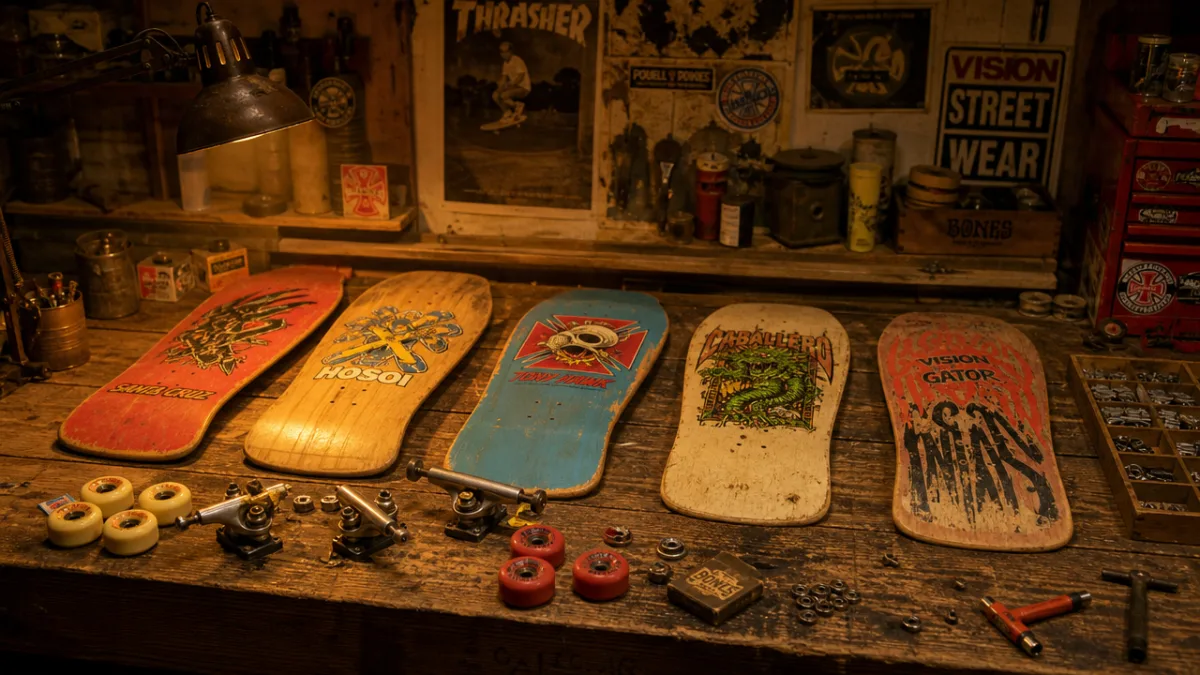
To really appreciate a skateboard table, it helps to know a little about where deck art came from. Going back to the 1970s, deck graphics have been one of the most expressive art forms in street culture. Brands like Powell Peralta, Santa Cruz, and Vision were commissioning original artwork for their decks long before most people thought of graphic design as a real career. Those decks were canvases, and the artists behind them were developing a visual language that would eventually influence everything from streetwear to gallery shows.
The art has always reflected its moment. The ’80s brought skulls, screaming figures, and psychedelic neon patterns. The ’90s pulled back toward minimalism and street-art influences. By the 2000s, skate brands were collaborating with fine artists and muralists, and some decks were being bought purely as collectibles — plenty of skaters would pick up two copies of a favorite graphic, one to ride and one to keep pristine on the wall.
That dual identity — sporting equipment and art object at the same time — is exactly what makes skateboard decks such a natural fit for furniture. It’s not like repurposing a tennis racket or an old bike wheel. Using a deck in a piece of furniture actually honors its existing status as a visual artifact. The scratches and chips from years of street use aren’t damage — they’re patina. The kind of authentic wear that furniture collectors spend real money trying to fake.
Materials and Tools You Will Need to Build Your Own Skateboard Table
Building a skateboard table is more approachable than you might expect, but like any woodworking project, your results are only as good as your materials and tools. The decks themselves are obviously the starting point. You might need just one for a small side table, or a dozen or more if you’re going big with a dining table surface. Good places to hunt for decks include skate shops clearing out old stock, thrift stores, eBay, Craigslist, or your own pile of retired boards gathering dust in the garage.
You’ll also need something to support the table. The most popular options are hairpin legs for a mid-century modern vibe, wooden box frames for something more rustic and handmade-feeling, and metal pipe frames for an industrial look. Depending on your design, you may also need wood glue or epoxy resin to bond decks together, sandpaper in a few different grits, and a clear sealant or polyurethane coat to protect the finished surface from daily life.
Tool-wise, you’ll want a drill for attaching legs or frames, clamps to hold everything together while glue dries, and possibly a circular saw or jigsaw if you need to trim any decks. A measuring tape and level will save you a headache when it’s time to make sure the table sits flat. If you’re planning an epoxy pour, add mixing cups, stir sticks, and a heat gun or small butane torch to pop bubbles before it sets. None of this is hard to find or particularly expensive — which is part of what makes this such a great beginner project.
A Basic Shopping List for a Single-Deck Side Table
- One used or new skateboard deck (approximately 31 inches long, 8 inches wide)
- Four hairpin legs in your preferred height (typically 16 to 28 inches for a side table)
- Eight small wood screws compatible with your leg mounting plates
- 150-grit and 220-grit sandpaper for surface preparation
- One can of matte or satin polyurethane clear coat for protection
- A drill and appropriate screwdriver bits
- A measuring tape and pencil for marking leg placement
Step-by-Step Instructions for Building a Multi-Deck Coffee Table
A multi-deck coffee table is one of the most visually impressive things you can build from skateboards, and it’s totally doable for a beginner with a couple of free weekends and some patience. Start by sourcing and selecting your decks. For a standard coffee table surface around 48 by 20 inches, you’re looking at roughly six to eight full-size decks depending on width and arrangement. Before you commit to anything, lay them all out on a flat surface and play with different configurations. See how the graphics talk to each other. Decide if you want a coherent color story or a deliberately wild, anything-goes collage.
Once you’ve landed on a layout you love, apply wood glue generously to each adjoining edge and clamp the decks tightly side by side. Let the glue cure fully — most wood adhesives need a solid 24 hours. For a really strong, seamless bond, you can reinforce the underside with thin strips of hardwood running perpendicular to the decks, creating a subframe that keeps everything in alignment and gives you a good place to attach your legs later without having to drill into the deck edges.
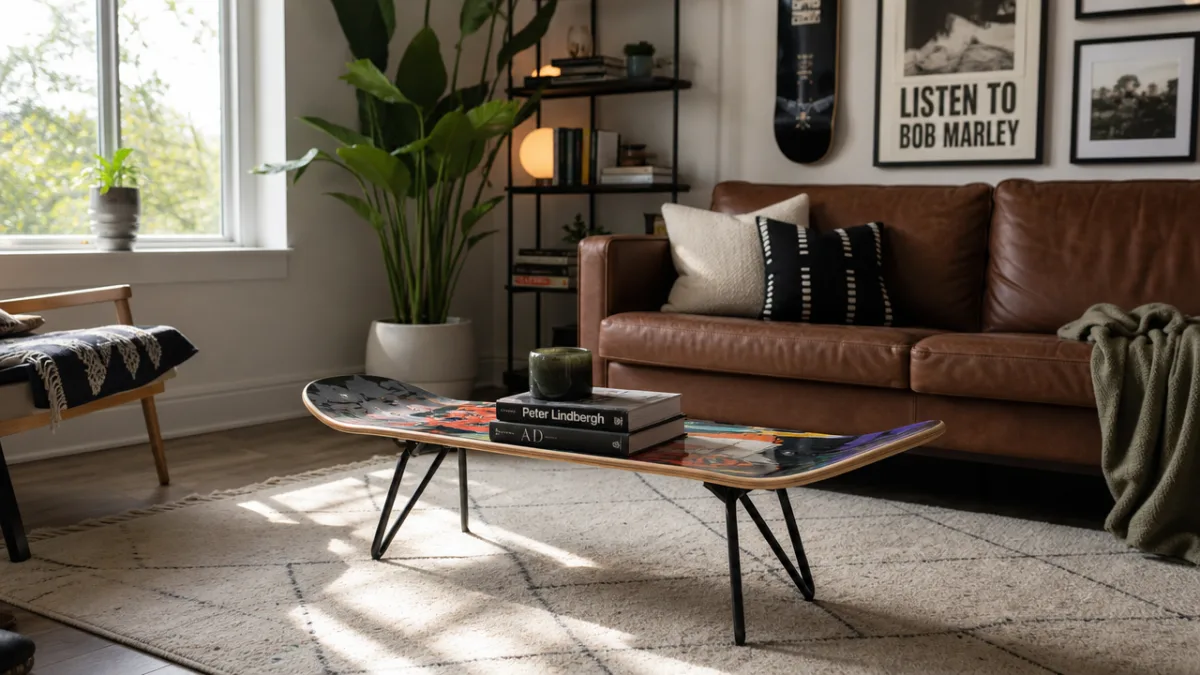
After the glue has fully cured, sand the top surface through progressively finer grits — start around 120 if there are noticeable height differences between decks, move to 150, and finish with 220 for a smooth, even surface. Wipe everything down with a tack cloth before applying your finish. For a coffee table that’s going to see real daily use, three coats of oil-based polyurethane with a light sanding between each coat is a solid choice. Then attach your legs, check that the table sits level, and you’re done. Not bad for a weekend project.
Finishing Options Compared
- Polyurethane: Highly durable and water-resistant, available in matte, satin, and gloss. Ideal for tables that will see heavy daily use. Amber-tints slightly over time.
- Epoxy Resin: Creates a thick, glass-like surface that can encapsulate the decks entirely. Spectacular visual effect but requires careful mixing and application. Best for display or light-use tables.
- Wax or Oil Finish: A natural, low-sheen option that is easy to apply and repair. Offers less protection than the above options but allows the wood grain and deck graphics to breathe visually.
- Lacquer: Fast-drying and very clear, lacquer provides a hard finish that resists scratches well. Best applied with a spray gun for an even coat over a complex multi-deck surface.
Design Variations and Creative Interpretations of the Skateboard Table
One of the best things about skateboard tables is how loosely you can interpret the concept. On one end of the spectrum, you’ve got the ultra-minimalist approach — a single pristine deck on simple metal legs, presented almost like a sculpture that happens to be functional. In a contemporary or Japandi-influenced space where restraint is the whole point, this works beautifully. The deck gets to be the star, its graphic fully intact and perfectly preserved under a crystal-clear finish.
On the other end, you’ve got the maximalist mosaic approach — dozens of decks in various states of wear, cut, arranged, and bonded into a richly layered surface that functions almost like a painting you can set your coffee on. This style is right at home in industrial lofts, game rooms, music studios, and other spaces that lean into visual complexity. Vintage decks from the ’80s and ’90s are especially good for this kind of project — their graphics are so bold and distinctive that each one adds its own personality to the mix.
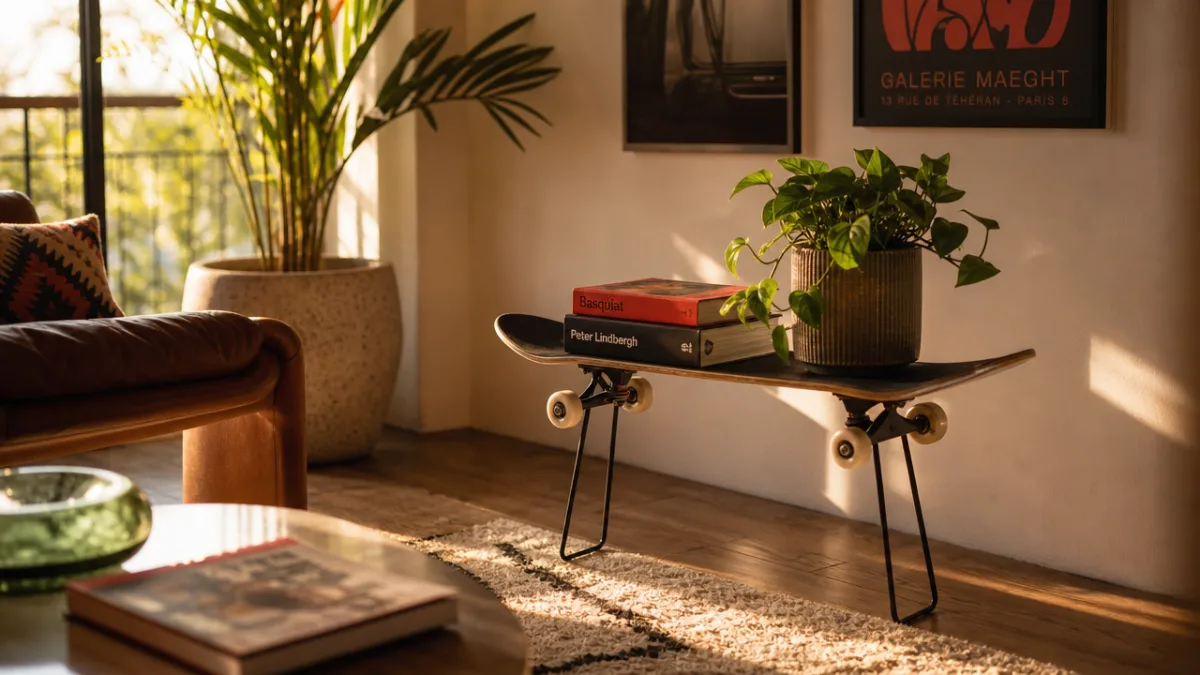
Plenty of creative makers have explored everything in between, and platforms like Pinterest, Instagram, and YouTube are full of unexpected ideas. Deck halves make great wall-mounted shelves. A single deck can become the handle of a bar cart. Decks can serve as drawer fronts on a repurposed dresser. The trucks and wheels can be worked in as decorative details or even as actual casters to make a rolling table. The deeper you get into this community, the more playful and inventive the ideas become. It’s less a rigid furniture category and more a creative prompt.
Styling and Placing Your Skateboard Table in Your Home
Once the table is built, the fun shifts to figuring out where it lives and how it fits into your space. The good news is that deck graphics have a kind of chameleon quality — depending on the context, the same table can read as a deliberate design-forward statement or as a relaxed, organic part of an eclectic room. In a space with white walls, concrete floors, and spare modern furniture, a skateboard coffee table looks like it belongs in an architecture magazine. In a room full of vintage rugs, overstuffed bookshelves, and trailing plants, that same table just feels like it belongs to whoever lives there.
How you style the surface matters too. A glass vase with a single sculptural branch on a single-deck side table plays up its art-object quality. A stack of well-chosen coffee table books, a vintage ashtray, and a small succulent on a multi-deck table leans into a more casual, creative-household vibe. Pair a skateboard table with raw metal furniture and Edison bulbs for a cohesive industrial look. Place that same table alongside mid-century chairs and chunky wool textiles and suddenly it reads as something warmer and more handcrafted. It’s a surprisingly flexible piece to work with.
Lighting is another variable that often gets overlooked. Under flat overhead light, deck graphics can look surprisingly dull. But position a floor lamp at a low angle so the light rakes across the surface, and everything changes — the wood grain, the texture of the grip tape, and the slight concave curve of the deck all come alive in a way that’s genuinely striking. If your skateboard table is a focal point of the room, it’s worth experimenting with a dedicated light source to see what it looks like at night. You might be surprised by how much of a difference it makes.
Sustainability, Community, and the Broader Meaning of Making Skateboard Furniture
There’s something that goes a bit deeper here than just making a cool table. At a time when fast furniture is filling landfills faster than anyone seems to know what to do with, building your own piece from repurposed materials means something. Skateboard decks are made from North American maple — a dense, beautiful hardwood — and when a deck gets tossed out after its riding life is over, all of that material just disappears. Turning it into a table instead extends its life by decades. That’s a real thing, not just a feel-good story.
Skateboarding has always had a strong DIY spirit at its core. Skaters build their own ramps, mod their own boards, and find creative uses for urban spaces and structures that were never designed with them in mind. Making furniture from old decks fits naturally into that same inventive, make-do-and-make-it-better ethos. For anyone who grew up in skate culture — whether they’re still riding or just carry that part of their identity into adult life — building a skateboard table is a way of keeping that connection alive in a tangible, daily-use kind of way.
There’s also a whole community of artists, craftspeople, and small-batch makers who have turned skateboard furniture into an actual vocation, producing beautifully finished pieces from reclaimed decks and selling them through independent channels. Supporting those makers, or learning from the tutorials and documentation they share freely online, is a way of being part of something that genuinely values skill, authenticity, and sustainability over disposability. Whether you build your own or buy one from an independent maker, a skateboard table is a choice — a choice to fill your home with objects that carry real meaning and history, rather than ones that just fill space until you replace them.








What do you think?
It is nice to know your opinion. Leave a comment.