










Skateboard Bench: Where Street Culture Meets Home Decor
The Rise of Skateboard Furniture in Modern Interior Design
Over the past decade or so, street culture and interior design have been quietly colliding in some really interesting ways. What used to live exclusively on half-pipes and city sidewalks has started showing up in living rooms, entryways, and studios all over the world. The skateboard bench is one of the best examples of this shift — taking repurposed or purpose-built decks and turning them into functional, genuinely striking pieces of furniture that carry real artistic weight.
The appeal of skateboard furniture goes way beyond novelty, though. These pieces speak to a generation that grew up with boards underfoot and art on their walls — people who see no reason why their homes shouldn’t have the same energy and creativity they brought to the skatepark. A well-made skateboard bench has history, texture, and personality baked right into it in a way that anything mass-produced simply can’t match. It’s the kind of thing that gets people talking the moment they walk into a room.
Interior designers working with clients who want something genuinely distinctive have been turning to skateboard-inspired furniture more and more as a way to bridge youthful energy and sophisticated style. The graphics on skateboard decks — bold geometric patterns, intricate illustrations, wild color combinations — act as built-in artwork, giving these benches a visual depth that puts them well above your average piece of seating. And honestly, this trend doesn’t look like it’s going anywhere, because people are increasingly prioritizing authenticity and individuality in their homes over anything that could have come from a big-box store.
Anatomy of a Skateboard Bench: Design and Construction
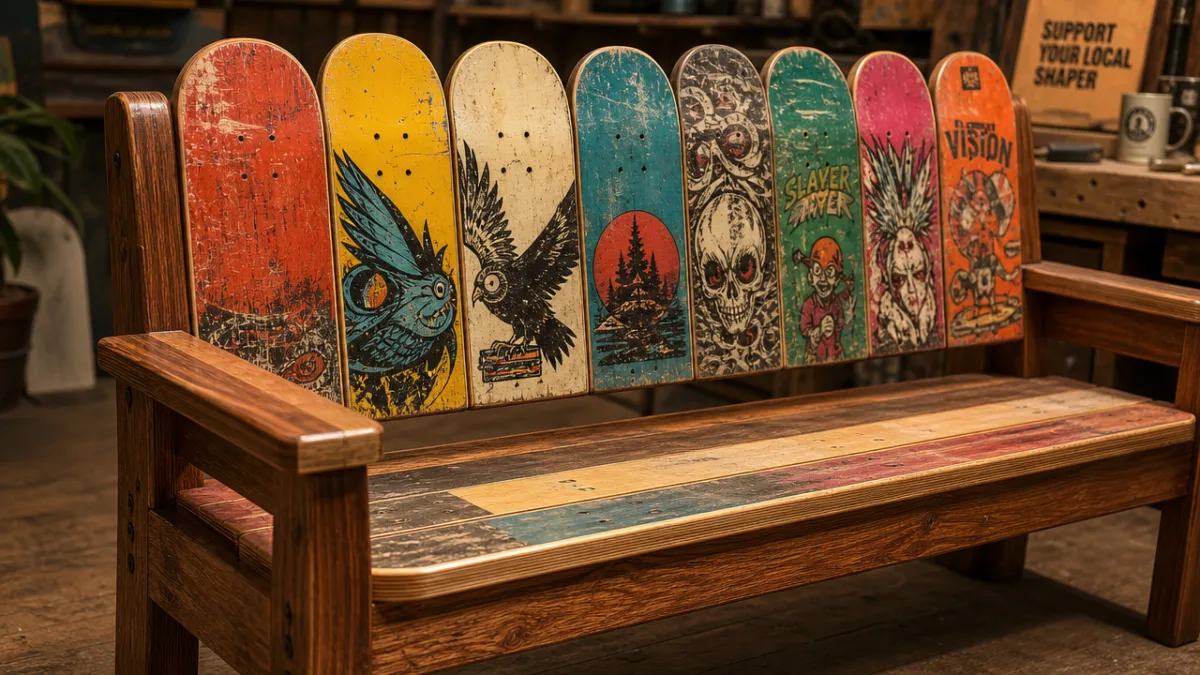
Skateboard benches can be built in a few pretty different ways, and knowing the difference helps you really appreciate the craft behind each one. The most artisanal versions are made from actual retired decks — typically seven-ply Canadian maple boards that have seen real use out in the world. They’re cleaned up, sometimes stripped or sanded down, and then laminated together or mounted onto a sturdy frame. The scuffs, wear patterns, and faded graphics aren’t flaws; they’re the whole point, the proof of a life lived on the street.
Purpose-built skateboard benches take a different approach, using fresh decks arranged in a deliberate pattern to land on a specific visual effect. A designer might stack decks horizontally to get that layered, striped look that shows off the cross-section of the laminate construction. Or they might lay decks side by side with graphics facing up, creating a mosaic of color and imagery across the whole seating surface. The frame underneath is usually welded steel for an industrial feel, solid hardwood if you want something warmer, or cast aluminum if you’re going for something a bit more contemporary.
Hardware plays a surprisingly big role in how the whole thing comes together. Some builders work actual truck assemblies — the metal axle fixtures that normally hold the wheels — into the structure as either functional or decorative elements under the seat. You might even find wheels used as feet or accents, which adds a playful authenticity that makes the piece’s origins undeniable. And the finishing choices matter a lot too: raw steel, powder-coated metal, oiled wood, lacquered composite — each one changes how the bench reads in a room and how much upkeep you’ll be signing up for down the line.
Choosing the Right Skateboard Bench for Your Space
Finding a skateboard bench that actually works in your home means thinking carefully about both the physical dimensions of your space and the vibe you’re going for. A long bench made from five or six full-length decks makes a bold horizontal statement that looks fantastic in an entryway or along a hallway wall — it gives you somewhere practical to sit while you’re putting on shoes, and it doubles as something gallery-worthy at the same time. Smaller two- or three-deck versions tend to fit better in compact apartments or as accent seating next to a bed or desk.
Color palette is another big thing to think about when you’re trying to blend a skateboard bench into an existing room. Vintage or well-used decks often have graphics in vivid, high-contrast colors that can easily take over a space if you’re not thoughtful about it. In a minimalist room with neutral walls and calm furnishings, a bright graphic bench becomes the intentional focal point — the thing everything else quietly revolves around. In a more eclectic space that’s already full of pattern and color, you might want something with more muted graphics or a deliberately weathered surface that adds texture without competing with everything else going on.
And don’t overlook practicality. Skateboard benches vary quite a bit in comfort depending on how they’re built. A flat arrangement of bare decks with no cushion looks incredible but isn’t exactly inviting for a long sit, so it works better as an occasional bench or display surface. Adding a custom cushion in leather, canvas, or upholstered fabric can completely change how comfortable and livable the piece is, while also letting you bring in another layer of material and color. Before you buy, here are some questions worth asking:
- What is the bench’s weight capacity, and is the frame welded or bolted together?
- Are the decks sealed or finished to prevent splintering and color fading?
- Does the piece include non-slip feet to protect your flooring?
- Is the height standard seating height at approximately 18 inches, or is it designed as a coffee table or display surface?
- Can a custom cushion be ordered alongside the bench from the same maker?
Styling Your Skateboard Bench: Room-by-Room Ideas
The entryway might be the most natural home for a skateboard bench, and not just because of the obvious thematic connection. Entryways really benefit from furniture that pulls double duty — somewhere to sit while also making an immediate statement about the personality of whoever lives there. A skateboard bench positioned against a bare wall with a few well-chosen hooks above it, maybe a vintage helmet or a stack of worn-in caps resting on top, creates an entry vignette that feels curated without being try-hard or overthought.
In the living room, a skateboard bench can work really well as a coffee table alternative, especially in spaces with an industrial, urban, or eclectic aesthetic. Set in front of a low sofa with a few art books and a small plant arranged on top, it holds its own as a surface while keeping its identity as an art object. The key is not to pile too much on it — the bench itself is the visual moment, and anything you put on it should support that rather than bury it. A single sculptural object or a small stack of magazines will always read better than a crowded arrangement.
Teenage bedrooms and creative studio spaces feel like natural fits too, where the cultural references built into the furniture line up with the broader identity of the room. In a bedroom, a bench at the foot of the bed gives you practical seating and an interesting visual counterpoint to all the softer textiles around it. In a studio, workshop, or creative space, it reinforces the sense that this is a room where making things matters — where craft and imagination are actually taken seriously. That’s maybe the most powerful thing a piece of furniture can do: tell you something true about the person who chose it.

DIY Skateboard Bench Projects: Building Your Own
If you have even basic woodworking skills, building your own skateboard bench is a genuinely rewarding project that ends with something completely one-of-a-kind. The most accessible way to start is by sourcing used decks from local skate shops, thrift stores, or online marketplaces, where boards with cracked noses, delamination, or just outdated graphics often go for next to nothing or get given away entirely. Four to six standard 31-inch decks are usually enough for a bench seat of comfortable length, though the exact number depends on how tightly you space them and whether you’re running them lengthwise or across the width.
For the frame, you can go with standard lumber using a simple box construction — four legs, crossbars, and a top rail to attach the decks to with screws or bolts. If you’re comfortable with metalworking, welding a frame from square steel tubing gives you a cleaner, more modern silhouette with more of an industrial edge. Whichever route you take, pre-drilling your skateboard decks before attaching them will save you a lot of headaches — it prevents splitting and makes the whole assembly much more forgiving. Countersinking the screws keeps the top surface flush so nothing snags clothing or draws the eye in the wrong way.
Finishing the bench properly makes a bigger difference than most people expect, both in how it looks and how long it lasts. Lightly sand the decks to remove any burrs and soften sharp edges at the corners and ends. A coat of clear polyurethane or epoxy over the graphics will protect them from UV fading and everyday wear — though some builders skip this intentionally, preferring to let the bench keep aging naturally over time. Steel frames need a rust-inhibiting primer before you put on a finish coat, while wood frames can be stained, painted, or simply oiled depending on the look you’re after. Here’s a basic rundown of what you’ll need to get started:
- Four to six used or new skateboard decks in your preferred graphics or color palette
- Lumber or steel tubing for the frame, plus appropriate fasteners and hardware
- A drill with wood and metal bits, plus a countersink bit if using screws
- Sandpaper in multiple grits from coarse to fine
- Clear coat finish, wood stain or paint, and a primer suitable for your frame material
- Non-slip rubber or felt pads for the bottom of the legs
Skateboard Benches as Collectible Art Objects
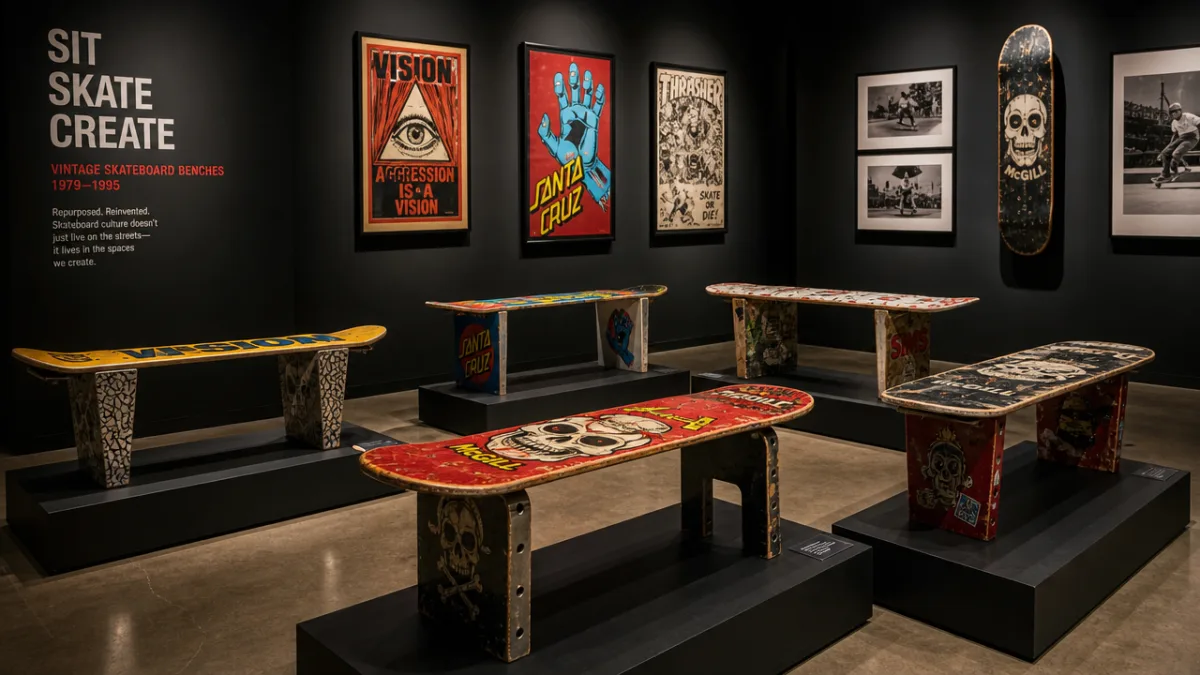
The most exceptional skateboard benches exist in a fascinating space between furniture and fine art, especially when they’re built from decks tied to notable artists or limited-edition graphic collaborations. Skateboard culture has an incredibly rich history of artistic collaboration — brands have been commissioning work from painters, illustrators, graphic designers, and street artists since the early 1980s. A bench built from a carefully curated selection of those decks is essentially a collection of small canvases, each with its own provenance and cultural context, brought together into a single object that carries all of that history with it.
Collectors and design enthusiasts are starting to take real notice of this, and a secondary market has emerged for high-end, artist-made skateboard benches that command prices in line with other serious collectible design objects. Furniture makers who specialize in this space often collaborate with specific deck artists or brands to produce limited runs that come with certificates of authenticity documenting exactly which boards went into the build. The provenance of the decks — whether they were ridden by a particular skater, featured art from a well-known artist, or came from a documented limited run — can have a real impact on both the cultural significance and the monetary value of the finished piece.
But even outside the world of high-end collectibles, there’s something genuinely meaningful about furniture with traceable cultural history. A bench made from decks ridden by local skaters at a neighborhood park tells a community story in material form. One assembled from boards collected across a particular era of skateboarding’s evolution preserves a snapshot of visual culture that might otherwise end up in a landfill as boards wear out and get tossed. In that sense, the skateboard bench works as a kind of archive — keeping alive the graphics, the stories, and the spirit of a culture that has always valued creativity, individuality, and finding something extraordinary in everyday objects.
Where to Source Skateboard Benches: Makers, Marketplaces, and More
Finding the right skateboard bench has gotten a lot easier as the category has matured and more makers have entered the market. Independent woodworkers and furniture makers on platforms like Etsy offer a wide range of handcrafted options, from straightforward deck-on-sawhorses builds to elaborate custom pieces with inlaid graphics and powder-coated steel frames. The real advantage of going with an independent maker is that you can commission something completely custom — choosing specific deck graphics, frame finishes, dimensions, and even a matching cushion to get something that fits your space exactly the way you want it.
Vintage and secondhand markets are another great place to look, especially if what draws you to these pieces is the authenticity of genuinely used materials. Estate sales, flea markets, and online secondhand platforms will occasionally surface early examples of skateboard furniture made by skaters themselves back in the 1990s and 2000s — pieces with all the beautiful imperfections of home fabrication and the patina of real use. It takes more patience and a bit of luck, but the reward of finding something with genuine history is hard to beat, and the prices are often considerably lower than comparable new custom work.
Mainstream home furnishing retailers have also started offering skateboard-inspired benches that capture the aesthetic at more approachable price points, though these typically use reproduction graphics and manufactured composites rather than authentic decks and handcrafted construction. If you’re drawn to the look but less focused on provenance and authenticity, these are a perfectly reasonable entry point. Wherever you end up sourcing your bench, what matters most is finding something that genuinely clicks with your taste and feels like an honest expression of who you are — not just a trend you’ve picked up from the outside. The best furniture, like the best skateboarding, has always come from a place of real personal conviction.








What do you think?
It is nice to know your opinion. Leave a comment.