










Do This to Start Your Upcycling Journey!
What Is Upcycling and Why It Matters Now More Than Ever
Upcycling is the creative practice of transforming discarded, worn-out, or seemingly useless items into something of greater value and purpose. Unlike recycling, which typically breaks materials down into raw components before reprocessing them, upcycling works with what already exists — giving objects a second life without the energy-intensive industrial process. The result is something new, often more beautiful or functional than the original, born entirely from what others might have thrown away.
The environmental case for upcycling has never been stronger. Landfills around the world are filling at an alarming rate, and the fashion, furniture, and consumer goods industries are among the biggest contributors to global waste. Every piece of clothing rescued from a donation bin, every old pallet converted into a garden bench, and every glass jar transformed into a pendant lamp represents a small but meaningful act of resistance against a throwaway culture that is simply unsustainable in the long run.
Beyond the environmental benefits, upcycling carries a deeply personal reward. There is a profound satisfaction in holding something you made with your own hands — something unique that carries history, intention, and creativity. As more people grow weary of mass-produced goods that look identical to everything else in every store, upcycled pieces offer authenticity and individuality that simply cannot be purchased off a shelf. Starting your upcycling journey means stepping into a world where imagination truly is the only limit.
Gathering Your First Upcycling Materials Without Spending a Fortune
One of the most common misconceptions about starting an upcycling practice is that you need to spend money to get materials. In reality, the best source of upcycling supplies is often completely free. Begin by walking through your own home with fresh eyes — look at furniture you no longer love, clothing that no longer fits, kitchenware collecting dust, and decorative items that feel dated. These are your raw materials, and you already own them. That chipped ceramic bowl, that outdated denim jacket, that wobbly wooden chair — each one is a project waiting to happen.
Once you have exhausted your home, expand your search into the community. Thrift stores and charity shops are treasure troves of inexpensive finds, and many items there cost less than a coffee. Garage sales, estate sales, and flea markets offer similar opportunities with the added bonus of unique and often vintage items that carry real character. Online platforms like Facebook Marketplace, Freecycle, Craigslist, and Nextdoor frequently list items people are giving away simply because they no longer need them — furniture, fabric, tools, and more.
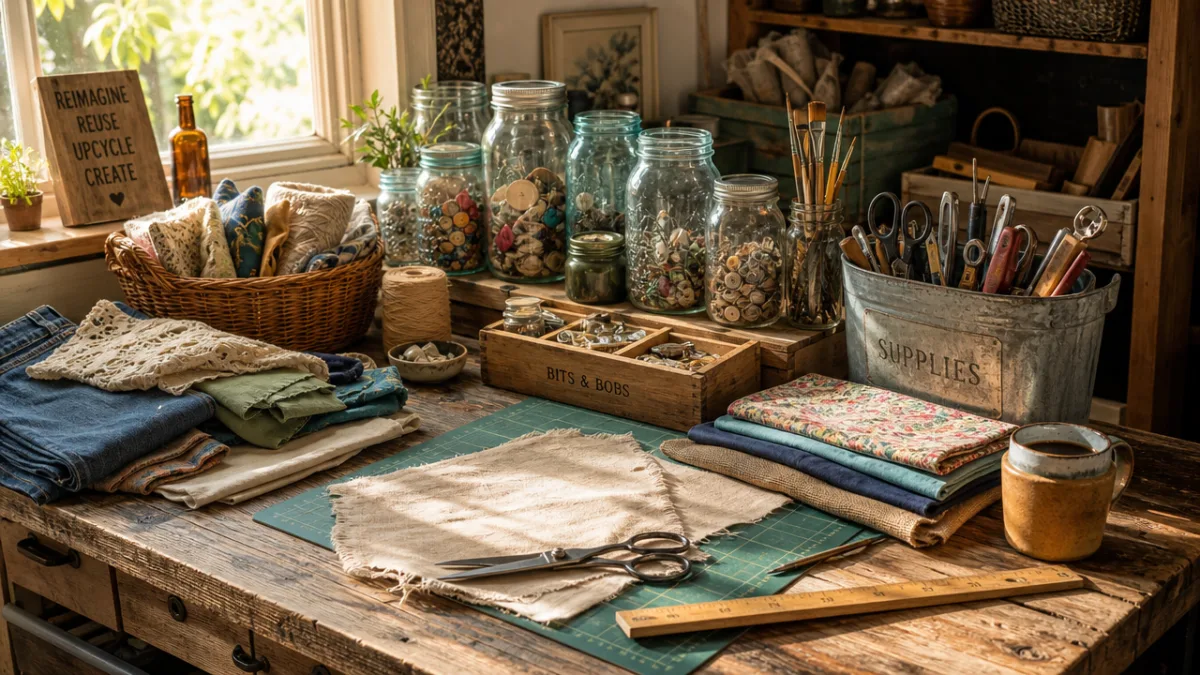
It also helps to develop a collector’s mindset early in your journey. Start keeping a small stash of materials that might be useful later: buttons, zippers, interesting fabric scraps, glass containers, old hardware, and natural elements like driftwood or smooth stones. Many experienced upcyclers describe their material collection as a kind of creative pantry — when inspiration strikes, the ingredients are already on hand. This habit of intentional collecting is itself a form of environmental mindfulness, training your eye to see potential where others see only waste.
Community connections can also become a surprisingly rich source of materials. Let friends, family, and coworkers know you have started upcycling, and you will likely find that people are happy to pass things along rather than throw them away. Local businesses — print shops, florists, bakeries, fabric stores — often have offcuts, packaging, or display items they routinely discard. Asking politely is often all it takes to secure a steady stream of interesting materials that would otherwise end up in the trash.
Essential Tools and Techniques Every Beginner Upcycler Should Know
Starting your upcycling journey does not require a fully equipped workshop or a large investment in tools. A surprisingly wide range of projects can be completed with just a handful of basic supplies that most households already have. Sandpaper in a few different grits is indispensable for preparing wooden surfaces. A good quality paintbrush set, some strong adhesive, a craft knife, scissors, and a hot glue gun will carry you through the majority of beginner projects. As your skills and interests develop, you can gradually add more specialized tools to your collection.
Painting is one of the most accessible and transformative techniques in the upcycler’s toolkit. A coat of chalk paint can completely reinvent an old piece of furniture, giving it a matte, velvety finish that works beautifully with both vintage and modern interiors. Chalk paint adheres to almost any surface with minimal preparation, making it ideal for beginners who want impressive results without complicated prep work. Spray paint, meanwhile, is perfect for smaller items like frames, vases, and hardware, offering an even coat and a professional-looking finish with minimal effort and skill required.
Decoupage is another beginner-friendly technique that opens up enormous creative possibilities. Using a simple mixture of diluted craft glue, you can adhere paper, fabric, napkins, or tissue to virtually any surface — wood, glass, ceramic, plastic — creating layered, textured designs that look intricate but are surprisingly straightforward to execute. Old books, maps, sheet music, and wrapping paper all make excellent decoupage materials. The technique is forgiving, allows for experimentation, and produces results that look far more sophisticated than the level of skill required to achieve them.
Sewing and textile manipulation skills are enormously valuable for anyone interested in fashion upcycling or soft furnishings. Even basic hand stitching opens up the world of mending, patchwork, and embellishment. Embroidery in particular has experienced a massive resurgence in recent years, offering a way to add color, texture, and personality to plain or damaged garments. If you do not already own a sewing machine, many community centers, makerspaces, and libraries now offer access to machines and even introductory classes, making it more accessible than ever to develop these skills without a significant financial commitment.
Your First Five Upcycling Projects to Build Confidence and Skills
Choosing the right first project is crucial. Start too ambitious and you risk frustration; start too simple and you may not feel the full excitement of the craft. The sweet spot is a project that stretches your skills just slightly, teaches you something useful, and produces a result you are genuinely proud to display or use. The five project ideas outlined here are chosen specifically to build foundational skills while delivering satisfying, practical outcomes that will motivate you to keep going and take on bigger challenges.
A painted plant pot is perhaps the ideal first upcycling project. Take any old terracotta, ceramic, or plastic pot and clean it thoroughly. Sand it lightly if needed, then apply your chosen paint in whatever design inspires you — solid colors, geometric patterns, abstract brushwork, or even simple hand-lettered words. Seal it with an outdoor varnish if the pot will live outside, and the project is complete. The whole process can be done in an afternoon, costs almost nothing, and produces something genuinely decorative and useful that you will be happy to look at every day.
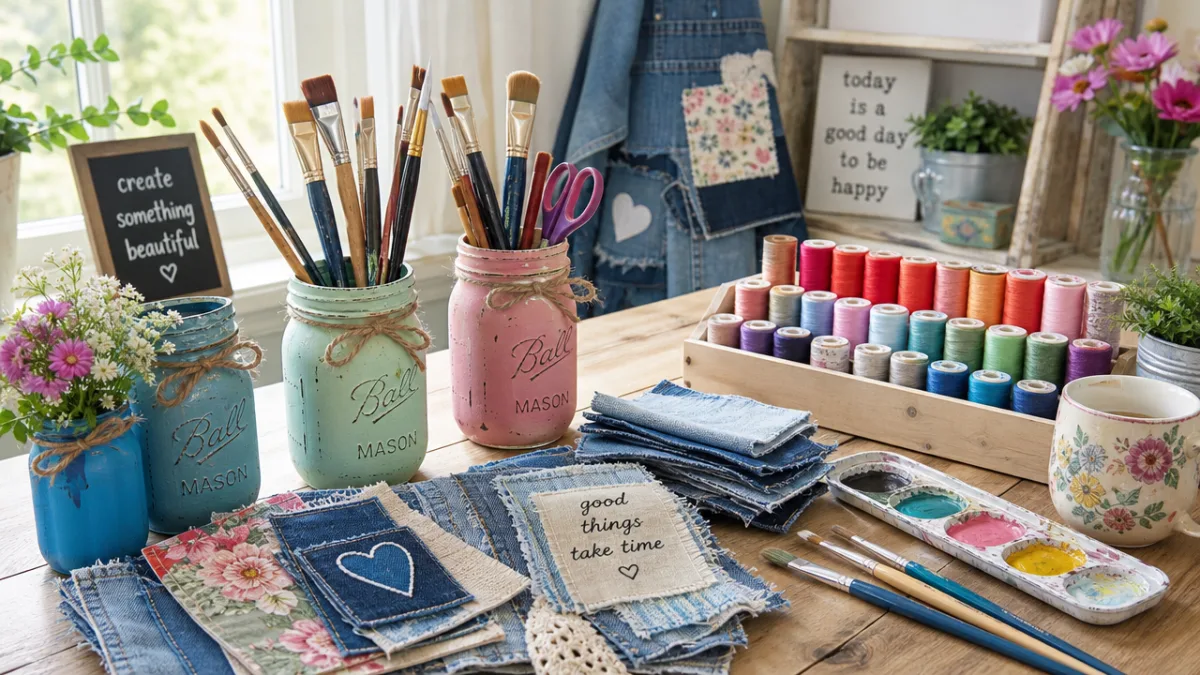
Transforming old glass jars into beautiful storage or lighting is another project that rewards beginners quickly. Pasta sauce jars, pickle jars, and jam jars can be cleaned, painted, wrapped in twine or lace, filled with dried flowers or decorative stones, or drilled to accommodate a small lamp fitting. A cluster of mismatched painted jars on a kitchen windowsill looks intentional and charming. With an inexpensive battery-operated fairy light string tucked inside, they become atmospheric bedside lamps or table centerpieces that look far more expensive and deliberate than they actually are.
Here are five beginner projects worth trying in your first month of upcycling:
- Painted plant pots: Use old pots and chalk or outdoor paint to create decorative planters for your home or garden. Personalize with stencils, patterns, or freehand brushwork.
- Glass jar storage and lighting: Clean old food jars and transform them into stylish storage containers or fairy-light lanterns for an instant decorative upgrade.
- Denim patchwork cushion cover: Cut old jeans into squares, sew them together, and stitch on a simple backing to create a durable, textured cushion cover with genuine character.
- Framed fabric art: Stretch an interesting piece of fabric, scarf, or vintage print over a cheap or thrifted picture frame for instant wall art that costs almost nothing.
- Painted wooden crate shelving: Sand and paint an old wooden crate, then mount it on a wall or stack several to create open shelving with an industrial or rustic aesthetic.
Clothing upcycling is a particularly rewarding area for beginners because the materials are universally accessible and the results are wearable. An oversized thrifted shirt can be cropped, tied, or tailored with minimal sewing. Old denim jeans can be cut into shorts, embroidered with flowers, or bleached into new patterns using a simple tie-dye resist technique. Even iron-on patches and fabric paint can transform a plain garment into something that feels entirely personal and entirely unique, without requiring any particular level of sewing expertise.
Building a Creative Practice That Lasts: Staying Inspired and Growing Your Skills
The most common reason people abandon a new creative hobby is not lack of talent — it is lack of momentum. The enthusiasm of the beginning is easy; what sustains a practice over months and years is a combination of community, inspiration, and a realistic approach to how creativity actually works. Upcycling, like any craft, has rhythms of high motivation and quieter periods, and understanding this from the start will help you build something durable rather than another short-lived new year’s resolution abandoned by February.
Social media, particularly Pinterest and Instagram, is an extraordinary resource for upcycling inspiration, and using it intentionally makes a real difference. Create dedicated boards or saved collections organized by material type or project category — furniture, textiles, lighting, garden — so that when inspiration is low, you have a rich visual library to browse. Following upcycling creators whose aesthetic genuinely resonates with you will mean your feed becomes a constant, gentle source of ideas rather than an overwhelming stream of unrelated content. Many of the best upcycling educators on social media also share tutorials, supply lists, and process videos that can teach you new techniques completely free of charge.
Keeping a project journal is a habit that many experienced upcyclers swear by. It does not need to be elaborate — a simple notebook where you sketch ideas, note what worked and what did not in completed projects, and paste in fabric swatches or paint samples is enough. Over time, this journal becomes a valuable record of your developing taste and skill, and flipping back through its pages is genuinely motivating. It also helps you identify patterns in what you are drawn to creatively, which in turn makes it easier to build a cohesive body of work rather than a scattered collection of unrelated projects.
Community is perhaps the single most powerful sustainer of a long-term creative practice. Seek out local crafting groups, upcycling meetups, or skill-sharing workshops where you can meet other makers in person. If your local community does not offer these, online communities on Reddit, Facebook, and dedicated forums are warm, generous spaces where beginners are welcomed and questions are answered freely. Sharing your projects — even the imperfect ones, perhaps especially the imperfect ones — builds accountability and connection, and the encouragement of fellow makers is a genuinely powerful force for keeping your creative momentum alive and growing.
The Bigger Picture: How Your Upcycling Journey Contributes to a Sustainable Future
It would be easy to dismiss individual creative choices as too small to matter against the scale of global environmental challenges. But this framing misunderstands the nature of cultural change, which always begins with individual behavior shifting in aggregated, interconnected ways. Every person who chooses to upcycle rather than purchase new is participating in a growing movement that is actively reshaping consumer culture, influencing what manufacturers produce, and demonstrating through lived example that beauty, function, and sustainability are not in conflict but are in fact deeply aligned values.
The economic dimension of upcycling is also worth acknowledging directly. Fast fashion and disposable furniture have come at enormous hidden costs — not just environmental, but human. The cheapness of mass-produced goods is subsidized by exploitative labor practices and externalized environmental damage that does not appear in the price tag but is paid by communities, ecosystems, and future generations. Choosing to upcycle, even occasionally, is a practical and meaningful way to opt out of this system. It keeps money in local economies through thrift stores and small creative businesses, and it builds skills and self-sufficiency that have genuine long-term value.
Upcycling also has the remarkable quality of making sustainability feel joyful rather than punishing. So much environmental discourse is framed in terms of sacrifice and restriction — what we must give up, what we must stop doing. Upcycling flips this entirely. It is generative, creative, and pleasurable. It produces things of beauty and usefulness. It connects people to materials, to history, and to each other. It is sustainability as abundance rather than austerity, and this is precisely why it resonates so deeply across such diverse communities of makers around the world.
As you begin your own upcycling journey, carry with you an awareness that what you are doing is larger than any single project. You are developing a way of seeing the world — one that finds potential in what others overlook, value in what others discard, and creativity in constraint. This way of seeing will enrich not just your home but your thinking, your relationships with things and materials, and your sense of what is possible when imagination is brought to bear on the ordinary. The journey begins with a single project. Start today, start small, and let the practice grow from there.








What do you think?
It is nice to know your opinion. Leave a comment.