










26 Handmade Wine Cork Decor Ideas For Sustainable Design
The Art of Upcycling: Why Wine Corks Deserve a Second Life
Every year, billions of wine corks get tossed in the trash after a single use, where they sit in landfills for decades before breaking down. And that’s a shame, because natural cork — harvested from the bark of cork oak trees — is one of the most remarkable sustainable materials out there. It’s biodegradable, renewable, and incredibly versatile, yet most of us don’t give it a second thought the moment we pop open a bottle. The handmade cork decor movement is pushing back on that habit, turning a humble little stopper into a medium for real artistic expression and more intentional living.
As a material, cork has qualities that make it almost perfectly suited for home decor projects. It’s naturally water-resistant, lightweight, buoyant, and has a warm, appealing texture that adds a tactile richness to any space. Unlike synthetic materials, cork comes with natural variation in color and grain, so every piece feels genuinely handcrafted and one-of-a-kind. When you work with wine corks specifically, you also get a little bit of their history — the faint stain from a good Bordeaux, the embossed name of a winery you love, the small imperfections that bring back the memory of a good evening with good people.
There’s also a bigger picture here. Choosing to repurpose wine corks fits into a broader philosophy of conscious consumption — the idea that we should look at what we already have before buying something new. Corks accumulate naturally over time through the simple pleasure of drinking wine, so gathering them costs nothing extra and requires no additional environmental footprint. They come into your home as a byproduct of enjoyment, and they can leave it as something genuinely beautiful. That journey — from vineyard to table to handmade art — is about as elegant a design philosophy as you could ask for.
Functional Cork Decor: Projects That Earn Their Place in Your Home
One of the best things about wine cork decor is that the most satisfying projects aren’t just pretty — they actually do something useful. A DIY cork bulletin board is a perfect example. Slice corks in half lengthwise, arrange them in a frame, and you’ve got a pinboard that’s both functional and visually interesting, with a texture that would cost serious money to buy in a store. A herringbone or basketweave arrangement of those cork halves adds a graphic quality that lifts it well above your average craft project.
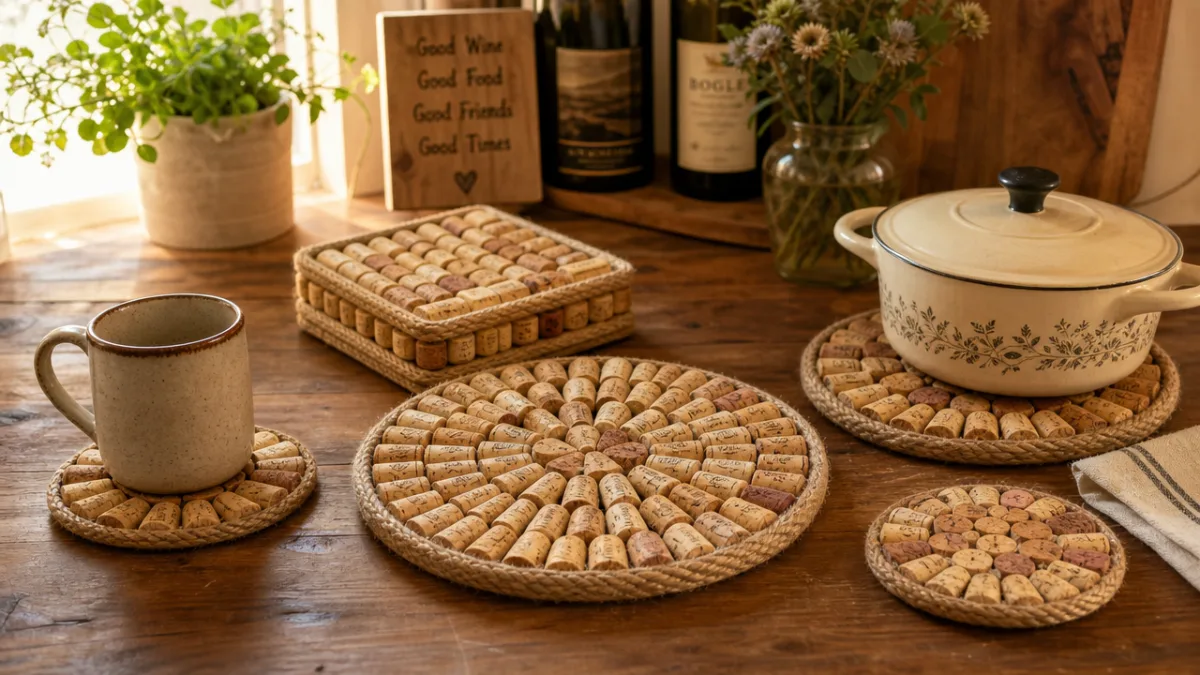
Cork trivets and coasters are another great entry point, especially if you’re just getting started. A cluster of whole corks bound together with wire, string, or adhesive makes a heat-resistant trivet that protects your kitchen surfaces and looks great doing it. Because cork is a natural insulator, it actually works — and that organic, mosaic-like surface becomes an instant conversation piece at dinner parties. Cork coasters, whether you leave them round or cut them into squares, bring that same warmth and sustainability to coffee tables and kitchen counters without much effort at all.
If you’re ready for something more ambitious, cork bath mats have become genuinely popular in spa-inspired bathroom design. Glue a large number of whole corks onto a wooden base or mesh backing, and you end up with a bath mat that’s naturally antimicrobial, water-resistant, and wonderfully textural underfoot. It takes some patience and a solid collection of corks to pull off, but the end result is a luxurious bathroom accessory that would be pricey to buy and is entirely your own. Other functional ideas worth trying include cork drawer knobs, cork-wrapped pen holders, and cork-lined jewelry trays that keep delicate pieces from getting scratched.
Wall Art and Decorative Displays: Cork as a Canvas
Wine corks are remarkable raw material for wall art because they have a natural three-dimensionality that flat media just can’t match. One of the most iconic projects involves filling a deep shadowbox frame with hundreds of corks arranged to spell letters, form geometric patterns, or create an abstract mosaic. As light moves across the surface throughout the day, the shadows between individual corks shift in a way that gives the whole piece a kind of living quality — something a painting or print simply can’t do. These large-format cork installations have become a popular focal point in dining rooms, wine cellars, and living spaces with a relaxed but sophisticated feel.
Cork maps are another favorite among fans of sustainable home decor. Arrange corks in the rough shape of a country, state, or city that means something to you, build it into a frame against a contrasting painted background, and you’ve got art that’s both visually striking and personally meaningful. Wine lovers especially enjoy displaying the outline of a beloved wine region — Tuscany, Bordeaux, Napa Valley — rendered in the actual corks from bottles they’ve enjoyed. The connection between the material and the meaning is genuinely satisfying in a way that’s hard to put into words.
Beyond maps and mosaics, individual corks can be transformed into smaller sculptural elements — miniature wreaths, decorative garlands, tabletop centerpieces. Cork wreaths assembled by hot-gluing corks to a foam or wire form have an earthy warmth that feels especially at home in autumn and winter, though a lighter arrangement threaded with greenery or dried flowers works beautifully for spring gatherings too. What’s great about cork as a decorative element is how adaptable it is — the same material can feel rustic, modern, coastal, or elegantly minimal depending on how you arrange it and what you pair it with.
Garden and Outdoor Cork Decor: Taking Sustainability Outside
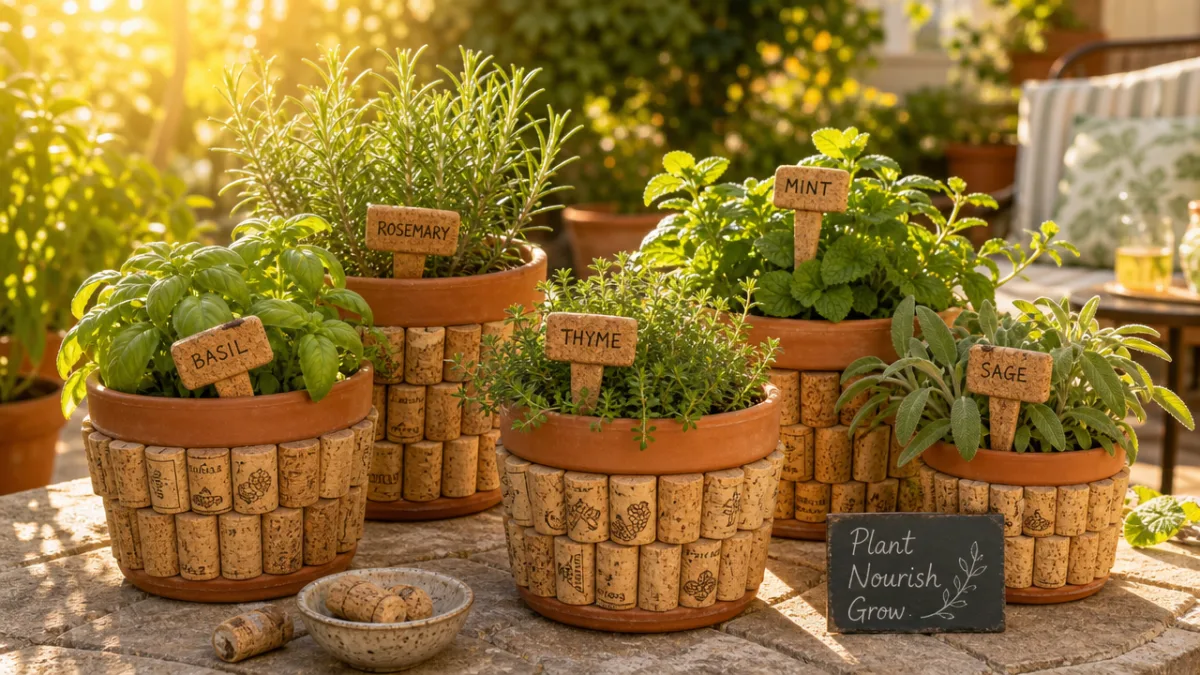
Cork’s natural resistance to water and rot makes it a surprisingly good material for outdoor and garden projects too. One of the simplest and most charming ideas is using wine corks as plant markers — just write the plant name on a cork with a permanent marker, push it onto a wooden skewer or bamboo stick, and you’ve got a cohesive, cost-free, fully biodegradable labeling system for your herb garden or vegetable bed. At the end of the growing season, you can compost the corks or clean them up and use them again the following year, making this one of the most genuinely zero-waste garden projects around.
Cork is also useful inside your containers. Crushing or chopping wine corks and layering them at the bottom of a plant pot before adding soil improves drainage and aeration, which helps prevent root rot. Because cork is pH-neutral and doesn’t leach chemicals, it’s perfectly safe for edible plants — in fact, some professional nurseries use it as a perlite alternative. It might not be the most visually dramatic application, but it’s a perfect example of the kind of holistic sustainable thinking the handmade decor world celebrates: finding usefulness at every stage of a material’s life.
For something more decorative, cork birdhouses and small garden sculptures are a lovely way to bring personality to an outdoor space. Corks stacked and glued into towers, animal shapes, or abstract forms make whimsical garden ornaments that weather naturally and settle beautifully into a planted environment. Cork-wrapped planters — made by adhering whole corks to the outside of a terracotta or plastic pot — add texture and warmth to a balcony or patio. They’re lightweight, naturally insulating for roots, genuinely attractive, and they age gracefully in a way synthetic materials simply can’t.
Wine Cork Jewelry and Wearable Crafts: Small-Scale Sustainable Design
The intersection of sustainability and personal style is one of the most exciting spaces in the handmade craft world right now, and wine corks turn out to be a surprisingly capable material for jewelry and wearable accessories. Cork leather — a commercially produced material made from cork oak bark — has already been embraced by designers worldwide as an ethical alternative to animal leather. But individual wine corks can also yield small, beautifully textured pieces that can be carved, stamped, or sliced into pendants, earrings, and brooches with an organic, artisanal quality that mass-produced accessories just can’t touch.
Slicing a cork into thin rounds and drilling a small hole through the center gives you the basic form for a pendant necklace. The natural grain and coloring of each slice is completely unique, which means every piece of jewelry you make is one-of-a-kind by default. You can leave the slices natural and seal them with a clear coat for a minimal look, paint tiny designs on them, add a touch of metallic leaf, or press small flowers into them for something more decorative. Because cork is so lightweight, even a large cork pendant sits comfortably all day — a real advantage over a lot of conventional pendant materials.
Cork scraps from larger decor projects can also be repurposed as stamping tools for fabric printing. Cut a simple shape — a star, a leaf, a heart — into the flat end of a cork, dip it in fabric paint, and you’ve got a reusable stamp that costs nothing and produces charmingly imperfect, handmade results on tote bags, tea towels, or scarves. It’s a perfect example of how one material, approached with a little creativity, can yield an almost unlimited range of outputs. That kind of lateral thinking is really at the core of sustainable design, and wine corks reward it beautifully.
Building Your Cork Collection and Setting Up a Creative Practice
Before you can make anything, you need corks — and building up a good collection is actually a pretty enjoyable process in itself. Your own household is the obvious starting point, though most personal collections grow slowly unless you’re a dedicated wine drinker. To build faster, a little community outreach goes a long way: restaurants with wine lists are often happy to save corks for you if you just ask, and wine bars can accumulate hundreds in a single week. Once your friends and family know what you’re working on, they’ll start saving their corks with an enthusiasm that might genuinely surprise you. Online cork-trading communities are also out there and worth seeking out.
Once you have a meaningful stash, taking some time to sort and organize it before you dive in is really worthwhile. Natural corks and synthetic corks behave quite differently when you cut, glue, or drill them, so separating them is a smart first step. Within natural corks, there’s a lot of variation in density, color, diameter, and staining that you can actually use to your advantage — choosing only the darkest, most wine-stained corks for a dramatic mosaic, for instance, or selecting only corks with visible winery branding for a project where the typography becomes part of the design. That kind of intentional curation is part of what takes cork crafting from a simple hobby into something that feels like a genuine design practice.
The good news is that the tools you need for most cork decor projects are minimal and easy to find, which makes this one of the more accessible crafts to get into. A sharp craft knife or serrated blade, a hot glue gun, sandpaper in a few grits, and some basic woodworking tools will carry you through the vast majority of projects. More advanced work — carving, lathe-turning, detailed painting — calls for additional tools, but the entry point is genuinely low. Most experienced cork crafters suggest starting with two or three simpler projects just to get a feel for how the material behaves before moving on to anything more ambitious. Cork rewards patience and observation, and the more you work with it, the more intuitive it becomes.
- Start with a bulletin board or trivet — these beginner-friendly projects teach you how cork cuts, adheres, and finishes without requiring a large collection or advanced skills.
- Collect corks intentionally — ask restaurants, bars, and friends; join online cork-swapping communities to gather varieties you cannot source locally.
- Invest in a quality sharp knife — clean cuts are the single most important factor in professional-looking cork work, and a dull blade crushes rather than slices.
- Seal finished projects — a coat of matte or satin polyurethane protects your work and brings out the warm, honey tones of natural cork beautifully.
- Mix cork with complementary materials — wood, linen, leather, jute, and natural stone all pair harmoniously with cork’s organic warmth.
- Document your process — photographing your projects in progress helps you refine your technique and builds a portfolio that can inspire others in the sustainable design community.
At the end of the day, making handmade wine cork decor is about more than the objects themselves. It’s a way of building a different kind of relationship with the materials that pass through your life — one built on attention and creative curiosity rather than automatic disposal. Every cork that becomes a piece of art or a useful household object is a small but real act of resistance against throwaway culture. And because the results are beautiful, personal, and made by your own hands, they carry a meaning that nothing bought off a shelf ever quite can. That combination — beauty, sustainability, and personal investment — is exactly what the handmade decor movement has always been about, and wine corks embody it with a warmth and elegance all their own.








What do you think?
It is nice to know your opinion. Leave a comment.