










15 Floating Headboard Ideas on a Budget That Look Surprisingly Expensive
Why Floating Headboards Are the Design Upgrade Your Bedroom Deserves
A floating headboard is one of those rare design moves that can completely transform a bedroom — and yet most people assume it must cost a fortune to pull off. Here’s the thing: a floating headboard mounted directly to the wall (rather than attached to a bed frame) creates a clean, architectural look that interior designers and photographers genuinely love. It draws the eye upward, makes the ceiling feel taller, and gives your bedroom that intentional, hotel-room quality that traditional headboards almost never manage to achieve.
What makes the floating approach so appealing from a budget standpoint is that you’re essentially separating the headboard from the bed entirely. That means you’re not stuck buying a matching furniture set or hunting for an expensive upholstered piece designed to bolt onto a specific frame. Instead, you can use almost anything flat and wall-mounted — reclaimed wood planks, a fabric panel stretched over a canvas frame, you name it — and position it at exactly the right height for a custom, bespoke look at a fraction of what you’d pay in a furniture store.
And it’s not just about looks. Floating headboards come with some genuinely useful practical perks. Because they don’t touch the bed frame, they stay stable and quiet — no more creaking or shifting in the middle of the night. They’re also much easier to clean around, since you can move the mattress independently without dismantling anything. If you’re a renter, many floating headboard options use damage-free mounting hardware or simply lean against the wall, making this a totally accessible upgrade even if drilling isn’t an option.
Wood-Based Floating Headboard Ideas That Feel Warm and Luxurious
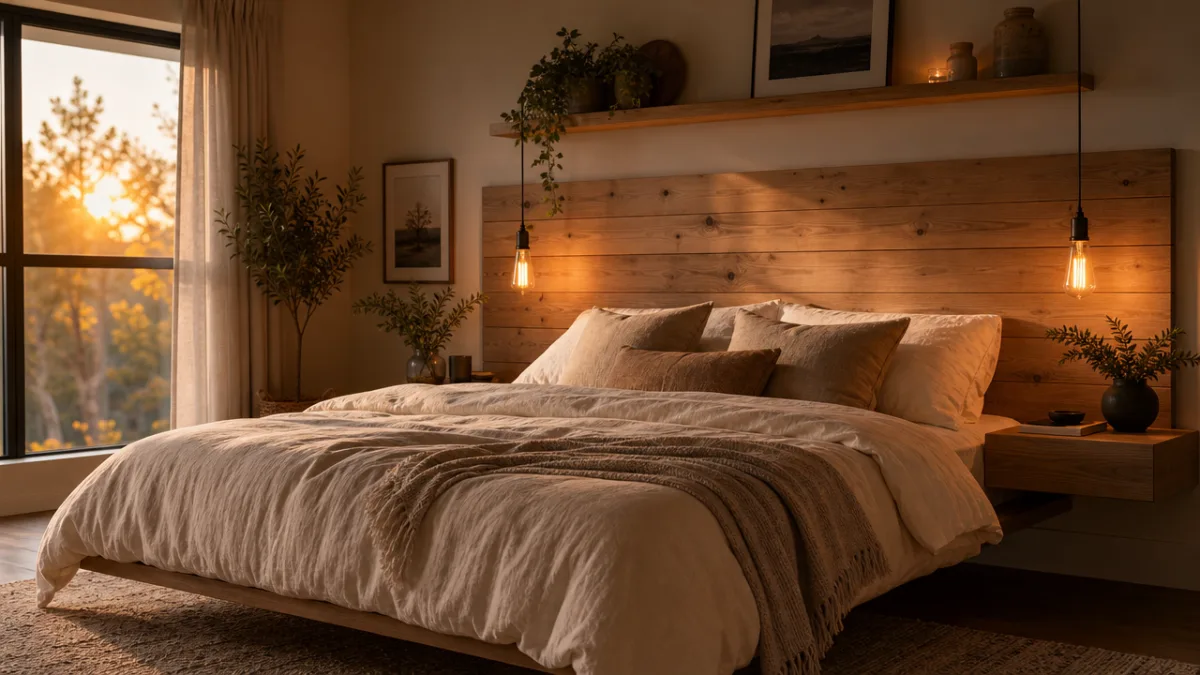
Wood is the go-to material for DIY floating headboards, and honestly, it’s not hard to see why. It’s widely available, affordable when you buy raw lumber or reclaimed boards, and it brings a warmth to a bedroom that’s hard to replicate with anything else. A simple arrangement of horizontal planks mounted behind your bed can look remarkably similar to something from Pottery Barn or West Elm — sometimes at one-tenth the cost. The secret is picking the right finish and making sure everything is level and evenly spaced.
One of the most effective techniques is the shiplap-style installation, where horizontal boards are mounted with a small, consistent gap between each one. Painted white or a soft warm grey, the result feels both rustic and modern — exactly the kind of backdrop you see in professionally styled bedroom photos. You can grab pre-primed MDF planks or pine boards from any home improvement store, cut them to width, and mount them with construction adhesive and finishing nails or wall anchors. For a queen-sized headboard area, you’re often looking at a total cost of under sixty dollars.
If you want something with a bit more drama, a full wood panel or live-edge slab behind the bed can be absolutely stunning. Live-edge wood — where the lumber keeps the natural contour of the tree — has become a staple of high-end interior design. Large finished slabs through specialty retailers can get pricey, but raw slabs from local sawmills are often surprisingly affordable. One coat of natural oil or polyurethane is all you need to seal it and bring out the grain, and suddenly you’ve got a headboard that looks like it came from a boutique furniture gallery.
Fabric and Upholstered Floating Panels for a Soft, Hotel-Inspired Look
Upholstered headboards have a reputation for being expensive — and sure, from a furniture retailer they usually are. But building your own fabric panel headboard is actually pretty straightforward if you’re comfortable with basic tools and a staple gun. The basic structure is just a piece of plywood or MDF cut to shape, topped with foam or quilt batting for softness, then wrapped tightly in your chosen fabric and mounted to the wall. The finished result is genuinely indistinguishable from panels that sell for hundreds of dollars in stores.
The fabric you choose is where you really get to put your stamp on the space. Linen and velvet are the two materials that tend to photograph the most luxuriously and have the richest visual depth — and both are available in affordable versions through fabric retailers and discount stores. A neutral linen panel creates a calm, Scandinavian-feeling bedroom that reads as both sophisticated and restful. A deep jewel-toned velvet — think navy, emerald, or dusty rose — instantly gives the room a sense of drama that’s hard to achieve with any other single design choice.
One of my favorite variations on the fabric headboard is the tufted or French mattress panel, where buttons are pulled through the foam and fabric to create a diamond or grid pattern across the surface. Tufting kits are cheap and easy to find online, and while the process takes a bit of patience, it doesn’t require any special skills. A tufted velvet panel behind a white bed with crisp linen bedding is the kind of combination that makes a bedroom look like a five-star hotel room — and you can often do the whole project for under a hundred dollars including materials.
Macramé, Tapestry, and Textile Wall Art as Floating Headboards
Not every floating headboard has to be a rigid structure. Some of the most visually striking bedrooms use soft textiles hung directly behind the bed to create the same anchoring effect — a large macramé wall hanging, a woven tapestry, even a vintage rug suspended from a wooden dowel. Any of these can work beautifully as a floating headboard, adding texture, pattern, and personality without any complicated installation. This approach fits naturally into bohemian, global, and eclectic spaces, but with the right material choices it can honestly work in almost any style of bedroom.
Macramé headboards have made a huge comeback over the past few years, and it’s easy to understand the appeal. The knotted cotton rope creates a layered, dimensional surface that casts interesting shadows and adds real depth to an otherwise flat wall. Large macramé panels are available through artisan marketplaces like Etsy at a range of price points, and there’s also a wealth of tutorials out there if you’d rather make your own. A homemade macramé headboard isn’t just budget-friendly — it’s genuinely personal, and the process of making it is surprisingly meditative and satisfying.
Tapestries probably offer the widest range of visual options in the textile headboard world. Moroccan geometric prints, traditional Indian block prints, moody botanical illustrations, abstract watercolors — whatever direction your taste runs, there’s a tapestry at an accessible price point that can completely transform your bedroom wall. Installation is as simple as a few nails or a tension rod, and being able to swap out tapestries seasonally means you can essentially redecorate your bedroom for the cost of a new piece of fabric whenever the mood strikes.
Paint, Wallpaper, and Mural Techniques That Create Floating Headboard Illusions
Some of the most budget-friendly floating headboard ideas involve no physical structure whatsoever — instead using paint, wallpaper, or mural techniques to create the visual impression of a headboard directly on the wall. This approach is not only incredibly affordable but also gives you total creative freedom, since you’re essentially painting or papering whatever shape, color, or style you want. The painted arch behind the bed, for instance, has become one of the most widely shared bedroom design trends in recent years, and it’s not hard to see why.
The painted arch headboard requires nothing more than painter’s tape, a pencil, a piece of string for drawing the curve, and your wall paint of choice. Tape off the arch, apply two coats of a rich contrasting color, pull the tape, and you’re left with crisp, clean edges that look genuinely designed. Terracotta, dusty sage, deep navy, and warm camel are all popular choices that create a sophisticated backdrop making the bed feel intentionally framed and styled. The whole thing can cost as little as a single quart of paint, and the results look like something you’d hire an interior designer to pull off.
Peel-and-stick wallpaper has completely changed the game for renters and anyone who’s not ready to commit to something permanent. A panel of bold floral, geometric, or textured peel-and-stick wallpaper applied in a headboard-shaped rectangle behind the bed looks curated and expensive while being totally reversible when you’re ready to move on. Today’s peel-and-stick products have genuinely improved to the point where many of them are indistinguishable from traditional wallpaper — both in photos and in person — making this one of the most effective budget design tricks available.
Shelving, Ledges, and Functional Floating Headboard Designs
One of the smartest evolutions of the floating headboard concept is combining it with shelving or ledge systems, so your headboard does double duty as bedside storage. In smaller bedrooms especially, this can be genuinely transformative — you eliminate the need for nightstands entirely while creating a cohesive, built-in look that makes the whole room feel custom-designed. A few floating shelves mounted at headboard height, arranged symmetrically around the center of the bed and styled with books, plants, lamps, and a few personal items, provides the visual anchoring a headboard gives you while also being actually useful.
IKEA’s LACK shelf series has quietly become a cult favorite in the budget decorating community for exactly this reason. Several LACK shelves arranged in a structured grid pattern behind the bed — painted to match the wall or in a contrasting accent color — can look remarkably like expensive custom millwork. Style them with a sculptural vase, a stack of books, a trailing plant, and a warm lamp, and the whole arrangement reads as deliberate and high-end in a way that really doesn’t give away how little it cost.
If you’re up for a slightly more involved DIY project, a floating plywood ledge with a small lip can be built and mounted behind the bed to create one continuous surface running the full width of the mattress. This ledge-style headboard works especially well with platform beds, where the low profile of the frame benefits from the strong horizontal emphasis of a wide, flat shelf. Finish it with paint or wood stain, add a couple of clip-on or recessed reading lights, and you’ve solved the eternal bedside problem of where to put your water glass, your phone, and whatever book you’re currently reading — without anything cluttering the floor.
- Floating shelves at headboard height eliminate the need for bedside tables while adding vertical interest and storage to small bedrooms.
- A grid of IKEA LACK shelves painted to match the wall creates a built-in, custom millwork appearance for under fifty dollars.
- A full-width plywood ledge with reading lights integrated into the design combines form and function in one seamless element.
- Open cubbies or shadow box frames mounted in a headboard arrangement allow for rotating displays of art, plants, and personal objects.
- Pegboards installed behind the bed provide a highly adaptable surface where hooks, shelves, and accessories can be rearranged at will without additional drilling.
Bringing It All Together: Tips for Making Your Budget Headboard Look Expensive
Whichever floating headboard approach you go with, the gap between a result that looks genuinely expensive and one that looks like a weekend project almost always comes down to execution and styling. The two biggest factors are precise installation and intentional proportions. A beautiful wood plank headboard mounted slightly crooked or at the wrong height will always read as DIY, while that exact same headboard installed carefully — level, centered perfectly above the mattress — looks like a deliberate design decision. Take your time, use a level every step of the way, and measure twice before you commit to any holes or adhesive.
Proportion is the other thing that separates a great result from a mediocre one. The most common DIY headboard mistake is going too small, which leaves the wall above looking bare and the bed looking strangely unanchored. As a general rule, your floating headboard should extend at least a foot beyond the width of your mattress on each side, and it should be tall enough that the top edge is still visible above your pillows once the bed is made. For a standard ceiling height, a headboard that reaches roughly five feet above the floor tends to hit the right proportions for a queen or king bed — giving it the visual presence it needs to actually anchor the room.
And finally, don’t underestimate the power of your bedding and styling to make or break the whole look. Crisp, well-ironed pillowcases and a neatly arranged duvet or coverlet will always make a headboard look more intentional and polished. Layering two or three pillow sizes — including at least one set of euro shams in a fabric that coordinates without being an exact match — adds the kind of depth you see in professionally styled bedroom photography. A good bedside lamp on each side, a small plant, and one piece of art or a mirror placed slightly above and to one side of the headboard will tie the whole thing together and make sure your budget floating headboard reads exactly the way you want it to: considered, cohesive, and genuinely beautiful.








What do you think?
It is nice to know your opinion. Leave a comment.