










Old Bathroom Farmhouse Makeover: A Complete DIY Guide on a Budget
There is something deeply satisfying about walking into a bathroom that feels like it belongs in a cozy farmhouse retreat, especially when you transformed it yourself without spending a fortune. Old bathrooms often carry the burden of dated tile, worn fixtures, and a general sense of neglect that makes the space feel uninspiring and cramped. But with the right approach, a handful of weekend projects, and a commitment to creative problem-solving, you can turn even the most tired bathroom into a warm, characterful space that feels completely refreshed.
The farmhouse aesthetic has endured as one of the most beloved interior design styles precisely because it is forgiving, warm, and accessible to DIY enthusiasts at every skill level. It embraces imperfection, celebrates natural materials, and layers texture in ways that make a space feel lived-in and loved rather than sterile and staged. This guide will walk you through every major element of a budget farmhouse bathroom makeover, from planning and painting to hardware swaps and finishing touches that pull the whole look together.
Planning Your Budget Farmhouse Bathroom Makeover
Before you pick up a paintbrush or head to the hardware store, spending time in the planning phase will save you significant money and frustration down the road. Start by taking a thorough inventory of what you already have in your bathroom and identifying exactly what is causing the space to feel outdated or unappealing. Sometimes the culprit is simply a dark paint color, outdated light fixtures, or builder-grade hardware that can be swapped out for a fraction of the cost of a full renovation. Write down every element you want to change, then sort that list into categories: paint, fixtures, accessories, and structural changes.
Setting a realistic budget is the cornerstone of any successful DIY project, and farmhouse makeovers are wonderfully budget-friendly when approached strategically. Most homeowners are surprised to discover that a dramatic transformation can be achieved for anywhere between two hundred and eight hundred dollars, depending on the size of the bathroom and how many elements need updating. Prioritize the changes that will have the most visual impact — typically paint, lighting, and a vanity update — and leave lower-priority items like decorative accessories for last, purchasing them only if your budget allows after the major work is complete.
Gathering inspiration before you begin is just as important as budgeting. Spend time collecting images that capture the farmhouse bathroom feeling you are aiming for, paying attention to recurring elements like shiplap walls, vintage-style faucets, open shelving, and neutral color palettes anchored by natural wood tones. Notice whether you are drawn to a brighter, more airy farmhouse style with white walls and light wood, or a moodier, more rustic approach with darker accents and aged metal finishes. Having a clear visual direction will help you make faster, more confident decisions as you shop for materials and accessories.
Creating a Prioritized Project Timeline
Once your budget is set and your inspiration is gathered, creating a simple project timeline ensures that tasks are completed in a logical order that avoids rework and wasted effort. For example, painting always comes before installing new hardware, and any wall treatments like shiplap installation should happen before hanging mirrors or shelves. Map out your weekends a few weeks in advance and assign each major task to a specific day, building in buffer time for drying, curing, and unexpected complications that almost always arise in older homes with quirky plumbing or unusual wall construction.
Sourcing materials ahead of time is another planning step that experienced DIYers swear by. Check thrift stores, architectural salvage shops, Facebook Marketplace, and online platforms like eBay or Etsy for vintage-inspired pieces that fit the farmhouse aesthetic at a fraction of retail prices. Salvaged barn wood can become a custom floating shelf. An old mirror with a worn frame can be repainted and hung above the vanity for a charming, one-of-a-kind look. Vintage mason jars, old ironstone pitchers, and antique-style drawer pulls are frequently found at estate sales for pennies compared to their boutique counterparts.
Transforming Walls with Paint and Shiplap
Nothing transforms a bathroom more dramatically or affordably than fresh paint in the right color. For a farmhouse bathroom, the classic palette leans heavily on warm whites, creamy off-whites, soft grays, and muted sage greens — colors that feel clean without being clinical and warm without being overwhelming. Benjamin Moore’s White Dove, Sherwin-Williams Alabaster, and Behr’s Swiss Coffee are perennial favorites among DIY farmhouse renovators for their ability to brighten a space while maintaining that cozy, organic quality that defines the farmhouse style. Make sure to use a paint formulated specifically for bathrooms, as these contain mildew-resistant additives that are essential in high-humidity spaces.
Shiplap is perhaps the single most iconic element of farmhouse interior design, and adding it to even one wall of your bathroom can instantly anchor the entire look. Authentic shiplap is hardwood boards with a rabbet joint cut along each edge so the boards overlap slightly, but for a bathroom makeover, you have several more affordable options. Primed pine boards from the lumber yard spaced with a nickel gap between each one achieve a nearly identical look at a lower cost. For an even more budget-friendly approach, consider peel-and-stick shiplap panels or even beadboard wainscoting, which can cover the lower half of your walls and deliver a charming cottage-farmhouse look without complex carpentry.
When installing shiplap or wood wall treatments in a bathroom, moisture protection is a critical consideration that should never be skipped. Prime all surfaces thoroughly before painting, apply at least two coats of a semi-gloss or satin finish bathroom paint over the wood, and make sure any gaps around the tub or shower area are properly caulked to prevent water intrusion. In bathrooms that experience high humidity, running the exhaust fan during and after every shower will extend the life of your wall treatments considerably. A properly sealed and painted shiplap accent wall can last many years and will become the visual anchor that ties your entire farmhouse design together.
Affordable Alternatives When Shiplap Isn’t Possible
If your walls are in poor condition or your budget doesn’t stretch to shiplap installation, there are several equally charming alternatives that deliver farmhouse character without the complexity. Wallpaper with subtle botanical prints, classic ticking stripes, or vintage-inspired tile patterns can be applied directly over smooth, primed walls and removed later if you rent your home. Many peel-and-stick wallpaper options now come in moisture-resistant formulations designed specifically for bathrooms and half-baths. These are particularly useful for creating an accent wall behind the vanity or toilet without committing to a full installation.
Another wall treatment that suits the farmhouse aesthetic beautifully is stenciling, which allows you to create the appearance of hand-painted tile, geometric patterns, or organic botanical designs using nothing more than a stencil kit, a foam roller, and two cans of paint. Moroccan tile stencils, French linen patterns, and classic buffalo check designs are all popular choices that complement farmhouse-style hardware and accessories. The technique requires patience and a steady hand, but the results can be genuinely stunning and cost only a fraction of real tile or wallpaper installation.
Updating the Vanity Without Replacing It
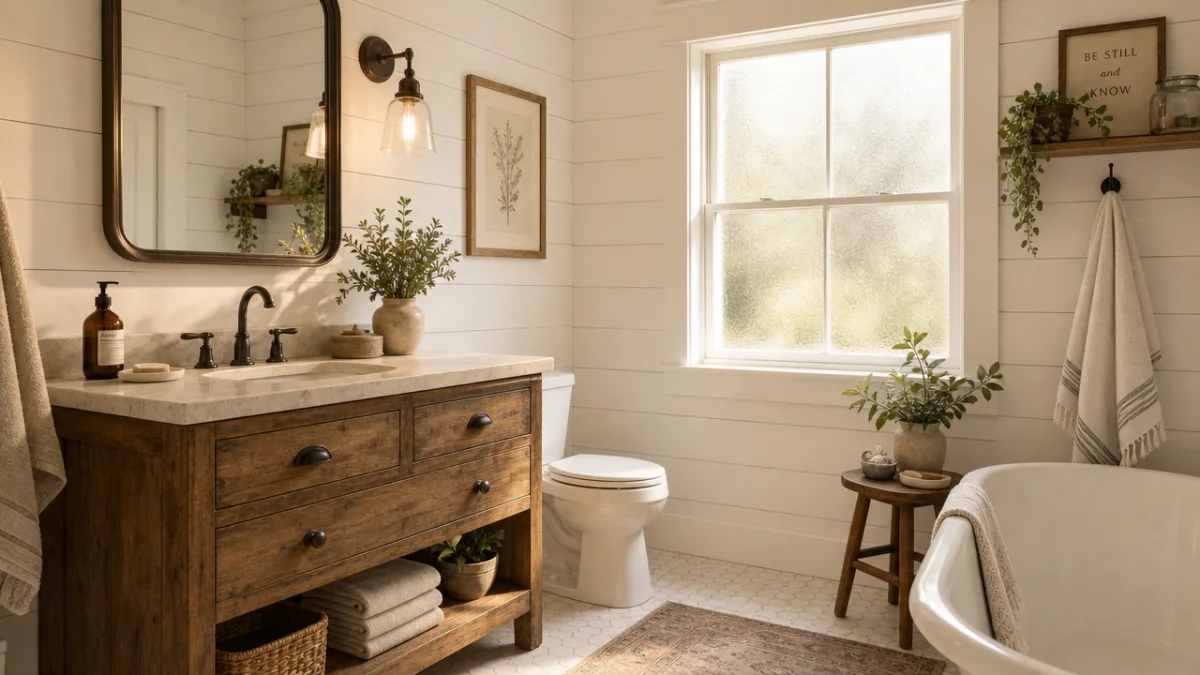
The vanity is the centerpiece of most bathrooms, and it is also the element most likely to make or break the farmhouse aesthetic you are working toward. The good news is that you almost certainly do not need to replace your existing vanity to achieve a completely transformed look. In most cases, painting the vanity cabinet a fresh color and swapping out the hardware is all that is needed to shift the piece from dated to charming. Navy blue, soft sage green, warm charcoal, and classic white are all popular farmhouse vanity colors that work beautifully against the neutral walls and natural wood accents typical of this design style.
Painting a bathroom vanity correctly requires a bit more preparation than painting walls, but the investment in proper prep pays off with a durable, professional-looking finish that holds up to daily use and humidity. Begin by removing all hardware and doors, cleaning every surface thoroughly with a degreaser, and lightly sanding to promote adhesion. Apply a bonding primer designed for furniture or cabinetry, let it dry completely, then apply two to three thin coats of a high-quality cabinet paint in your chosen color, allowing full drying time between each coat. Finish with a clear topcoat or polycrylic sealer to protect the paint from moisture, and you will have a vanity that looks like a professional transformation.
Hardware swaps are among the most cost-effective upgrades in any bathroom makeover, delivering an outsized visual impact relative to their modest price tag. For a farmhouse bathroom, look for drawer pulls and cabinet knobs in matte black, brushed nickel, aged bronze, or unlacquered brass — all finishes that complement the warm, slightly rustic character of the style. Cup pulls and bin pulls have a particularly charming, utilitarian quality that feels at home in a farmhouse design, while simple round knobs in ceramic or porcelain add a delicate, vintage touch. Replacing all the hardware in a standard bathroom typically costs between twenty and sixty dollars and takes less than an hour with a basic screwdriver.
DIY Vanity Countertop and Sink Updates
If your vanity countertop is cracked, stained, or simply mismatched with your new color scheme, there are affordable ways to update it without a full replacement. Refinishing kits specifically designed for bathroom surfaces can transform a worn laminate or cultured marble countertop into something that resembles stone, concrete, or polished plaster. These kits typically include a base coat, textured topcoat, and sealer, and the entire process can be completed in a weekend with patience and careful application. The results vary depending on the product and the applicator’s technique, but at a cost of thirty to sixty dollars per kit, they represent an excellent option for budget-conscious renovators.
Vessel sinks have become a popular way to update a vanity without replumbing, since they sit on top of the counter and connect to existing drain hardware with minimal modification. White ceramic vessel sinks with a simple, organic shape have a farmhouse quality that pairs beautifully with a freshly painted cabinet and vintage-style faucet. Matte black or oil-rubbed bronze faucets with a cross-handle or lever design complete the look and are widely available at home improvement stores in the one-hundred-dollar price range. This combination — painted cabinet, new hardware, vessel sink, and updated faucet — can transform a standard builder-grade vanity into something that looks completely custom.
Lighting and Mirror Updates That Define the Farmhouse Look
Lighting is frequently the most overlooked element in bathroom makeovers, yet it has a profound effect on how the space feels and how well the rest of your design choices read. Replacing a generic builder-grade light bar with a farmhouse-style fixture immediately elevates the entire room and signals a clear design intention. Look for vanity lights in matte black, aged brass, or brushed nickel with exposed Edison-style bulbs, wire cage surrounds, or simple industrial silhouettes that complement shiplap and painted cabinetry without competing with them. These fixtures are widely available at home improvement stores and online retailers for anywhere from fifty to one hundred fifty dollars and can be installed by most homeowners with basic electrical knowledge and the guidance of a YouTube tutorial.
The mirror above your vanity is another element with significant stylistic leverage, and updating it can reframe the entire focal wall of your bathroom. A simple frameless mirror can be easily transformed by building a wood frame around it using basic lumber, pocket screws, and wood glue. Paint or stain the frame to match your vanity or coordinate with your hardware finish, and you will have a custom mirror that looks like it came from a boutique home goods store. Alternatively, a large, leaning mirror with a simple painted frame leaned against the wall beside the vanity has a casual, layered quality that suits the farmhouse aesthetic particularly well in larger bathrooms.
Natural light is a precious resource in any bathroom, and maximizing it is always worth the effort. If your bathroom has a window, consider replacing heavy, privacy-blocking curtains with linen or cotton cafe curtains that cover only the lower half of the window, allowing light to filter in while maintaining privacy. Sheer white linen curtains on simple metal rings have a soft, slightly undone quality that is deeply farmhouse in character. For bathrooms without windows, strategically placed mirrors can help bounce artificial light around the room and create the impression of greater brightness and depth without any additional fixtures.
Layering Light Sources for Warmth and Function
A single overhead or vanity light source is rarely sufficient for a bathroom that feels truly warm and well-designed. Layering light sources creates depth, improves functionality, and contributes to the cozy, welcoming quality that farmhouse spaces are known for. Consider adding a small plug-in wall sconce beside the mirror, a candle lantern on the back of the toilet, or a battery-operated LED strip light inside a cabinet or shelf to add warmth and dimension. These additions are inexpensive and require no electrical work, but they add a significant amount of visual character and make the space feel more intentionally designed.
Switching from cool-toned bulbs to warm-toned bulbs with a color temperature in the 2700K to 3000K range is a free or nearly free upgrade that can completely change the feeling of a bathroom. Warm light flatters skin tones, softens the appearance of surfaces, and creates an ambience that aligns perfectly with the welcoming, comfortable character of farmhouse design. If you have already replaced your light fixture, choosing the right bulb temperature for it is one of the final touches that brings the entire lighting plan together and ensures that all of your other design choices are seen at their best.

Storage Solutions and Finishing Touches
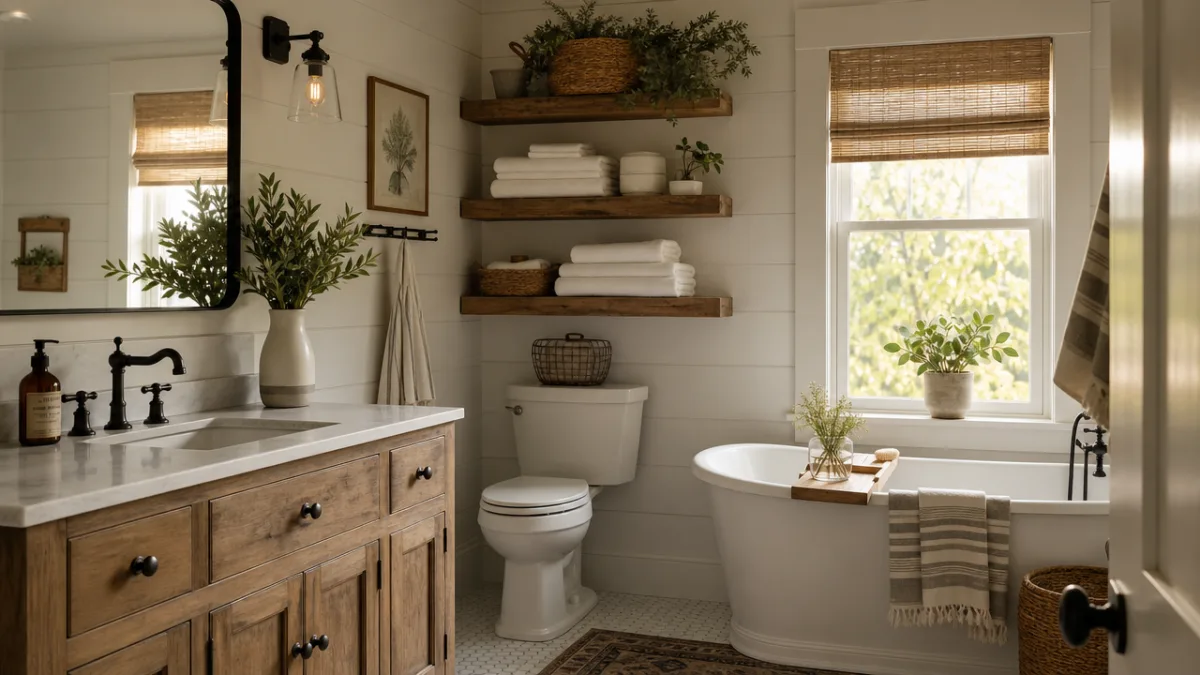
Farmhouse bathrooms are defined as much by their practical, utilitarian storage solutions as by their aesthetic elements. Open shelving made from reclaimed wood or simple pine boards stained in a warm walnut or natural finish is one of the most popular and versatile storage upgrades in a farmhouse makeover. A single floating shelf above the toilet provides space for stacked white towels, a small potted plant, and a few carefully chosen decorative objects like a vintage ceramic jar or a wooden sign. Multiple shelves arranged beside the mirror can replace a medicine cabinet while adding far more visual interest and creating opportunities for layered styling.
Woven baskets, galvanized metal buckets, and vintage crates are all storage vessels that serve double duty in a farmhouse bathroom, functioning as both practical organizers and decorative elements. Keep rolled hand towels in a large woven basket on the floor beside the vanity. Store cotton balls and swabs in small glass jars with metal lids on an open shelf. Display a collection of amber glass bottles or vintage apothecary containers on the counter to hold cotton rounds, bath salts, or hair accessories. These small organizational choices accumulate into a coherent, curated look that feels both intentional and effortlessly casual.
Textile choices play an enormous role in establishing the farmhouse atmosphere in a bathroom, and they are among the most affordable and easily changed elements in any space. Replace standard thin bath towels with thick, textured cotton towels in white, cream, or natural linen tones. Add a simple striped or buffalo check bath mat in neutral tones to ground the space and introduce a subtle pattern. Hang a cotton waffle weave hand towel from a vintage-style hook beside the sink. These textile layers add softness, warmth, and a sense of careful curation that elevates the entire room and reinforces the farmhouse narrative you have built through your other design choices.
Plants, Patina, and the Art of Intentional Imperfection
Living plants are one of the most transformative and budget-friendly finishing touches you can add to a farmhouse bathroom. A small potted eucalyptus, a trailing pothos, or a simple succulent in a terracotta pot introduces life, color, and organic texture that no manufactured accessory can replicate. Hang a bundle of dried lavender or eucalyptus branches from a showerhead hook to release a gentle fragrance while adding a bohemian, slightly rustic detail that photographs beautifully and costs almost nothing. Fresh flowers in a simple ceramic vase on the countertop are another easy addition that brings color and vitality to the space and can be refreshed weekly from a grocery store or garden for just a few dollars.
Embracing patina and intentional imperfection is perhaps the most important philosophical element of farmhouse design, and it is the one that most distinguishes this style from more polished, contemporary aesthetics. A slightly distressed picture frame, a mirror with a faint antique quality, a wooden shelf with visible knots and grain variation — these are not flaws to be corrected but character to be celebrated. If you are purchasing new items for your farmhouse bathroom makeover, look for pieces that have a handmade, slightly irregular quality rather than the machine-perfect uniformity of mass-produced goods. This attention to texture, history, and imperfection is what gives farmhouse spaces their warmth and depth, and it is something that no amount of budget can buy — it simply requires a willingness to look at the world a little differently.
When your farmhouse bathroom makeover is complete, take a moment to assess the space as a whole and identify any final adjustments that would bring greater cohesion and balance. Sometimes a single element — a too-shiny mirror frame, a towel color that doesn’t quite fit the palette, a light fixture that reads as too modern — can undermine the harmony of an otherwise beautifully executed design. Swap these outliers out if your budget allows, or simply note them as future updates to address over time. Great rooms are rarely finished in a single weekend; they evolve through small, thoughtful additions and subtractions that gradually bring them closer to the vision that inspired them in the first place.
A Final Checklist for Your Farmhouse Bathroom Transformation
Before you consider your project complete, running through a final checklist ensures that no small detail has been overlooked and that the space is ready to function both beautifully and practically. Check that all new hardware is tightened securely, all caulk lines are clean and fully cured, and all painted surfaces have received their final protective topcoat. Make sure your ventilation fan is working properly to protect your new wall treatments and paint from moisture damage. Step back, take a photograph from the doorway, and compare it to your original inspiration images — you may be surprised at just how far a determined weekend warrior with a clear vision and a modest budget can take an old, tired bathroom.
- Paint walls and vanity cabinet in coordinating farmhouse-appropriate colors, using bathroom-specific paint formulas with mildew-resistant properties for lasting durability.
- Replace all cabinet and drawer hardware with matte black, aged bronze, or brushed nickel pulls and knobs to immediately elevate the farmhouse character of the space.
- Install a new vanity light fixture with warm Edison-style bulbs and a style that complements shiplap or beadboard wall treatments throughout the room.
- Add open wood shelving above the toilet or beside the mirror for practical farmhouse-style storage that doubles as a display surface for carefully chosen accessories.
- Layer textiles including thick cotton towels, a woven bath mat, and a striped or checked hand towel to introduce softness and pattern without overwhelming the neutral palette.
- Introduce living plants, dried botanicals, or fresh flowers to bring organic life and fragrance into the finished space at minimal ongoing cost.
- Style open shelves and countertop surfaces with a mix of functional and decorative objects in natural materials like wood, ceramic, glass, and woven fiber.








What do you think?
It is nice to know your opinion. Leave a comment.