










Dollar Tree Kitchen Organization: Top 10 Viral Hacks That Will Transform Your Space
Why Dollar Tree Is the Secret Weapon for Kitchen Organization
If you’ve spent any time scrolling through Pinterest or Instagram lately, you’ve almost certainly stumbled upon the wave of Dollar Tree kitchen organization content taking over social media feeds. What started as a niche corner of the DIY community has exploded into one of the most shared categories of home content online, and for very good reason. People are discovering that a budget-friendly trip to their local Dollar Tree can yield the same satisfying, magazine-worthy results that used to require expensive trips to specialty organizing stores or big-box retailers.
The appeal is simple but powerful: you don’t need to spend a fortune to have a beautifully organized kitchen. Dollar Tree stocks an impressive and ever-rotating selection of bins, baskets, trays, containers, and accessories that, when used creatively, rival products sold at three to five times the price elsewhere. The key is knowing which items to look for, how to combine them strategically, and which hacks have gone genuinely viral for a reason. Once you see how transformative these small investments can be, you’ll never look at a cluttered kitchen drawer the same way again.
Beyond the obvious financial benefit, Dollar Tree hacks carry a psychological advantage as well. When you’re working with low-cost items, you feel free to experiment without the fear of wasting money. You can try a new system, decide it doesn’t work for your lifestyle, and pivot without guilt. This freedom to iterate is actually one of the most important ingredients in building an organization system that sticks long-term, and Dollar Tree gives you that flexibility in spades.
Hack #1 and #2: Drawer Dividers and Countertop Caddy Systems
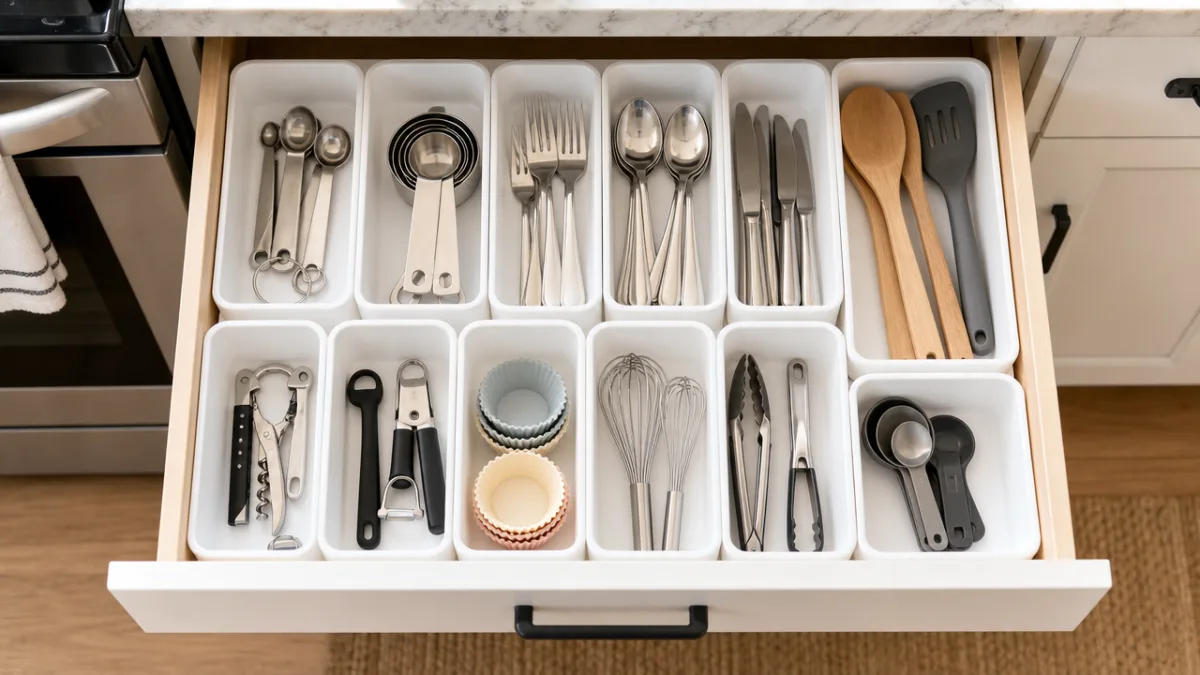
The single most transformative Dollar Tree hack for kitchens involves their small rectangular plastic bins used as DIY drawer dividers. Standard kitchen drawers tend to become chaotic catch-all spaces where spatulas tangle with whisks, batteries roll into measuring spoons, and nobody can find anything quickly. By placing two to four of Dollar Tree’s small plastic storage bins inside a single drawer, you instantly create dedicated zones for different categories of items. The bins sit snugly side by side and can be rearranged in seconds if your needs change, making this one of the most flexible organizational systems available at any price point.
The countertop caddy hack uses Dollar Tree’s small plastic or wire bins combined with adhesive labels to create a dedicated station for your most-used cooking tools. Rather than stuffing everything into one large utensil holder where items jam together and nothing is easily accessible, you place two or three smaller containers side by side on the counter. One holds wooden spoons and spatulas, one holds tongs and ladles, and one holds small tools like peelers and zesters. The visual clarity this creates is immediate, and the time saved during meal preparation adds up meaningfully over the course of a week.
Both of these hacks share a common principle that underpins nearly all effective organization: category separation. When like items live together and unlike items are kept apart, your brain can navigate your kitchen on near-autopilot. You stop opening three drawers to find the vegetable peeler. You stop knocking over the whisk to grab the spatula. Dollar Tree’s modular bins are perfectly sized to make this kind of separation possible without requiring any measuring, cutting, or permanent modifications to your cabinets or drawers.
Hack #3 and #4: Refrigerator Bins and Pantry Basket Systems
One of the most viral Dollar Tree hacks of the past two years involves using their clear plastic rectangular bins inside the refrigerator to create a grocery-store-style organization system. The problem most people face with their fridge is that items get pushed to the back, forgotten, and eventually wasted. By placing clear bins on each shelf dedicated to specific food categories — one for dairy products, one for leftovers, one for deli meats and cheeses — you create a pull-out drawer effect even though your fridge shelves are fixed. When you need something, you pull the entire bin forward and can see everything inside at once.
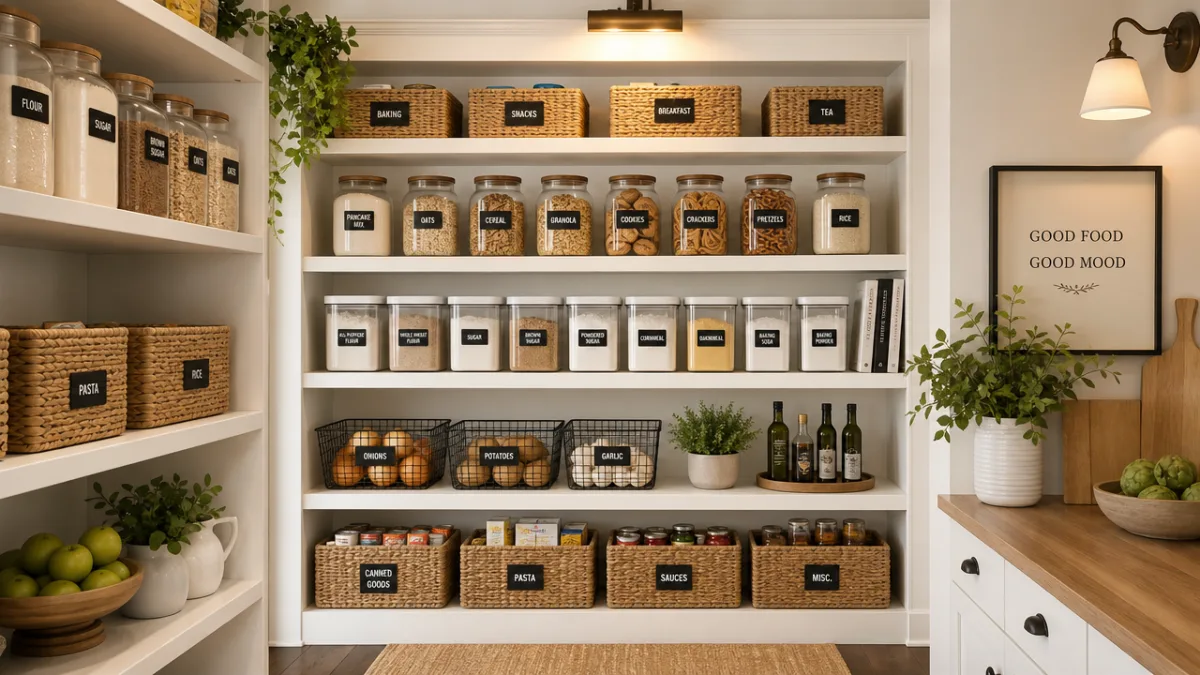
The pantry basket hack takes the same logic and applies it to your cabinet or pantry shelves. Dollar Tree carries a rotating selection of wire baskets, plastic bins, and woven-look storage containers that work beautifully as pantry organizers. The viral approach is to dedicate one basket per meal category: a breakfast basket with oatmeal, granola, and pancake mix; a pasta basket with dried noodles, sauces, and seasonings; a snack basket for chips and crackers. When you’re planning a meal or making a grocery list, you pull the relevant basket and immediately see what you have and what you need. The reduction in food waste alone can offset the cost of the bins within the first month.
Labeling is what elevates these hacks from helpful to genuinely transformative. Dollar Tree stocks chalkboard labels, adhesive label stickers, and even small chalkboard tags that can be tied to baskets with twine. Taking ten extra minutes to label every bin and basket in your fridge and pantry creates a system that every member of your household can use and maintain, not just the person who set it up. This shared usability is what separates a short-term organizing binge from a durable long-term system, and it’s something many expensive professional organizers emphasize as their top principle.
Hack #5 and #6: Cabinet Door Storage and Tension Rod Tricks
The inside of your cabinet doors represents a significant amount of storage real estate that most people leave completely unused. Dollar Tree’s adhesive hooks and small over-door organizers unlock this space beautifully. One of the most popular viral applications is using adhesive hooks inside a cabinet door to hang pot lids in a vertical row, eliminating the frustrating problem of lids taking up valuable shelf space and falling over constantly. A set of four to six adhesive hooks costs just a dollar or two and can hold lids of various sizes securely without any drilling or permanent installation.
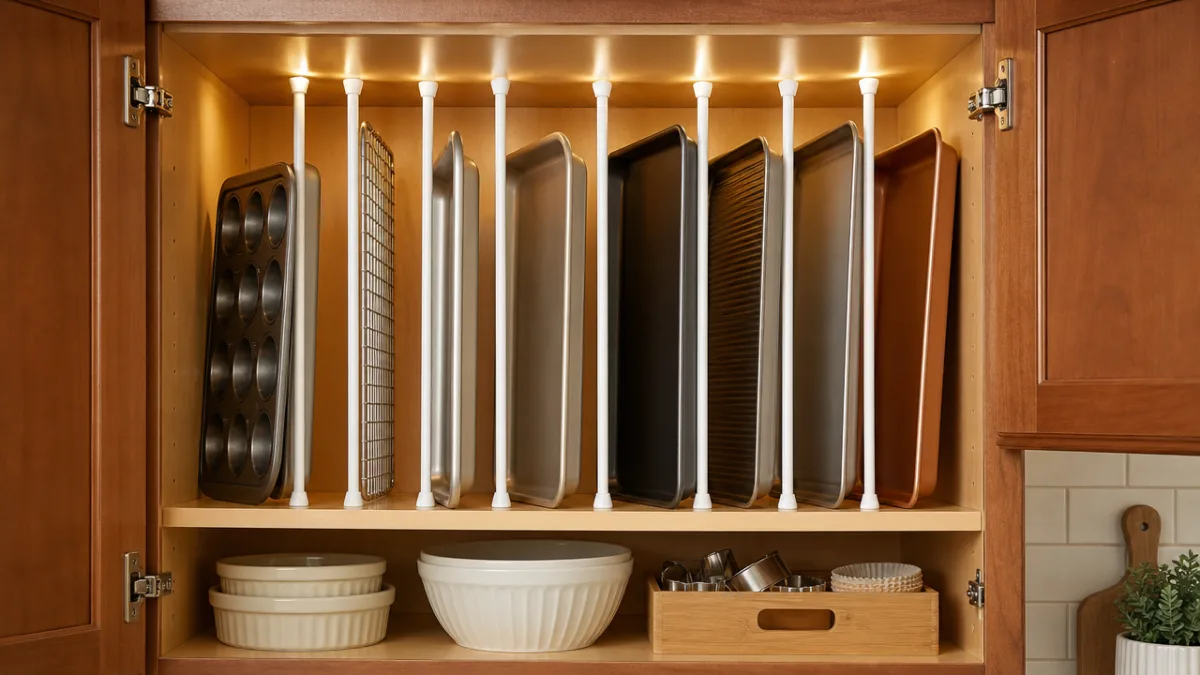
Tension rods are another Dollar Tree staple that has gone massively viral in kitchen organization content. The hack that generates the most amazed reactions involves placing a tension rod vertically inside a cabinet to create a divider for baking sheets, cutting boards, and platters. Instead of stacking these flat items in a precarious pile where you have to unstack everything to reach the one on the bottom, you stand them upright like books on a shelf and the tension rod keeps them separated and stable. You can grab any single item without disturbing the others, which sounds simple but represents an enormous quality-of-life improvement for anyone who bakes or cooks regularly.
A second tension rod hack uses a horizontal rod placed low inside a cabinet under the sink to create a hanging storage rail for spray bottles. Instead of bottles tipping over and rolling around on the cabinet floor, they hang from their trigger handles on the tension rod, keeping them upright, organized, and easy to grab. This hack also frees up the floor of the cabinet for other items like sponges, scrubbers, and cleaning product refills. Together, these tension rod tricks demonstrate how a single one-dollar item can solve multiple distinct organizational problems throughout the kitchen.
Here are some of the best Dollar Tree items to use for cabinet and door organization:
- Adhesive hooks in various sizes for hanging lids, utensils, and measuring cups
- Tension rods for dividing baking sheets or hanging spray bottles
- Small over-door wire baskets for spices, foil boxes, or cleaning supplies
- Adhesive-backed magazine holders repurposed as cabinet door organizers for aluminum foil, plastic wrap, and parchment paper
- Suction cup hooks for smooth cabinet interiors where adhesive won’t stick
Hack #7 and #8: Spice Organization and Under-Sink Makeovers
The spice drawer and spice cabinet are among the most universally chaotic areas in any kitchen, and Dollar Tree has two viral solutions that address this problem elegantly. The first uses small plastic bins laid flat in a drawer, with spice jars placed inside them in a single layer so their labels face upward and are readable at a glance. This replaces the old system of stacking jars in a cabinet where you inevitably knock five over trying to find the paprika. The bins also group spices thematically — baking spices in one bin, savory herbs in another, heat and chili spices in a third — so you always know exactly where to look.
The under-sink cabinet is often the most neglected and most chaotic space in the entire kitchen. Pipes create awkward obstacles, bottles crowd each other, and bags of sponges and gloves get lost in the back. The viral Dollar Tree under-sink makeover uses a combination of stacking bins, a tension rod for spray bottles, and small baskets to create a multi-level organized system within a single cabinet. By adding a stacking shelf riser — also frequently available at Dollar Tree — you effectively create a second level of storage above the pipes, doubling the usable space without any construction or permanent changes.
The transformation that this particular hack produces is dramatic enough to warrant the “mind-blown” emoji that appears in so many of the viral posts about it. People share before and after photos showing what looks like two entirely different cabinets. The before image shows a dark tangle of products with no visible order; the after image looks like a small organized store shelf where every product is visible, labeled, and easily accessible. The total investment to achieve this transformation is typically under ten dollars in Dollar Tree supplies, which is part of what makes these posts so compelling and shareable to an audience that increasingly values both aesthetics and frugality.
Hack #9 and #10: Turntable Lazy Susans and Freezer Organization
Dollar Tree periodically stocks small plastic turntables — lazy Susans — that have become one of the most celebrated finds in the organization community. Used inside a corner cabinet, they solve the classic dead-zone problem where items pushed to the back of a deep corner shelf become essentially inaccessible. A lazy Susan in a corner cabinet means a simple spin brings everything within reach. Used inside the refrigerator, they work equally well for condiments and sauces, eliminating the need to move six bottles to reach the one you want. And placed on a pantry shelf for canned goods, they allow you to rotate your stock naturally so older cans get used first.
The freezer, often the most organizationally neglected appliance in the kitchen, responds extraordinarily well to Dollar Tree bins and baskets. The viral freezer hack involves sorting all frozen items into Dollar Tree bins by category — proteins in one bin, vegetables in another, frozen meals in a third, and breakfast items in a fourth — then labeling each bin clearly. This system solves the frozen tundra problem where items freeze together into an indistinguishable mass and you can never find what you need without excavating half the freezer. It also helps with meal planning, because a quick glance into each bin tells you exactly what proteins or vegetables you have available when planning the week’s meals.
What makes both of these hacks particularly powerful is how they address the visibility problem at the core of kitchen disorganization. Most kitchen chaos isn’t caused by having too much stuff — it’s caused by having stuff that’s hidden, stacked, or buried in ways that make it effectively invisible. When you can’t see what you have, you forget what you have. You buy duplicates of things you already own. You let food expire without realizing it’s there. Dollar Tree bins, turntables, and dividers solve this visibility problem at minimal cost, and the resulting clarity has a genuine and measurable positive impact on how smoothly your household functions day to day.
To put the full system together effectively, consider working through your kitchen in this sequence:
- Start with a full declutter, removing expired food and items you no longer use before buying any organizational products
- Measure your drawers, shelves, and cabinet interiors so you know what sizes of bins will fit
- Visit Dollar Tree with a list organized by zone: drawers, countertop, fridge, pantry, under-sink, and freezer
- Install everything before labeling so you can adjust placement based on what actually fits
- Label every bin, basket, and container clearly using Dollar Tree’s chalkboard labels or a label maker
- Take before and after photos — not just for social media, but to remind yourself of the transformation when motivation to maintain the system wanes
Making Your Dollar Tree Organization System Last
Creating a beautiful, organized kitchen with Dollar Tree hacks is genuinely achievable in a single weekend, but maintaining that organization over months and years requires a slightly different kind of effort. The most important principle is what professional organizers call “the one-in, one-out rule”: whenever a new item enters the kitchen, an old one leaves. This prevents the gradual re-accumulation of clutter that undermines so many well-intentioned organization projects. Dollar Tree’s low cost actually helps here, because when a bin gets cracked or a basket wears out, you can replace it without agonizing over the expense.
A monthly reset is another practice that the most successful Dollar Tree organization enthusiasts swear by. Once a month — perhaps on the same day you do your big grocery shop — spend fifteen to twenty minutes pulling everything out of your fridge bins, wiping them down, and restoring order. Do the same quick pass through your pantry baskets and drawer dividers. This small investment of time prevents the slow entropy that turns organized systems back into chaotic ones, and it’s much easier to do a fifteen-minute reset monthly than a two-hour overhaul once a year.
Finally, remember that the best organizational system is the one your whole household will actually use. Before finalizing the placement of bins and the assignment of categories, involve the people who share your kitchen in the conversation. If your children can’t reach the snack basket or your partner finds the new drawer layout counterintuitive, the system will break down quickly regardless of how beautiful it looks. Dollar Tree’s flexibility — the ease of rearranging, relabeling, and replacing individual components — means you can iterate your way toward a system that works for everyone without significant cost or effort. That combination of accessibility, affordability, and adaptability is precisely what has made these hacks some of the most shared and most replicated content in the entire home organization space.








What do you think?
It is nice to know your opinion. Leave a comment.