










“`html
DIY Cutting Board Storage: A Quick and Easy Solution for Your Kitchen
Why Cutting Board Storage Matters More Than You Think
If you’ve ever swung open a kitchen cabinet and had a cutting board come crashing down on your foot, you don’t need me to explain why this matters. Cutting boards are something you reach for all the time, but their flat, awkward shapes make them genuinely tricky to store. Without a real system in place, they end up leaning against cabinet walls at weird angles, sliding behind other stuff, or stacked in a pile where getting the right size out turns into a small production every time you cook.
And it’s not just an annoyance — bad storage can actually shorten the life of your boards. Wooden boards stored flat in a stack trap moisture between surfaces, which leads to warping over time. Plastic boards that get scratched up from rough stacking can harbor bacteria in ways that clean, smooth surfaces don’t. A decent storage solution keeps everything upright, separated, and able to air out properly, so your boards last longer and stay cleaner with barely any extra effort.
The good news is you don’t need a kitchen renovation or a specialty store to fix this. A well-thought-out DIY solution can be sized exactly for your space, your specific boards, and the way you actually cook. Whether you’re working with a tiny apartment kitchen or something more spacious, there’s an approach that’ll fit perfectly — and it’ll cost a fraction of anything you’d buy off the shelf.
Assessing Your Kitchen Space and Storage Needs
Before you buy a single thing or make a single cut, it’s worth spending a few minutes actually looking at your kitchen. Pull everything out of the cabinet or drawer where your boards currently live and measure the inside carefully — height, width, and depth. Take note of any shelves that can’t be moved. A lot of kitchen cabinets have fixed shelves at heights that make zero sense for cutting boards, so knowing your exact constraints upfront will save you from building something that almost fits.
Then take Stock of what you actually own. Lay all your cutting boards out on the counter and sort them by size. Most home cooks are a little surprised by this step — it turns out they’ve accumulated five or six boards in various sizes and materials, half of which they’d forgotten about. Knowing exactly what you have, and which ones you actually reach for regularly, helps you figure out whether you need a simple two-slot holder for your everyday boards or something bigger that handles the whole collection. No sense building storage for boards you never use.
Also think about where the storage is actually going to live. Inside a cabinet is the most popular option because it keeps your counters clear, but an under-cabinet rack or a countertop stand near your prep area can both work really well depending on your layout and habits. If you’re grabbing a cutting board multiple times a day, having it within easy reach — on the counter, or mounted inside a cabinet door — might make a bigger difference in your daily cooking than tucking it away in a lower cabinet ever would.
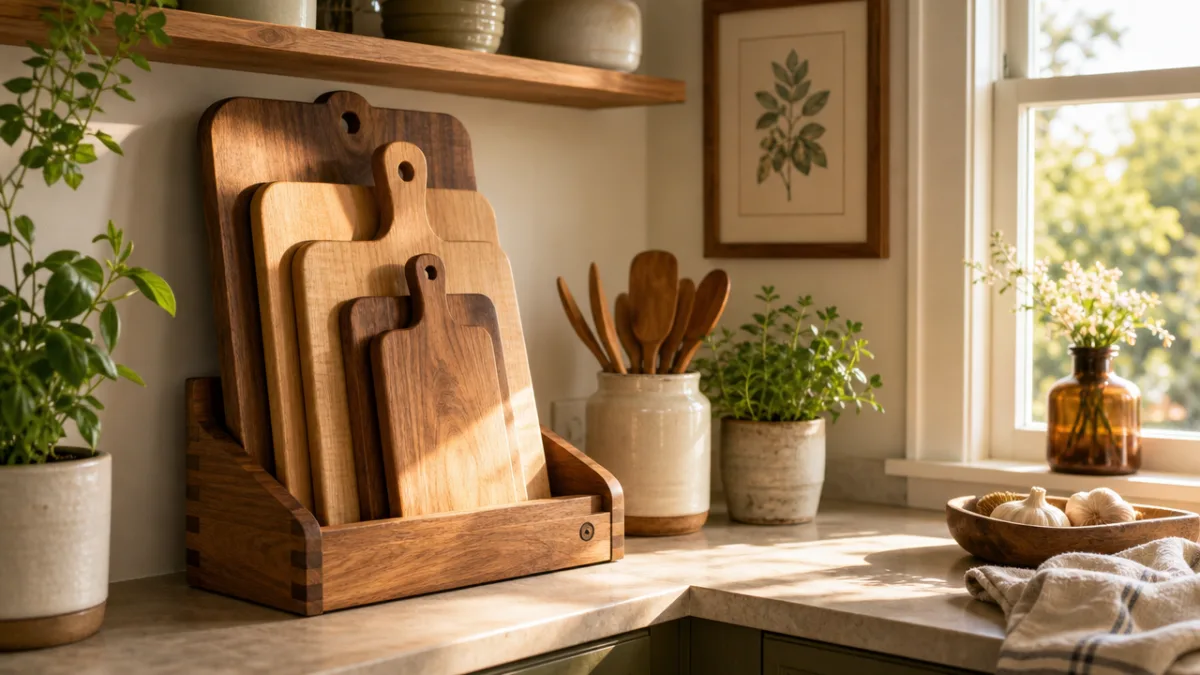
Materials and Tools You’ll Need
One of the best things about this kind of project is how little you actually need. For a basic wooden slot-style holder that sits inside a cabinet, you’re looking at a few pieces of common lumber, some wood glue, and maybe a handful of screws. Pine and poplar are cheap and beginner-friendly; oak or maple will give you a more polished, furniture-grade look if you want something that can double as a countertop display. Usually a single eight-foot length of one-by-six lumber is plenty for a standard holder.
The tools are just as simple. A circular saw or miter saw makes cuts faster and cleaner, but a regular handsaw works fine if that’s what you’ve got. Beyond that, you’ll need a tape measure, a pencil, sandpaper in a couple of grits (around 80 for shaping, 220 for finishing), and wood glue or pocket screws to hold it together. If you’re painting or staining it, add a small brush and your finish of choice. A clamp or two helps while the glue dries, though a strip of masking tape can do the job in a pinch.
Not into woodworking? No problem — there are plenty of non-wood options that work just as well. Tension rods installed vertically inside a cabinet create instant dividers for a few dollars and require zero tools. Heavy-gauge wire closet shelving cut to size makes a great airy rack that lets boards dry out quickly. Even PVC pipe sections cut to different lengths and bundled in a basket can work, giving you a surprisingly modern look. The trick is matching the material to your skill level and your kitchen’s style so the whole thing looks like it belongs there.
Here’s a basic materials list for a simple wooden cabinet insert holder:
- One eight-foot length of 1×6 pine or poplar lumber
- Wood glue or 1.25-inch pocket screws
- Sandpaper in 80 and 220 grit
- Wood stain, paint, or food-safe mineral oil for finishing
- Tape measure and pencil
- Saw (circular, miter, or hand)
- Clamps or masking tape for assembly
Step-by-Step Guide to Building a Simple Slot-Style Holder
Start by measuring the inside of the cabinet where the holder will live. Subtract about half an inch from both the width and the depth so you have a little wiggle room. Cut your lumber into a base piece and two side pieces to match those dimensions. If you want a back panel, cut a fourth piece to fit. The sides need to be tall enough that your largest board can stand up without tipping, but short enough that the cabinet door still closes. For most standard cutting boards, sides somewhere between ten and twelve inches tall hit that sweet spot.
Once everything’s cut, sand all the surfaces and edges — start with the coarser grit to knock down any rough spots, then finish with the finer grit to smooth things out. Give extra attention to the tops of the side pieces and any edges your hands will regularly touch. Before you reach for the glue, do a dry fit first: hold the pieces together without gluing anything and check that everything lines up and that the holder actually fits in the cabinet the way you planned. It’s much easier to trim a little off now than to wrestle with it after the glue has set.
When everything checks out, apply your wood glue to the joints and put it together, using clamps or masking tape to hold things in place while it cures. If you’re using pocket screws, drive those in now for added strength. Let the glue dry for at least an hour — longer if you can — before you handle it much. Once it’s dry, give the whole thing one last light sanding to clean up any glue squeeze-out or uneven spots, then apply your finish. Food-safe mineral oil is a solid choice if the holder will be in contact with wooden boards, since it won’t introduce any chemicals to the surfaces.
Once the finish is completely dry, add your dividers. You can glue in thin strips of wood to create individual slots, or you can drill a row of wooden dowels along the base at even intervals. Dowels are actually a really nice option because they let air circulate under the boards and make it easy to pull one board out without knocking everything else over. Space them based on your thickest board, with a little extra room so things slide in and out smoothly rather than jamming.
Creative Variations and Design Ideas
The slot-style holder is really just a starting point. Once you’ve got the basic concept down, there are all kinds of directions you can take it depending on your kitchen’s style or your specific storage challenges. A wall-mounted version, for instance, frees up both cabinet and counter space by using wall real estate that most kitchens completely ignore. It can be as simple as a small shelf with dowel dividers, or as polished as a floating wooden panel with integrated hooks for boards that have a hole drilled in the corner.
Mounting a rack to the inside of a cabinet door is another great option, especially when every inch of interior cabinet space is already spoken for. Done right, it creates usable storage that essentially didn’t exist before. This approach works best with lighter plastic or thin composite boards rather than heavy hardwood slabs, and you’ll want to measure the clearance carefully to make sure the rack doesn’t prevent the door from closing properly — that gap varies quite a bit depending on the cabinet style.
If you like an industrial or modern look, a steel pipe and flange setup is genuinely striking and incredibly sturdy. Short sections of half-inch black iron pipe threaded between two flanges mounted to a wooden backer create bold vertical dividers that can handle even your heaviest boards. You can get a similar look for less by using PVC pipe with a coat of metallic spray paint. Either version looks great mounted on a tile backsplash or a painted wall, and it’ll cost far less than anything comparable you’d find in a store.
It’s also worth thinking about how your cutting board storage can pull double duty. A unit that holds cutting boards on one side and baking sheets or cooling racks on the other solves two problems without taking up any extra space. A countertop holder with a small slot for a knife or a built-in groove for a kitchen scale adds real practical value. When you’re building your own storage rather than buying something off a shelf, you get to design it around what your kitchen actually needs — and that’s a pretty significant advantage.
Finishing Touches, Maintenance, and Long-Term Organization Tips
A well-built holder deserves a finish that’s been thought about. If yours is going to live on the counter or hang on a wall, take a little time to match it to your existing cabinetry or kitchen décor. Painting it the same color as your cabinets makes it look intentional, almost like it was always there. Staining it to show off the wood grain adds warmth that works especially well in farmhouse or rustic-style kitchens. Even a simple coat of food-safe oil on raw wood gives it a finished, deliberate look that makes a real difference.
Maintenance is pretty straightforward, but it’s worth staying on top of. Wooden holders should be wiped down weekly with a damp cloth and allowed to dry completely before you slide the boards back in — moisture sitting in the joints over time can weaken the glue and invite mold. If you finished it with mineral oil, a thin reapplication every few months keeps the wood from drying out and cracking. Holders made from metal, PVC, or wire shelving need even less: a quick wipe with a damp sponge is usually all they ever need.
The habits you build around your new storage matter just as much as the storage itself. Get in the habit of returning each board to its slot right after it’s been washed and dried, rather than setting it on the counter to deal with later. If you have boards made from different materials, consider assigning each slot a dedicated purpose — meat boards always on the left, vegetable boards in the middle, the big prep board on the right. When everything has a consistent home, you stop thinking about it and just reach for what you need, which is when a kitchen genuinely starts to feel efficient rather than just tidy.
Finally, check in on your system every six months or so and be willing to tweak it. If you’re constantly reaching past boards you never use to get to the ones you grab every day, swap the order. If you’ve picked up new boards that don’t fit the current setup, modify or expand the holder rather than letting things drift back into chaos. That’s one of the real advantages of building your own solution — it can always be adjusted, repaired, or rebuilt as your kitchen and your cooking habits change over time.

“`








What do you think?
It is nice to know your opinion. Leave a comment.