










Relics from an Industrious Time: A Journey Through the Artifacts of Industrial Heritage
The Weight of Iron and Memory
There’s something that stops you in your tracks when you pick up an object that was hammered or cast into shape by hands working a century or more before yours. Industrial relics carry more than just the physical marks of how they were made — the hammer dents, the casting seams, the slow creep of rust and oxidation. They hold the memory of an era that rewired the entire human world. The Industrial Revolution didn’t just change manufacturing; it changed how people thought about time, work, community, and meaning. When we come across these objects today, we’re touching the bones of a civilization caught mid-transformation.
The factories, foundries, and workshops of the eighteenth and nineteenth centuries were loud, dangerous, unrelenting places. Workers showed up before dawn and left after dark, their days governed by steam-powered machinery rather than the rise and set of the sun. And yet, out of that punishing environment came objects of real ingenuity — and often, unexpected beauty. Gear assemblies, pressure gauges, wrought-iron hinges, ceramic insulators, brass fittings: each one was built with a clear purpose, and each one still carries, in every curve and joint, the evidence of human thought and skill.
Collectors, historians, and designers have been waking up to just how much cultural and aesthetic value these artifacts hold. Things that once ended up in salvage yards or demolished skips are now sitting in museum collections, showing up in carefully restored interiors, and turning up at specialist antique fairs with serious price tags. This isn’t just nostalgia. There’s a genuine desire to understand where our material world came from — and to give some recognition to the millions of unnamed workers whose labor built it. In the truest sense, industrial relics are monuments to human effort on a massive, democratic scale.
Tools of the Trade: The Artisan’s Arsenal
Before mass production standardized every nut and bolt to identical dimensions, skilled tradespeople built up personal collections of tools that were as individual as the people who used them. A blacksmith’s hammers, tongs, and hardies were often made to his own specifications, weighted and balanced for the exact rhythm of his swing. A millwright’s levels and gauges might be calibrated by hand over years of careful tweaking. These tools weren’t just instruments of work — they were extensions of the person holding them, shaped through decades of daily use into something close to personal expression.
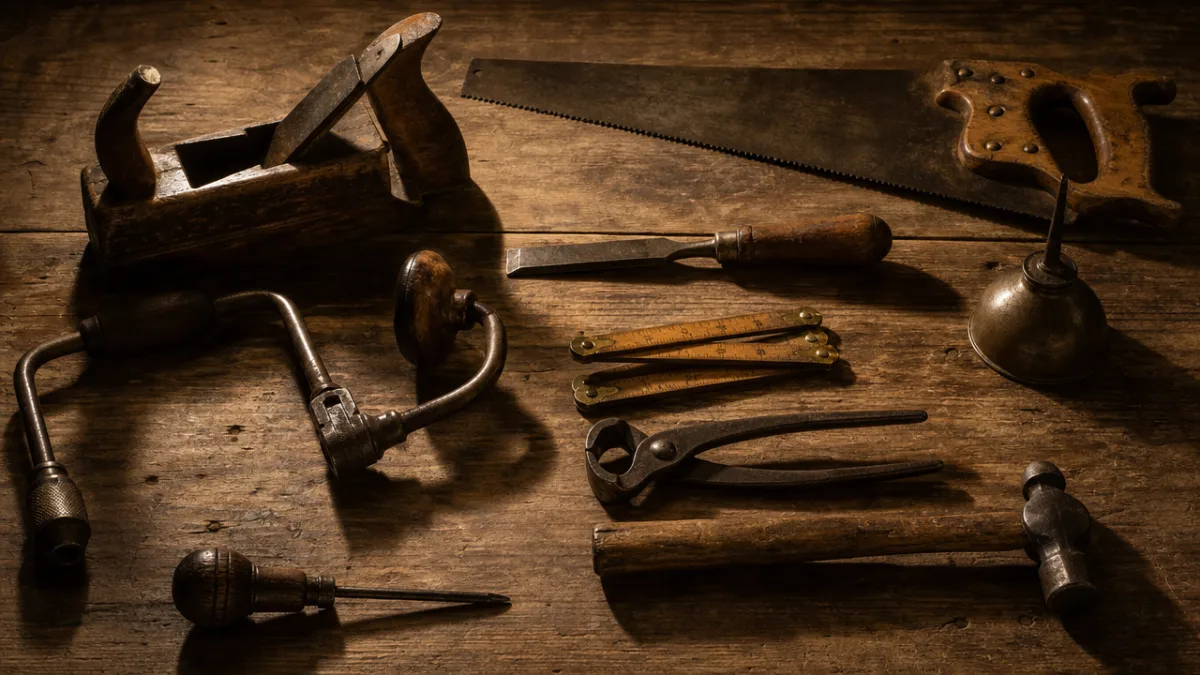
Among the most evocative industrial relics out there are the hand tools that survive from Victorian and Edwardian workshops. Wooden-handled chisels with blades worn to a gentle curve from years of sharpening, folding rules with brass hinges gone green with age, spoke shaves with bodies of burnished fruitwood — these objects have an intimacy their modern equivalents, stamped from molded plastic and stainless steel, simply can’t match. The wear patterns alone tell a story of repetitive, skilled work that no historical record can fully capture. Every nick in a blade, every polished patch on a handle, is a line in someone’s biography of labor.
The sheer variety of specialized tools produced during the industrial era is itself a reminder of how many trades once flourished in a pre-automation economy. There were tools for coopering and caulking, for rope-making and rivet-setting, for glass-cutting and gear-cutting, for leather-working and loom-dressing. Many of these implements have no modern equivalent, because the trades they served have completely vanished. When we come across them in museum cases or at antique markets, we often can’t even say what they were for without specialist knowledge. They sit there as physical evidence of skills and ways of knowing that the modern world has quietly let disappear.
- Coopers’ croze and chiv tools, used to cut the grooves and bevels in barrel staves, now virtually unknown outside specialist collections.
- Farriers’ buffer and pritchel punches, once essential on every farm and in every town stable, now encountered only at blacksmithing heritage demonstrations.
- Sailmakers’ palms, seam rubbers, and prickers, the hand tools of a trade that kept global commerce moving under wind power for centuries.
- Typographers’ composing sticks and lead-casting equipment, instruments of a craft that shaped the entire printed culture of the modern world.
Iron Giants: The Machinery of Production
If hand tools represent the intimate, personal side of industrial heritage, the great machines of the factory floor represent something else entirely — something monumental and collective. The beam engines, power looms, steam hammers, and rolling mills of the industrial age were on a completely different scale from anything that had come before. A Watt beam engine, with its massive cast-iron cylinder and slow, majestic rocking motion, opened up a whole new aesthetic category: something that was at once functional, architectural, and almost alive in the way it moved. These machines demanded new kinds of workers, new ways of organizing people, and new relationships between human beings and mechanical systems.
Many of the great industrial machines that survive in working museums today represent remarkable achievements of preservation and restoration. Organizations like the Ironbridge Gorge Museum in Shropshire, the Science Museum in London, and the Slater Mill Historic Site in Rhode Island have put enormous resources into keeping functional examples of early industrial machinery alive. Watching a Newcomen atmospheric engine make its slow, hissing stroke, or standing in a room full of power looms clattering in synchronized rhythm, gives you a feel for the industrial past that no textbook can replicate. These machines don’t just illustrate history — they embody it, in steel and cast iron and brass.
The engineering thinking behind early industrial machinery is fascinating in its own right. Before standardized interchangeable parts became the norm — a shift that took most of the nineteenth century to really take hold — every machine was essentially a one-off, fitted and adjusted by skilled engineers to tolerances judged as much by eye and touch as by instrument. That means early machines had a handmade quality that sits oddly with our modern idea of mechanical production. Fitters and turners in the great engine shops of Manchester, Birmingham, and Pittsburgh developed extraordinarily refined tactile and visual judgment, building through years of apprenticeship a kind of embodied knowledge that couldn’t be written down or passed on in any other way.
Ceramics, Glass, and the Decorative Industrial Object
Not everything from the industrial age is made of iron and steel. The ceramic and glass industries of the eighteenth and nineteenth centuries produced objects of real beauty that blur the line between industrial manufacture and decorative art. Staffordshire potteries, Venetian glassworks, and the great porcelain factories at Meissen and Sèvres all developed production methods that were genuinely industrial in scale and organization, yet they were turning out pieces of extraordinary refinement and complexity at the same time. Even the purely utilitarian ceramics — salt-glazed stoneware from domestic production, plain white earthenware from factory canteens, heavy creamware from hospital wards — have a directness and honesty of form that gives them real aesthetic appeal.
Among the most sought-after industrial ceramic relics are the insulators produced in vast quantities from the mid-nineteenth century onward for the telegraph and telephone networks that were transforming how the world communicated. These small objects, often beautifully proportioned and glazed in rich cobalt blues, deep emerald greens, or warm ambers, were purely functional in design — their shape dictated entirely by the need to stop electrical current from leaking into the wooden poles and cross-arms on which they sat. And yet they have an elegance that feels almost accidental, as if the engineers who specified them had stumbled into making miniature sculptures. Insulator collecting has become a significant hobby worldwide, with rare examples fetching prices that would have completely baffled their original manufacturers.
The glass industry offers its own unexpected beauties among its industrial remnants. Glass telegraph floats, used by fishing fleets to keep their nets suspended in the water column, were produced by the million in Norway, Japan, and the United States from the nineteenth century onward. Found occasionally on beaches today, smoothed and frosted by years of ocean tumbling, they seem to carry the sea inside them — blues and greens and pale aquamarines that hold light within their curved surfaces. Factory glass in the form of acid-etched advertising signs, colored glass pharmacy bottles, and pressed-glass industrial components has found equally enthusiastic collectors who see in these functional objects a kind of vernacular beauty that formal art history has been slow to catch up with.
- Ceramic telegraph and telephone insulators, produced in hundreds of distinct styles and colors, collected internationally under a detailed classification system.
- Transfer-printed Staffordshire pottery depicting industrial scenes, providing visual records of early factories and ironworks that photography had not yet captured.
- Pressed-glass workers’ lamp shades from early electrical installations, their geometric patterns pressed from molten glass in iron molds by skilled craftspeople.
- Salt-glazed stoneware water filters and storage crocks from municipal water supply companies, combining utilitarian form with the accidental beauty of salt-glaze firing.

The Architecture of Industry: Buildings as Relics
Among the most significant — and most challenging — industrial relics are the buildings themselves: the mills, warehouses, engine houses, and manufactories that once defined the skylines of industrial cities around the world. These structures represent a unique architectural heritage, shaped by functional demands that were entirely new to human history. The need to house hundreds of power looms, or to store and shift thousands of tons of grain or raw cotton, produced building forms unlike anything that had existed before. Multi-story brick mill buildings with their rows of large windows, cast-iron internal structures, and imposing water towers and chimney stacks constitute a genuine architectural tradition — one born out of engineering necessity that ended up achieving its own kind of monumental grandeur.
The adaptive reuse of industrial buildings has become one of the most significant trends in urban architecture over the past half-century. Former textile mills in Massachusetts and Yorkshire have been converted into apartment complexes and creative industry hubs. Redundant warehouses in London’s Docklands and Hamburg’s Speicherstadt have become galleries, offices, and restaurants. Disused power stations — most famously Bankside in London, now Tate Modern — have found new cultural lives that their original builders couldn’t possibly have imagined. This process of transformation isn’t without its complications and controversies, though, raising hard questions about gentrification, community displacement, and whether a building can retain its historical meaning once its function and its people have entirely changed.
Preserving industrial buildings in their original condition, rather than adapting them for new uses, presents its own particular challenges for conservation professionals. These structures were built to demanding functional specifications but rarely with permanence in mind — they were expected to be modified, extended, or replaced as technology and production methods moved on. Many are built from materials, like early Portland cement concrete or wrought-iron structural elements, that present complex and poorly understood conservation problems. The authentic atmosphere of these spaces — the smell of oil and coal dust, the acoustics of vast empty volumes, the particular quality of light through factory-scale windows — is extraordinarily hard to preserve or recreate once it’s gone. Yet those atmospheric qualities are often exactly what makes the spaces so powerful for visitors, and what gives them their unique ability to convey a sense of the past that words alone simply can’t.
Collecting, Preserving, and Interpreting Industrial Heritage
The field of industrial archaeology, which took shape as a formal academic and practical discipline in Britain during the 1950s and 1960s, has done a great deal to establish how we study and preserve industrial relics. Pioneered by figures like Kenneth Hudson and Angus Buchanan, industrial archaeology brought systematic survey techniques, documentary analysis, and material culture study to bear on the physical remains of industrial civilization. The core argument was that factory buildings, machinery, and associated artifacts deserved the same rigorous scholarly attention that had long been given to prehistoric earthworks or medieval cathedrals. That intellectual repositioning had a profound impact — on heritage legislation, on museum practice, and on public attitudes throughout the industrialized world.
Private collectors have played an indispensable role in saving industrial relics that official heritage institutions were too slow or too selective to protect. The early steam railway enthusiasts who pulled locomotives back from the scrapyard in the 1950s, the industrial tool collectors who rescued workshop inventories before demolitions in the 1960s and 1970s, the canal boat restorers who kept traditional narrow boat traditions alive through the long years of waterway decline — all of these people acted out of personal passion and commitment to preserve material culture that would otherwise have been lost for good. The collections they built, and the skills they kept alive, have turned out to be resources of incalculable historical value.
Interpreting industrial heritage raises questions that are as much ethical and political as they are historical or aesthetic. Industrial civilization was built on the labor of workers who were frequently exploited, put in danger, and poorly rewarded for their efforts. Children worked in mines and mills. Industrial pollution devastated communities and ecosystems. The prosperity that industrial production generated was distributed with profound inequality. An interpretation that focuses only on the ingenuity of inventors and entrepreneurs, or on the abstract beauty of machinery and artifacts, risks scrubbing the human cost of industrialization out of historical memory entirely. The most thoughtful approaches to industrial heritage are the ones that hold both things at once — the celebration of human ingenuity and the honest acknowledgment of human suffering — recognizing that both were genuinely present in the industrious time that shaped our world.
When we look at the relics of industrial civilization — whether in a museum gallery, a reclaimed warehouse apartment, or a stall at a specialist antique market — we’re being invited into a complex act of historical imagination. These objects ask us to consider what it meant to build a new kind of world with your hands and your labor, to live inside economic and technological systems of unprecedented scale and power, and to make a human life within constraints that were as often brutal as they were liberating. The patina on an old machine, the wear on a craftsperson’s tool, the faded lettering on a factory sign — these aren’t just aesthetic qualities. They’re the material evidence of lives lived in full, in a time that was harder, louder, dirtier, and in many ways more consequential than our own comfortable present. To preserve and study these relics is to insist that those lives — and the industrious time in which they were lived — won’t be forgotten.








What do you think?
It is nice to know your opinion. Leave a comment.