










Party Games: The Ultimate Guide to Making Every Celebration Unforgettable
Why Party Games Are the Heart of Every Great Celebration
There’s a moment at every great party when things just click. The careful small talk gives way to real laughter, people who didn’t know each other an hour ago are suddenly high-fiving over a shared ridiculous challenge, and the whole vibe in the room shifts into something electric. That moment almost always has a game behind it. Party games aren’t just filler between dinner and dessert — they’re what actually turns a room full of people into a group with shared memories and inside jokes.
This isn’t a new idea, either. Humans have been playing together at gatherings for as long as there have been gatherings — ancient festivals had their athletic competitions, medieval banquets had their riddles and wordplay, and the instinct to play together in groups is just deeply baked into who we are. Modern party games carry that tradition forward, adapted for everything from a cozy dinner party of six to a sprawling backyard bash with sixty guests ranging from toddlers to grandparents.
What makes games so valuable is how adaptable they are. It doesn’t matter whether you’re hosting a kids’ birthday, a bridal shower, a corporate team-building afternoon, or a lazy summer barbecue — there’s a game out there that fits your crowd, your space, and your energy. Knowing your options means you can put together something that feels genuinely thoughtful rather than like you grabbed whatever was in the closet at the last minute.
Classic Party Games That Never Go Out of Style
Some games have genuinely earned their place in the party-planning hall of fame, because they just work — every time, with every generation. Charades is the perfect example. People have been playing it for well over a century, and the premise is almost laughably simple: act out a word or phrase without making a sound. Yet somehow it reliably produces some of the most genuinely hilarious moments a party will ever see. Watching someone you know contort their face in desperate, wordless communication never gets old, and the room-wide laughter it generates is the real thing.
Pictionary has that same staying power, but it swaps the physical performance for drawing — which turns out to be a completely different kind of comedy. There’s a particular genius to it in how it levels the playing field. Someone who would rather disappear into the couch than act out a movie title in Charades might absolutely thrive with a marker in hand, gleefully scrawling their version of “roller coaster” while teammates shout increasingly baffled guesses.
Trivia deserves its own category of appreciation. A well-built trivia game respects the fact that your guests know wildly different things, so the best versions mix pop culture, history, science, sports, music, and current events — giving everyone a few moments to shine. The social dynamic that emerges is genuinely lovely: the quiet guest in the corner suddenly becomes the most valuable person in the room when a question lands squarely in their wheelhouse, and that moment of recognition is worth a lot.
- Charades: Best for groups of 6 to 20 players, requires no materials, endlessly adaptable to any theme or age group.
- Pictionary: Ideal for creative groups, easy to customize with themed word lists that fit your party’s occasion.
- Trivia Nights: Perfect for mixed-age gatherings where broad general knowledge levels the competitive playing field.
- Two Truths and a Lie: An excellent icebreaker for parties where not all guests know each other well yet.
- Bingo: A classic that works beautifully across all age ranges, especially adaptable for themed celebrations.
Outdoor Party Games That Transform Your Backyard Into a Playground
When you’ve got sunshine and outdoor space on your side, the possibilities for party games open up considerably — in scale, in physicality, and honestly, in style. Lawn games have had a real moment in recent years, with classic formats getting refreshed and elevated into party staples that look as good as they play. Cornhole, Bocce Ball, Croquet, Ladder Toss, Kubb — these aren’t just campsite activities anymore. Hosts set them up with the same intention they put into their table settings and flower arrangements, and for good reason.
Cornhole — called Bean Bag Toss in some parts of the country — might be the most socially perfect outdoor party game around. The rules take maybe ninety seconds to explain to someone who’s never played. The equipment is portable and looks great in coordinating colors or custom designs. And the gameplay is relaxed enough that you can genuinely hold a conversation while you’re competing — one hand on your drink, tossing beanbags at angled boards, chatting about weekend plans between turns. For a host who wants people mixing and talking, it’s almost too good.
For bigger gatherings where you want to get everyone involved at once rather than rotating through stations, a field day format is hard to beat. Relay races, obstacle courses, water balloons, sack races, tug-of-war — set these up right and you’ve got something that’s equal parts athletic event and joyful chaos. The secret is enthusiastic organization: clear boundaries, someone on the mic keeping energy high, and maybe a little prize table with ribbons or goofy trophies. Even the guests who walked in insisting they were “way too old for this” tend to find themselves sprinting with full commitment the moment the whistle blows.
Indoor Party Games for Intimate Gatherings and Small Spaces
Not every party has a lawn. Plenty of the most memorable ones happen in apartments, dining rooms, and living rooms where there’s barely enough floor space to spin around in — and that’s completely fine. Some of the best party games ever designed need nothing more than a few chairs, a deck of cards, a pen, and some paper. Square footage and fun are not related.
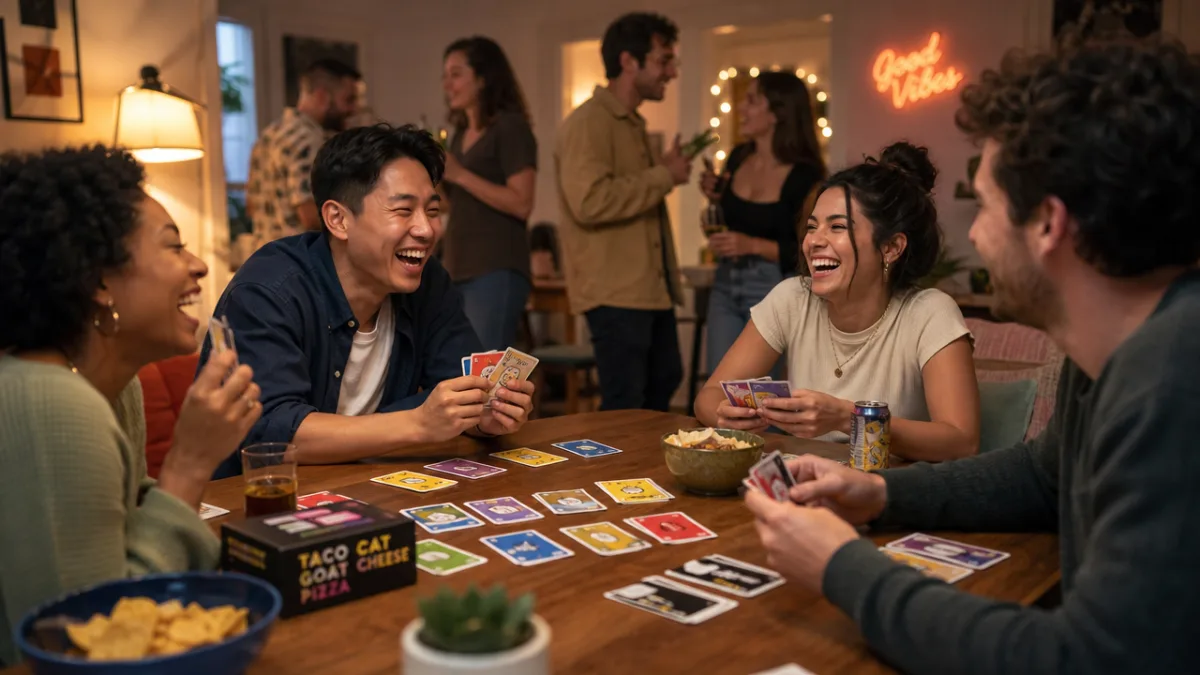
Card games built for party play are a particularly rich category here. Exploding Kittens, What Do You Meme, Taco Cat Goat Cheese Pizza, Cards Against Humanity (keep that one for adult audiences who know each other reasonably well) — these games have devoted followings because they’re compact, easy to pick up, and tend to produce genuine surprise and laughter within the first few minutes. They understand something important about the reality of parties: people often arrive a little tired or socially cautious, and the best games pull them in quickly rather than opening with a ten-minute rules explanation that drains everyone’s enthusiasm before a single card is played.
Word and guessing games are equally at home in a small indoor space because they run entirely on human creativity and competitive spirit — no equipment required. Codenames has become a modern classic because it rewards lateral thinking and the kind of satisfying mental stretch that leaves people still buzzing when they get home. Werewolf and Mafia do something different but equally compelling: they turn a quiet living room into a theater of bluffing and social deduction, with genuinely dramatic moments that guests recreate and replay in conversation for days afterward. These are the games people text you about the following week.
- Set up a dedicated game area with comfortable seating arranged to face a central focal point where activities can unfold.
- Prepare a brief, clear explanation of rules in advance so you can deliver them confidently and concisely when the moment comes.
- Have backup game options ready in case your first choice doesn’t land as expected with your particular group of guests.
- Consider offering light snacks and drinks at game stations to keep energy levels high and guests comfortable throughout play.
- Build in natural pauses between games to allow for bathroom breaks, snack refills, and organic conversation to flow.
Party Games for Kids: Designing Magic for Young Guests
Planning games for a children’s party is one of the most genuinely fun creative challenges a host gets to take on, because kids bring a completely unguarded enthusiasm to play that most adults have long since talked themselves out of. A well-chosen game at a kids’ party doesn’t just pass the time — it creates that glowing, breathless, flushed-cheek happiness that sticks around in memory for years. Getting it right matters, and the starting point is understanding that kids’ games need to balance structure with spontaneity, competition with inclusion, and excitement with enough fairness that every child feels like they’re actually in it — not just waiting around for their one moment.
Musical Chairs is genuinely underappreciated as a design achievement. Think about what it asks of kids: quick physical reaction, spatial awareness, just enough competitive edge to feel real — all wrapped up in music, which makes everything feel festive. And when kids get eliminated, the host can keep them engaged as an enthusiastic audience if the energy stays high and the music stays fun. Dress it up with chairs decorated to match the party’s theme, and it goes from a standard activity to a coordinated entertainment moment.
Treasure hunts and scavenger hunts deserve a much bigger role in kids’ party planning than they usually get, because they offer something most group games don’t: a story. Instead of a self-contained round of play, a good treasure hunt unfolds over fifteen to thirty minutes, pulling kids from clue to clue through different corners of the party space, building real suspense with each discovery, and ending in a group reward that celebrates everyone’s effort. Yes, the prep takes more time than simpler games. But the return — in engagement, in thematic coherence, in sheer excitement — is extraordinary.
Creating Your Perfect Party Game Lineup: Tips for Every Host
The difference between a game lineup that flows beautifully and one that kind of falls flat usually isn’t about which specific games you chose — it’s about how intentionally you’ve sequenced and paced them. The best hosts think about their game plan the way a good DJ thinks about a setlist. You start with accessible, low-stakes warmers that ease people into playing mode. You build toward higher-energy peak experiences somewhere in the middle of the evening. Then you wind down toward the end with more relaxed, conversational activities that let everyone decompress while still feeling connected. That attention to rhythm and flow is what makes a gathering feel like a real experience rather than a series of disconnected activities.
Knowing your guests is probably the single most important factor in choosing games, and it really can’t be overstated. Before you lock in any game plan, take an honest look at who’s going to be in the room. What’s the age range — are there kids who need to be included, or older guests for whom physical games might be a stretch? What are the social dynamics — is this a tight group of longtime friends who can handle irreverent humor, or a mixed crowd where keeping things comfortable and inclusive matters more? What’s the energy going to be like — an after-dinner group at ten at night has completely different needs than an afternoon crowd that just arrived buzzing on coffee and excitement. Tailoring your choices to the actual humans in front of you will always beat rigidly sticking to a plan that doesn’t fit the room.
Don’t underestimate the power of a good prize moment — not because the prizes themselves need to be impressive, but because the ceremony around them does. A custom ribbon, a silly trophy, a themed gift bag, even just enthusiastic group applause and a genuine spotlight moment — these things make winning feel special, and when winning feels special, people play harder and more joyfully. Get the celebration right, and the prize itself almost doesn’t matter. What matters is the countdown, the announcement, the reaction from the room. Nail that, and your guests will bring an investment to the games that lifts the entire atmosphere of the party.

At the end of the day, the philosophy behind every good party game decision is pretty simple: the best game is the one that makes everyone in the room feel included, energized, and glad they showed up. There’s no formula that works every time for every group, and there shouldn’t be. What there is, always, is an opportunity to actually read your guests and respond to what they need — whether that’s the focused competition of a trivia showdown, the joyful absurdity of an improv challenge, the relaxed sociability of a lawn game, or the cozy intimacy of cards around a candlelit table. Choose with intention, host with warmth, and the games will handle the rest.








What do you think?
It is nice to know your opinion. Leave a comment.