










Garden Glow: Transforming Your Outdoor Space with Light, Life, and Luminous Beauty
The Magic of a Glowing Garden
There’s something almost magical about a garden that glows. Maybe it’s the soft amber warmth of string lights tangled through an old oak tree, or the blue-white shimmer of solar lanterns lining a path through the yard, or even fireflies drifting lazily through tall grasses at dusk. Whatever the source, a garden that radiates light stops being just an outdoor space — it becomes a sanctuary. The whole idea behind Garden Glow is pulling together every source of luminosity you can find, artificial and natural alike, to create somewhere that feels alive and welcoming no matter the time of day.
For centuries, garden design was almost entirely about the daytime visitor. Sunlight drove every decision, and plants were chosen for how brilliantly they’d perform under the midday sun. A glowing garden asks a completely different question: what does this space look like after sunset? How does moonlight filter through the leaves of a silver-leafed eucalyptus? What happens to a humble birch tree when you tuck an uplighter at its base? Chasing those answers opens up a whole new dimension of garden design that most people never even think to explore.
A glowing garden also taps into something deeper — our need for warmth and connection. A well-lit outdoor space invites you to stay longer, share a meal with friends, read by the evening air, or just sit quietly and feel held by the natural world. Research consistently backs this up: time in thoughtfully designed natural environments lowers cortisol, eases blood pressure, and lifts mood. Add lighting that captures the gentle quality of candlelight or twilight, and those benefits get even stronger. A Garden Glow isn’t just a pretty project — it’s genuinely good for you.
Choosing Plants That Radiate Natural Light
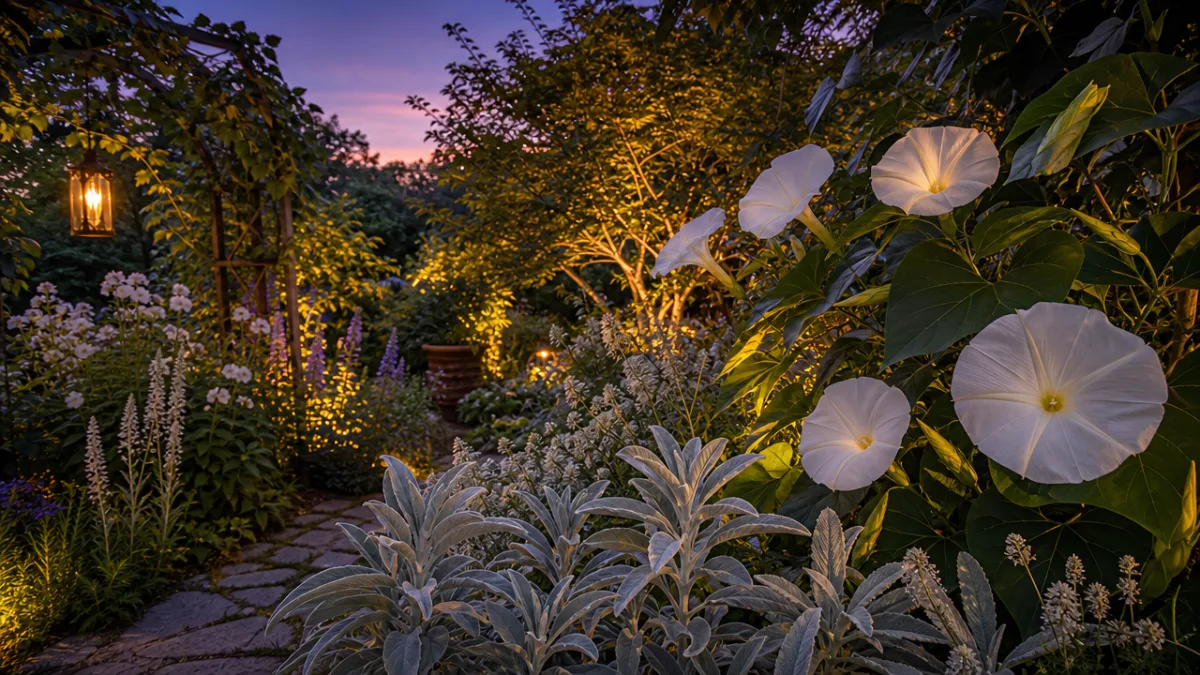
Before you hang a single bulb or push in a single solar stake, your plant choices will already determine how naturally luminous your garden feels. Some species have an almost eerie ability to catch and hold light, and they’re worth seeking out specifically for this reason. White and cream-colored flowers are the obvious starting point — blooms like white phlox, Shasta daisies, moonflowers, and white foxglove practically glow in low light, seeming to gather the last of the evening and hold onto it. Moon gardens built around these plants have been a thing for generations, and honestly, they haven’t gone out of style for good reason.
Silver and gray-foliaged plants are equally important. Artemisia, lamb’s ears, dusty miller, and eucalyptus all have leaves coated in fine silvery hairs or a waxy bloom that does a beautiful job of bouncing light around. Planted in drifts or used to edge a path, these varieties create a shimmering, almost liquid quality at dusk. They also look intentional and interesting during the day against darker green foliage, so you’re not sacrificing daytime appeal. When you backlight a cluster of artemisia with even a modest garden spotlight, the effect is genuinely dream-like.
Don’t underestimate texture and movement either. Grasses like Stipa tenuissima, Miscanthus, and Pennisetum catch the breeze and shimmer in a way no static plant can match. Their fine blades and translucent seed heads diffuse light rather than simply reflecting it, creating a soft haze that shifts and dances with every gust of wind. Plant them where afternoon or evening sun can backlight them and you’ll get a spectacular golden haze effect. Add bronze fennel — same translucent quality — and you’ve essentially built a living light installation that changes with every breath of wind.
- White and cream flowers: Moonflower, white foxglove, Shasta daisy, white phlox, nicotiana
- Silver-foliaged plants: Artemisia, lamb’s ears, dusty miller, stachys, curry plant
- Translucent grasses: Stipa tenuissima, Miscanthus sinensis, Pennisetum, bronze fennel
- Luminous bark and stems: Betula (birch), Cornus alba (dogwood), white-stemmed bramble
- Night-blooming species: Evening primrose, four o’clocks, night-blooming jasmine, angels trumpets
Lighting Design: The Art and Science of Garden Illumination
Planning a garden lighting scheme is part art, part science. You need to understand how different light sources actually behave, how our eyes read light in natural spaces, and — this is the part people always forget — how to use shadow just as deliberately as light itself. The most common mistake people make when they first get into garden lighting is simply adding more light everywhere, as if the garden were a stage that needs to be uniformly bright. The result looks flat, institutional, and oddly lifeless after dark. Real Garden Glow lighting is built on contrast, restraint, and intention — putting light exactly where it matters, and trusting the darkness to carry its own weight.
Professional garden lighting designers rely on a handful of core techniques that any home gardener can learn. Uplighting means positioning fixtures at ground level pointing upward, typically to illuminate tree canopies, architectural features, or statement plants — the effect is dramatic and makes familiar plants look completely different after dark. Downlighting does the opposite: fixtures placed high in trees or on structures angle downward, mimicking the quality of moonlight and casting soft dappled shadows below. Path lighting handles both safety and aesthetics at once, defining movement and drawing the eye through the garden. And spotlighting does exactly what it sounds like, pulling a single feature — a sculpture, a container, an unusual specimen — into sharp, focused relief.
Color temperature matters more than most people realize. Warm white light in the 2700K to 3000K range is almost always the right call for garden settings. It flatters golden, amber, and red tones in flowers and foliage, creates a cozy and intimate feel, and reads as natural and welcoming. Cool white or daylight bulbs above 4000K tend to make gardens look clinical after dark, draining warmth from flowers and turning foliage a flat, uniform gray-green. When in doubt, go warmer. And wherever possible, look for LEDs with a Color Rendering Index (CRI) of 90 or above — that’s what ensures colors look true and vibrant rather than washed out under artificial light.
- Begin with a plan: sketch your garden layout and identify key focal points, pathways, and areas where you spend the most time.
- Layer your light sources: combine uplighting, downlighting, path lighting, and accent lighting rather than relying on a single type.
- Use warm-toned LEDs with a CRI of 90 or above for the most natural, flattering results.
- Install dimmer controls wherever possible, allowing you to adjust the mood from subtle to festive as needed.
- Test fixtures in position before committing to permanent installation — what looks right in daylight may need adjusting after dark.
- Consider smart lighting systems that allow automated schedules and colour adjustment via smartphone.
Sustainable Glow: Solar, LED, and Eco-Friendly Lighting Solutions
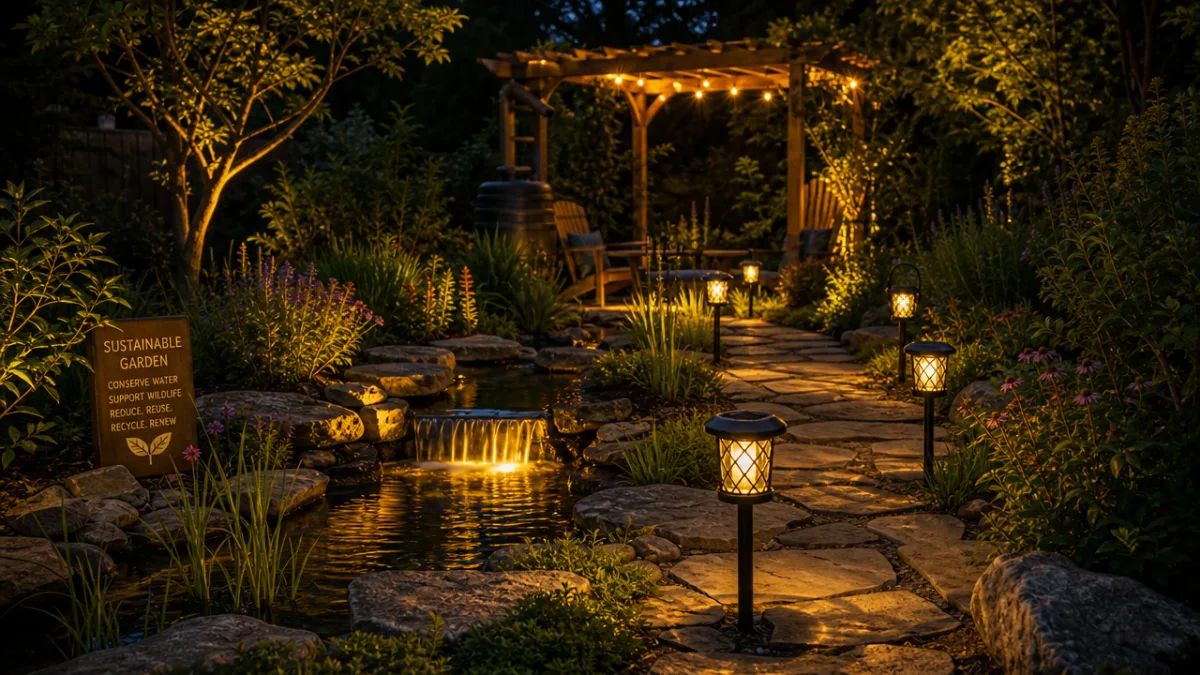
One of the most exciting things to happen in garden lighting over the past decade is how good solar-powered and LED options have gotten. Early solar garden lights had a pretty rough reputation — dim, blue-tinged output, fading out after a couple of hours — and honestly, that reputation was earned. But modern solar technology has come a long way. Today’s best solar garden lights pair high-efficiency photovoltaic panels with lithium battery storage and warm-toned LEDs, delivering results that genuinely compete with mains-powered options. Run reliably for eight to twelve hours on a single day’s charge in decent conditions? Absolutely.
The wider shift to LED technology is its own sustainability story worth telling. LED bulbs use up to 90 percent less energy than traditional incandescent bulbs and can last anywhere from 15,000 to 50,000 hours — compared to the roughly 1,000-hour lifespan of a conventional bulb. For garden lights that might run several hours every evening through a whole growing season, that difference in energy use and replacement frequency adds up fast, both in cost and carbon footprint. A growing number of manufacturers are also building fixtures from recycled or sustainably sourced materials, and the move toward minimal, biodegradable packaging is real and continuing.
Water features open up another interesting avenue here. Solar-powered submersible pumps can run small fountains, rills, and water walls with no electrical connection required, and pairing them with waterproof LED lighting creates reflected light effects that dramatically multiply the perceived luminosity of your whole garden. A solar fountain with warm-white LEDs, set in a reflective container or small pond, throws dancing patterns of light across walls and surrounding foliage that no static fixture can replicate. Combine that with the sound of moving water and you have something genuinely extraordinary — even the smallest courtyard starts to feel like a private retreat. Sustainability and beauty really do line up perfectly here.
Seasonal Garden Glow: Adapting Your Garden Through the Year
A great Garden Glow isn’t something you set up once and call done — it’s a living practice that shifts with the seasons. Spring brings an entirely fresh palette: the translucent petals of tulips and cherry blossoms that almost glow when backlit, the electric lime-green luminosity of brand-new foliage, and those long, low-angled evenings that cast long shadows and rich golden tones across everything. In spring you often need very little artificial lighting, because the natural world is doing most of the heavy lifting. Your job as a gardener is mainly to position plants where they’ll catch that extraordinary quality of spring light most effectively.
Summer is peak season for Garden Glow enthusiasts, and for obvious reasons. Long warm evenings beg for outdoor entertaining, and the garden is at its fullest and most lush. This is when string lights through pergolas really earn their keep, when lanterns on the dining table feel exactly right, when candlelit pathways and the glow of a fire pit make everything feel special. One thing to watch: the abundance of summer foliage means uplighters can get swallowed by dense growth, so make sure they’re well-positioned and keep fast-growing climbers trimmed back from fixtures. Night-blooming plants come into their own now too — moonflowers open after dark, night-blooming jasmine scents the air, and nicotiana releases its fragrance as the temperature drops, turning the whole experience into something that engages smell just as much as sight.
Autumn and winter have their own garden glow magic that tends to get underappreciated. As leaves fall and the bones of the garden are revealed, many lighting designers will tell you that winter is actually their favorite season for this work. Without summer’s dense foliage in the way, the dramatic architectural forms of trees, the texture of bark, and the geometry of seed heads and skeletal stems become the real stars of the show. Frost and ice amplify artificial light in genuinely beautiful ways, and the sight of a frosty garden lit in warm amber is hard to beat. Evergreens, ornamental grasses that hold their form through winter, and berrying shrubs all keep the garden interesting and glowing through the colder months.
Creating Your Personal Garden Glow: Design Principles and Inspiration
You don’t need a big budget, a professional designer, or a sprawling property to pull this off. Some of the most beautiful glowing gardens in the world are tiny courtyard spaces, balconies, or ordinary suburban backyards where the gardener applied a few core principles consistently and creatively. The single most important shift is this: start thinking about every element you introduce — a plant, a light fixture, a reflective surface, a piece of furniture — in terms of how it will look and function after dark, not just during the day. Designing for both conditions simultaneously is what separates a truly luminous garden from a garden that just happens to have a few lights stuck in the ground.
Reflective surfaces are one of the most underused tools in the whole Garden Glow toolkit. A simple mirror on a garden wall, framed by climbing plants, can double the apparent depth and brightness of a small space after dark. Metallic containers — copper, brass, brushed steel — scatter light in ways that ceramic or terracotta simply can’t. Even swapping in pale-colored gravel or white stone as mulch can noticeably brighten a garden bed at night by bouncing ambient and artificial light back up into the plants above it. And water, as always, is the most powerful reflective surface of all. Even a shallow bowl placed under a spotlight creates a shimmering, animated quality that transforms everything around it.
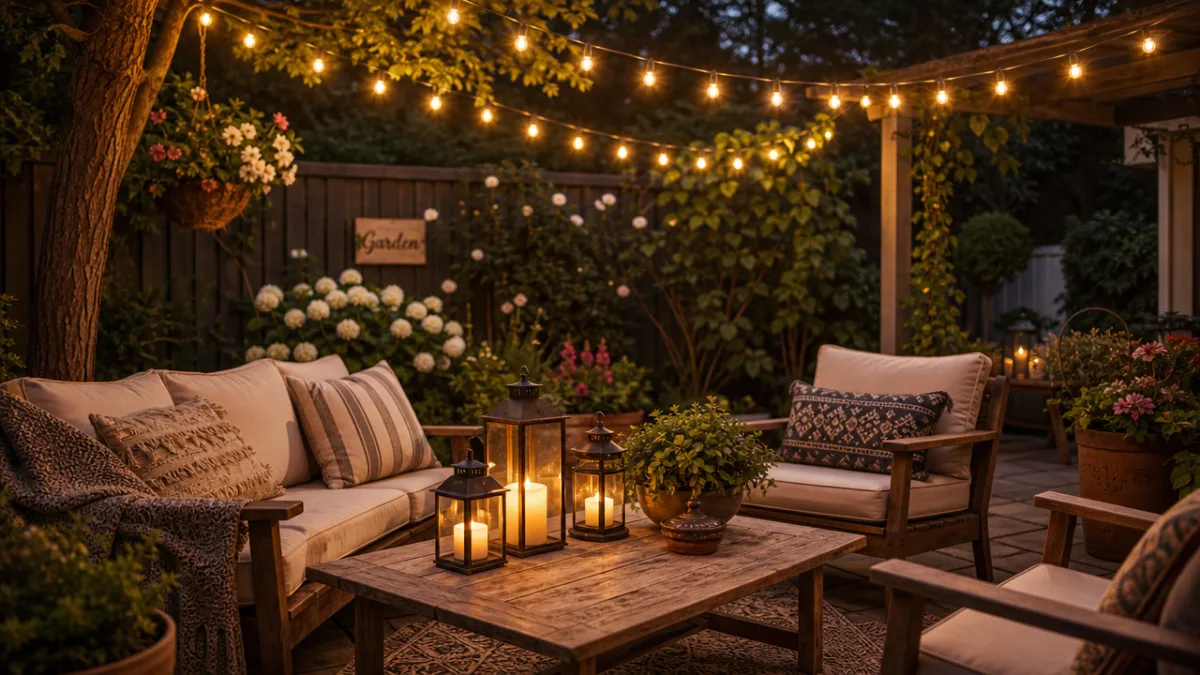
The last thing to remember is that a glowing garden is meant to be experienced, not just looked at. Design around real moments: a cozy seating corner with low, warm light for evening conversations; a dining terrace with festoon lights overhead for summer nights with friends; a quiet path lined with soft solar lanterns for an evening walk alone; a water feature you hear before you see it. When your lighting design actually serves the moments you want to have, it becomes something more than decoration. A garden that glows is a garden that welcomes, comforts, and restores — and in a world that often feels overwhelming, that’s one of the most generous things you can offer yourself and the people you invite to share it.
- Use reflective surfaces: Mirrors, metallic containers, pale gravel, and water all multiply luminosity without additional energy use.
- Design for experience: Think about specific activities and moments you want your garden to support after dark.
- Layer plant heights: Combine low-growing luminous ground covers, mid-height silver-foliaged perennials, and tall translucent grasses for a multi-dimensional glow effect.
- Balance light and shadow: Allow dark areas to remain dark — they make the illuminated areas feel more magical by contrast.
- Start simple and build gradually: A few well-placed, high-quality lights will always outperform many poorly placed, cheap ones.
- Consider scent as part of the experience: Night-fragrant plants like jasmine and nicotiana extend the sensory experience of your garden glow beyond the visual.








What do you think?
It is nice to know your opinion. Leave a comment.