










20+ Inspiring Pallet Fence Ideas and Designs for Rustic and Sustainable Outdoor Enclosures
Why Pallet Fences Are Taking Over Backyard Design
Pallet fences have surged in popularity over the last decade, and it’s easy to understand why. As homeowners become increasingly conscious of waste, sustainability, and the rising costs of traditional building materials, repurposed wooden pallets offer an elegant solution that checks nearly every box. These humble structures, once destined for landfills or industrial recycling, can be transformed into beautiful, functional outdoor enclosures that add genuine character to any yard or garden space.
Beyond the environmental appeal, there’s something deeply satisfying about creating something beautiful and purposeful from discarded materials. A pallet fence carries with it a story — the weathered grain, the nail holes, the rough-cut edges all speak to a previous life in a warehouse or shipping yard. That history becomes part of the aesthetic, lending an authenticity that no manufactured fencing product can replicate. Rustic charm isn’t just a design trend; when it comes from reclaimed materials, it becomes a genuine expression of creativity and resourcefulness.
Cost savings are another major driver of the pallet fence movement. Traditional wooden privacy fences can run anywhere from $15 to $30 per linear foot installed, making a modest backyard enclosure a significant financial investment. Pallets, by contrast, can often be sourced for free or at very low cost from local businesses, warehouses, and hardware stores that would otherwise pay to dispose of them. With a modest investment in hardware, paint or stain, and your own time, you can construct a fence that rivals more expensive alternatives in both looks and durability.
Sourcing and Preparing Pallets for Outdoor Use
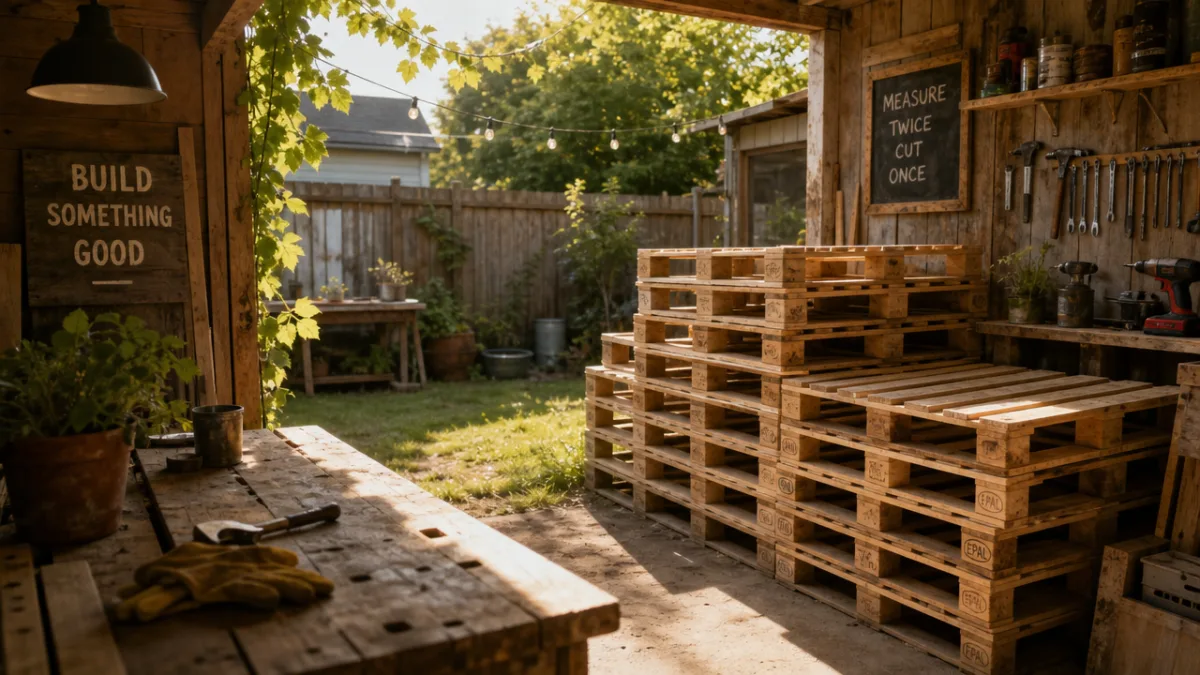
Before you can build anything, you need to find and select the right pallets. Not all pallets are created equal, and using the wrong kind can actually create health and safety concerns in your outdoor space. The most important thing to look for is the IPPC (International Plant Protection Convention) stamp that appears on the side of most wooden pallets. Look for the letters “HT,” which stand for heat-treated — these pallets have been safely processed to eliminate pests and pathogens without using harmful chemicals. Avoid any pallet marked “MB,” which indicates methyl bromide treatment, a chemical you absolutely do not want near your garden or family.
Pallets come in a variety of standard sizes, with the most common being the 48-inch by 40-inch GMA pallet used widely in North American shipping. However, you’ll also encounter Euro pallets at 47 by 31 inches and various custom sizes depending on the industry. For fence building, consistency matters, so try to source as many pallets of the same dimensions as possible. This will make your installation much more straightforward and ensure a more polished finished result. Visit local grocery stores, garden centers, furniture retailers, and construction supply companies — many will happily give away pallets to avoid disposal fees.
Preparation is equally critical. Once you’ve gathered your pallets, inspect each one carefully for loose boards, protruding nails, deep rot, or serious structural damage. Pallets that are compromised shouldn’t be used in load-bearing positions or in high-traffic areas of your fence. For those that pass inspection, use a pry bar or reciprocating saw to remove any broken boards, then hammer down or pull out all protruding nails. Sanding the surface — at least a light pass with 60-grit sandpaper — will remove splinters and open the wood grain to better accept stain, paint, or sealant. Finally, applying a wood preservative or outdoor sealant before installation will dramatically extend the life of your fence.
Popular Pallet Fence Styles and Design Ideas
One of the most rewarding aspects of building a pallet fence is the sheer variety of styles you can achieve. Standing pallets vertically in a row is the most classic approach, creating a tall, slatted privacy fence with a natural, open feel that still allows for airflow and filtered light. This style works beautifully as a garden border, a patio enclosure, or even a backyard divider between neighboring properties. You can leave the slats as they are for a more open, airy look, or fill in the gaps with additional boards salvaged from broken pallets for complete privacy.
Horizontal pallet fences offer a more contemporary aesthetic that suits modern farmhouse and Scandinavian-inspired outdoor spaces. In this approach, individual boards are removed from the pallet structure and installed horizontally on a separate post-and-rail framework. The result is a sleek, clean-lined fence that looks far more refined than traditional stacked pallets while still using entirely reclaimed wood. This method requires a bit more carpentry skill, but the design versatility it affords makes the extra effort well worthwhile.
Beyond the basic standing configurations, creative builders have devised dozens of hybrid approaches that elevate the pallet fence from simple boundary marker to genuine landscape feature. Consider some of the most popular design variations currently inspiring outdoor enthusiasts:
- Pallet and post combination: Alternating vertical pallets with decorative posts creates visual rhythm and breaks up long fence runs without sacrificing structure or privacy.
- Painted accent fences: Applying bold colors or subtle stains to pallets transforms them into vivid garden backdrops, with each pallet potentially painted a different shade for an eclectic, cheerful effect.
- Living pallet walls: Filling the built-in pockets of a standing pallet with soil and planting trailing plants, succulents, or herbs creates a living wall that doubles as a fence and a vertical garden simultaneously.
- Pallet picket fences: Cutting pallet boards into pointed picket shapes and spacing them evenly on a horizontal rail delivers the classic cottage picket look at a fraction of the traditional cost.
- Pallet and wire hybrid: Combining the wooden structure of pallets with chicken wire or mesh panels between sections creates a functional enclosure ideal for garden beds or small livestock areas.
Mixed-material designs are also gaining significant traction among creative homeowners. Pairing pallet wood with metal pipe posts, corrugated steel panels, or even woven willow branches produces fences that feel genuinely artistic and unique. The natural warmth of reclaimed wood contrasts beautifully with industrial or natural materials, and the combination of textures gives these fences a depth and sophistication that purely wooden enclosures sometimes lack. Don’t be afraid to experiment — the low cost of pallets makes creative risk-taking entirely reasonable.
Step-by-Step Guide to Building Your First Pallet Fence
Building a pallet fence is well within the capability of most DIY enthusiasts with basic carpentry skills and a weekend to spare. The process begins with careful planning and layout. Measure the perimeter you want to enclose and sketch a simple diagram noting where your corner posts, gate openings, and straight runs will fall. Standard pallets work as your measurement units — a 48-inch pallet plus a few inches of post on either side gives you roughly a 4-foot module to work with. Plan your post spacing around your pallet dimensions rather than trying to cut pallets to fit arbitrary post spacing.
Once your plan is finalized, you can begin setting your posts. For most pallet fences, 4×4 pressure-treated wooden posts sunk at least 24 inches into the ground (deeper in frost-prone regions) provide a solid, lasting foundation. Use a post hole digger or rented auger to excavate your holes, then set each post in a bed of quick-setting concrete for stability. Check each post for plumb with a level before the concrete sets, and brace them temporarily if necessary while they cure. Allow the concrete to cure fully — at least 24 to 48 hours — before hanging any pallets.
With your posts set and cured, attaching the pallets is relatively straightforward. For vertical pallet fences, stand each pallet against the posts and secure them using heavy-duty exterior screws or carriage bolts through the pallet stringers and into the post faces. Pre-drilling your holes will prevent splitting, especially if you’re working with older, drier pallet wood. For a more polished look, you can attach a horizontal top rail of 2×4 lumber across the tops of all the pallets to tie the fence together visually and structurally. Here’s a quick material checklist to keep your project on track:
- Heat-treated wooden pallets (uniform size preferred)
- 4×4 pressure-treated lumber for posts
- Quick-setting concrete mix
- 3-inch exterior wood screws or carriage bolts with nuts and washers
- Post hole digger or power auger
- Level, tape measure, and string line
- Circular saw or reciprocating saw for trimming
- Wood sealant, stain, or exterior paint
- Safety equipment: gloves, goggles, work boots
Finishing is where your fence truly comes to life. Apply your chosen stain, paint, or clear sealant after all the pallets are installed and any final trimming is complete. Work in sections and use a brush or roller for solid colors, or a garden sprayer for stain or sealant to speed up the process. Don’t overlook the post tops — cap them with flat caps or cut them at an angle to shed water, which is the primary enemy of wooden outdoor structures. A well-finished pallet fence, properly sealed and maintained, can last ten or more years with minimal intervention.
Creative Finishing Touches and Decorative Enhancements
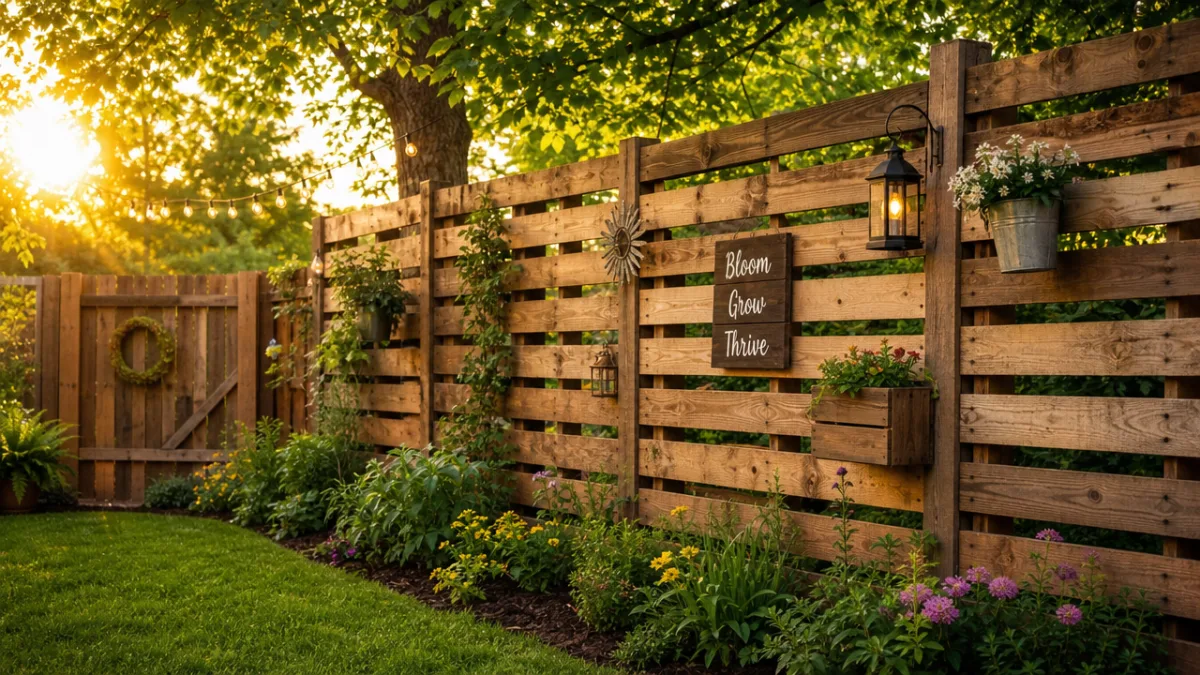
The structural work may be complete, but the most visually exciting phase of any pallet fence project is the finishing and decoration. One of the most popular approaches is to use the fence itself as a vertical canvas for outdoor art. Reclaimed pallet wood takes outdoor paint exceptionally well, and the rough, uneven surface actually enhances the character of hand-painted murals, botanical illustrations, or simple geometric patterns. Whether you commission a local artist or tackle the painting yourself, a decorative element painted directly onto the fence makes an unforgettable focal point in any outdoor space.
Integrating planters directly into the fence design is another strategy that bridges the gap between hardscape and garden. Attaching small wooden boxes or repurposed crates to the fence face and filling them with seasonal flowers, trailing vines, or herbs creates a layered, lush effect that makes the boundary feel like a living part of the garden rather than a mere dividing line. Window boxes mounted at regular intervals along the fence top add a particularly charming cottage-garden feel, especially when overflowing with lavender, petunias, or trailing rosemary.
Lighting transforms a pallet fence from a daytime feature to a nighttime showpiece. Solar-powered string lights woven through the slats of a vertical pallet fence create a warm, romantic ambiance that makes outdoor entertaining genuinely magical. LED strip lights tucked along the top rail cast a diffused glow downward along the fence face, highlighting the wood grain and texture in a dramatically appealing way. Battery-operated or solar lanterns hung at regular intervals add another layer of warmth, and because they require no wiring, they’re entirely accessible to non-electricians.
Sustainability, Maintenance, and Long-Term Care
The sustainability credentials of pallet fences are genuinely compelling, but they’re worth understanding in their full context. Each pallet used in a fence project is one fewer pallet contributing to landfill waste, and the embodied energy in that reclaimed lumber — the trees harvested, the processing, the transportation — is essentially recycled rather than wasted. From a lifecycle assessment perspective, a pallet fence has dramatically lower environmental impact than a new-cut timber fence, a vinyl privacy fence, or a metal security fence. For homeowners committed to reducing their ecological footprint, the choice is remarkably clear.
Ongoing maintenance is the key to making that sustainability story last. Pallet wood, particularly when sourced from older or lower-grade pallets, can be more susceptible to weathering than kiln-dried dimensional lumber. Annual inspection is a non-negotiable habit for any pallet fence owner. Walk the entire fence line each spring and look for boards that have cupped, cracked, or begun to show significant rot. Replacing individual boards is far easier and cheaper than rebuilding an entire section, so catching problems early pays significant dividends. Reapplying a quality exterior sealant or wood stain every two to three years will dramatically slow weathering and help the fence maintain both its beauty and its structural integrity.
Pest management is another dimension of pallet fence maintenance that deserves attention. Even heat-treated pallets can become attractive habitat for wood-boring insects, termites, or carpenter ants over time, particularly when in direct ground contact or when moisture accumulates in joints and gaps. Wherever possible, leave a small gap between the bottom of the fence and the soil surface to improve airflow and reduce moisture retention. Applying a borate-based wood preservative to the lower sections of your fence during initial construction provides a long-lasting chemical barrier against wood-destroying insects without introducing significant environmental risk. Staying proactive rather than reactive is always the smarter maintenance philosophy.
Beyond physical maintenance, it’s worth thinking about how your pallet fence can evolve over time as your outdoor space and aesthetic preferences change. Because pallets are modular by nature, sections can be removed, replaced, or completely reconfigured without dismantling the entire structure. A fence that started as a plain natural wood enclosure can be repainted in a new color, enhanced with additional planters, or partially replaced with a different material in future years. This adaptability is one of the most underappreciated advantages of pallet-based construction and one more reason why the design community continues to embrace and celebrate it as a genuinely sustainable approach to outdoor living.
Inspiring Real-World Pallet Fence Applications
Seeing how other homeowners and garden designers have successfully deployed pallet fences in real outdoor spaces is one of the best ways to spark ideas for your own project. In urban settings, pallet fences have become a popular solution for rooftop terraces and balcony privacy screens, where traditional fencing installation is often impossible and custom materials are prohibitively expensive. A row of standing pallets secured to a metal railing framework creates instant privacy and visual warmth in spaces that would otherwise feel exposed and industrial, and the lightweight nature of pallet construction keeps structural load well within acceptable limits for most rooftop applications.
Community gardens have enthusiastically embraced pallet fencing as both a practical and philosophical choice. The reclaimed materials align naturally with the ethos of shared growing spaces, and the low cost means that limited garden budgets can be directed toward soil, seeds, and irrigation rather than expensive perimeter fencing. Many community gardens use pallets to create individual plot dividers, tool storage enclosures, and decorative entry features that give the space a sense of identity and welcome. In several urban agriculture projects across North America and Europe, pallet fencing has become an almost iconic visual element of the community garden landscape.
For rural properties and hobby farms, pallet fencing offers a fast, economical way to create paddocks, garden enclosures, and windbreaks. When combined with wire mesh or hardware cloth, pallet fences can keep small animals contained or excluded from specific areas of the property. Chicken runs, goat paddocks, and raised bed gardens are all natural applications, and the rustic aesthetic of weathered pallet wood fits seamlessly into the rural vernacular. Several small-scale farmers have documented building hundreds of linear feet of functional fencing for less than the cost of a single panel of commercial agricultural fencing, making the resource efficiency argument for pallets almost irresistible in that context.
From intimate urban balconies to sprawling rural properties, from minimalist modern designs to lush cottage garden escapes, the pallet fence has proven itself to be one of the most versatile, accessible, and rewarding DIY outdoor projects available to homeowners of any experience level. Whether you’re drawn by the sustainability story, the cost savings, the creative freedom, or simply the undeniable charm of reclaimed wood, building a pallet fence is an investment in your outdoor space that delivers both immediate visual impact and lasting functional value. The only real question is which design you’ll build first.








What do you think?
It is nice to know your opinion. Leave a comment.