










These 11 Fragrant Flowering Vines Will Make Your Garden Smell INCREDIBLE
Why Fragrant Flowering Vines Deserve a Place in Every Garden
There is something almost magical about stepping into a garden where the air itself greets you with a wave of intoxicating perfume. Fragrant flowering vines occupy a special category in the gardening world, offering not only the visual drama of cascading blooms but also a sensory experience that no other plant category can quite replicate. Unlike shrubs or perennial beds that you must lean close to appreciate, a well-placed vine can scent an entire terrace, a garden path, or the air drifting through an open window on a warm summer evening.
Beyond their aromatic qualities, flowering vines are among the most versatile plants a gardener can choose. They climb trellises, drape over pergolas, soften the hard edges of fences and walls, and even work as sprawling ground covers when allowed to ramble freely. This dual function of beauty and utility makes them genuinely indispensable in any thoughtfully designed outdoor space. Whether your garden is a sprawling country estate or a compact urban balcony, there is a fragrant vine suited to your conditions and scale.
The eleven fragrant vines explored in this article span a range of climates, growth habits, and bloom seasons, ensuring that no matter where you garden or what your aesthetic preferences may be, you will find at least a few candidates worth planting. From the legendary sweetness of jasmine to the rich spice of chocolate vine, these plants represent the very best that the climbing plant world has to offer in terms of fragrance. Prepare to rethink how you plan your next garden project entirely.
Classic Choices: Jasmine, Honeysuckle, and Wisteria
When most people think of fragrant vines, jasmine comes immediately to mind, and for excellent reason. Common jasmine (Jasminum officinale) and its cousin star jasmine (Trachelospermum jasminoides) both produce clouds of small white flowers whose scent is so potent it has been used in perfumery for centuries. Star jasmine is particularly beloved for its reliability in warmer climates, its glossy evergreen foliage making it attractive even when it is not in bloom. Plant it near a doorway or beneath a bedroom window to enjoy its evening fragrance drifting indoors on warm nights.
Honeysuckle is perhaps the most nostalgic of all fragrant vines, its sweet tubular flowers evoking memories of childhood summers for gardeners across the temperate world. Japanese honeysuckle (Lonicera japonica) is the most powerfully scented species, though it can become invasive in some regions, so gardeners should check local guidelines before planting. The native woodbine (Lonicera periclymenum) offers a more garden-friendly alternative with equally impressive fragrance and beautiful red and cream bicolored flowers that attract hummingbirds and sphinx moths alike throughout the long summer season.
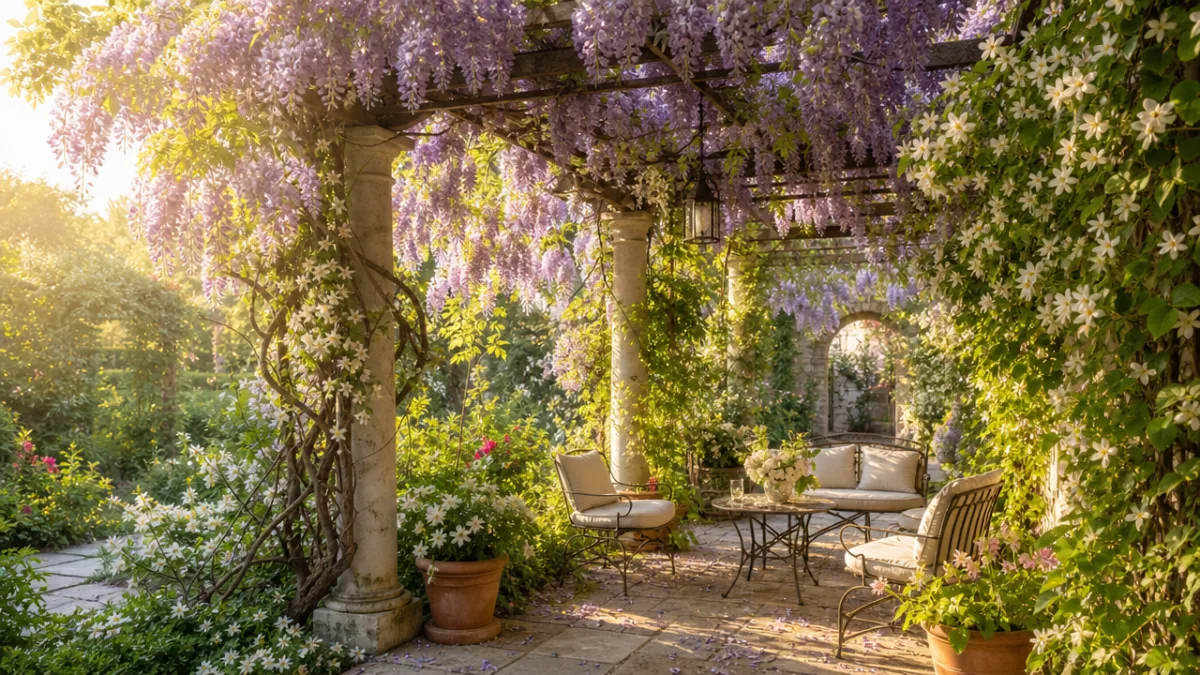
Wisteria is arguably the most dramatic of the classic fragrant vines, capable of covering entire buildings with its enormous drooping clusters of violet, white, or pink flowers. The scent of a wisteria in full bloom is genuinely overwhelming in the most delightful sense, a heady combination of vanilla, grape, and something almost floral and indefinable. Japanese wisteria (Wisteria floribunda) and Chinese wisteria (Wisteria sinensis) are the most commonly grown species, though both require a strong support structure and patient pruning to keep them from dominating everything around them. American wisteria (Wisteria frutescens) is a well-behaved native alternative for North American gardens.
Romantic Climbers: Roses, Sweet Peas, and Chocolate Vine
Climbing roses represent the romantic pinnacle of the fragrant vine world, and the best varieties can perfume an extraordinary amount of garden space with relatively little effort from the gardener. Varieties such as ‘Zéphirine Drouhin,’ ‘New Dawn,’ and ‘Gertrude Jekyll’ are celebrated not only for their abundant blooming but for their complex scents, which blend notes of myrrh, fruit, old rose, and spice in endlessly appealing combinations. Training a climbing rose over a wooden arch or along a picket fence creates an image straight from a cottage garden dream, and the fragrance that envelops you as you pass through is nothing short of extraordinary.
Sweet peas (Lathyrus odoratus) are technically annuals rather than perennial vines, but no list of fragrant climbers would be complete without them. Their slender tendrils reach eagerly for any support, and their ruffled flowers in shades of pink, purple, red, cream, and bicolor are among the most intricately beautiful in the entire plant kingdom. The fragrance of sweet peas is unique and immediately recognizable, an intensely sweet, floral, slightly powdery scent that has made them among the most popular cut flowers for centuries. Sow them early in rich, moisture-retentive soil and they will reward you with months of blooms and perfume.
The chocolate vine (Akebia quinata) deserves far more attention than it typically receives, offering a fascinating combination of unusual beauty and delicate fragrance. Its hanging clusters of deep maroon to chocolate-purple flowers emit a scent genuinely reminiscent of vanilla and dark chocolate, especially noticeable in the warm stillness of a spring afternoon. The vine itself is a vigorous semi-evergreen climber with attractive palmate leaves divided into five leaflets, giving it an almost exotic appearance in the garden. It thrives in both sun and partial shade, making it one of the more adaptable fragrant vines available to temperate gardeners.
Tropical and Exotic Fragrant Vines Worth Growing
Gardeners in warmer climates have access to some of the most intoxicatingly scented vines in the plant world, and even those in cooler regions can grow many of them in containers brought indoors for winter. Confederate jasmine or star jasmine (Trachelospermum jasminoides) thrives in USDA zones 8 and above, producing thousands of pinwheel-shaped white flowers with a fragrance so rich and sweet it can be detected from a considerable distance. In mild coastal climates where it grows unchecked, it commonly blankets garden walls and spills over fences in great fragrant waves throughout spring and early summer.
Mandevilla and its close relative Dipladenia have become increasingly popular in recent years as gardeners discover their impressive climbing habit combined with large trumpet-shaped flowers in shades of pink, red, and white. While not as heavily scented as jasmine or honeysuckle, certain Mandevilla species and hybrids produce a soft, pleasant floral fragrance, particularly in the early morning. They are excellent container plants for northern gardeners who can bring them indoors before frost, and their glossy foliage remains attractive throughout the growing season even when the plant is not in active bloom.
Passionflower vines (Passiflora species) offer a more subtle fragrance than some of their competitors on this list, but their extraordinary alien-looking flowers more than compensate for any aromatic restraint. The intricate blooms, with their radiating filaments and architectural structure, look as though they belong on another planet entirely. Several species including Passiflora incarnata (native to the southeastern United States) and Passiflora caerulea emit a light, sweet fragrance that is most noticeable on warm days. As a bonus, many species produce edible fruits, making them among the most productive as well as beautiful of fragrant vines.
Growing Tips for Maximum Fragrance and Performance
Getting the most fragrance from your vines requires more than simply planting them and hoping for the best. Soil preparation is the essential foundation, and most fragrant vines perform at their aromatic peak when planted in rich, well-draining soil amended with generous quantities of compost or well-rotted manure. Avoid the temptation to simply dig a hole and drop the plant in whatever soil exists, because a vine struggling with poor nutrition or drainage will produce fewer flowers and correspondingly less fragrance than one that has everything it needs from the very beginning of its life in your garden.
Placement is critically important for maximizing your enjoyment of fragrant vines, and it involves thinking strategically about how air moves through your garden space. Sheltered spots such as enclosed courtyards, the lee side of walls, and covered pergolas allow fragrance molecules to accumulate rather than dispersing on the breeze, creating intensely perfumed pockets that make outdoor entertaining genuinely memorable. Consider the following key factors when choosing where to plant:
- Plant vines near seating areas, dining patios, or frequently used doorways for maximum daily enjoyment of their fragrance
- Choose locations sheltered from prevailing winds, which can rapidly disperse scent before it reaches your nose
- South and west-facing walls retain heat that intensifies the release of aromatic compounds from flowers and foliage
- Proximity to windows allows fragrance to drift naturally indoors on warm evenings, scenting interior spaces beautifully
- Elevated plantings on overhead structures allow scent to fall downward into the space below, where people gather
Pruning is another area where many gardeners inadvertently reduce their vines’ fragrant potential by either pruning at the wrong time or pruning too aggressively. Most spring-flowering vines including wisteria, climbing roses, and clematis bloom on wood produced the previous season, meaning that hard pruning in late autumn removes the flowering wood entirely and results in a vine that leafs out vigorously but fails to bloom. Always research the specific pruning requirements of each vine you grow, and when in doubt, the old rule of thumb is to prune immediately after flowering, which gives the plant the entire remainder of the growing season to develop the flower buds that will open the following year.
Designing with Fragrant Vines: Creating a Sensory Garden Experience
The most memorable gardens are those that engage all the senses simultaneously, and fragrant vines are perhaps the single most powerful tool available to gardeners seeking to create this kind of multi-sensory experience. When designing a fragrant garden, think in terms of a sequence of scented moments rather than a single mass planting. By choosing vines that bloom at different times throughout the season, from early spring jasmine through summer roses and honeysuckle to late-season sweet autumn clematis, you can create a garden that offers a continuous and ever-changing olfactory experience from the first warm days of spring through the final mild weeks of autumn.
Layering fragrant vines with other aromatic plants amplifies the overall effect considerably. Consider combining a climbing rose with an underplanting of lavender, catmint, or scented geraniums to create a multi-level fragrance experience at different heights. The vine carries scent upward and outward from overhead structures while the lower plants scent the air at waist and knee height, ensuring that wherever you are in the garden space, some form of fragrance reaches you. This layering approach also extends the visual season, ensuring that something attractive is always visible even when the principal vine is between bloom cycles.
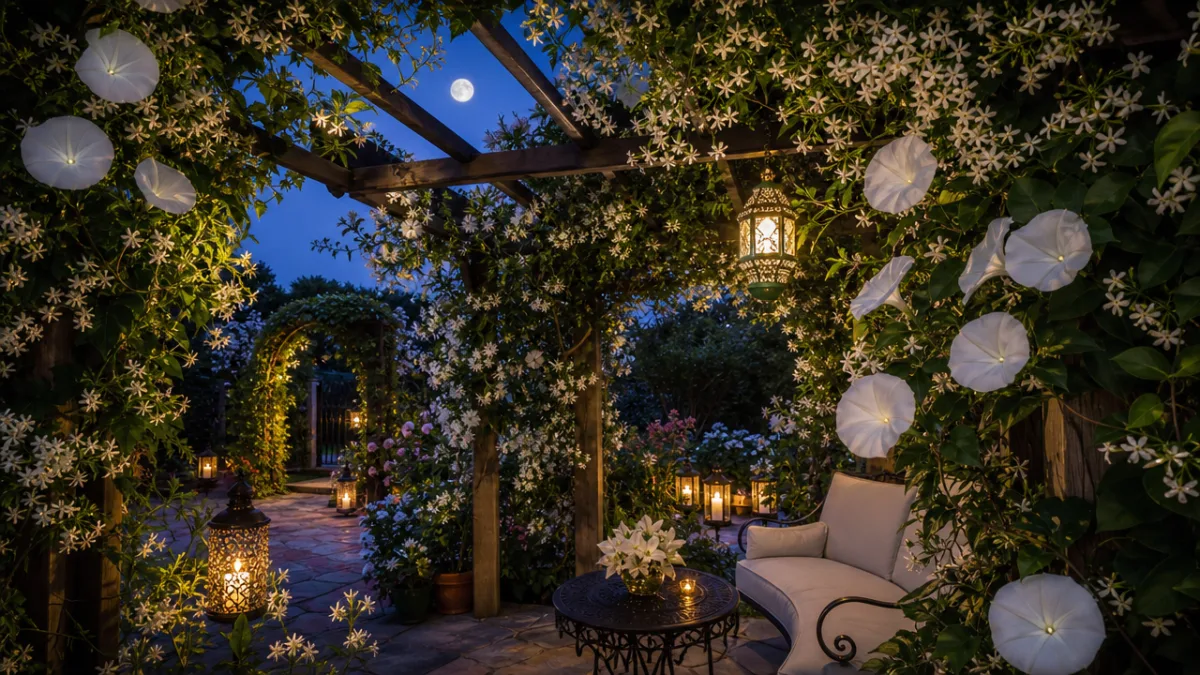
Finally, do not overlook the evening dimension of fragrant vine gardens, because many of the most powerfully scented species release their greatest fragrance after sunset as a strategy for attracting nocturnal pollinators such as moths and bats. Moonflower (Ipomoea alba), a spectacular white-flowered vine that opens its enormous blooms exclusively at dusk, is one of the most romantic plants a gardener can grow and its heady sweet fragrance transforms an evening garden completely. Jasmine, too, intensifies its fragrance after dark, making a jasmine-covered pergola with comfortable seating beneath one of the most sensory-rich places imaginable to spend a warm summer evening under the stars.
The 11 Fragrant Flowering Vines at a Glance
To help you make your selection and plan your planting, here is a practical summary of all eleven fragrant vines discussed throughout this article, organized to help you match each plant to your specific garden conditions. Remember that fragrance intensity can vary between cultivars of the same species, so whenever possible, try to smell a plant in person before purchasing it, either at a well-stocked nursery or at a botanical garden that grows the variety you are considering. The difference between a highly fragrant and a weakly scented cultivar of the same species can be remarkable.
- Common Jasmine (Jasminum officinale) — intensely sweet, classic perfume fragrance; zones 7–10
- Star Jasmine (Trachelospermum jasminoides) — sweet vanilla-jasmine scent; evergreen; zones 8–11
- Japanese Honeysuckle (Lonicera japonica) — powerfully sweet; check for invasiveness in your region
- Woodbine Honeysuckle (Lonicera periclymenum) — sweet and spicy; excellent wildlife value; zones 5–9
- Wisteria (Wisteria spp.) — grape and vanilla; spectacular spring display; zones 5–9
- Climbing Rose (various cultivars) — complex fruity and floral; enormous range of varieties; zones 4–10
- Sweet Pea (Lathyrus odoratus) — intensely sweet and powdery; annual; all zones
- Chocolate Vine (Akebia quinata) — vanilla and chocolate; semi-evergreen; zones 4–9
- Passionflower (Passiflora spp.) — light sweet fragrance; exotic flowers; zones 6–11
- Moonflower (Ipomoea alba) — intensely sweet at night; fast-growing annual; zones 10–12 perennial
- Sweet Autumn Clematis (Clematis terniflora) — vanilla-scented; late season bloomer; zones 4–9
Growing even two or three of these vines thoughtfully placed around your garden will transform the outdoor experience entirely, adding a dimension of pleasure that purely visual plantings simply cannot provide. The investment of time and space required is modest compared to the return in sensory richness and garden atmosphere. A garden that smells as wonderful as it looks is a garden that people never want to leave, and that is perhaps the highest compliment that any outdoor space can receive from those who spend time within it.
Begin with whichever vine suits your climate and available structure most naturally, learn its habits and requirements through a season or two of observation, and then gradually add others as your confidence and garden infrastructure grow. Within a few years, you will have created a living tapestry of fragrance that changes character with every season, every time of day, and every shift in the breeze, making your garden one of the most genuinely pleasurable places in your world.








What do you think?
It is nice to know your opinion. Leave a comment.