










The Formula That Helps Bougainvillea Flowers Bloom Longer and More Durably
Bougainvillea is one of the most spectacular flowering plants in the world, beloved for its vivid cascades of magenta, purple, orange, red, and white bracts that seem to defy the heat and thrive where other plants struggle. Gardeners across tropical and subtropical climates have long been captivated by this vine’s ability to transform a fence, wall, or pergola into a living tapestry of color. Yet as any bougainvillea enthusiast knows, coaxing those brilliant blooms to last longer and return more reliably season after season is both an art and a science.
The challenge with bougainvillea is that the plant is naturally adapted to stress. Its native habitat spans the dry coastal regions of South America, where periods of drought, poor soil, and intense sun are the norm rather than the exception. This means that when gardeners lavish too much care on it — overwatering, over-fertilizing, or fussing too much — the plant often responds by producing lush green foliage at the expense of flowers. Understanding the plant’s biology is the first step toward unlocking blooms that are not only more abundant but far more enduring.
In recent years, home gardeners and horticulturalists alike have developed a practical formula for extending bougainvillea’s blooming period and improving the durability of its bracts. This formula combines strategic watering practices, targeted fertilization with the right nutrient ratios, deliberate pruning schedules, and a few well-timed natural supplements that work with the plant’s own chemistry rather than against it. The result is a plant that rewards your patience with months of breathtaking color instead of weeks.
Understanding Why Bougainvillea Blooms — and Why It Stops
Before you can help bougainvillea bloom longer, you need to understand the mechanism behind flowering in this genus. Bougainvillea is what botanists call a “stress bloomer.” The plant flowers most prolifically when it perceives a degree of environmental hardship — specifically, reduced water availability and nutrient scarcity during certain growth phases. When soil moisture drops and the plant senses mild drought stress, it shifts its energy from vegetative growth to reproductive effort, pushing out the papery, colorful bracts that surround its tiny white true flowers.
The bracts themselves are not petals in the traditional botanical sense. They are modified leaves, and their color comes from pigments called betalains and flavonoids, which are produced in response to light intensity, temperature, and the plant’s overall nutritional status. When the plant is well-nourished with the right nutrients and exposed to high light conditions, these pigments are produced in abundance, resulting in the vivid, long-lasting color that gardeners prize. Conversely, when nitrogen levels are too high, the plant prioritizes chlorophyll production over pigment synthesis, and flowering declines dramatically.
Another critical factor is photoperiodism. Bougainvillea is a short-day plant, meaning it is triggered into flowering when nights become longer relative to days. In tropical regions this shift is subtle, but it is enough to initiate bloom cycles. Understanding this rhythm helps gardeners time their interventions — pruning, fertilizing, and stress-watering — to align with the plant’s natural readiness to flower, amplifying rather than disrupting the process. When you work with these biological cues, the results can be extraordinary.
The Core Fertilization Formula for Extended Blooming
The single most impactful intervention a gardener can make to extend bougainvillea blooming is adopting the correct fertilization formula. The key principle is this: during the blooming phase, bougainvillea needs a fertilizer that is low in nitrogen and high in phosphorus and potassium. A ratio such as 5-50-17 or any high-phosphorus formulation, often sold commercially as bloom booster, sends a clear biochemical signal to the plant that it is time to flower rather than grow. Phosphorus directly stimulates root development and flower initiation, while potassium strengthens cell walls in the bracts, making them more resilient and longer-lasting.
Beyond the commercial fertilizer, many experienced bougainvillea growers swear by a supplemental formula that combines potassium sulfate, superphosphate, and a diluted solution of chelated micronutrients including iron, magnesium, and zinc. Iron is particularly important because it supports enzyme function in pigment synthesis, helping the bracts achieve and maintain that saturated, eye-catching color. Magnesium, the central atom in every chlorophyll molecule, plays a supporting role in overall plant health without triggering the excessive vegetative growth associated with straight nitrogen applications. A monthly drench with this micronutrient blend through the blooming season keeps the plant’s internal chemistry finely tuned.
Timing and frequency of fertilizer application are just as important as the formula itself. During the pre-bloom phase — typically six to eight weeks before you want peak flowering — begin applying a balanced fertilizer with equal NPK numbers to build up the plant’s reserves. Then, as soon as you see the first bract development, switch immediately to your high-phosphorus bloom booster and apply it every two weeks at half the recommended strength rather than full strength monthly. This gentle, consistent feeding approach maintains a steady nutrient supply without creating the nitrogen spike that shuts down flowering.
One natural supplement that has gained considerable attention among bougainvillea growers is banana peel tea. Rich in potassium, calcium, and phosphorus, banana peel tea is made by soaking dried or fresh banana peels in water for 24 to 48 hours and then applying the liquid directly to the root zone. Used once a month as a supplement to the main fertilization program, banana peel tea provides a gentle, bioavailable dose of bloom-supporting nutrients that the plant can absorb gradually. Its benefits are not dramatic overnight, but over a full blooming season the cumulative effect on bract size, color saturation, and longevity is clearly noticeable.
Strategic Watering: The Stress Cycle That Triggers Lasting Blooms
Water management is arguably the most misunderstood aspect of bougainvillea care, and getting it right is absolutely central to the formula for longer, more durable blooming. The approach is counterintuitive for most gardeners who have been taught that consistent, generous watering produces the healthiest plants. With bougainvillea, the opposite is often true during the flowering phase. A deliberate cycle of mild drought stress followed by deep, thorough watering is what keeps the bloom cycle going strong for months rather than weeks.
The practical application of this stress-watering cycle works as follows. Allow the soil to dry out almost completely between watering sessions — to the point where the top two to three inches of soil are dry to the touch and the leaves may show the faintest hint of wilt. At that moment, water deeply and thoroughly, saturating the entire root zone until water drains freely from the bottom of the container or soaks well beyond the drip line in the ground. Then allow the soil to dry out again before repeating. This cycle mimics the natural wet-and-dry seasons of the plant’s native South American habitat and keeps the plant in a state of mild, productive stress that sustains flowering.
The frequency of this cycle will vary depending on your climate, the size of the plant, the type of container, and the time of year. In hot, dry summer conditions, the cycle might repeat every five to seven days. In cooler or more humid weather, it could be as long as ten to fourteen days. The key is observation rather than a fixed schedule. Train yourself to read the plant’s signals — the very early stages of leaf droop, the slightly lighter weight of a container, the cracked surface of the soil — and respond to those cues rather than to the calendar. This responsive approach ensures the plant never swings too far into genuine drought stress, which causes bract drop and dormancy, but stays in that productive middle zone where flowering is sustained.
One important caveat to the stress-watering approach is that newly planted bougainvillea or plants that have been recently transplanted must be treated differently. A plant that has not yet established its root system cannot tolerate deliberate drought stress without risk of serious damage. For the first three to four months after planting or transplanting, water consistently to support root establishment, then gradually introduce the stress cycle as the plant becomes anchored in its location. Patience during this establishment phase pays enormous dividends later, because a well-rooted bougainvillea handles stress cycles far more effectively and responds with proportionally more flowers.
Pruning Techniques That Extend and Multiply Bloom Cycles
Pruning is the third pillar of the formula for extended bougainvillea blooming, and it is one that many gardeners either neglect entirely or carry out incorrectly. Bougainvillea blooms on new growth — specifically, on the tips of young shoots that have matured to a certain woody stage. This means that without regular pruning to stimulate the production of new shoots, the plant eventually runs out of suitable flowering wood and the bloom display dwindles. A well-timed pruning schedule effectively resets the plant’s internal clock and generates waves of new blooming wood, translating into multiple distinct bloom cycles throughout the growing season.
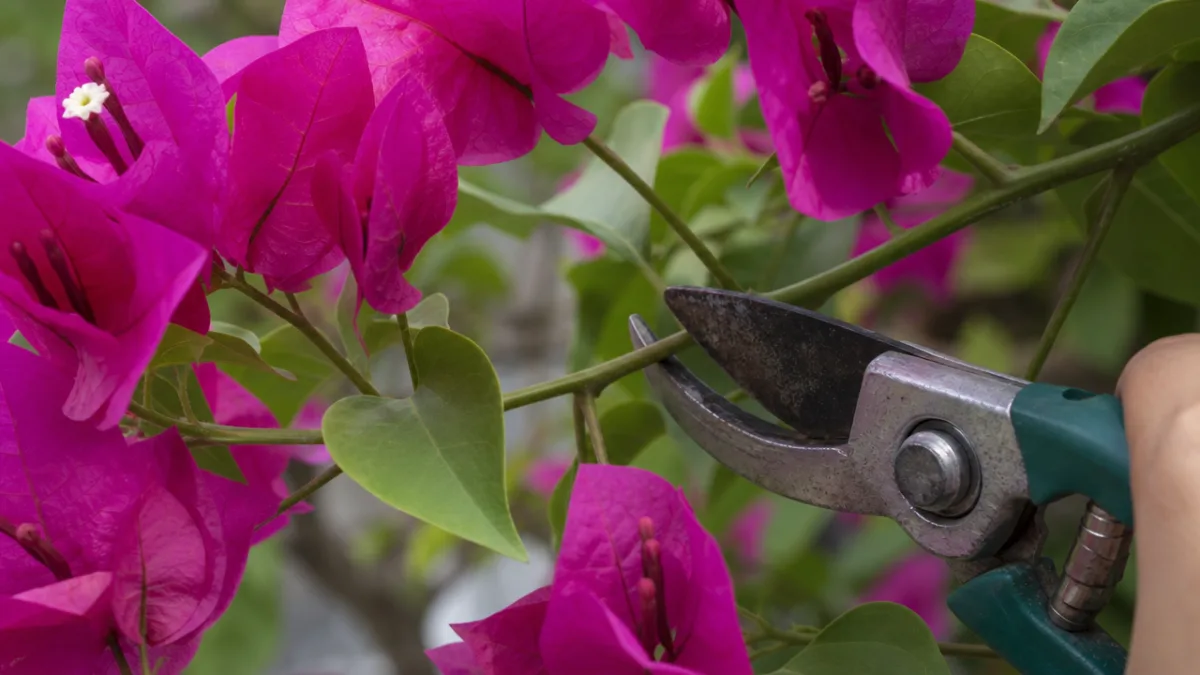
The most important pruning intervention is the post-bloom hard cut. After the plant’s main bloom flush has finished and the bracts begin to fade and drop, cut back the stems that carried the flowers by approximately one-third to one-half their length. Use clean, sharp pruning shears to make cuts just above a node where you can see a dormant bud or a pair of small leaves. This cut triggers the dormant buds below it to break and send out multiple new shoots, each of which will mature into potential flowering wood over the next six to eight weeks. The result is a fuller, more branched plant with significantly more flowering tips than it had before pruning.
Beyond the major post-bloom pruning, light tip-pruning throughout the growing season can be used strategically to stagger the bloom cycles. Rather than pruning all stems at once, divide the plant mentally into thirds and prune each section at two-week intervals. By the time you have pruned the last section, the first section will already be pushing out new growth and approaching readiness to flower again. This rolling pruning approach creates an almost continuous succession of bloom cycles, keeping the plant in near-constant color throughout the warm months rather than producing one spectacular but brief display followed by a long dormant green period.
- Always use sterilized, sharp pruning shears to prevent disease transmission between cuts.
- Remove dead, crossing, or inward-growing branches during each pruning session to improve airflow and light penetration.
- Avoid pruning in the four to six weeks leading up to your region’s coldest period, as new growth stimulated by pruning is particularly vulnerable to cold damage.
- After a hard prune, apply a light top-dressing of compost to the root zone to support the flush of new growth that follows.
- Wear thick gloves when pruning, as bougainvillea stems carry sharp thorns that can cause painful puncture wounds.
Natural Supplements and Soil Amendments That Build Resilience
Beyond the core fertilization formula, a range of natural supplements and soil amendments can dramatically improve both the duration of the bloom period and the structural integrity of the bracts themselves. These supplements work by improving the underlying health of the plant’s root system, enhancing its ability to absorb nutrients, and building the cellular strength that makes bracts resistant to wind, rain, and temperature fluctuations. Think of them as the foundation beneath the formula — not replacements for proper fertilization and watering, but powerful amplifiers of those core practices.
Mycorrhizal fungi inoculants are among the most effective and increasingly accessible supplements available to home gardeners. These beneficial fungi form symbiotic relationships with plant roots, effectively extending the root system’s reach by orders of magnitude and dramatically improving the plant’s ability to access water and nutrients from the surrounding soil. When applied at planting time or introduced as a soil drench for established plants, mycorrhizal inoculants have been shown to increase flowering duration and bract color intensity in bougainvillea, likely because the plant’s improved nutrient uptake efficiency allows it to sustain the metabolic demands of flowering for longer periods without exhausting its reserves.
Wood ash, applied sparingly as a soil amendment, is another time-tested supplement for bloom-promoting potassium and calcium. A light sprinkling of wood ash around the drip line of the plant, worked gently into the top inch of soil, raises soil pH slightly — an additional benefit for bougainvillea, which prefers a slightly acidic to neutral pH in the range of 5.5 to 6.5. Be cautious with quantities, however, as excessive wood ash can raise pH too high and begin to lock out the iron and other micronutrients that bougainvillea depends on for healthy pigment production. A quarter cup per square foot of root zone area, applied no more than twice per growing season, is a safe and effective rate.
Seaweed extract deserves special mention as a supplement that addresses bract durability specifically. Rich in natural plant hormones including cytokinins and auxins, seaweed extract applied as a foliar spray or soil drench has been documented to strengthen cell walls, improve stress tolerance, and extend the functional life of flowers and modified leaves like bougainvillea bracts. Many growers report that plants treated regularly with diluted seaweed extract produce bracts that hold their color and remain attached to the plant for significantly longer — sometimes an extra two to three weeks beyond untreated plants — before fading and dropping. Applied once every three weeks throughout the blooming season, seaweed extract is one of the simplest and most cost-effective upgrades to the standard bloom formula.
Environmental Conditions and Long-Term Care for Sustained Color
Even the most carefully calibrated fertilization formula will underperform if the plant’s fundamental environmental conditions are not met. Bougainvillea is an obligate sun plant — it requires a minimum of six hours of direct sunlight daily, and performs best with eight or more hours. In locations where sunlight is insufficient, the plant diverts energy to stretching toward the light source rather than flowering, and the bracts that do develop tend to be pale, thin, and short-lived. If your bougainvillea is in a container, one of the most powerful interventions available to you is simply to move it to a sunnier location, a change that can transform a reluctant bloomer into an abundant one within a single growing season.
Temperature also plays a defining role in bloom duration and quality. Bougainvillea bracts achieve their richest color and greatest structural integrity when daytime temperatures are in the range of 70 to 95 degrees Fahrenheit and nighttime temperatures drop by at least ten to fifteen degrees. The cooler nights trigger pigment synthesis and slow cellular respiration in the bracts, helping them maintain their color and structural integrity longer than they would under uniformly warm day-and-night conditions. In climates where nighttime cooling is minimal during the summer, planting in a location that benefits from slight shade in the late afternoon — reducing heat accumulation — can partially compensate and extend bract life noticeably.
Container-grown bougainvillea requires some additional considerations for long-term sustained blooming. Containers restrict root growth, which actually works in the plant’s favor in terms of stress-triggered flowering — a slightly root-bound bougainvillea typically blooms more freely than one with unlimited root run. However, this benefit comes with a cost: nutrients are depleted rapidly from a limited volume of soil, and drainage becomes critical because root health deteriorates quickly when roots sit in waterlogged growing medium. Use a well-draining potting mix that includes perlite or coarse grit, ensure that drainage holes are open and unobstructed, and refresh the top two inches of potting mix annually to replenish depleted organic matter without disturbing the established root system.
- Place containers on feet or risers to ensure unobstructed drainage and prevent root rot from standing water.
- During peak summer heat, a light mulch of pine bark or gravel over the container soil surface helps reduce moisture evaporation and keeps roots cooler.
- If temperatures drop below 40 degrees Fahrenheit, move container plants to a sheltered location, as bougainvillea can be damaged or killed by frost.
- Inspect the plant regularly for common pests including aphids, spider mites, and bougainvillea looper caterpillars, which can weaken the plant and shorten bloom duration if left untreated.
- Every three to four years, repot container bougainvillea into a container only slightly larger than the current one to maintain the beneficial mild root restriction that promotes flowering.
The formula for longer, more durable bougainvillea blooms is not a single trick or a secret ingredient — it is a system of interconnected practices that work together to align the plant’s care with its deep biological programming. By understanding why bougainvillea flowers, respecting its need for stress, feeding it what it actually needs rather than what seems generous, pruning it thoughtfully to multiply its flowering capacity, and supplementing with nature-derived boosters that strengthen its cellular architecture, any gardener can transform a sporadically flowering shrub into a near-perpetual cascade of brilliant color. The rewards are well worth the learning curve, and once the system clicks into place, maintaining it becomes second nature — as effortless and joyful as the blooms themselves.








What do you think?
It is nice to know your opinion. Leave a comment.