










Walking Through Paradise: Umberto Pasti’s Moroccan Hillside Garden
A Writer’s Dream Rooted in Moroccan Soil
Umberto Pasti wears a lot of hats — celebrated Italian novelist, essayist, literary provocateur — but honestly, his most quietly radical move has been building a garden on a sun-soaked hillside in Rohuna, a coastal stretch of northern Morocco near Tangier. What started as a personal obsession has grown into something much bigger: a living archive of endangered plants, a refuge for wild things, and a deeply personal expression of one man’s love affair with a landscape the modern world seems intent on forgetting. Pasti first came to Morocco decades ago, pulled in by the light, the silence, and something harder to put into words — a feeling that the earth there still had secrets worth knowing.
The garden itself sits among rolling hills that spill down toward the Atlantic, and it’s not the kind of place you stumble across by accident. Getting there takes real intention — and that intention pays off in an experience that feels completely outside of time. Pasti has talked often about how the Moroccan landscape spoke to him in a language he didn’t know he understood until that first visit. His literary instincts — honed over years of writing fiction that digs beneath the surface of everyday life — found in this hillside the perfect physical counterpart. The land became a manuscript he’s been revising and rereading ever since.
Unlike the clipped, formal gardens of European tradition, what Pasti has created in Rohuna pushes back against the urge to control everything. It’s sprawling, layered, and gloriously untamed-looking, even though it’s actually the result of decades of careful, passionate curation. He’s gathered thousands of plant species from across Morocco and the wider Mediterranean world, many of them threatened by agricultural expansion, climate change, and the relentless homogenization of the global landscape. The garden manages to be both genuinely beautiful and a quiet act of conservation — which is probably why it’s earned him recognition in both horticultural and literary circles.
The Philosophy of Wildness and Cultivation
To really get what Pasti is doing here, you first have to understand his philosophy, which lands somewhere between wildness and deep human engagement with the natural world. He’s fundamentally opposed to the kind of gardening that tries to impose rigid order on the land — the symmetrical hedgerows, the color-matched flowerbeds, the almost anxious neatness that runs through so much of Western horticultural tradition. What he champions instead is a vision where the gardener becomes a collaborator with nature rather than its boss, coaxing and suggesting rather than dictating. And that stance, however easygoing it sounds, actually demands enormous knowledge, patience, and a willingness to release your grip on outcomes.
Pasti draws heavily on the traditional agricultural wisdom of Moroccan farmers and rural communities — people who have worked this land for generations and built up an intimate feel for its rhythms and demands. He’s talked at length about learning from local knowledge: which plants do well on north-facing slopes, how rainfall shifts across different microclimates, the ancient relationships between specific insects and flowers that have been evolving together for millennia. Weaving that traditional ecological knowledge together with his own literary and aesthetic sensibilities gives the garden a texture that neither a purely academic nor a purely intuitive approach could produce on its own.
The result is a garden that feels discovered rather than designed. The paths wind and double back on themselves, throwing up unexpected views and sudden, intimate encounters with individual plants. Visitors often describe a pleasant kind of disorientation — and Pasti has said that’s entirely the point. He wants people to leave their certainties at the gate and move through the space with fresh eyes, the way you move through a great novel: not quite sure what’s coming on the next page, but completely trusting the experience unfolding under your feet.

A Living Archive of Endangered Botanicals
At the core of Pasti’s project is a mission that goes well beyond personal pleasure or aesthetic adventuring. He has dedicated himself to collecting and preserving plant species that are vanishing from the Moroccan landscape at a genuinely alarming pace. Modern agriculture, urbanization, overgrazing, and invasive species have combined to devastate the remarkable botanical diversity that once defined this region. Pasti has described watching entire meadows of rare wildflowers disappear between one season and the next — swallowed by monocultures or concrete — and that grief has driven a collection of remarkable scope and urgency.
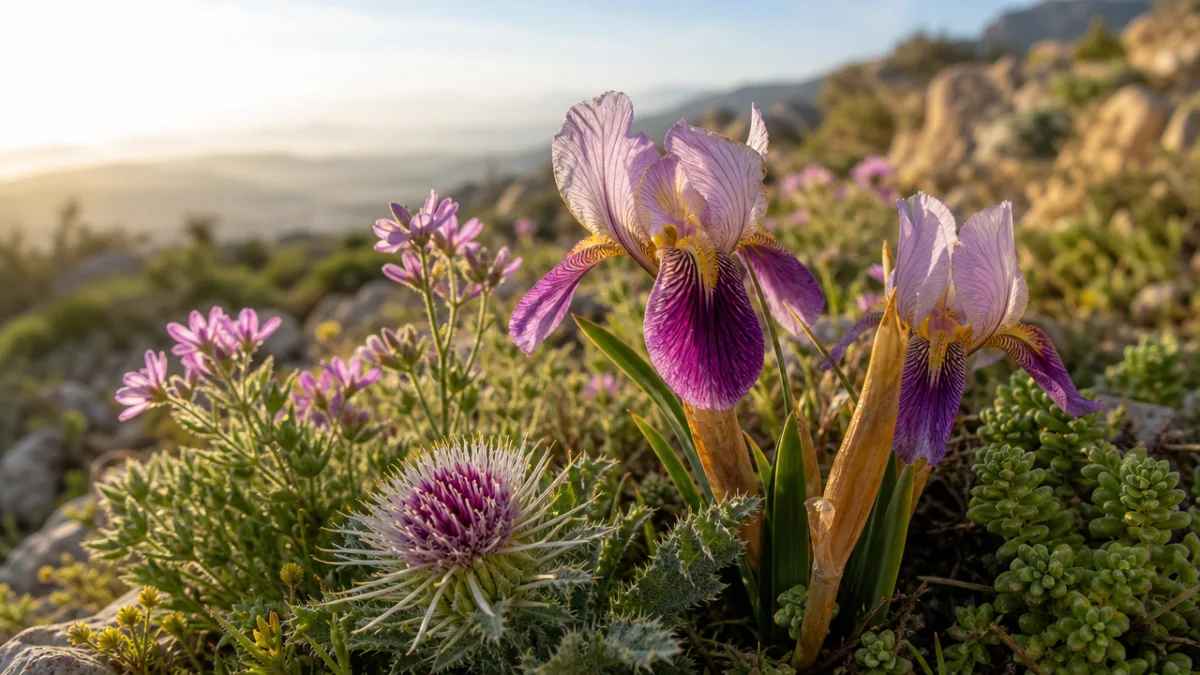
Among the plants he’s gathered are numerous iris, narcissus, and tulip species native to Morocco and the broader Maghreb region, many of which now exist in vanishingly small wild populations. He’s also collected stunning specimens of cistus, lavender, and a staggering range of bulbous plants that bloom in glorious succession through the Moroccan spring. Visitors who really know their botany describe the garden as something close to miraculous — a concentration of botanical heritage that would take weeks of cross-country tramping to encounter in its scattered wild state.
Pasti works alongside botanists and conservationists, and the garden functions informally as a seed bank and propagation center for rare species. Plants are grown on, seeds collected and shared, and the knowledge of how to cultivate these species is preserved and passed along. This unglamorous but essential work happens quietly in the background of the garden’s more visible beauty, giving it a whole second life beyond the visual. It’s a garden with a conscience, in other words — beautiful, yes, but purposeful in ways that reach far beyond anything purely aesthetic.
- Hundreds of rare Moroccan iris species, some found nowhere else in cultivation
- Endangered narcissus varieties native to the Atlas Mountain foothills
- Wild tulip species under pressure from agricultural expansion in the Rif region
- Ancient cistus varieties and aromatic shrubs disappearing from coastal hillsides
- Native bulbous plants whose habitats have been dramatically reduced in recent decades
The Landscape of Rohuna and Its Ancient Character
Rohuna sits along a stretch of coastline and hillside between Tangier and the small town of Asilah on Morocco’s Atlantic edge, and it’s a landscape of rugged, exceptional beauty. It’s been shaped over millennia by wind, water, and the patient work of generations of farmers who carved stone terraces into the hillsides and coaxed harvests from thin but generous soil. The light here is something painters and writers have been chasing for centuries — it shifts through a single day from the cool silver of Atlantic mornings to deep amber in the late afternoon, and then on to the extraordinary rose and violet of a Moroccan dusk.
Pasti has written movingly about this landscape in his nonfiction, describing a countryside that still carries traces of deep time: Phoenician settlements, Roman remains, the layered palimpsest of cultures that have passed through and left their marks without completely erasing what came before. His garden joins that long conversation with the past, incorporating ancient dry-stone walls and working with the hillside’s existing contours rather than flattening or fighting them. In that way it becomes part of the landscape’s history rather than an imposition on it.
The microclimate of this particular hillside plays a huge role in what Pasti can grow and how the garden performs through the seasons. Sheltered from the harshest Atlantic winds by a ridge to the north and west, it enjoys a slightly longer growing season than the surrounding countryside and holds moisture better through the dry summer months. Springs emerge from the hillside in several spots, feeding a network of small channels that Pasti has carefully maintained over the years, letting him sustain plants that would otherwise struggle through the punishing heat of July and August. That intimate knowledge of the land’s hydrology is, in no small part, what makes the whole garden possible.

Literature, Memory, and the Garden as Text
Spend any time in Pasti’s garden and you can’t help noticing how deeply connected his horticultural work is to his life as a writer. As a novelist, he’s drawn to questions of memory, loss, and the stubborn persistence of beauty in the face of erasure — and his garden embodies those themes with uncanny fidelity. The endangered plants he tends are themselves a kind of memory made visible, a refusal to let certain stories disappear. Walking his hillside paths, for those tuned into this dimension, has a distinctly narrative quality: there are beginnings and endings, moments of revelation and quiet reflection, stretches of dense sensory richness followed by sudden openings onto vast views.
Pasti has described the garden in interviews as a kind of autobiography — a record of his preoccupations, his loves, his obsessions, and his evolving sense of beauty across the decades. Certain plants carry associations with specific moments or people; certain corners of the garden hold emotional resonances that only he fully understands. This layering of personal meaning over the botanical gives the space an almost novelistic density, the feeling that what you see on the surface is just the visible portion of something much deeper and more intricate. Literary friends who’ve visited describe the experience of walking with him through the garden as something close to reading a great book aloud with its author.
There’s also, running through everything Pasti does here, a deep meditation on impermanence. Gardens aren’t static objects — they shift with every season, every storm, every passing year — and Pasti embraces that mutability with a writer’s understanding that the best art is always, in some sense, unfinished. He’s watched entire sections of his garden be transformed by drought, by unexpected frosts, by the arrival of a new plant that rearranged its neighbors. Rather than experiencing those changes as failures or losses, he describes them as new sentences being written into an ongoing text — revisions he didn’t plan but that the garden, in its own wisdom, knew were necessary.
Visitors, Influence, and a Broader Conservation Vision
Word of Pasti’s extraordinary garden has traveled steadily through the overlapping worlds of horticulture, conservation, and literature, drawing visitors from across Europe and beyond who make the journey to Rohuna with something that can only be described as pilgrimage energy. Garden designers, botanists, writers, and passionate plant lovers of every stripe have all found their way to this hillside and gone home changed — not just by what they’ve seen, but by the conversations they’ve had with Pasti himself, who is by every account as singular and compelling as the garden he’s created. His generosity with knowledge, seeds, and time has seeded other projects across the Mediterranean world.
His influence extends well beyond the garden’s physical edges. Through his writing — including his celebrated book on the Moroccan garden, translated into several languages — and through interviews, lectures, and collaborations with conservation organizations, Pasti has helped shift the conversation about what a garden is actually for and what it can mean. He’s been particularly effective at articulating the political and ethical dimensions of botanical conservation: that allowing plant species to disappear means losing not just biodiversity, but cultural memory, traditional knowledge, and an irreplaceable thread of human experience on earth.
The garden also serves as a model for a kind of engagement with the non-Western natural world that goes beyond tourism or extraction. Pasti’s decades of deep immersion in Moroccan culture and landscape, his relationships with local communities, and his weaving of traditional knowledge into his practice represent a genuine alternative to the extractive model that has too often defined European engagement with North African natural heritage. He’s careful to frame his work as collaborative, and his role as that of a custodian rather than an owner — a distinction that carries real moral and practical weight in a postcolonial context.
- Seed sharing networks connecting Pasti’s garden with botanical institutions across Europe and North Africa
- Informal apprenticeships for Moroccan gardeners and plant enthusiasts interested in conservation horticulture
- Collaboration with international organizations working on Mediterranean flora preservation
- A body of written work that has raised public awareness of Moroccan botanical heritage
- Inspiration for a new generation of conservation gardeners working in marginal and threatened landscapes
What ultimately sets Umberto Pasti’s hillside garden in Rohuna apart is the completeness of its vision. It’s at once a place of extraordinary beauty, a serious conservation project, a literary artifact, and a testament to what a sustained and passionate engagement with a particular piece of earth can become over the course of a lifetime. To walk its paths is to encounter something genuinely rare in the contemporary world: a place shaped entirely by love — love of plants, love of landscape, love of a culture not his own that he has adopted wholeheartedly — and that love radiates from every terrace, every improbable bloom, every sudden view of the Atlantic horizon that appears at a bend in the path. By any measure, it’s one of the great gardens of our time.








What do you think?
It is nice to know your opinion. Leave a comment.