










Prairie Rose Flowering Crab (Malus ‘Prairie Rose’): A Complete Guide to One of the Midwest’s Most Beautiful Ornamental Trees
Introduction to Prairie Rose Flowering Crabapple
The Prairie Rose Flowering Crab, known botanically as Malus ‘Prairie Rose’, is one of the most striking ornamental trees available to Midwest gardeners and landscapers. Developed with the challenging conditions of the northern plains in mind, this cultivar combines breathtaking floral beauty with the kind of cold-hardiness and disease resistance that makes it a practical long-term investment for any landscape. Whether you’re a homeowner looking to add seasonal drama to your yard or a professional landscaper seeking reliable specimen trees, Prairie Rose deserves serious consideration.
Bachman’s Landscaping, a trusted name in Minnesota horticulture for well over a century, has long championed the Prairie Rose crabapple as a standout performer in their plant inventory. Their expertise in selecting trees adapted to the upper Midwest climate lends significant credibility to this variety’s reputation. When a nursery with Bachman’s track record consistently stocks and recommends a particular cultivar, it’s a strong signal that the tree delivers on its promises year after year across a wide range of residential and commercial landscape settings.
What truly sets Prairie Rose apart from the crowded field of ornamental crabapples is its combination of aesthetic appeal across multiple seasons and its impressive resistance to the diseases that plague so many other crabapple varieties. From its stunning spring bloom to its persistent colorful fruit and attractive branching structure in winter, this tree earns its place in the landscape every single month of the year. Understanding what makes it special starts with a close look at its origins and botanical characteristics.
Origins, Botanical Profile, and Key Characteristics
Malus ‘Prairie Rose’ belongs to the Rosaceae family, the same large botanical family that includes apples, pears, cherries, and roses. Like many successful ornamental crabapple cultivars, Prairie Rose is the result of careful breeding work aimed at producing a tree that excels in ornamental value while shedding some of the disease susceptibility that makes older crabapple varieties frustrating to maintain. The ‘Prairie Rose’ name is both descriptive and evocative, nodding to the native landscapes of the Great Plains where this tree is designed to thrive.
In terms of size and form, Prairie Rose is considered a medium-sized ornamental crabapple, typically reaching 15 to 20 feet in height with a spread of roughly 15 to 20 feet as well, giving it a pleasingly rounded to slightly vase-shaped crown at maturity. This size makes it extremely versatile in the landscape — large enough to serve as a true focal point or shade provider, yet compact enough to fit comfortably in residential yards, urban streetscapes, and smaller commercial properties. The branching habit is graceful and well-structured, contributing to winter interest even when the tree is leafless.
The foliage of Prairie Rose is another point of distinction. Emerging with a reddish-bronze tinge in early spring before settling into a rich, dark green through summer, the leaves provide a handsome backdrop to the flowers and later to the small persistent fruit. The leaf shape is typical of the Malus genus — ovate with serrated margins — but the coloration and texture give Prairie Rose a slightly more refined appearance than many common crabapples. Fall color can range from orange to purplish-red depending on the season’s conditions, adding yet another layer of seasonal interest.

Flowering and Ornamental Beauty Through the Seasons
The most celebrated feature of Prairie Rose is undoubtedly its flowers. In mid-spring, typically in May across much of the Midwest, this tree erupts in a magnificent display of rose-pink to deep pink blossoms that completely cover the branches before the leaves have fully expanded. The flowers are semi-double to double in form, giving them a fuller, more lush appearance than single-flowered crabapple varieties, and their rich color holds well even as temperatures fluctuate during the often unpredictable Midwest spring. Standing beneath a Prairie Rose in full bloom is genuinely one of the great simple pleasures of the gardening year.
The fragrance of Prairie Rose flowers is another often-underappreciated attribute. While not all crabapple cultivars are notably fragrant, Prairie Rose produces blossoms with a pleasant, sweet scent that carries on warm spring breezes, making it an especially rewarding choice near patios, walkways, or windows where the fragrance can be enjoyed without having to seek it out deliberately. Pairing this tree with early spring bulbs like tulips and daffodils beneath its canopy creates a multi-layered spring spectacle that few other single plantings can rival in terms of visual and sensory impact.
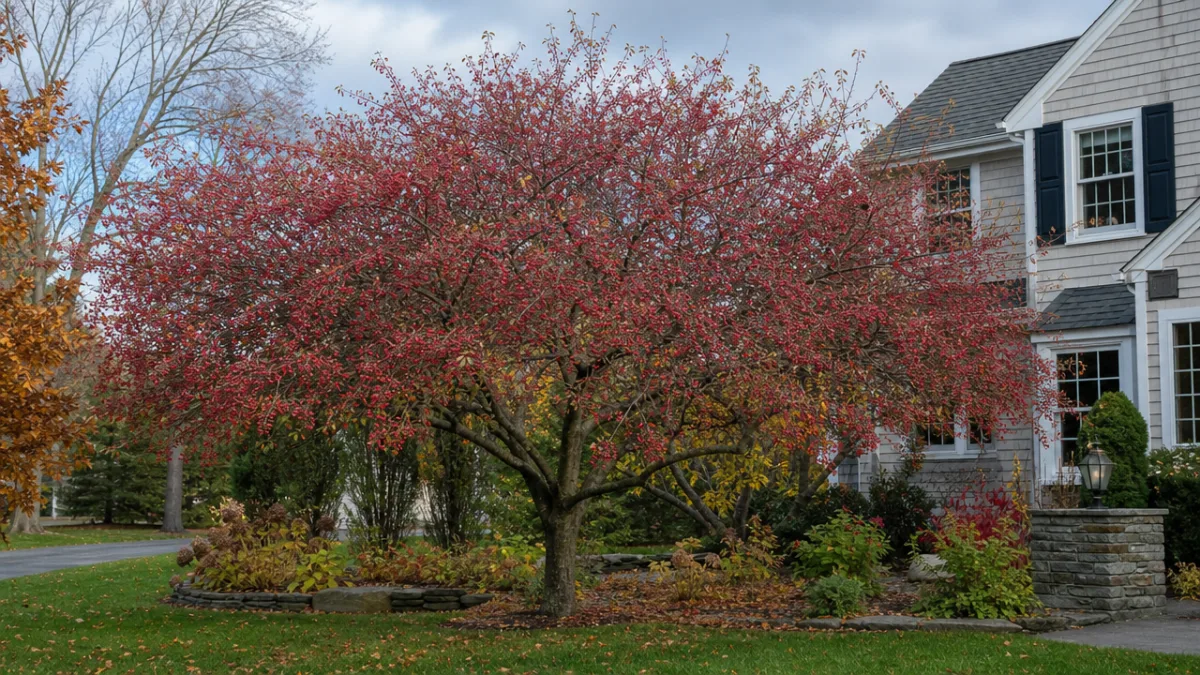
As summer progresses and the flowers give way to fruit, Prairie Rose continues to contribute to the landscape. The small crabapples that develop are typically red to maroon in color and persist on the branches well into fall and even winter, providing an important food source for birds including cedar waxwings, robins, and various native species. This persistence of fruit is a key landscaping asset, as many crabapple varieties drop their fruit messily, creating maintenance headaches. Prairie Rose’s tendency to hold its small, tidy fruit on the branch neatly sidesteps this common complaint and keeps the tree looking attractive across multiple seasons.
Winter brings its own quiet beauty to the Prairie Rose crabapple. The persistent fruit, now often darkened and slightly shriveled but still richly colored, clings decoratively to the bare branches, catching light against snow and attracting wildlife during the coldest months. The tree’s well-structured branching pattern, visible in its entirety once the leaves have fallen, reveals an architectural quality that many gardeners come to appreciate as much as the spring floral display. Thoughtful placement where winter silhouette can be viewed from inside the home makes the most of this four-season value.
Disease Resistance and Why It Matters
For anyone who has grown older crabapple varieties, the topic of disease resistance is not academic — it is intensely practical. The three major diseases that historically plague crabapples are fire blight (caused by the bacterium Erwinia amylovora), apple scab (caused by the fungus Venturia inaequalis), and cedar-apple rust (caused by Gymnosporangium juniperi-virginianae). Any one of these can disfigure or seriously damage susceptible trees, leading to defoliation by midsummer, unsightly lesions on leaves and fruit, and in severe cases, dieback of branches. Managing these diseases in susceptible varieties requires repeated fungicide and bactericide applications throughout the growing season.
Prairie Rose has been selected for strong resistance to all three of these major diseases, which represents a significant practical advantage for both homeowners and professional landscapers. A disease-resistant tree is not only more attractive throughout the growing season — retaining its foliage and looking healthy rather than blighted and ragged by July — but it also dramatically reduces the time, cost, and environmental impact of chemical controls. In an era of increasing awareness about pesticide use and its effects on pollinators and the broader ecosystem, choosing a disease-resistant cultivar like Prairie Rose is both a practical and an environmentally responsible decision.
It’s worth emphasizing that “resistant” does not mean completely immune, and no crabapple cultivar can be guaranteed to remain entirely disease-free under all conditions. However, trees rated as resistant, like Prairie Rose, typically show minimal symptoms even in years when disease pressure is high, and they recover quickly from any minor infection without the kind of catastrophic defoliation that sends gardeners scrambling for the spray equipment. This reliability is a major reason why professional landscapers and nurseries with reputations to uphold, like Bachman’s, consistently recommend disease-resistant cultivars over their more susceptible but sometimes more widely available counterparts.

Planting Requirements and Site Selection
Successfully establishing a Prairie Rose crabapple begins with choosing the right location, and the single most important criterion is sunlight. Like virtually all flowering crabapples, Prairie Rose performs best — and flowers most prolifically — in full sun, defined as a minimum of six hours of direct sunlight per day and ideally eight or more. Trees planted in too much shade will produce fewer flowers, develop weaker, more open branch structure, and may be more susceptible to disease due to reduced air circulation and slower drying of foliage after rain or heavy dew. When in doubt, err on the side of more sun rather than less.
Soil adaptability is one of Prairie Rose’s genuine strengths. While it performs best in moist, well-drained loam with a slightly acidic to neutral pH (roughly 5.5 to 7.0), it tolerates a reasonably wide range of soil types including clay-heavy soils common throughout much of the Midwest, provided drainage is adequate. Planting in consistently waterlogged soil is the one condition most likely to cause serious problems, as crabapples are susceptible to root rot in saturated conditions. Raised beds or berms can be effective solutions in sites with problematic drainage, allowing you to take advantage of a desirable location while protecting the root zone.
When selecting a planting site, consider the tree’s mature size and allow adequate space from structures, utilities, and other trees. Planting too close to buildings or overhead lines creates future maintenance problems and compromises the tree’s natural form. A general rule of thumb is to allow at least half the tree’s expected mature spread as a clearance distance from buildings and property lines. Also consider the view from key vantage points — windows, patios, driveways — so that the tree’s spring bloom and winter silhouette can be fully appreciated from where you spend the most time.
- Sunlight: Full sun, minimum 6 hours daily; 8+ hours ideal for best flowering performance.
- Soil: Moist, well-drained loam preferred; tolerates clay if drainage is adequate; pH 5.5–7.0.
- Spacing: Allow 15–20 feet clearance in all directions to accommodate mature spread.
- Avoid: Low spots, areas with standing water, locations under utility lines or too close to structures.
- Consider: Proximity to patios or windows to enjoy fragrance and seasonal display.
Planting Process, Establishment, and Ongoing Care
The best time to plant Prairie Rose crabapple in the Midwest is either spring, after the ground has thawed and before temperatures become consistently hot, or early fall, giving the tree several weeks of mild weather to begin establishing roots before winter. Container-grown trees from reputable nurseries like Bachman’s can be planted throughout the growing season if supplemental watering is diligently maintained, but spring and fall planting remain the lowest-risk options for most homeowners. Balled-and-burlapped trees should be planted promptly after purchase and handled carefully to avoid disturbing the root ball during installation.
Proper planting technique makes a substantial difference in the tree’s long-term health and stability. Dig a planting hole that is two to three times as wide as the root ball but no deeper — planting too deep is one of the most common and consequential mistakes made with trees of all kinds. The root flare, where the trunk visibly widens at its base as it meets the roots, should sit at or very slightly above finished grade. Backfill with the native soil removed from the hole rather than amended soil, which can create an artificial soil interface that discourages roots from spreading into the surrounding ground.
After planting, apply a 3- to 4-inch layer of organic mulch — wood chips, shredded bark, or similar material — in a ring extending out to the dripline of the canopy, keeping mulch a few inches away from direct contact with the trunk to prevent moisture accumulation and bark decay. This mulch layer moderates soil temperature, conserves moisture, suppresses competing weeds and grass, and gradually improves soil structure as it decomposes. Water thoroughly at planting and maintain consistent moisture throughout the first growing season, as establishment-phase drought stress is the leading cause of transplant failure in newly planted landscape trees.
Pruning, Fertilization, and Long-Term Maintenance
Prairie Rose crabapple is not a high-maintenance tree by any reasonable measure, but some attention to pruning and feeding will keep it looking its best and performing reliably for decades. Pruning is best done in late winter or very early spring, before bud break, when the tree is dormant and the branch structure is clearly visible. The primary goals of routine pruning are to remove any dead, diseased, or damaged wood; to eliminate crossing or rubbing branches that can create wounds and entry points for disease; and to maintain the tree’s natural graceful form without imposing an artificial shape that requires constant correction.
Avoid the common mistake of heavy topping or shearing crabapple trees, which destroys their natural form, stimulates the production of weakly attached water sprouts, and severely reduces flowering. Light, selective pruning that maintains the tree’s inherent structure is far preferable to drastic cutting. If suckers emerge from the base of the tree or from below the graft union — recognizable as vigorous upright shoots often with different leaf character from the named cultivar — remove them promptly at their point of origin to prevent them from diverting energy from the desirable top growth.
Fertilization needs for established Prairie Rose crabapples are generally modest. In most Midwest soils, an annual application of a balanced slow-release fertilizer in early spring, or simply a top-dressing of compost incorporated into the mulch layer, is sufficient to maintain healthy growth and good flowering. Over-fertilization, particularly with high-nitrogen products, can promote excessive leafy growth at the expense of flowers and fruit and may increase susceptibility to fire blight. A soil test every few years provides the most reliable guide to actual nutrient needs and pH, allowing you to fertilize with precision rather than guesswork.
- Prune in late winter or early spring while the tree is dormant and branch structure is visible.
- Remove dead, diseased, damaged, crossing, or rubbing branches as a first priority.
- Eliminate suckers from the base or below the graft union promptly throughout the growing season.
- Avoid heavy topping or shearing; preserve the tree’s natural graceful form at all times.
- Apply balanced slow-release fertilizer or compost top-dressing in early spring as needed.
- Conduct a soil test every 3–5 years to guide fertilization decisions accurately.
Landscape Uses and Design Applications
The versatility of Prairie Rose in the designed landscape is one of its most compelling assets for professional landscapers and home gardeners alike. As a specimen tree planted where it can be appreciated from multiple angles, it delivers year-round interest unmatched by many competing ornamentals. Placed at a corner of the house, at the end of a driveway, or as a centerpiece in a lawn panel, a single mature Prairie Rose becomes a defining feature of the entire property, drawing the eye and anchoring the composition across every season of the year.
Prairie Rose also performs beautifully as a street tree in urban and suburban settings, provided irrigation support is available during establishment and the planting strip is wide enough to accommodate root development. Its relatively compact mature size makes it appropriate for the scale of residential streetscapes, and its tolerance for the somewhat challenging conditions of urban environments — reflected heat, compacted soils, salt spray from winter road maintenance — makes it a practical as well as attractive choice for municipal and commercial plantings. Many neighborhoods gain enormous character from consistent street plantings of ornamental crabapples like Prairie Rose.
In naturalistic or wildlife-focused landscape designs, Prairie Rose earns its place by supporting a surprisingly rich array of wildlife. The flowers provide nectar and pollen for native bees, honeybees, and butterflies during a critical early-season period when other food sources may still be scarce. The persistent fruit feeds dozens of bird species through fall and winter, and the tree’s dense branching provides nesting sites and protective cover. Pairing Prairie Rose with native shrubs and perennials that provide complementary bloom times and habitat values creates a layered, ecologically functional landscape that is also visually stunning throughout the year.
Purchasing Prairie Rose at Bachman’s and Other Reputable Sources
When purchasing a Prairie Rose crabapple, buying from a reputable local nursery is strongly recommended over big-box retail or anonymous online sources. Bachman’s Landscaping in Minnesota has been connecting gardeners with high-quality, regionally appropriate plants since 1885, and their expertise in selecting and growing trees suited to the upper Midwest climate is genuinely difficult to replicate. Staff at established nurseries like Bachman’s can advise on the best size and form for your specific application, answer questions about local soil and climate considerations, and often provide planting guidance that saves considerable time and frustration during establishment.
Look for trees with a straight, well-defined central leader or, in multi-stemmed forms, a balanced branching structure free of visible wounds, cracks, or signs of disease. The root ball should be firm and intact, with no circling or kinked roots visible at the soil surface — a common problem in pot-bound nursery stock that can cause long-term structural instability if not corrected at planting. Larger is not always better when it comes to tree purchases; smaller caliper trees often establish more quickly and can overtake larger specimens planted at the same time within just a few growing seasons.
Investing in a Prairie Rose crabapple from a trusted source like Bachman’s is ultimately an investment in your property’s long-term value and beauty. Mature, well-placed ornamental trees are consistently cited by real estate professionals as significant contributors to curb appeal and property values, and a Prairie Rose that has been properly sited, planted, and maintained for a decade or more becomes an irreplaceable landscape asset. With its extraordinary combination of floral beauty, wildlife value, disease resistance, and four-season interest, Prairie Rose is not just a purchase but a legacy planting — one that will reward every generation of owners who has the pleasure of watching it bloom.








What do you think?
It is nice to know your opinion. Leave a comment.