










Love-in-a-Mist: A Complete Guide to Growing Nigella damascena
Introduction to Love-in-a-Mist
Love-in-a-mist, known botanically as Nigella damascena, is one of the most enchanting and whimsical annual flowers you can grow in a garden. Its common name perfectly captures its ethereal appearance: delicate blooms that seem to float within a fine, feathery mist of thread-like green bracts. Native to southern Europe and North Africa, this cottage garden classic has been captivating gardeners for centuries with its otherworldly beauty and effortless charm.
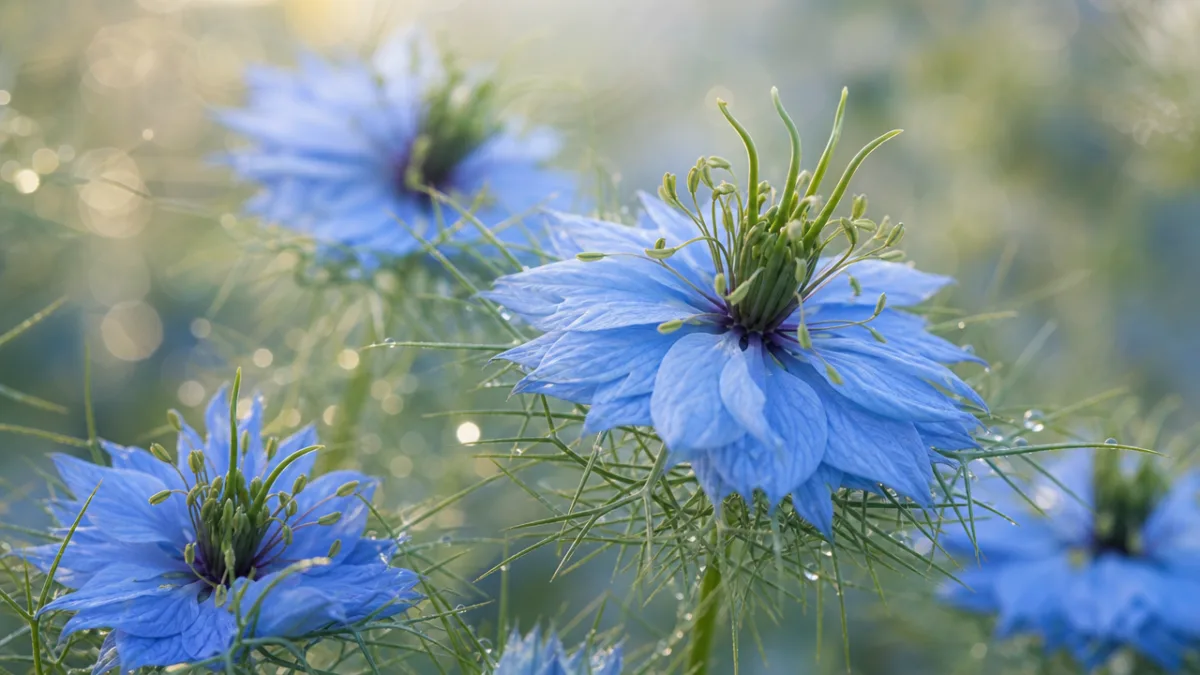
The flowers themselves come in a soft palette of blues, whites, pinks, and purples, with the most iconic variety producing blooms in a cool, sky-blue hue that is almost unmatched in the annual flower world. What makes Love-in-a-mist particularly special is that its appeal does not end when the petals fall. As the season progresses, the spent flowers give way to ornamental seed pods — swollen, striped capsules surrounded by the same feathery foliage — that are just as decorative as the blooms themselves, making this a plant that earns its place in the garden from spring through to autumn.
Beyond its visual qualities, Love-in-a-mist is beloved by gardeners of all skill levels because it is wonderfully easy to grow. It thrives from direct-sown seed, requires minimal fuss, and self-seeds freely once established, meaning that a single planting can supply your garden with colour for many years to come. Whether you are an experienced horticulturalist or planting your very first flower bed, Nigella is a plant that rewards generously with very little effort in return.
History and Cultural Significance
The history of Love-in-a-mist stretches back thousands of years. The genus Nigella, which takes its name from the Latin word niger meaning black — a reference to the plant’s dark seeds — has been cultivated and used medicinally and culinarily across the Mediterranean and Middle East since antiquity. The related species Nigella sativa, commonly known as black seed or kalonji, has been found in archaeological sites including the tomb of Tutankhamun, suggesting its importance to ancient Egyptian culture both as a spice and as a medicinal herb.
In European cottage gardens, Love-in-a-mist became particularly fashionable during the Victorian era, when the fashion for dense, romantic plantings made it a natural companion to roses, larkspur, and foxgloves. The Victorians, who assigned symbolic meaning to nearly every flower, associated Nigella with perplexity and delicacy — sentiments that feel fitting when you consider how the bloom seems to puzzle and enchant in equal measure. It appeared frequently in the tussie-mussies and floral arrangements of the period, prized as much for its texture as for its colour.
Across different cultures, the plant has gathered a rich collection of folk names that speak to its mysterious, romantic quality. In France it is known as cheveux de Vénus — Venus’s hair — while in Germany it goes by Jungfer im Grünen, meaning maiden in the green. In England, other names include devil-in-a-bush and ragged lady. Each of these names reflects a slightly different cultural lens through which people have perceived the plant’s strange, veiled beauty, and together they paint a picture of a flower that has long fired the human imagination.
Varieties and Cultivars
While the classic wild form of Nigella damascena produces single flowers in pale blue, plant breeders have developed a wide and wonderful range of cultivars over the decades. The most popular series for garden use is probably the ‘Persian Jewels’ mix, which offers a cheerful blend of blue, white, pink, and rose blooms on plants that typically reach around 45 centimetres in height. This variety is highly reliable, producing masses of flowers over a long season and generous quantities of the decorative seed pods that follow.
For those who prefer a more refined, single-colour planting, ‘Miss Jekyll’ is considered one of the finest cultivars available. Named in honour of the legendary garden designer Gertrude Jekyll, it produces semi-double flowers in a clear, cornflower blue that is simply stunning when planted en masse or woven through a mixed border. It grows slightly taller than some other varieties, reaching up to 50 or 60 centimetres, and its long stems make it an excellent choice for cutting. The seed pods are equally attractive and dry beautifully for use in winter arrangements.
Beyond the blue, there are several white-flowered cultivars worth exploring. ‘Albion White’ and ‘Albion Black Pod’ are particularly striking, with the latter producing white petals that contrast dramatically with its unusually dark seed pods, creating an almost gothic elegance. For something more unusual still, ‘Delft Blue’ offers larger, double flowers in a softer blue with distinctive white edging, while the ‘Moody Blues’ series provides an extremely dwarf, compact habit suitable for containers and the front of borders. The range of available cultivars means there is truly a Nigella for every garden style and colour scheme.
- Persian Jewels Mix — A classic multi-coloured blend in blue, white, pink, and rose, ideal for wildflower-style plantings and cottage gardens.
- Miss Jekyll — Semi-double cornflower-blue flowers on tall stems, excellent for cutting and named after the celebrated garden designer.
- Albion Black Pod — White flowers with dramatic dark seed pods, offering a striking contrast that extends the season of interest well into autumn.
- Delft Blue — Larger, double flowers in soft blue with white edging, a show-stopping variety for focal plantings.
- Moody Blues — Compact and dwarf-growing, suited to containers, window boxes, and the very front of a flower border.
How to Grow Love-in-a-Mist
One of the great pleasures of growing Love-in-a-mist is its simplicity. Unlike many annuals that require starting under glass weeks in advance, Nigella performs best when direct-sown into the ground where it is to flower. The plant dislikes root disturbance and does not transplant well, so sowing it in situ is not just convenient — it is actually the method most likely to result in strong, healthy plants with the best possible display of blooms. Fortunately, the seed is inexpensive and widely available, and germination rates are typically very good.
For the best results, sow seeds in early spring as soon as the soil can be worked, or alternatively in autumn for earlier flowering the following year. Choose a position in full sun or very light partial shade, in soil that is reasonably well-drained. Love-in-a-mist is not particularly demanding about soil fertility, and growing it in overly rich conditions can actually encourage excessive leafy growth at the expense of flowers. Simply rake the soil to a fine tilth, scatter the seeds thinly, and rake again lightly to cover them. Water gently and keep the area moist until germination occurs, which typically takes between ten and twenty days depending on soil temperature.
Once the seedlings emerge, thin them to around 20 to 23 centimetres apart to give each plant sufficient room to develop its characteristic airy habit. Beyond this, very little ongoing care is required. Deadheading will prolong the flowering season if you wish to extend the blooms, but if you are happy to allow the decorative seed pods to develop — and most gardeners are — simply leave the plants to do their thing. If you want the plant to self-seed and return the following year, allow some pods to ripen and split naturally, scattering their seeds into the surrounding soil.
- Choose a sunny, well-drained spot and prepare the soil to a fine, crumbly texture by raking thoroughly.
- Scatter seed thinly across the surface in early spring or autumn and lightly rake to cover.
- Water gently and maintain moisture until germination, which takes approximately 10 to 20 days.
- Thin seedlings to 20–23 cm apart once they are large enough to handle without risk of damage.
- Allow seed pods to develop at the end of the season for ornamental value and natural self-seeding.
Using Love-in-a-Mist in Garden Design
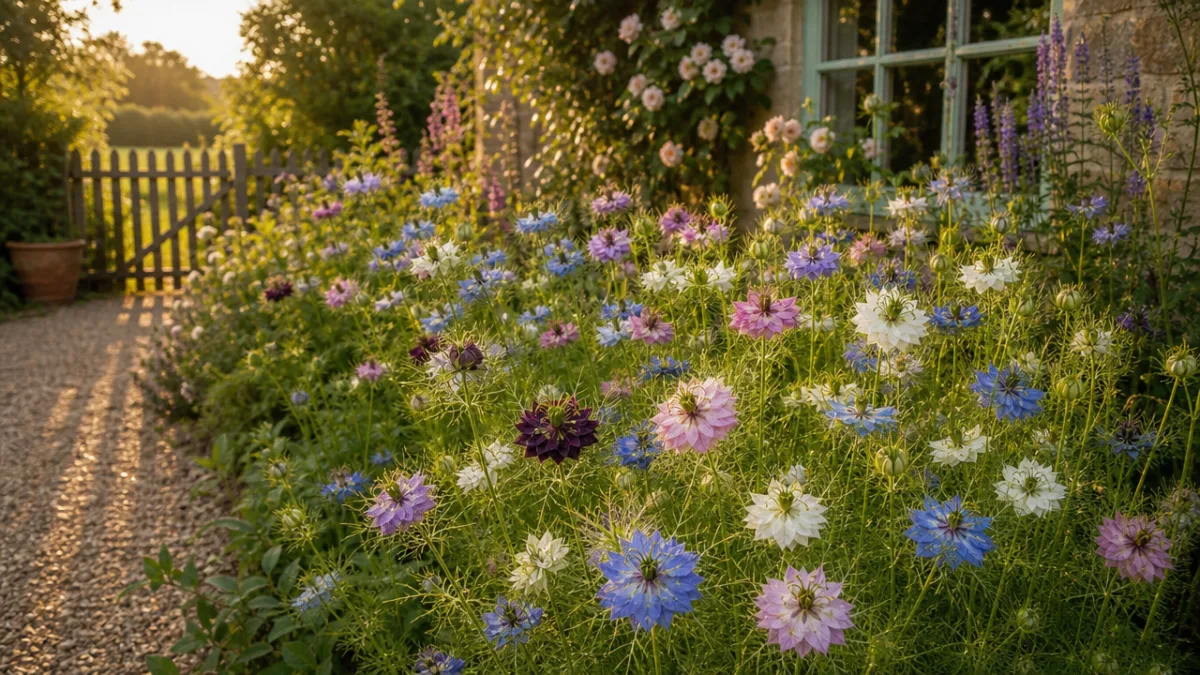
Few flowers integrate as gracefully into a wide variety of garden styles as Love-in-a-mist. In the traditional cottage garden, it is an almost indispensable plant, threading its way between roses, peonies, sweet peas, and lavender with a lightness that helps to unify a border without ever dominating it. Its fine, ferny foliage provides a textural foil for bolder-leafed neighbours, and its cool blue tones work particularly well to balance warmer pinks, reds, and oranges in a mixed planting scheme. Gertrude Jekyll famously used it in great sweeps, allowing it to create a flowing, naturalistic effect that many gardeners still emulate today.
In a more contemporary or minimalist garden, Love-in-a-mist can be used to soften hard lines and introduce a sense of spontaneity and movement. A single large drift of the white cultivar ‘Albion’ planted in a gravel garden or alongside architectural plants such as grasses or alliums creates an effect that feels both modern and romantic. The plant also works beautifully in naturalistic or prairie-style plantings, where its tendency to self-seed and spread means it can be allowed to roam freely through a planting, finding its own level and changing slightly from year to year in a way that feels wonderfully organic and alive.
Love-in-a-mist is also a superb cut flower, and its inclusion in the cutting garden is highly recommended. Both the flowers and the seed pods are valuable for different reasons: the flowers, with their intricate structure and soft colours, add delicacy and complexity to fresh arrangements, while the dried pods bring shape, texture, and a pale, papery beauty to winter posies and wreaths. To dry the pods, cut the stems when the pods are fully formed but before they split open, and hang them upside down in a cool, airy space for several weeks. The result is a wonderfully long-lasting material that will serve you through the darker months.
Companion Planting and Wildlife Benefits
Love-in-a-mist is not only beautiful but also genuinely useful in the garden ecosystem. Its open, accessible flowers are a valuable source of nectar for a wide range of pollinating insects, including bumblebees, honeybees, hoverflies, and various species of solitary bee. Because it flowers in early to midsummer, it bridges the gap between spring bulbs and the main flush of summer perennials, providing a critical food source at a time when other nectar-rich flowers may be scarce. Planting it in generous quantities can make a measurable difference to the diversity and abundance of beneficial insects in your garden.
As a companion plant, Nigella pairs particularly well with roses, and this combination has a long tradition in both decorative and functional gardening. The fine foliage provides ground cover that helps to suppress weeds around the base of rose bushes, while the open flowers attract beneficial insects that feed on aphids and other rose pests. Other excellent companions include Ammi majus, larkspur, sweet peas, scabiosa, and cornflowers — plants that share a similar airy, cottage-garden character and that together create a planting with enormous textural richness and colour variety throughout the summer season.
Once the seeds ripen and the pods begin to split, Love-in-a-mist provides a late-season food source for seed-eating birds, particularly goldfinches and sparrows, who will visit the plants to feed on the small black seeds within the pods. This extends the plant’s ecological contribution well beyond its flowering period, making it an excellent choice for gardens designed with wildlife in mind. Leaving the plants standing rather than cutting them back immediately after flowering therefore serves a dual purpose: it preserves the decorative value of the seed pods while simultaneously providing food and habitat for garden wildlife.

Harvesting Seeds and Saving for Next Year
One of the most satisfying aspects of growing Love-in-a-mist is the ease with which you can save your own seed from year to year, building up a personal stock of plants that are well-adapted to your garden’s conditions. The seed pods are easy to identify when ready for harvest: they will have turned from green to a papery, buff-brown colour, and the capsule will begin to show the characteristic dark tips that indicate the seeds within are fully ripened. At this stage, the pod will feel dry and slightly papery to the touch rather than firm and green.
To harvest the seed, cut the stems just below the pods and place them upside down inside a paper bag, securing the neck of the bag loosely around the stems. As the pods continue to dry, they will split naturally and the seeds will fall into the bottom of the bag, making collection simple and efficient. Once fully dry — which usually takes two to three weeks — shake the bag thoroughly to dislodge any remaining seeds, then tip the contents out and carefully separate the seeds from any pod debris. Store the cleaned seed in a labelled paper envelope in a cool, dry, dark place until you are ready to sow the following season.
Seed saved in this way will typically remain viable for two to three years, though germination rates will be highest if you sow fresh seed each spring. It is worth saving seed from several different plants to maintain genetic diversity within your stock, particularly if you are growing named cultivars that you would like to keep true to type. Bear in mind that if you grow different varieties close together, some cross-pollination may occur, resulting in seedlings with slightly variable flower colours — something that many gardeners find delightful rather than troublesome, as unexpected colours can produce some of the most beautiful plants in the garden.
Troubleshooting Common Problems
Love-in-a-mist is generally a robust, trouble-free plant, but like all garden flowers it can occasionally encounter difficulties. One of the most common issues is poor germination, which is usually caused by sowing into cold, wet soil too early in the season, or by covering the seed too deeply. Nigella seed needs light to germinate and should be pressed into the soil surface and covered with no more than a thin layer of fine compost or soil. If germination is slow, be patient — in cool spring conditions it can take up to three weeks — but if nothing has emerged after a month, the seed may be old or of poor quality, and resowing with fresh stock is advisable.
In humid or wet summers, Love-in-a-mist can be susceptible to powdery mildew, a fungal condition that manifests as a greyish-white powdery coating on the leaves and stems. While rarely fatal to the plant, it can affect its appearance and vigour. The best prevention is good air circulation — avoid sowing too densely, and thin plants to the recommended spacing to allow air to move freely through the foliage. If mildew does appear, remove and dispose of affected foliage, avoid watering from overhead in the evening, and consider treating with a dilute solution of potassium bicarbonate, which is an effective organic control for many powdery mildew species.
Slug and snail damage can be a problem with young seedlings, particularly in wet springs when these pests are most active. The tender emerging foliage is especially vulnerable in the first few weeks after germination. Protective measures such as copper tape, crushed eggshells, or organic iron phosphate pellets placed around emerging seedlings can help to reduce losses significantly. Once the plants are established and growing strongly, they become much more resistant to pest damage, and the majority of plants in an average season will reach flowering with no significant problems whatsoever. With these few precautions in mind, Love-in-a-mist remains one of the most obliging and rewarding flowers a gardener can choose to grow.








What do you think?
It is nice to know your opinion. Leave a comment.