










Oaxacan Clay Candelabra: A Living Tradition of Light and Craft
The Ancient Roots of Oaxacan Pottery
The Oaxacan clay candelabra stands as one of the most visually striking and culturally rich expressions of Mexican folk art. Rooted in pre-Columbian ceramic traditions that stretch back thousands of years, these extraordinary objects are far more than decorative items — they are living vessels of cultural memory, spiritual meaning, and extraordinary human skill. The valley of Oaxaca, nestled in the southern highlands of Mexico, has long been considered one of the great cradles of Mesoamerican civilization, and its ceramic heritage reflects that depth with breathtaking complexity and beauty.
Long before Spanish colonizers arrived in the sixteenth century, the indigenous peoples of the Oaxacan region were already masters of clay. Zapotec and Mixtec artisans shaped funeral urns, ritual vessels, and figurines that archaeologists continue to unearth today at sites like Monte Albán and Mitla. These early objects reveal a sophisticated understanding of form, symbolism, and firing technique that would be refined and transformed over the centuries into the distinctive folk art tradition we recognize today. The candelabra, with its branching arms and elaborate ornamentation, draws directly from this deep well of ancestral knowledge.
The arrival of the Spanish introduced new elements — Catholic iconography, European candle-holding forms, and new color vocabularies — but the indigenous soul of Oaxacan pottery was never extinguished. Instead, artisans absorbed and reinterpreted these influences through their own cultural lens, creating hybrid objects that belong entirely to neither tradition but transcend both. The Oaxacan candelabra is perhaps the most dramatic example of this creative synthesis, blending the spiritual urgency of pre-Columbian ritual art with the formal requirements of colonial religious ceremony into something wholly original and deeply moving.
The Villages That Keep the Tradition Alive
The production of Oaxacan clay candelabras is concentrated in a handful of villages within the Central Valleys region, each with its own distinct style, clay source, and artistic lineage. The most celebrated of these is San Bartolo Coyotepec, world-famous for its barro negro — the lustrous black clay that has become synonymous with Oaxacan craft. In this village, families have passed down ceramic knowledge across generations, with grandmothers teaching granddaughters the same hand-building techniques their own ancestors used, creating an unbroken chain of transmitted skill that spans centuries.
Atzompa, another key village in the ceramic tradition, is known for its green-glazed pottery and particularly elaborate candelabra forms adorned with human faces, flowers, birds, and fantastical animals. The artisans of Atzompa have a remarkable gift for the theatrical — their candelabras frequently tower to heights of two feet or more, covered in dozens of individually sculpted clay elements that seem to cascade from the central stem like an explosion of life. Visiting the village market on any given day, one encounters these magnificent objects arranged in rows, each one slightly different, each bearing the unmistakable imprint of the individual hand that made it.
Other villages including San Marcos Tlapazola and Cuilapam de Guerrero contribute their own variations to the broader tradition. What unites all of these communities is a shared reverence for the material itself — the clay that comes from the earth of Oaxaca is considered almost sacred by the artisans who work it, a gift from the land that must be handled with respect and intention. Many potters speak of their relationship to clay in terms that are spiritual rather than merely practical, describing the moment when a form begins to emerge under their hands as something closer to discovery than invention.
Materials, Methods, and the Making of a Candelabra
The creation of an Oaxacan clay candelabra begins long before any shaping takes place, with the careful preparation of the clay itself. Local clay is typically harvested from specific deposits that artisans have used for generations, then cleaned of stones and organic matter, dried, and ground before being mixed with water and worked by hand or foot until it reaches the ideal consistency. This preparatory process can take days, and experienced potters emphasize that no amount of skill in shaping can compensate for clay that has not been properly prepared. The material must be smooth, plastic, and responsive — almost alive — before work can begin.
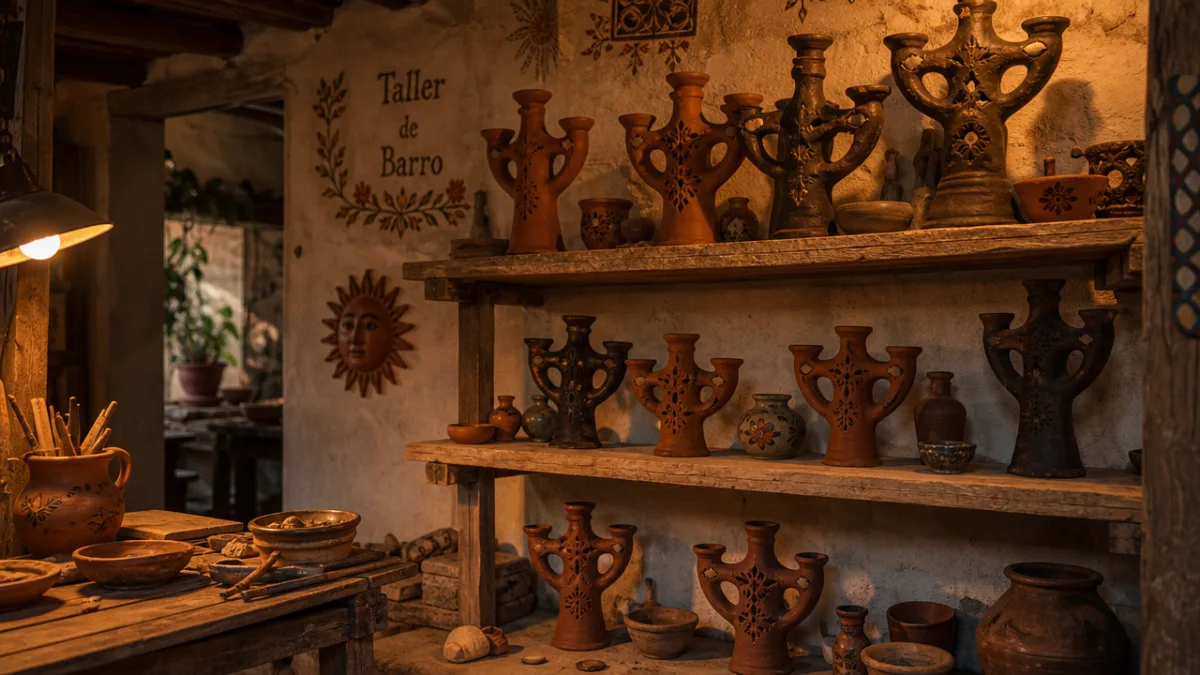
Most Oaxacan candelabras are built using a combination of coil-building, pinching, and hand-modeling techniques, without the use of a potter’s wheel. The central column is typically constructed first, built up from coils of clay smoothed together into a solid form. From this central stem, arms branch outward to hold candles, and it is in the decoration of these arms and the spaces between them that the artisan’s creativity finds its fullest expression. Individual flowers, leaves, fruits, birds, angels, skeletons, and human figures are sculpted separately and attached to the main form while the clay is still leather-hard, creating the dense, layered compositions that make these pieces so visually overwhelming.
The firing process used in many traditional Oaxacan communities differs significantly from industrial ceramics. Many pieces are fired in simple wood-burning kilns or even in open pit fires, achieving temperatures that are lower than those used in commercial production but that are perfectly suited to the local clay. The famous black color of barro negro is not achieved through glazing but through a burnishing process — the leather-hard clay is polished with a quartz stone until it develops a sheen, and the reduction atmosphere of the fire turns it a deep, even black. Other villages use lead-free glazes in brilliant greens, blues, and yellows to finish their work.
Symbolism and Spiritual Significance
An Oaxacan candelabra is never merely a candle holder. Every element of its decoration carries meaning — meaning that is sometimes Catholic, sometimes pre-Columbian, and often both simultaneously in ways that cannot be easily separated. The tree of life motif, one of the most common compositional frameworks for these objects, draws on both the Christian concept of the Tree of Knowledge and much older indigenous cosmological ideas about a sacred axis that connects the underworld, the earth, and the heavens. On these candelabras, that tree is populated with figures and creatures that represent the full spectrum of existence.
The Día de los Muertos, or Day of the Dead, represents one of the most important contexts in which Oaxacan candelabras are made and used. During this celebration, which takes place on November 1st and 2nd, families construct elaborate home altars called ofrendas to welcome the spirits of deceased relatives back to the world of the living. Candelabras are central to these altars, their candles lit to guide the souls home through the darkness. Artisans in the weeks leading up to Día de los Muertos produce candelabras specifically designed for this purpose, often incorporating skeleton figures, marigold flowers, and portraits of the deceased into their designs.
The imagery found on Oaxacan candelabras forms a rich visual lexicon that repays careful attention. Among the most commonly encountered symbols and figures are the following:
- Angels and saints — reflecting the deep Catholic faith woven into Oaxacan community life, often appearing at the crown of the candelabra
- Skulls and skeletons — representing the indigenous understanding of death not as an ending but as a transformation and continuation
- Marigold flowers (cempasúchil) — the flower of the dead, whose bright orange petals and powerful scent are believed to guide spirits
- Birds and serpents — ancient Mesoamerican symbols of divine power, transformation, and the connection between earthly and spiritual realms
- Mermaids and fantastical creatures — drawn from folk traditions that blend indigenous mythology with European fairy tale imagery
- Adam and Eve — a common biblical scene that appears on tree-of-life candelabras, usually surrounded by animals and serpents
These symbolic elements are not applied randomly but reflect a coherent worldview in which the natural and supernatural, the living and the dead, the human and the divine are understood to be intimately connected. When an artisan places a hummingbird beside an angel beside a skeleton on a single candelabra, she is not simply making a decorative choice — she is articulating a cosmology, describing the nature of the world as her community understands it. This is what elevates these objects from craft to art, and from art to something that might more accurately be called theology in clay.

The Artisans Behind the Work
The names of Oaxacan ceramic masters deserve to be as well known as those of any celebrated artist working in any medium anywhere in the world. Doña Rosa Real de Nieto, who died in 1980, is credited with reviving and transforming the barro negro tradition of San Bartolo Coyotepec, developing new techniques for shaping and burnishing that expanded the expressive possibilities of the medium enormously. Her descendants, particularly her son Valente Nieto Real, have continued to push the tradition forward, creating pieces that command serious attention in major museum collections and art galleries internationally.
In Atzompa, the name Dolores Porras is spoken with reverence. Known for her extraordinarily elaborate green-glazed candelabras and tree-of-life sculptures, Porras was designated a National Human Treasure by the Mexican government — one of the highest honors the country bestows on its folk artists. Her work is characterized by a joyful, almost overwhelming abundance of detail: figures crowd every surface, flowers burst from every corner, and the whole composition hums with a kind of barely contained vitality that reflects both extraordinary technical skill and a deeply generous creative spirit. Her daughter and grandchildren continue to work in her tradition today.
It is important to recognize that ceramic production in these communities has historically been — and in many cases remains — predominantly women’s work. In villages like San Bartolo Coyotepec, it is women who have been the primary carriers and innovators of the clay tradition, managing the full production process from clay preparation through firing and finishing. This fact complicates simple narratives about folk art as anonymous or collective production: many of the most celebrated innovations in Oaxacan ceramics can be attributed to specific named women whose creative vision shaped the tradition as we know it today.
Oaxacan Candelabras in the Global Art Market
The international recognition of Oaxacan folk art has grown enormously since the mid-twentieth century, when a series of influential exhibitions and publications began bringing these extraordinary objects to the attention of collectors, curators, and design enthusiasts outside Mexico. Today, Oaxacan candelabras can be found in the permanent collections of major museums including the Smithsonian Institution, the Museum of International Folk Art in Santa Fe, and numerous European institutions. This visibility has brought economic benefits to producing communities but has also introduced complex questions about authenticity, cultural appropriation, and the pressures that commercial success places on traditional practice.
The market for Oaxacan ceramics spans a wide range, from inexpensive tourist pieces produced quickly for souvenir shops to museum-quality works by recognized masters that command prices in the thousands of dollars. Navigating this market as a buyer requires some knowledge and ideally a personal connection to the producing communities, since the most meaningful purchases are those made directly from the artisan or through cooperatives that ensure fair compensation flows back to the maker. Several organizations in Oaxaca work to connect collectors with master artisans and to provide education about the distinction between authentic traditional work and lower-quality imitations.
The question of how tradition evolves in response to market demand is a live and sometimes contentious one within Oaxacan ceramic communities. Some artisans have embraced innovation, developing new forms and color schemes that appeal to contemporary collectors while retaining the essential techniques and materials of the tradition. Others are more conservative, arguing that the integrity of the tradition depends on strict adherence to established forms and methods. Both positions have merit, and the tension between them is itself a sign of a living tradition — one that is actively negotiated rather than simply inherited. The most vital Oaxacan candelabras being made today are those that emerge from this creative tension, honoring the past while remaining fully alive in the present.

Caring for and Living with an Oaxacan Candelabra
Bringing an Oaxacan candelabra into your home means taking responsibility for an object that is both fragile and precious — fragile in the physical sense, since these hand-built clay pieces can be vulnerable to chips and breakage, and precious in the cultural sense, since each one carries within it the accumulated knowledge and creative energy of an entire tradition. Caring for these objects well is a way of honoring that tradition, and it begins with understanding something about the material itself. Unglazed clay pieces like barro negro should be kept away from moisture, since repeated wetting and drying can weaken the clay over time. Glazed pieces from Atzompa are somewhat more durable but should similarly be handled with care.
When it comes to display, Oaxacan candelabras reward thoughtful placement. Their complex forms and rich ornamentation benefit from lighting that comes from the side or slightly above, casting shadows that reveal the depth and texture of the sculpted surface. A candelabra placed in a window where natural light can play across it throughout the day will reveal different aspects of its form at different hours — an effect the original makers would have known well from the way firelight animates these objects in their traditional ceremonial contexts. On an ofrenda or a mantelpiece, surrounded by flowers, photographs, and other meaningful objects, an Oaxacan candelabra achieves its fullest expressive power.
For those who wish to use their candelabra functionally — to actually burn candles in it as it was designed to do — a few practical considerations apply:
- Use candles that fit the holders securely and are sized appropriately for the arm dimensions of the specific piece
- Never leave burning candles unattended, particularly with such ornate and combustible-adjacent objects
- Place the candelabra on a heat-resistant surface and ensure that no flammable materials are within reach of the flames
- After use, allow the clay to cool completely before moving the piece, as the heat from candles can temporarily soften the clay
- Remove any wax drips carefully with a soft tool once cooled, taking care not to chip or scratch the clay surface
Living with an Oaxacan candelabra means living with a piece of an ancient and continuing human story — the story of people who looked at the earth beneath their feet, saw its creative potential, and devoted their lives to realizing that potential in objects of extraordinary beauty and meaning. Every time light moves across the surface of one of these pieces, every skull and flower and bird briefly illuminated and then returned to shadow, something of that original creative intention is renewed. These objects were made to hold light and to be transformed by it, and in that simple, profound function, they continue to do exactly what they were always meant to do.








What do you think?
It is nice to know your opinion. Leave a comment.