










Ipomoea quamoclit: The Cypress Vine — A Complete Guide to This Enchanting Climber
Introduction to Ipomoea quamoclit
Ipomoea quamoclit, commonly known as cypress vine, cardinal climber, or star glory, is one of the most captivating annual vines in the plant world. Native to tropical regions of Mexico and Central America, this delicate yet vigorous climber has enchanted gardeners across the globe for centuries. Its feathery, fern-like foliage combined with brilliant star-shaped flowers creates a visual spectacle that few other vines can match. The plant belongs to the morning glory family, Convolvulaceae, and shares the spirited climbing habit of its relatives while bringing its own unique charm to any garden setting.
The plant earned its common name “cypress vine” from the striking resemblance its finely divided leaves bear to those of cypress trees. Each leaf is deeply pinnate, creating a lacy, almost ethereal texture that remains attractive even when the plant is not in bloom. This combination of fine foliage and vivid flowers makes Ipomoea quamoclit a versatile garden performer, equally at home covering a trellis, scrambling over a fence, or spilling gracefully from a hanging basket. It grows rapidly, often reaching heights of ten to fifteen feet within a single growing season, making it an excellent choice for gardeners who want quick, dramatic results.
Beyond its ornamental appeal, Ipomoea quamoclit carries significant ecological value. The tubular flowers, typically rendered in a brilliant scarlet red though also available in white and pink varieties, are perfectly adapted to attract hummingbirds and butterflies. The long, narrow floral tube aligns precisely with the bill length of ruby-throated hummingbirds, making this plant a favorite stopover along migration routes. Gardeners who plant cypress vine often report increased wildlife activity in their gardens, turning a simple ornamental choice into a meaningful contribution to local biodiversity and pollinator support.
History and Cultural Significance
The history of Ipomoea quamoclit stretches back to pre-Columbian Mesoamerica, where indigenous peoples cultivated the plant for both its ornamental beauty and its symbolic associations. Spanish explorers and botanists encountered it during the sixteenth century and were so captivated by its appearance that they quickly transported seeds back to Europe. By the seventeenth century, cypress vine had become a prized exotic in European botanical gardens, where it was studied by naturalists and coveted by wealthy collectors who maintained elaborate walled gardens. The plant’s introduction to Europe marked one of the earliest examples of ornamental plant exchange between the New World and the Old.
In Victorian England, the language of flowers — a practice known as floriography — assigned specific meanings to virtually every plant, and Ipomoea quamoclit was no exception. The cypress vine came to symbolize “I am attached to you” or “busybody,” reflecting both its clinging growth habit and the enthusiastic warmth of its bright flowers. Victorians used these floral meanings in elaborate bouquets and garden designs to communicate sentiments that social convention prevented them from expressing directly. A garden trellis adorned with cypress vine was therefore not merely decorative but carried layers of coded meaning understood by those schooled in this popular botanical language.
The plant also traveled extensively through colonial trade networks, eventually naturalizing across much of Asia, Africa, and the southeastern United States. In India, it became particularly beloved and is now so well established that many gardeners consider it native. In parts of China and Japan, it appeared in traditional botanical illustrations and garden manuals, celebrated for its delicate beauty and ease of cultivation. This global journey, driven by the plant’s sheer ornamental magnetism, speaks to its enduring ability to cross cultural and geographic boundaries and find admirers in nearly every corner of the world.
Growing Conditions and Cultivation
Successfully growing Ipomoea quamoclit begins with understanding its tropical origins. The plant thrives in warm, sunny conditions and demands full sun — at least six to eight hours of direct sunlight per day — to produce its best growth and most prolific flowering. In climates with long, warm summers, it will reward gardeners with continuous blooms from midsummer right through the first frost. In cooler climates, starting seeds indoors four to six weeks before the last frost date gives the plant the head start it needs to achieve its full potential before temperatures drop in autumn. Selecting the warmest, most sheltered spot in the garden is always the wise choice for this heat-loving species.
Soil requirements for cypress vine are refreshingly undemanding. The plant performs well in average to poor soils and actually flowers more abundantly when nutrients are somewhat limited. Excessively rich, fertile soils tend to encourage lush foliage growth at the expense of flower production, a phenomenon gardeners sometimes call “going to leaf.” Well-drained soil is essential, as waterlogged conditions can lead to root rot and rapid decline. A neutral to slightly acidic pH between 6.0 and 7.0 is ideal, though the plant shows reasonable tolerance for slight deviations in either direction. Once established, cypress vine is remarkably drought tolerant, making it a sensible choice for water-conscious gardening.
Planting and germination require one important preparation step that makes a significant difference in success rates. The seeds of Ipomoea quamoclit have a hard outer coat that inhibits water absorption and delays germination. Scarification — the process of nicking or filing the seed coat, or soaking seeds in warm water for twenty-four hours before planting — dramatically improves germination speed and uniformity. After this treatment, seeds typically sprout within five to ten days when soil temperatures are consistently above sixty-five degrees Fahrenheit. Direct sowing into the garden after all frost danger has passed is the simplest approach in warmer climates, while starting indoors suits gardeners in zones with shorter growing seasons.
Care, Maintenance, and Common Problems
Once established, Ipomoea quamoclit is among the lower-maintenance vines a gardener can choose. Regular watering during dry spells supports steady growth and continuous flowering, though the plant’s drought tolerance means that missed irrigation sessions rarely cause lasting harm. The vine climbs by twining its stems around any available support, so providing a trellis, netting, fence, or string framework early in the growing season allows it to ascend tidily and display its foliage to best advantage. Without support, cypress vine will sprawl across the ground or through neighboring plants, which can be charming in informal plantings but untidy in structured garden beds.
Fertilization should be approached with restraint. A single application of a balanced, slow-release fertilizer at planting time, or a light feeding with a low-nitrogen formula in midsummer, is typically sufficient to sustain healthy growth. Excessive nitrogen, as noted earlier, diverts energy from flowering into vegetative growth, so the temptation to feed heavily should be resisted. Deadheading spent flowers is not strictly necessary since the plant produces blooms continuously regardless, but removing old flowers can improve the plant’s overall appearance and, more importantly, prevents the excessive self-seeding that can make cypress vine problematic in mild climates where it may naturalize aggressively.
Pest and disease problems are relatively uncommon with Ipomoea quamoclit, which is part of its appeal as a garden plant. Spider mites can occasionally become an issue during hot, dry periods, and aphids sometimes cluster on young growth, but both are easily managed with a strong spray of water or, if necessary, an application of insecticidal soap. Fungal diseases such as powdery mildew and leaf spot may appear in humid conditions or when plants are overcrowded, so maintaining good air circulation around the vines is a sensible preventative measure. In the southeastern United States and other warm regions, self-sown seedlings can appear prolifically the following spring, so monitoring for volunteers is part of responsible garden management.
- Provide full sun exposure for six to eight hours daily to maximize flower production and maintain compact, vigorous growth throughout the season.
- Soak or scarify seeds before planting to break dormancy and ensure faster, more reliable germination rates in the garden.
- Use lean, well-drained soil and avoid excessive fertilization, which promotes foliage at the expense of the plant’s signature star-shaped flowers.
- Install support structures early in the season so the vine can climb neatly and display its feathery foliage and blooms to their full advantage.
- Monitor for self-seeding in mild climates and remove unwanted seedlings promptly to prevent the plant from spreading beyond intended areas.
Ecological Role and Wildlife Value
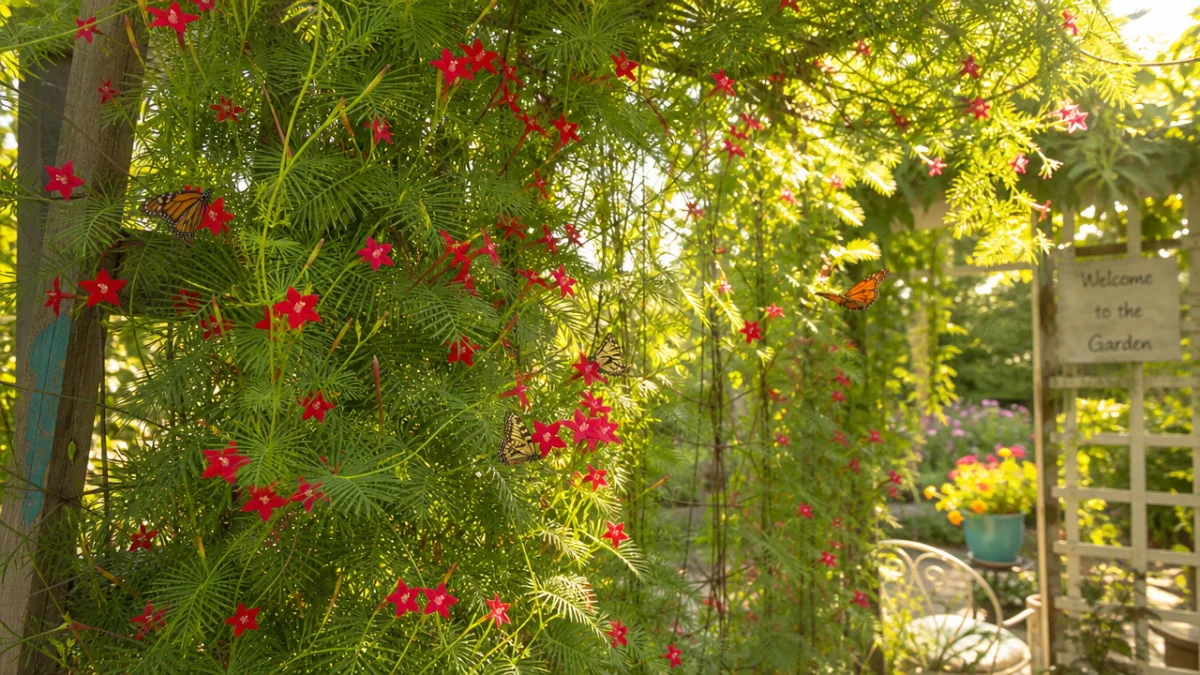
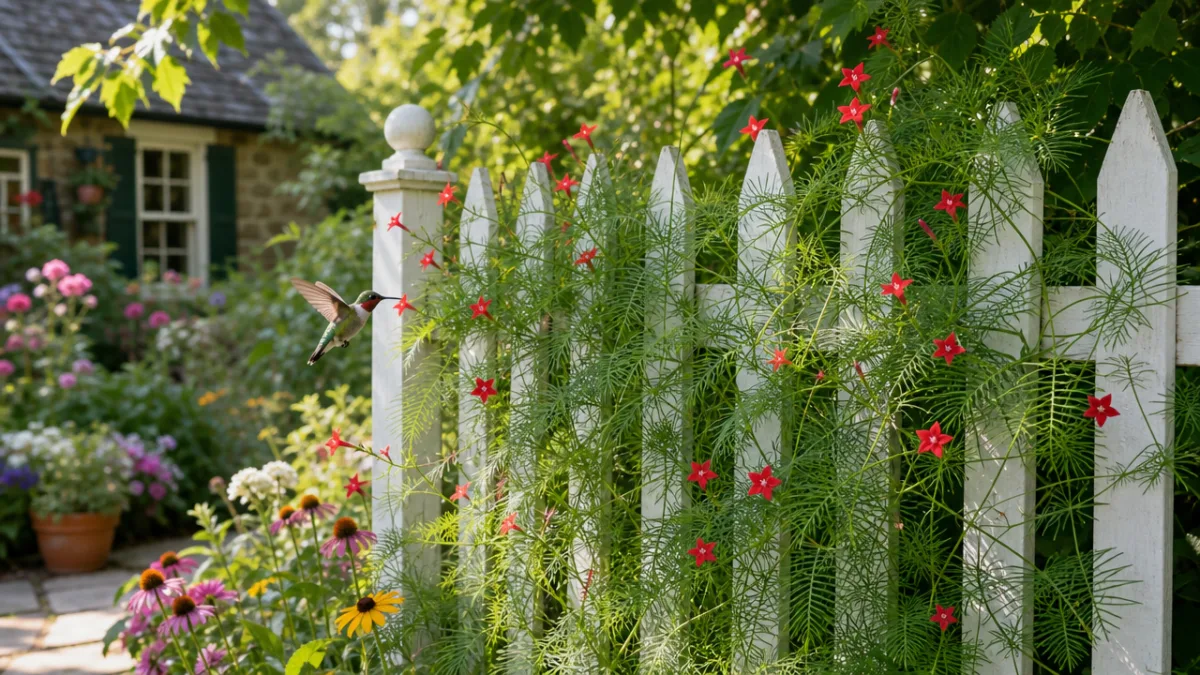
The ecological contributions of Ipomoea quamoclit extend far beyond simple aesthetics, positioning it as a genuinely valuable plant for wildlife-friendly gardening. The vivid red, tubular flowers are architectural masterpieces of co-evolution, shaped over millions of years to serve as near-exclusive feeding stations for hummingbirds. The long corolla tube houses nectar at a depth that effectively excludes most insects, reserving this energy-rich reward for hummingbirds whose long bills and rapid hovering flight make them the ideal pollinators for the plant. This intimate relationship between flower and pollinator exemplifies the intricate biological partnerships that underpin healthy ecosystems.
Butterflies, particularly swallowtails and skippers, also visit cypress vine flowers, sipping nectar from the floral opening even if they cannot access the full nectar pool within the tube. The plant’s fine foliage provides shelter and microhabitat for small insects, spiders, and other invertebrates that form the base of garden food webs. Birds beyond hummingbirds sometimes forage in the vine for these invertebrates, creating a layered ecological community centered on a single planting. Gardeners who are serious about supporting native wildlife increasingly recognize that including nectar-rich plants like cypress vine is one of the most effective and immediate steps they can take to increase biodiversity in cultivated spaces.
The self-seeding tendency of Ipomoea quamoclit, while sometimes requiring management in garden settings, plays an interesting ecological role in naturalized areas. In parts of the southeastern United States, the plant has established itself along roadsides, field edges, and woodland margins, where it continues to provide nectar resources for migrating hummingbirds traveling along well-established flyways. Conservationists have noted that patches of naturalized cypress vine in agricultural landscapes offer important refueling opportunities for these birds during their long journeys. This raises nuanced questions about the role of naturalized exotic species in supporting wildlife, complicating simple narratives about native versus non-native plants and their ecological worth.
Varieties, Companions, and Garden Design
While the classic scarlet-flowered form of Ipomoea quamoclit is most widely available and most commonly planted, several other color forms exist that offer interesting design possibilities. White-flowered varieties bring a cool, luminous quality to evening gardens, their pale blooms catching the last light beautifully and pairing elegantly with silver-leaved companions. Pink-flowered forms occupy a charming middle ground, softer than the intense scarlet yet more vibrant than pure white. Some seed suppliers offer mixed-color packets that allow gardeners to enjoy the full color range within a single planting, creating a tapestry effect across a trellis or fence that evolves as different plants come into bloom.
In terms of companion planting, Ipomoea quamoclit pairs beautifully with a wide range of garden plants. Its fine-textured foliage creates a striking contrast with broad-leaved plants such as cannas, dahlias, and elephant ears, the delicate against the dramatic producing a visually satisfying tension. Against a backdrop of ornamental grasses, the vine’s feathery leaves and star flowers harmonize naturally, creating a meadow-inspired aesthetic popular in contemporary naturalistic garden design. For hummingbird gardens specifically, planting cypress vine alongside other nectar-rich species such as salvia, penstemon, and monarda creates a multi-season resource that supports these birds from spring through autumn migration.
From a structural design perspective, cypress vine is an exceptionally versatile performer. It transforms utilitarian chain-link fences into lush green walls of foliage and color, softens the hard lines of pergolas and arbors, and can be trained up obelisks or tepee structures to create focal points within border planting schemes. In containers, it scrambles through adjacent plants or trails downward with considerable grace. Its rapid growth rate makes it an ideal temporary screen for areas where permanent planting is not yet established, and its annual nature means that the garden palette can be entirely reconsidered each spring without the constraints of established perennial structure. Few plants offer such a generous combination of beauty, ecological value, ease of cultivation, and design flexibility.
- Classic scarlet: The original and most widely grown form, offering the most vivid hummingbird appeal and the strongest visual impact in the summer garden.
- White cypress vine: A refined, moonlit variety that glows in evening light and pairs beautifully with silver, blue, and purple companion plantings.
- Pink cypress vine: A softer alternative to the traditional scarlet, suitable for pastel-themed garden designs and cottage-style planting schemes.
- Mixed color selections: Seed packets containing all three color forms, ideal for creating dynamic, evolving tapestries of color across large supports and structures.
Propagation, Seed Saving, and Sustainability
One of the most rewarding aspects of growing Ipomoea quamoclit is the ease with which seeds can be saved from year to year, creating a sustainable gardening cycle that requires minimal investment beyond the initial seed purchase. As the growing season draws to a close, spent flowers give way to small, oval seed capsules that mature from green to brown over several weeks. Collecting these capsules just as they begin to dry on the vine, before they split open and scatter their contents, is the key to a successful harvest. Seeds stored in a cool, dry location in paper envelopes or glass jars will remain viable for three to five years, ensuring a reliable supply for future seasons and for sharing with fellow gardeners.
Propagation from seed is the standard and most reliable method for this species, as cypress vine does not root easily from cuttings and does not divide like herbaceous perennials. Starting seeds fresh each year also guards against the buildup of soil-borne diseases that can affect established plantings. For gardeners interested in developing their own selections, growing several plants and saving seed only from those displaying the most desirable flower color, plant habit, or vigor over multiple generations is a simple form of amateur plant breeding that can yield rewarding results. This practice connects modern gardeners to the long tradition of seed saving that sustained agricultural and horticultural diversity across human history.
From a sustainability perspective, Ipomoea quamoclit represents a thoughtful garden choice in several respects. Its drought tolerance reduces the need for supplemental irrigation, its low fertility requirements mean minimal fertilizer inputs, and its self-seeding habit in suitable climates can eliminate the need for new seed purchases entirely. Its value to pollinators and hummingbirds contributes to ecosystem health in ways that extend far beyond the garden boundary. As gardeners increasingly seek plants that are both beautiful and ecologically responsible, cypress vine stands as an excellent example of a species that delivers abundantly on both fronts. Whether planted for its stunning visual display, its wildlife value, its historical interest, or its simple ease of care, Ipomoea quamoclit richly deserves its enduring place in gardens around the world.








What do you think?
It is nice to know your opinion. Leave a comment.