










Heaven in a Wildflower: Finding the Sacred in Nature’s Smallest Wonders
The phrase “heaven in a wildflower” comes from William Blake’s poem Auguries of Innocence, where he writes about holding infinity in the palm of your hand and eternity in an hour. It’s an invitation — maybe one of the most beautiful ever put into words — to slow down, look closely, and recognize that the grandeur of existence isn’t reserved for mountaintops or cathedral ceilings. It lives quietly in the petals of a flower pushing through a sidewalk crack, in the hum of a bee working through a summer meadow, in the soft tremble of a stem in the morning breeze. Finding heaven in a wildflower isn’t really a religious exercise so much as a practice of paying deep, genuine attention.
In an age built on overstimulation and endless digital noise, this feels more urgent than ever. We scroll through hundreds of images before our morning coffee goes cold. We consume news, entertainment, and opinion in quantities our grandparents couldn’t have imagined. And yet so many of us feel profoundly disconnected — from each other, from meaning, from the natural world that actually keeps us alive. The wildflower offers something of an antidote. It asks nothing of us except our attention. It promises nothing except itself, and somehow, that turns out to be enough.
This article is really an exploration of what it means to seek — and actually find — the sacred in nature’s smallest details. We’ll move through the science of wildflower ecosystems and the spiritual traditions that have long revered untamed blooms, through the art inspired by petals and pollen and the personal practice of wildflower walking, into a world that exists all around us, patient and luminous, waiting only to be noticed.
The Language of Wildflowers: History, Symbolism, and Meaning
Long before botanists assigned Latin names to every bloom, people were weaving flowers into their emotional and spiritual lives. In ancient Egypt, the blue lotus symbolized rebirth and the sun, showing up endlessly in hieroglyphics and tomb paintings. In ancient Greece, the asphodel meadow — a vast field of wildflowers — was believed to be where ordinary souls rested in the afterlife. The Japanese practice of hanakotoba, the language of flowers, gave precise emotional meanings to individual blooms, letting people communicate feelings too delicate or dangerous to say out loud. A yellow chrysanthemum meant grief; a red camellia spoke of love so deep it refused to fade.
The Victorian era turned this instinct into an elaborate social code called floriography. In a society where emotional expression was tightly constrained by class and gender, flowers became a covert language. A bouquet wasn’t just decorative — it was a message. Lavender meant devotion; rosemary meant remembrance; a wild pansy quietly whispered “I’m thinking of you.” Women pressed flowers between the pages of books and sewed them into handkerchiefs. Men tucked a single bloom into their buttonholes as a declaration they could never speak in polite company. The wildflower, uncultivated and free, often carried the strongest meanings of all — precisely because no human hands had shaped it.
Today, the symbolic power of wildflowers hasn’t faded — it’s just shifted. The wildflower has become, in contemporary culture, a symbol of resilience, authenticity, and beauty that flourishes without anyone’s permission. You see it in tattoo art, in wedding aesthetics that reject manicured roses in favor of tangled meadow bundles, in the names parents give their children. Wildflower isn’t just a botanical category anymore. It’s a metaphor for a way of being — growing where you’re planted, blooming on your own terms, not asking anyone’s approval for the color you choose to become.
The Science of Wonder: What Wildflowers Do for the World
To really appreciate wildflowers, it helps to understand the extraordinary ecological work they’re quietly doing. Wildflowers aren’t decorative additions to a landscape — they’re foundational infrastructure. They support pollinator populations that are essential to roughly 75 percent of the world’s flowering plant species and around 35 percent of global food production. Without wildflowers, the bee populations that pollinate our crops would collapse. Without bees, our food systems would be in serious trouble. The delicate bloom nodding in a hedgerow isn’t separate from your dinner plate — it’s intimately, urgently connected to it.
Beyond pollination, wildflowers perform a whole cascade of ecological services that scientists are only beginning to fully map. Their root systems prevent soil erosion and improve soil structure. Their leaf litter provides habitat and food for countless invertebrates, which in turn feed birds, amphibians, and small mammals. Many wildflowers have evolved over thousands of years in precise relationship with specific insects — a bond so finely tuned that losing one species can trigger the decline of the other. The greater yellow lady’s-slipper orchid, for instance, depends on a single species of bee for pollination, a partnership so ancient and specific it reads almost like a love story written in evolutionary time.
Then there’s the matter of medicine. An enormous share of modern pharmaceuticals trace their origins back to wild plant compounds. Aspirin comes from willow bark. Digitalis, a heart medication still in use today, comes from the foxglove. Taxol, one of the most effective cancer drugs ever developed, was discovered in the bark of the Pacific yew. Ethnobotanists continue to document the medical knowledge held by indigenous communities about wild plants, racing against time as both the plants and the communities that know them face extinction. Every wildflower meadow plowed under for development may contain chemical compounds we’ve never studied — potential treatments for diseases we haven’t faced yet. In that sense, wildflowers aren’t just beautiful. They may be, quite literally, lifesaving.
Walking with Eyes Open: The Practice of Wildflower Attention
There’s a real difference between walking through a landscape and walking with one. Most of us, most of the time, move through the natural world as though it were background scenery — pleasant, maybe, but peripheral to whatever’s happening on our screens or inside our heads. Wildflower attention is a deliberate push against that habit. It asks us to flip the hierarchy of our focus, to put the natural world at the center rather than the margins, and to discover what opens up when we do. In many ways it’s a form of meditation that needs no cushion, no studio, no special instruction — just a path and a willingness to actually look.
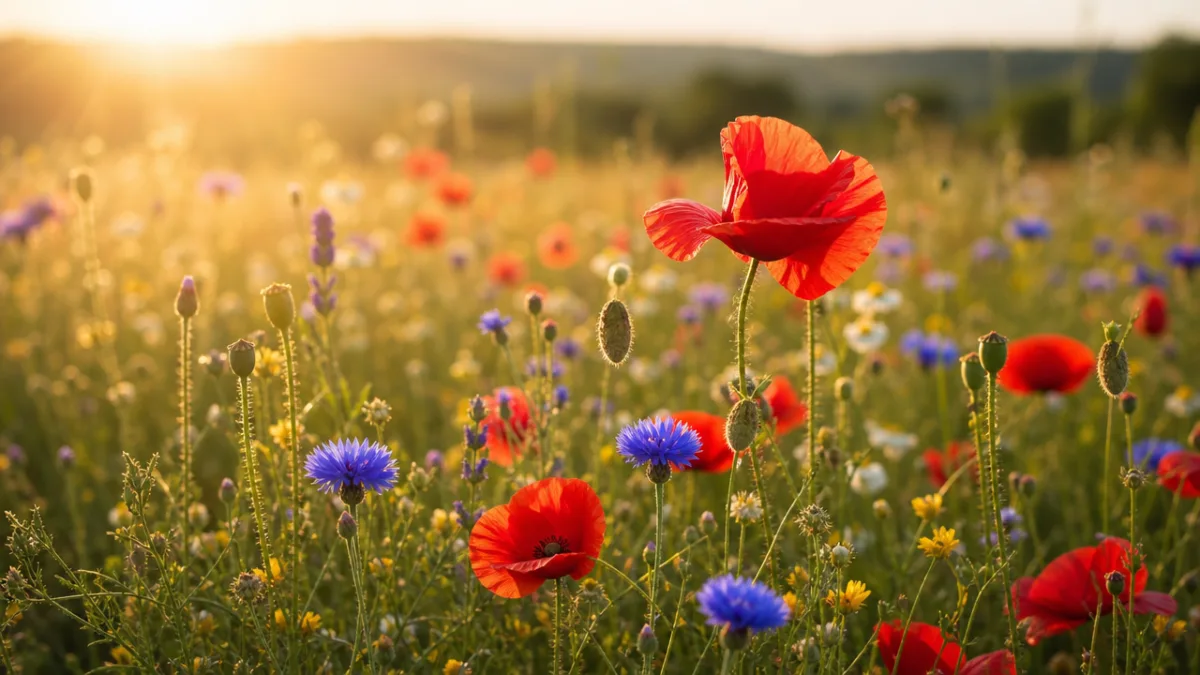
Getting started with wildflower walking doesn’t take much. You don’t need a field guide, though one can genuinely deepen the experience. You don’t need to be out in the countryside — urban parks, roadside verges, community gardens, even neglected lots are often surprisingly rich with wild blooms, especially in spring and early summer. What you do need is time and a particular quality of slowness. The wildflower reveals itself to people willing to crouch, to kneel, to lie down in the grass if it comes to that. The most extraordinary details — the veining inside a petal, the architecture of a seed head, the iridescent wing of a beetle pausing mid-flight — are simply invisible to anyone moving faster than a thoughtful amble.
People who develop a wildflower walking practice often report unexpected emotional and psychological benefits. Research on nature exposure consistently shows drops in cortisol, blood pressure, and symptoms of anxiety and depression after time outdoors. But something more specific seems to happen when attention turns toward small natural details rather than open vistas. Neuroscientists describe a state called “soft fascination” — a gentle, effortless absorption in something interesting that lets the mind rest without getting bored. Wildflowers are almost perfectly suited to induce this. They’re varied enough to hold your interest, complex enough to reward a closer look, and quiet enough to let the nervous system settle. In the language of modern wellness, they might just be the original mindfulness app.
Art, Poetry, and the Wildflower Imagination
Artists have long understood what neuroscientists are only now measuring. From the cave paintings at Lascaux, which include plant forms alongside the famous bison and horses, to the obsessive botanical illustrations of the Renaissance, to Georgia O’Keeffe’s monumental close-up canvases of desert flowers, the wildflower has captured the artistic imagination in ways that go deeper than aesthetic preference. Something about the flower — its transience, its symmetry, its effortless generosity of color — seems to make artists want to stop time, to hold the moment just before the petals fall.
In poetry, the wildflower has served as a vehicle for some of the most enduring meditations on beauty, mortality, and the divine. Blake’s line, which gives this article its title, sits alongside Wordsworth’s daffodils, Keats’s autumn flowers, Mary Oliver’s rapturous grasslands, and Ted Hughes’s bleak and beautiful wildflower verges. What’s striking about this tradition is how consistently the flower functions not as an object but as a portal — a point through which the poet moves from the visible world into something larger and harder to name. The wildflower doesn’t symbolize the infinite; it is the infinite, momentarily made visible in a form small enough to hold.
Contemporary artists are continuing this conversation in new forms. Botanical illustrators like Lizzie Harper bring scientific precision to wildflower art that doesn’t diminish its wonder — if anything, that accuracy deepens the awe. Photographers spend days following a single plant through its life cycle, from tight bud to scattered seed, creating records that reveal dimensions of wildflower existence invisible to the naked eye. And across social media, a vast community of wildflower enthusiasts share images, identifications, and encounters, collectively building what amounts to a distributed, citizen-science cathedral of attention — a living testament to the idea that beauty, noticed and shared, multiplies rather than diminishes.
Rewilding Your Garden: Inviting the Sacred Home
One of the most transformative things you can do in response to the beauty and ecological importance of wildflowers is to make space for them in your own outdoor life. Rewilding your garden — or even just a corner of it — isn’t about neglect or giving up. It’s about making a deliberate choice to prioritize biodiversity and ecological function over tidiness and control. In a real sense it’s a philosophical act as much as a horticultural one: an acknowledgment that nature knows things we don’t, and that the most beautiful garden might be one where we step back and listen more than we direct.
Starting a wildflower area in your garden is simpler than most people expect. The key principles are worth knowing before you begin:
- Choose seeds native to your region, since these will have evolved alongside your local pollinators and need far less intervention than imported species.
- Prepare the soil by reducing fertility rather than boosting it — wildflowers are adapted to lean conditions, and rich soil tends to produce vigorous grasses that crowd out the delicate blooms you actually want.
- Avoid pesticides entirely in any area you designate as wildflower habitat, since these chemicals kill not just pests but the whole invertebrate community that wildflowers depend on.
- Leave seed heads standing through autumn and winter, providing food for birds and overwintering habitat for beneficial insects.
- Accept that the space will change from year to year as different species establish and conditions shift — that dynamism is the whole point, not a sign of failure.
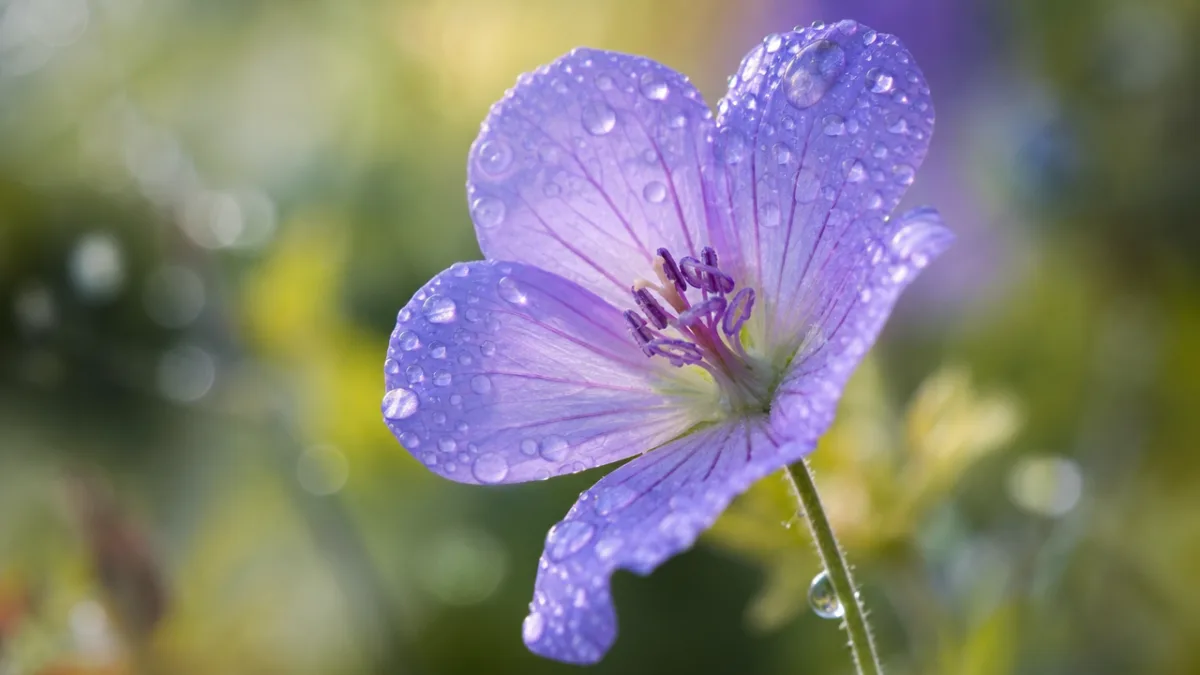
Beyond the ecological benefits, a wildflower patch gives you something harder to quantify but just as real: daily access to wonder. Walking into your garden on a morning and finding that overnight a new species has opened — that a bee you’ve never noticed before is working through a stand of borage, or that a painted lady butterfly has found the knapweed you planted two years ago — is to experience, in miniature, exactly the kind of revelation Blake was describing. Heaven isn’t distant. It’s here, in the dew on a petal, in the purposeful flight of a pollinator, in the patient return of the perennial. It was here all along, waiting only for your attention to arrive.
The Philosophical Wildflower: What Small Things Teach Us
There’s a philosophical tradition, running from the Stoics through the Romantics and into contemporary mindfulness thought, that locates wisdom not in grand systems or abstract principles but in close attention to immediate experience. The Stoic emperor Marcus Aurelius wrote in his Meditations about finding beauty in the cracks of bread crust and the rippling surface of a wave — the same impulse that Blake would later crystallize in his wildflower. What connects these thinkers across centuries is the conviction that reality, properly attended to, is enough. That the ordinary world, seen clearly, is neither ordinary nor insufficient — it’s astonishing, inexhaustible, and precisely what it needs to be.
The wildflower embodies a particular philosophical lesson about value and attention. It doesn’t perform for us. It doesn’t adjust itself to our preferences. It blooms according to its own nature, on its own schedule, in whatever location chance and wind and soil have conspired to offer. In this, it quietly corrects a culture that places enormous emphasis on optimization, personalization, and control. The wildflower can’t be improved by our intervention — only, at best, preserved by our restraint. To find it beautiful is to practice a form of acceptance that extends, with some effort, into other areas of life: the acceptance that things have their own nature, their own timing, their own rightness that doesn’t require our approval to be real.
Perhaps most profoundly, the wildflower teaches us something about impermanence. A single bloom may last only days. The meadow blazing with color in June will be seed and stalk by August. This isn’t a tragedy but a demonstration — of the way beauty and transience aren’t in tension but are, in some sense, the same thing. The Japanese concept of mono no aware — the bittersweet awareness of impermanence — finds its natural emblem in the wildflower. To watch a field of poppies is to understand that what makes something precious isn’t its permanence but its presence. And to carry that understanding back into your daily life, into your relationships and your work and your own brief flowering, is perhaps the deepest gift that heaven, hiding in a wildflower, has to give.








What do you think?
It is nice to know your opinion. Leave a comment.