










Hardy Hibiscus vs. Tropical Hibiscus: What’s the Difference?
Introduction: Two Plants, One Famous Name
Most people picture a hibiscus and immediately think of those bold, trumpet-shaped blooms — the ones you’d see woven into a lei in Hawaii or spilling over the edges of a resort garden somewhere warm. So it catches a lot of gardeners off guard to learn that “hibiscus” is actually an umbrella term for two very different groups of plants, each with its own personality, needs, and quirks. Figuring out which one you’re working with is honestly the most important first step.
Both hardy hibiscus and tropical hibiscus belong to the genus Hibiscus, tucked inside the mallow family, Malvaceae. But sharing a genus is about where the similarities end. These two groups have gone in pretty different directions when it comes to cold tolerance, flower size, leaf shape, and how they behave through the seasons. Gardeners who assume one will act like the other tend to end up frustrated — wondering why their plant won’t bloom, or why it died over winter when they were sure it would be fine.
This guide walks through every major difference between the two — where they come from, what climate they prefer, how to care for them, and how to use them well in your garden. Whether you’ve been growing hibiscus for years or you just picked one up at the garden center because it was gorgeous and you couldn’t resist, this should help you figure out exactly what you’ve got and how to help it thrive.
Origins and Natural Habitat
Hardy hibiscus is a North American native. Species like Hibiscus moscheutos (swamp rose mallow) and Hibiscus laevis grow naturally in wetlands, along stream banks, and across meadows throughout the eastern and central United States. These plants evolved alongside hard winters, wet feet, and the kind of wild temperature swings you get in a temperate climate. When the cold hits, their roots simply go dormant underground — and that’s exactly what makes them so impressively cold-hardy.
Tropical hibiscus comes from a very different world. Hibiscus rosa-sinensis, the species you’ll find at pretty much every garden center, is thought to have originated in East Asia, though it’s since been naturalized across the Caribbean, Pacific Islands, and tropical regions worldwide. It has never had to deal with frost. In its natural habitat, it grows as a perennial shrub or small tree — sometimes fifteen feet tall or more — and blooms nearly without stopping, since there’s no cold season to interrupt it.
Once you know where each plant is from, their care requirements start to make a lot more intuitive sense. Hardy hibiscus is built for toughness and resilience, shaped by thousands of years in temperate North American ecosystems. Tropical hibiscus is built for warmth and stability, designed to live somewhere that stays above freezing year-round. Try to grow either one outside of that comfort zone without some kind of strategy, and you’re going to have a rough time — but knowing their roots makes those adaptations much easier to think through.

Flower Size, Shape, and Color
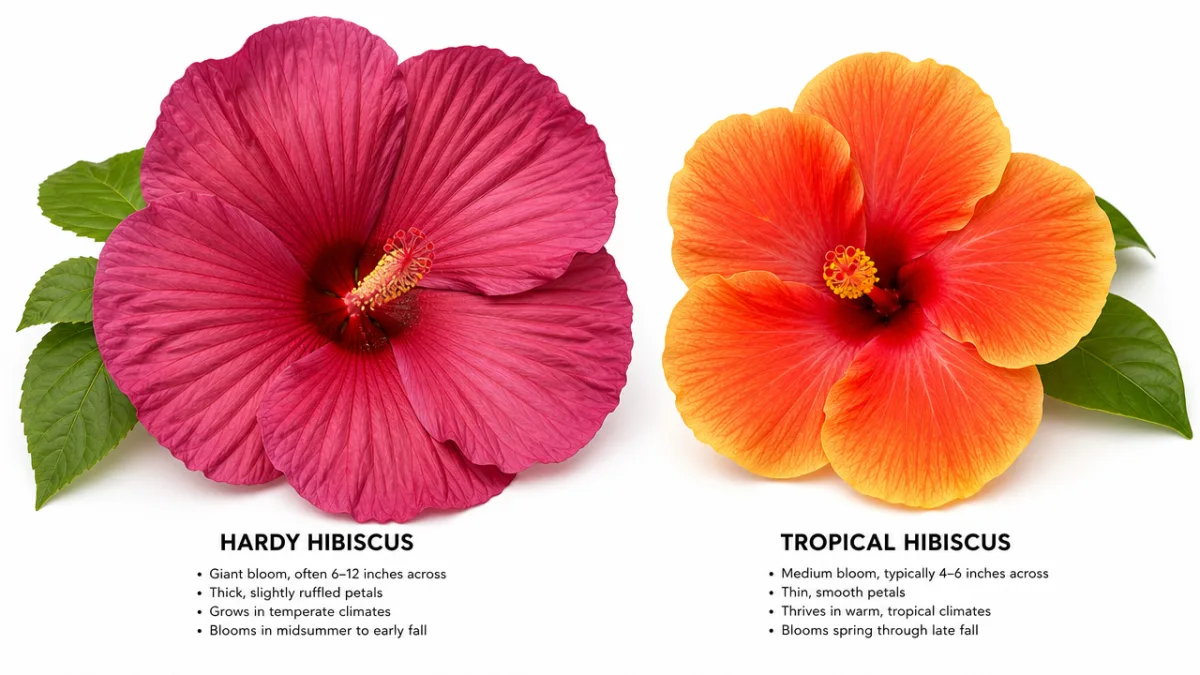
If there’s one thing hardy hibiscus is known for, it’s the sheer size of its flowers. We’re talking eight to twelve inches across — routinely. Some cultivars push even beyond that. The variety name ‘Dinner Plate’ is not an exaggeration. When these blooms open up in the late-summer garden, they create a kind of theatrical impact that’s hard to get from anything else at that time of year.
Tropical hibiscus flowers are smaller, typically landing somewhere between three and six inches in diameter. But what they give up in size, they more than make up for in color and complexity. The range of tropical hibiscus cultivars is genuinely stunning — deep reds, soft peaches, warm corals, bright yellows, lavender pinks, and elaborate multicolored blooms with contrasting centers or ruffled, layered petals. The texture tends to feel silkier and more refined, almost like each bloom was painted by hand.
The two types also bloom on very different schedules. Hardy hibiscus puts on its show in mid to late summer, typically July through September. Each flower only lasts a single day before closing, but new ones keep opening in succession, so the display carries on for several weeks. Tropical hibiscus, on the other hand, can bloom nearly year-round when conditions are right — consistently warm temperatures, plenty of sun, and a stable environment. In a good greenhouse or a warm climate, a healthy tropical hibiscus can realistically be in flower just about every single day.
Cold Hardiness and Climate Zones
Cold hardiness is probably the single most practical difference between these two plants, and it’s the one most likely to determine which is actually right for where you live. Hardy hibiscus really does live up to its name — most cultivars hold up reliably to USDA Zone 4, and some push into Zone 3, meaning they can survive temperatures as low as -30°F (-34°C). That puts them within reach for gardens across most of the continental United States and a good chunk of Canada, which is pretty remarkable given how tropical their flowers look.
Tropical hibiscus is a different story. Most varieties start struggling when temperatures dip below 50°F (10°C), and even a light frost can cause serious damage or kill the plant outright. They’re only reliably perennial in USDA Zones 9 through 11 — places like South Florida, Hawaii, and the warmest pockets of California, Texas, and Arizona. Everywhere else, they either need to be treated as annuals, grown in containers that can come inside for winter, or carefully overwintered somewhere heated like a sunroom or greenhouse.
One thing worth knowing about hardy hibiscus: it can look very convincingly dead in spring. Because it dies back all the way to the ground each winter, gardeners who aren’t familiar with its habits sometimes pull up perfectly healthy plants in early spring, assuming they didn’t make it. Hardy hibiscus is notoriously slow to wake up — it’s not unusual to see no signs of life until late May or even June in colder zones. But once it does emerge, it takes off fast, sometimes gaining several inches in a single warm day. Patience is the key, and if you’re unsure whether a plant survived, a quick scratch test on the stem base at soil level will usually tell you what you need to know.
Growth Habit, Size, and Foliage
Hardy hibiscus is an herbaceous perennial, which means its stems die back completely to the ground each winter. During the growing season, though, it gets impressively large — four to eight feet tall, forming a full, bushy mound covered in broad, lobed leaves. The foliage is typically dark green with a somewhat coarse, substantial texture, which makes a great backdrop for those enormous blooms. Come winter, it essentially vanishes, leaving nothing above the soil surface until spring.
Tropical hibiscus grows more like a woody shrub or small tree. Its stems don’t die back — they persist year after year and gradually build up a woody framework, similar to how a rose bush or azalea develops. In frost-free climates, a mature tropical hibiscus can reach ten to fifteen feet tall and develop a proper woody trunk at its base. When grown in containers in cooler climates, regular pruning and pot size keep things manageable, and the plant can live for many years as a long-term patio or houseplant specimen.
The leaves are also a dead giveaway if you know what to look for. Hardy hibiscus leaves are large, a bit rough or velvety to the touch, and a deep solid green. Tropical hibiscus leaves are typically smaller, darker, and glossier — almost lacquered-looking, with a smooth, polished texture that matches the refinement of the flowers. Some tropical cultivars even have variegated or unusually colored foliage, which adds ornamental interest even when no blooms are present. For an experienced gardener, a quick glance at the leaves is usually enough to tell the two apart without needing to see a single flower.
Care Requirements and Soil Preferences
Hardy hibiscus loves moisture — it comes from wetland habitats, and it shows. It tolerates, and often outright prefers, poorly drained spots where a lot of other plants would give up. Rain gardens, low-lying areas, spots near ponds or streams — these are the places where it really thrives. That said, it adapts reasonably well to average garden soil as long as it stays consistently moist. It wants full sun (at least six hours a day) to put on its best bloom display, and it’s a heavy feeder, so regular fertilizing through the growing season makes a real difference.
Tropical hibiscus has different ideas about soil. It actually performs best in well-drained conditions and can develop root rot if it sits in water for too long. It’s just as sun-hungry as hardy hibiscus and needs warmth to bloom well, but it’s especially sensitive to cold drafts, sudden temperature changes, and being moved around. One of tropical hibiscus’s most infamous quirks is that it really doesn’t like being relocated — shift it too suddenly to a new spot and it may drop all its buds and leaves in protest, then sulk for several weeks before settling back into normal growth. It’s also a heavy feeder and responds well to a bloom-boosting fertilizer during its active growing period.
Watering is another area where the two diverge. Hardy hibiscus, true to its wetland roots, can handle consistently moist conditions and even short periods of standing water without complaint. Tropical hibiscus wants what gardeners usually describe as “evenly moist but well-drained” — never waterlogged, but never completely dry either. In containers during summer heat, it might need water every single day. In cooler months or indoors over winter, it should be allowed to dry out a bit between waterings. Getting watering right is one of the biggest factors in keeping tropical hibiscus happy, especially when it’s living indoors.
- Hardy Hibiscus care summary: Full sun, moist to wet soil, cold hardy to Zone 4, dies back in winter, slow to emerge in spring, fertilize regularly during growing season.
- Tropical Hibiscus care summary: Full sun, well-drained soil, frost-sensitive (Zone 9–11 outdoors), woody and evergreen in warm climates, blooms nearly year-round, sensitive to environmental changes.
Landscape Uses and Design Considerations
Hardy hibiscus is a real workhorse in the late-summer garden. It blooms from roughly July through September in most temperate climates, which fills a gap that’s honestly hard to fill any other way — spring flowers are long gone, fall color hasn’t kicked in yet, and very few other plants are putting on a show at that scale. Landscape designers reach for it as a bold focal point in perennial borders, rain gardens, and naturalistic plantings near water. Because it disappears in winter, it pairs well with evergreen shrubs or ornamental grasses that hold their structure through the colder months.
Tropical hibiscus is where container gardening really gets exciting. Its near-continuous bloom makes it perfect for high-visibility spots where you want reliable color all season long. In warmer regions like Florida or Southern California, it’s a landscape staple — used as a hedge, a foundation planting, a flowering screen, you name it. The glossy foliage looks good even between bloom cycles, so it earns its keep in the landscape even on days when fewer flowers are open.
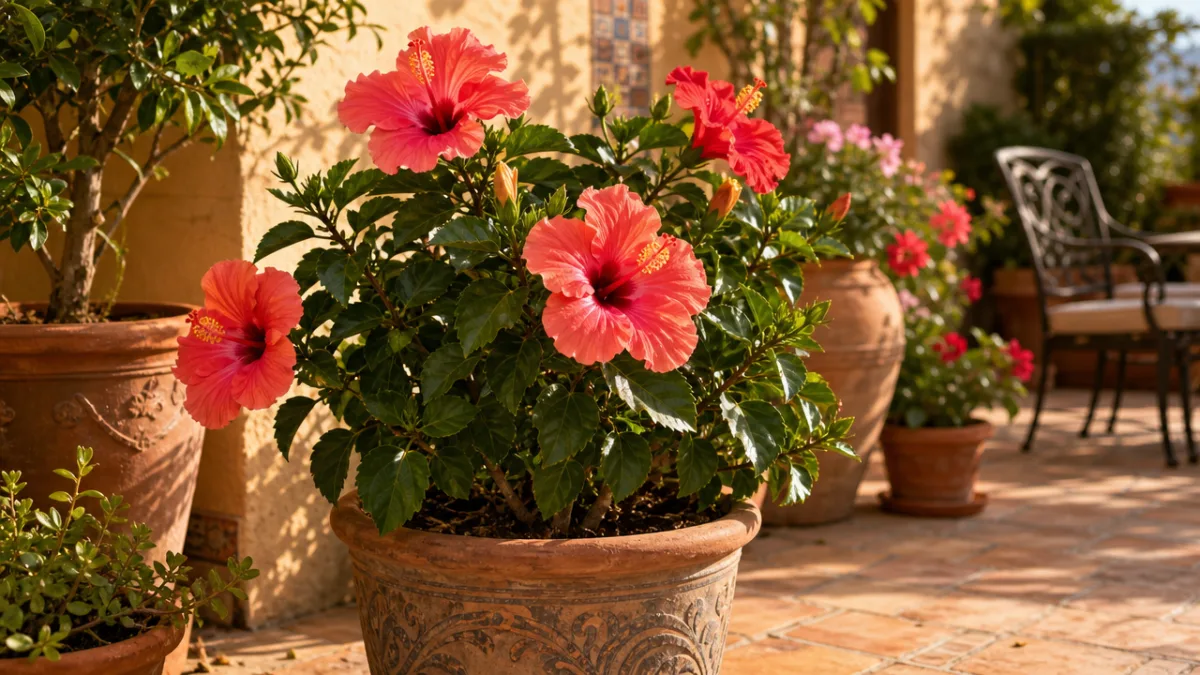
For gardeners in colder climates who love the look of tropical hibiscus, container growing offers a genuinely satisfying middle ground. A tropical hibiscus in a large decorative pot can spend the summer on a deck or patio, then come indoors before the first frost. With enough light — a south-facing window works well, or supplemental grow lights if needed — it can keep blooming indoors through winter, which is a pretty remarkable thing to have going on in January. It takes more effort than just planting a hardy hibiscus and stepping back, but for a lot of gardeners, that winter payoff makes all the seasonal moving around completely worth it.
Choosing the Right Hibiscus for Your Garden
When it comes down to it, the choice between hardy and tropical hibiscus depends on your climate, how much you want to fuss, and what you’re hoping for from the plant. If you have cold winters and want something that comes back on its own every year with minimal intervention and jaw-dropping summer blooms, hardy hibiscus is probably your answer. Once it’s established, it’s about as low-maintenance as a big, dramatic plant can be.
If you’re in a warm climate, work primarily with containers, or you’re the kind of gardener who genuinely enjoys the extra project of overwintering something special, tropical hibiscus offers things hardy hibiscus simply can’t — most notably, that almost uninterrupted bloom cycle and the sheer variety of flower colors and forms available. Modern tropical hibiscus cultivars have been developed to an impressive level of sophistication, with double blooms, ruffled edges, and color combinations that are hard to find anywhere else in the plant world. For some gardeners, collecting and overwintering different varieties becomes a hobby in itself.
It’s also worth saying that you don’t have to choose just one. Plenty of gardeners grow both — a hardy hibiscus in the ground for reliable late-summer drama that takes care of itself year after year, plus a few tropical hibiscus in containers that add color and variety from spring through fall before coming inside for winter. The goal isn’t to pick a winner; it’s to understand each plant well enough to put it in a situation where it can actually succeed. With that knowledge in hand, both types of hibiscus can become plants you genuinely look forward to seeing each season.








What do you think?
It is nice to know your opinion. Leave a comment.