










Flowering Tobacco (Nicotiana sylvestris): A Complete Guide to Growing and Enjoying This Elegant Garden Plant
Introduction to Nicotiana sylvestris
Flowering tobacco, known botanically as Nicotiana sylvestris, is one of the most enchanting and underutilized plants available to gardeners today. Native to northwestern Argentina, this dramatic annual or short-lived perennial belongs to the Solanaceae family, sharing lineage with tomatoes, peppers, and petunias. Unlike its utilitarian cousin Nicotiana tabacum, grown for commercial tobacco production, Nicotiana sylvestris is cultivated purely for its breathtaking ornamental qualities, offering gardeners a bold architectural presence combined with an intoxicating evening fragrance that few other plants can rival.
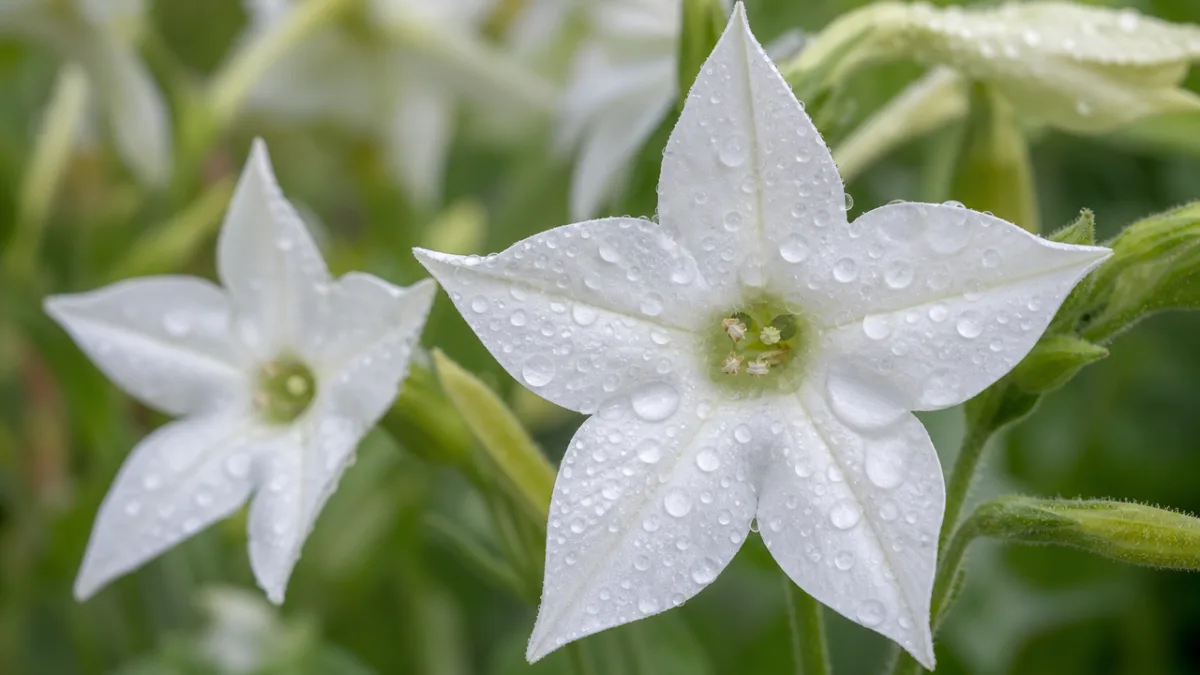
The plant earned its common name from the showy, tubular white flowers it produces in abundance throughout the growing season. These elegant blooms hang in graceful, drooping clusters atop tall, sturdy stems that can reach impressive heights of four to six feet under favorable conditions. The flowers themselves are slender and elongated, opening into a delicate star-shaped form at their tips, creating a chandelier-like effect that draws the eye upward and adds vertical interest to any garden design. Their pure white color glows with particular brilliance in fading light and under moonlight, making them a prized choice for moon gardens and evening entertaining spaces.
Gardeners around the world have long treasured Nicotiana sylvestris for its dual role as both a visual specimen and a sensory experience. The fragrance it releases, particularly during the evening hours, is rich, sweet, and jasmine-like, filling the surrounding air with a perfume that seems almost impossibly generous for a plant grown so easily from seed. This combination of striking height, architectural foliage, luminous flowers, and powerful scent makes flowering tobacco one of those rare garden plants that satisfies multiple senses simultaneously, rewarding those who choose to include it with an experience that lingers in memory long after the growing season ends.
Botanical Characteristics and Plant Structure
Understanding the physical structure of Nicotiana sylvestris helps gardeners make the most of this plant’s considerable ornamental potential. The foliage alone is worth growing the plant for, as the large, paddle-shaped basal leaves can reach lengths of up to two feet, creating a lush, tropical-looking rosette at ground level. These leaves are notably sticky to the touch, covered in fine glandular hairs that trap small insects, though the plant is not considered a true carnivore. The texture and size of the foliage give the plant a bold, exotic appearance that contrasts beautifully with finer-textured companion plants in mixed borders.
As the growing season progresses, the plant sends up one or more tall flowering stems from the central rosette, each branching toward the top into multiple panicles loaded with buds and blooms. The stems are sturdy enough to remain upright in most conditions without staking, though extremely windy or exposed locations may require some support. Each individual flower tube can measure two to three inches in length, flaring open at its terminus into five reflexed petals that form a graceful star. The flowers appear in succession over a long period, meaning that a well-established plant will remain in bloom from midsummer through the first frosts of autumn.
The reproductive biology of Nicotiana sylvestris is particularly interesting from a horticultural perspective. The flowers are pollinated primarily by hawk moths and other long-tongued insects capable of reaching the nectar at the base of the elongated floral tubes. This evolutionary relationship with nocturnal pollinators explains why the flowers are most fragrant and most fully open in the evening hours, essentially advertising their presence to their preferred pollinators through both scent and visual contrast against the darkening sky. After pollination, the plant produces small capsules containing hundreds of tiny seeds, which can be collected for future growing seasons or left to self-sow naturally throughout the garden.

Growing Conditions and Site Selection
Flowering tobacco is a remarkably adaptable plant, but providing it with ideal growing conditions will reward you with specimens of truly spectacular proportions. Nicotiana sylvestris thrives in full sun to partial shade, making it one of the few tall, dramatic annuals that performs reasonably well in spots that receive only a few hours of direct sunlight each day. In hotter climates and regions with intense summer sunshine, afternoon shade is actually beneficial, preventing leaf scorch and helping the flowers remain fresh and pristine rather than fading prematurely in the heat. In cooler northern gardens, full sun exposure encourages the most vigorous growth and the most prolific flowering.
Soil preferences for Nicotiana sylvestris are similarly flexible, though the plant performs best in rich, moisture-retentive soil with good drainage. Heavy clay soils should be amended with organic matter such as well-rotted compost or leaf mold before planting, both to improve drainage and to increase the nutritional content available to this hungry, fast-growing plant. Conversely, very sandy or gravelly soils benefit from substantial organic matter additions to improve their water-holding capacity, as flowering tobacco requires consistent moisture to support its large leaves and tall flower stems throughout the growing season. A slightly acidic to neutral soil pH in the range of 6.0 to 7.0 is ideal.
Site selection should also account for the plant’s impressive ultimate size and its potential impact on neighboring plants. When grown in ideal conditions with regular water and fertilization, Nicotiana sylvestris can become genuinely large and somewhat dominating, so thoughtful placement at the back of borders or in corners where height is welcome will serve the garden best. The plant’s sticky foliage and dramatic proportions make it an excellent choice for screening unsightly garden features or creating a sense of enclosure in open spaces. Its tropical appearance also makes it an ideal companion for other bold-leaved exotics in container arrangements or themed garden areas inspired by subtropical planting styles.
Planting, Propagation, and Cultivation
Starting Nicotiana sylvestris from seed is the most economical and widely practiced method of propagation, and it is a process that rewards patience with extraordinary results. Seeds should be started indoors eight to ten weeks before the last expected frost date in your area, sown on the surface of a fine, well-moistened seed-starting mix without covering them, as they require light to germinate successfully. Germination typically occurs within ten to fourteen days at temperatures between 65 and 75 degrees Fahrenheit. Once seedlings develop their second set of true leaves, they can be carefully transplanted into individual small pots to develop further before hardening off and transplanting outdoors after all frost danger has passed.
Outdoor planting should be carried out when nighttime temperatures reliably remain above 50 degrees Fahrenheit, as Nicotiana sylvestris is cold-sensitive and will sulk or stall in growth if subjected to prolonged cool conditions. Space transplants generously, allowing at least 18 to 24 inches between individual plants to accommodate their eventual spread and to ensure adequate air circulation around the foliage, which helps prevent fungal diseases. At planting time, incorporate a slow-release balanced fertilizer into the planting hole or the surrounding soil to give young plants a nutritional foundation that supports their rapid growth through the early part of the season.
Once established, flowering tobacco benefits from a consistent care regimen that includes regular watering, periodic fertilization, and attention to potential pest and disease issues. The plant is considered a moderate to heavy feeder, and supplemental applications of a balanced liquid fertilizer every two to three weeks through the growing season will noticeably improve plant size, foliage quality, and flower production. Deadheading spent flower clusters encourages the plant to continue producing new blooms rather than diverting energy into seed production, extending the flowering season considerably. However, leaving some spent flowers in place toward season’s end allows seed collection for the following year and encourages beneficial self-sowing throughout the garden.
- Sow seeds indoors 8 to 10 weeks before the last frost date, pressing them onto the surface of moist seed-starting mix without covering.
- Maintain germination temperatures between 65 and 75 degrees Fahrenheit for best results within the 10 to 14 day germination window.
- Harden off seedlings gradually over 7 to 10 days before transplanting outdoors once frost danger has completely passed.
- Space plants 18 to 24 inches apart to allow for mature spread and adequate air circulation around foliage.
- Water consistently, fertilize every two to three weeks, and deadhead regularly to prolong the flowering season.
Companion Planting and Garden Design
Few plants offer the design versatility of Nicotiana sylvestris, and understanding how to deploy it effectively within the garden landscape unlocks its full ornamental potential. As a tall, airy plant with large basal foliage and elevated flower clusters, it serves naturally as a background or mid-border specimen that provides vertical structure without the solidity of a shrub or the permanence of a perennial. Its white flowers and extended blooming season make it an invaluable connector between other plants, visually harmonizing diverse colors and textures in mixed plantings in the way that white always does in garden design — by creating breathing space and reducing visual competition among neighboring plants.
For a classic cottage garden aesthetic, pair Nicotiana sylvestris with tall dahlias, cosmos, and zinnias in rich jewel tones, where the white flowering tobacco serves as an elegant foil that allows the saturated colors of its companions to appear even more vivid and intense. In more sophisticated, restrained planting schemes inspired by the new perennial movement, combine it with tall ornamental grasses such as Stipa gigantea or Miscanthus, adding movement and textural contrast alongside the tobacco’s bolder, more static form. The plant also works beautifully alongside other large-leaved tropicals like cannas, elephant ears, and Melianthus major in high-impact exotic borders designed to create maximum drama.
Container gardening with Nicotiana sylvestris requires large vessels — minimum 15-gallon capacity — to accommodate the plant’s vigorous root system and support its considerable above-ground mass. A single large specimen planted in an oversized container makes a spectacular focal point for a terrace or patio, particularly when positioned near a seating area where its evening fragrance can be fully appreciated. For mixed container compositions, combine flowering tobacco with trailing plants such as bacopa, verbena, or sweet potato vine that will spill gracefully over container edges, counterbalancing the tobacco’s strong vertical emphasis and creating a complete, layered arrangement with appeal from multiple viewing angles and in multiple lighting conditions throughout the day.
Pest Management, Common Problems, and Practical Considerations
Despite its generally robust constitution, Nicotiana sylvestris is susceptible to a range of pests and diseases that gardeners should monitor for throughout the growing season. Aphids represent the most commonly encountered pest problem, frequently congregating on the undersides of leaves and on young growing tips, where they feed on plant sap and can cause distortion of new growth if populations are allowed to build unchecked. Regular inspection of plants, particularly in cool, humid weather that favors aphid reproduction, allows early intervention before infestations become severe. A strong jet of water from a garden hose, repeated over several days, is often sufficient to control moderate aphid populations without resorting to chemical controls.
Fungal diseases, particularly tobacco mosaic virus and various leaf spot pathogens, can affect Nicotiana sylvestris under conditions of poor air circulation, prolonged leaf wetness, or excessive humidity. Planting at recommended spacings, watering at the base of plants rather than overhead, and removing and disposing of affected foliage promptly when symptoms appear are the most effective cultural strategies for minimizing disease impact. Tobacco mosaic virus, which causes characteristic mottling and distortion of leaves, has no chemical cure and affected plants should be removed entirely from the garden to prevent spread to other susceptible plants in the Solanaceae family, including tomatoes and peppers growing nearby.
Gardeners should also be aware of the toxicity considerations associated with all Nicotiana species before introducing them into gardens frequented by children or pets. Like all members of the genus, Nicotiana sylvestris contains alkaloids including nicotine, which is toxic if ingested in significant quantities by humans or animals. The sticky foliage can also cause mild skin irritation in sensitive individuals, and gloves are advisable when handling the plant extensively during planting or pruning operations. Despite these cautions, the plant poses minimal risk in typical garden settings where it is appreciated visually rather than consumed, and its occasional mild toxicity should not deter gardeners from enjoying what is truly one of the most spectacular and rewarding ornamental annuals available for temperate climate gardens.
- Inspect plants weekly for aphids, particularly on leaf undersides and growing tips, addressing infestations early with water jets or insecticidal soap.
- Water at the base of plants to reduce foliar wetness and minimize conditions favorable to fungal disease development.
- Maintain proper plant spacing to ensure adequate air circulation around all foliage surfaces.
- Remove and dispose of any foliage showing signs of mosaic virus or severe leaf spot infections promptly.
- Wear gloves when handling plants extensively, and keep children and pets from ingesting any plant material.
- Monitor nearby Solanaceae family members such as tomatoes and peppers for signs of shared pest or disease problems.

Cultural History, Fragrance, and the Evening Garden Experience
The history of Nicotiana sylvestris in cultivation is relatively recent compared to many other ornamental plants, as it was not widely introduced to European and North American gardens until the late nineteenth century following botanical exploration of its South American native range. Victorian and Edwardian gardeners quickly recognized its potential as a striking bedding and border plant, and it appeared regularly in the elaborate formal gardens of that era, often grown in large drifts to create bold masses of white flowers that reflected moonlight and caught the eye across expanses of lawn. Its reputation as an evening garden plant became firmly established during this period, cementing its association with romance, leisure, and the pleasures of summer nights spent outdoors.
The fragrance of Nicotiana sylvestris deserves particular attention as one of its most compelling and least-replicable attributes. Unlike many garden flowers whose scent is relatively modest or localized, the perfume of flowering tobacco diffuses generously through the surrounding air, creating an olfactory environment rather than merely a point-source of fragrance. The scent is complex, combining sweet floral notes reminiscent of jasmine and tuberose with deeper, slightly spicy undertones that give it character and distinction. On warm, still evenings when the air is humid and heavy, this fragrance can carry remarkable distances, announcing the presence of the plant to approaching visitors before it is even visible and creating an atmosphere that transforms an ordinary garden into something genuinely magical and memorable.
Incorporating Nicotiana sylvestris into a dedicated evening or moon garden is one of the most rewarding ways to use this plant, and doing so thoughtfully produces an outdoor space that comes alive as other gardens wind down with the failing light. Combine it with other white-flowered, fragrant evening bloomers such as moonflowers (Ipomoea alba), evening primrose (Oenothera biennis), and four o’clocks (Mirabilis jalapa) to create a garden that peaks in beauty and fragrance precisely when you most want to be sitting outside after the heat of the day has passed. Add simple outdoor lighting, comfortable seating, and a water feature for sound, and the resulting garden room becomes an extraordinary sensory sanctuary that celebrates everything most beautiful and pleasurable about the art of gardening under the open sky.








What do you think?
It is nice to know your opinion. Leave a comment.